
DCE-470 · Lesson 9 of 12 · 25 min
Negotiation principles and preparation
Engineers and project managers negotiate constantly: contract terms with contractors, prices and delivery dates with suppliers, change orders and claims, connection agreements with utilities, conditions of approval with municipalities, and commitments to communities. Many technical professionals see negotiation as an uncomfortable contest of wills, but research and practice show that it is a skill that can be learned, built on preparation, clear thinking about interests and alternatives, and attention to relationships. This lesson covers the core concepts of negotiation: positions and interests, alternatives and reservation points, the zone of possible agreement, distributive and integrative bargaining, anchoring and concessions, creating value through trade-offs and packages, preparation, communication, ethics, and team negotiation. Lessons 10 and 11 apply them to utilities, municipalities and communities.
Positions and interests
A position is what a party says it wants: "We need a 20 % price increase", "The contract must include liquidated damages of 250,000 dollars per day." An interest is why it wants it: to cover rising labour costs, to protect against tenant penalties. Negotiators who argue over positions tend to dig in, make concessions grudgingly, and reach agreements that leave value on the table or none at all. Fisher and Ury's principled negotiation, set out in Getting to Yes, proposes instead to:
- Separate the people from the problem: maintain respectful relationships while being firm on substance.
- Focus on interests, not positions: ask why, and explain your own interests.
- Invent options for mutual gain before deciding: brainstorm several ways to satisfy both sides' interests.
- Insist on objective criteria: market prices, published indices, industry standards, independent estimates, precedent.
For example, behind a contractor's demand for a large price increase may lie concern about escalation risk; an escalation clause tied to a published index may satisfy that interest at lower expected cost to the owner than a fixed premium.
Alternatives and reservation points
The most important source of power in a negotiation is a good alternative. The BATNA (best alternative to a negotiated agreement) is what you will do if this negotiation fails: award to the second-ranked bidder, buy from another supplier, build at another site, go to arbitration. Your BATNA sets your reservation point (walk-away point): the worst deal you would accept, because anything worse is inferior to your alternative. Before negotiating, work out your BATNA and try to improve it, for example by qualifying a second supplier, and estimate the other side's BATNA, which sets its reservation point.
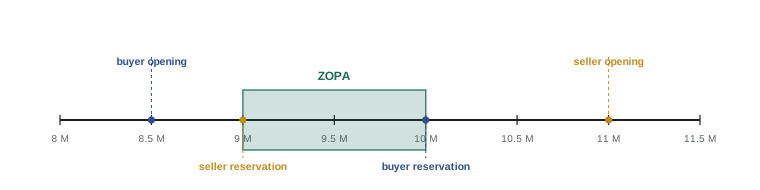
The zone of possible agreement (ZOPA) is the range between the two reservation points. If a buyer will pay up to 10 million dollars for a unit and the seller will accept no less than 9 million, the ZOPA is 9 to 10 million, and any agreement must fall within it. If the seller's minimum exceeds the buyer's maximum, there is no ZOPA, and no agreement on that issue alone is possible; the parties must either create value by adding issues or walk away.
Distributive and integrative bargaining
Distributive bargaining concerns dividing a fixed amount, such as price on a single issue: one side's gain is the other's loss. Integrative bargaining looks for ways to increase the total value available, by trading issues that the parties value differently. Most real negotiations contain both: parties first create value by finding efficient trade-offs, then claim value by dividing it. The key to integrative bargaining is that parties rarely value all issues equally. An owner may value early completion highly (lost revenue), while a contractor values it less (extra cost of acceleration); a supplier may value an early deposit (cash flow) more than the owner values the cash.
# Negotiating a contract with two issues: price and a schedule acceleration bonus.
# Each side values the issues differently, so package offers can create value.
import itertools
prices = [100, 102, 104, 106, 108, 110, 112]          # contract price, million dollars
finish = [24, 22, 20]                       # months to completion
def owner_value(p, f):                      # owner gains 4 M of revenue per month earlier than 24
    return -p + 4 * (24 - f)
def contractor_value(p, f):                 # contractor costs 1.5 M per month of acceleration
    return p - 1.5 * (24 - f)
deals = []
for p, f in itertools.product(prices, finish):
    o, c = owner_value(p, f), contractor_value(p, f)
    deals.append((o + c, o, c, p, f))
base_o, base_c = owner_value(104, 24), contractor_value(104, 24)
print(f"split the difference on price only (104 M, 24 months): owner {base_o:.1f}, contractor {base_c:.1f}")
better = [d for d in deals if d[1] > base_o and d[2] > base_c]
for joint, o, c, p, f in sorted(better, reverse=True)[:4]:
print(f"price {p} M, {f} months: owner {o:.1f} (+{o - base_o:.1f}), contractor {c:.1f} (+{c - base_c:.1f}), joint gain {joint - base_o - base_c:.1f}")split the difference on price only (104 M, 24 months): owner -104.0, contractor 104.0 price 112 M, 20 months: owner -96.0 (+8.0), contractor 106.0 (+2.0), joint gain 10.0 price 108 M, 22 months: owner -100.0 (+4.0), contractor 105.0 (+1.0), joint gain 5.0 price 110 M, 22 months: owner -102.0 (+2.0), contractor 107.0 (+3.0), joint gain 5.0
Splitting the difference on price alone, at 104 million dollars and 24 months, leaves value unused. Because each month of acceleration is worth 4 million dollars to the owner but costs the contractor only 1.5 million, packages that combine a higher price with earlier completion are better for both: at 112 million dollars and 20 months, the owner is 8 million better off and the contractor 2 million better off than in the price-only split, a joint gain of 10 million. Finding such trades requires each side to share enough information about its priorities, without revealing its reservation point, and to consider several issues together rather than settling them one at a time.
Anchoring, offers and concessions
The first offer in a negotiation often acts as an anchor, pulling the final outcome toward it, especially when there is uncertainty about value. Research suggests that making the first offer can be advantageous when you are well informed about the ZOPA, and that an ambitious but defensible opening, justified by objective criteria, tends to produce better outcomes than a modest one. An extreme, unjustifiable anchor can damage trust and end talks. When the other side anchors first, do not let the anchor frame the discussion: re-anchor with your own justified number and criteria.
Concessions should be planned, not improvised. Common guidance is to make concessions in decreasing increments (signalling that you are approaching your limit), to trade concessions rather than give them away ("if you can accept the escalation index, we can accept your payment schedule"), and to avoid conceding on issues you have not yet discussed. Deadlines and pressure lead to poor concessions; preparation reduces that risk.
Multiple offers and packages
Rather than presenting a single proposal, a negotiator can present multiple equivalent simultaneous offers (MESOs): two or three packages that are equally acceptable to you but differ in how they trade issues, for example a lower price with a longer schedule, or a higher price with liquidated damages reduced. The other side's choice reveals its priorities, helps find integrative trades, and signals flexibility. Package deals in general (negotiating several issues together rather than sequentially) allow trade-offs that single-issue bargaining cannot.
Preparation
Most of the outcome of a negotiation is determined before the parties meet. A preparation plan should cover:
- Issues: all the issues to be negotiated, including ones the other side may raise.
- Interests: your interests on each issue and their priority; your best estimate of the other side's.
- BATNA and reservation points: yours and your estimate of theirs; actions to improve your BATNA.
- Objective criteria: market data, indices, benchmarks, precedents and independent estimates.
- Options and packages: possible trades and MESOs.
- Opening offers and concession plan.
- Process: who will attend, roles, agenda, location, timing, and authority to agree.
- Relationship: the history with this party and the importance of future dealings.
For complex negotiations, such as a GMP agreement or a utility contract, preparation may take weeks and involve engineers, estimators, lawyers and executives.
Communication
Effective negotiators ask many questions and listen carefully: open questions about interests and constraints ("What would make the payment schedule workable for you?"), and active listening that summarizes the other side's points before responding. They explain their own interests clearly and justify proposals with criteria. They label emotions and acknowledge concerns without conceding substance. They are careful with information: sharing priorities helps find trades, but revealing reservation points or deadlines invites the other side to claim value. Written follow-ups that summarize what was agreed prevent misunderstandings, and agreements should be documented promptly in contract language.
Ethics
Negotiation ethics distinguishes legitimate tactics from dishonest ones. It is generally acceptable not to reveal your reservation point; it is not acceptable to lie about material facts, such as inventing a competing bid or misrepresenting test results. Misrepresentation can make agreements voidable and expose individuals and firms to liability, and it destroys the trust on which repeated dealings depend. Professional engineers are bound by codes of ethics requiring honesty and fairness. Public owners must also follow procurement rules that may limit negotiation after bids are received (Lesson 4).
Team negotiation and authority
Large negotiations involve teams. Successful teams agree on interests, priorities and limits beforehand, assign roles (lead negotiator, technical expert, note-taker, observer of the other side), and speak with one voice at the table, taking breaks to confer rather than disagreeing in front of the other side. Authority matters: negotiators should know what they can agree and who must approve beyond that; a negotiator who must seek approval for every point slows the process, while one with unlimited authority may be pressed into poor concessions. When negotiations stall, options include changing the format (smaller groups, technical working sessions), introducing new options or issues, using deadlines carefully, escalating to senior executives, or engaging a mediator.
Worked problem
Preparing for a GMP negotiation
An owner is negotiating a GMP with its CM at risk for a 40 MW facility. The CM proposes 452 million dollars; the owner's independent estimate is 430 million, and the owner's approved budget for construction is 445 million. The alternative is to tender the work in packages, which would delay the project about four months (costing roughly 34 million dollars in lost revenue and financing). How should the owner prepare?
Show solution
- BATNA: tender packages, with a four-month delay worth about 34 million dollars plus tender risk; this makes walking away expensive, so the owner's reservation point is above 445 million in pure value terms, but the budget limit of 445 million requires approval to exceed.
- Interests: owner wants schedule certainty, cost within budget, and transparency; the CM likely wants protection against escalation and labour productivity risk, and fair fee.
- Criteria: compare the CM's estimate line by line with the independent estimate to find the 22 million difference; use market data for trade prices and indices.
- Options: escalation clause on copper and steel instead of a fixed allowance; shared savings below the GMP; owner-held contingency for specific risks such as rock; early-completion bonus.
- Opening and concessions: open near the independent estimate with justification; plan concessions linked to risk-sharing terms.
Answer: Strong preparation shifts the conversation from a price gap to specific differences in scope, quantities and risk allowances. Replacing the CM's lump allowances with risk-sharing terms can close much of the gap while giving both sides better expected outcomes, likely producing a GMP near or below the 445 million dollar budget.
Common mistakes
MistakeArguing over positions.
InsteadExplore the interests behind positions and invent options.
MistakeNegotiating without knowing your BATNA.
InsteadDetermine and improve your BATNA before meeting.
MistakeSettling issues one at a time.
InsteadNegotiate packages to find value-creating trades.
MistakeMaking unplanned or unreciprocated concessions.
InsteadPlan concessions and trade them for something.
MistakeMisrepresenting facts to gain advantage.
InsteadWithhold reservation points if you wish, but never lie about material facts.
Summary and key terms
- Principled negotiation separates people from problems, focuses on interests, invents options and uses objective criteria.
- The BATNA sets the reservation point; the ZOPA lies between the parties' reservation points.
- Integrative bargaining creates value by trading issues valued differently; distributive bargaining divides it.
- Anchors influence outcomes; justified first offers and planned concessions help.
- MESOs and packages reveal priorities and enable trades.
- Preparation covers issues, interests, alternatives, criteria, options, offers, process and relationship.
- Honest, clear communication and team discipline sustain agreements and relationships.
- Position
- What a party says it wants.
- Interest
- The underlying reason for a position.
- BATNA
- Best alternative to a negotiated agreement.
- Reservation point
- The worst acceptable deal, set by the BATNA.
- ZOPA
- Zone of possible agreement between reservation points.
- Distributive bargaining
- Dividing a fixed amount of value.
- Integrative bargaining
- Creating value by trading differently valued issues.
- Anchoring
- The influence of an initial number on the outcome.
- MESO
- Multiple equivalent simultaneous offers.
- Objective criteria
- Independent standards used to justify proposals.
Practice problems
Work each problem on paper first, then reveal the answer to check.
What is the difference between a position and an interest?
Show answer
A position is what a party demands; an interest is why.
A buyer's maximum is 5.2 M and a seller's minimum is 4.8 M. What is the ZOPA?
Show answer
4.8 M to 5.2 M.
What happens if there is no ZOPA?
Show answer
No agreement on that issue is possible unless value is added through other issues.
How can you strengthen your BATNA before a supplier negotiation?
Show answer
Qualify alternative suppliers or obtain competing quotes.
From the output, which package gives the largest joint gain?
Show answer
112 million dollars and 20 months, with a joint gain of 10 million.
Why are some packages better for both sides?
Show answer
Acceleration is worth more to the owner than it costs the contractor.
When can making the first offer help?
Show answer
When you are well informed about the ZOPA and can justify an ambitious anchor.
What do decreasing concession sizes signal?
Show answer
That you are approaching your limit.
What does presenting MESOs reveal?
Show answer
The other side's priorities, from which package it prefers.
Is it ethical to conceal your reservation point?
Show answer
Yes, but lying about material facts is not.
Lesson quiz · 5 questions
Score 60% or more to complete this lesson.
Create a free account to save your progress, take quizzes and earn a certificate.