
DCE-470 · Lesson 12 of 12 · 23 min
Claims, disputes, closeout and capstone project
Even well-run projects generate disagreements: about whether work is a change, who caused a delay, what a specification means, or how much extra work is worth. Most are resolved through the contract's change process and ordinary negotiation. Some become formal claims, and a few become disputes that need outside help to resolve. How a project handles these moments affects its cost, schedule and relationships far more than the amounts involved might suggest. At the end of the project, closeout turns a construction site into an operating asset with complete documentation, settled accounts and lessons for the next project. This final lesson covers claims and their documentation, dispute avoidance, the ladder of dispute resolution methods, deciding whether to settle or pursue a dispute, project closeout, and the capstone project that brings the course together.
Claims
A claim is a formal request by one party for an adjustment to the contract, usually more time, more money or both, that the other party has not agreed. Contractors' claims commonly arise from owner changes, differing site conditions, owner-caused delays and disruption, acceleration ordered to recover owner-caused delay, late owner-furnished equipment, and disputed interpretation of documents. Owners' claims arise from defective work, contractor delay (liquidated damages) and back charges.
A well-prepared claim establishes entitlement (the contractual basis: which clause, which event, why the claimant is entitled) and quantum (how much time and money, and how it was calculated). Delay claims require schedule analysis showing the effect on the critical path (Lesson 6). Cost claims may include direct costs of extra work, extended general conditions for the delay period, unabsorbed head office overhead, lost productivity, escalation and financing. Lost productivity is often measured by the measured mile method: comparing productivity on unaffected portions of the work with productivity on affected portions. Contracts require timely notice, often within days of the claimant becoming aware of the event, and detailed substantiation; missing notice deadlines can forfeit entitlement.
The best defence against unjustified claims and the best support for justified ones is the same: contemporaneous records. Daily reports, photographs with dates and locations, meeting minutes, correspondence logs, schedule updates, cost records by change, requests for information and their response times, and equipment delivery records allow facts to be established quickly. Projects with poor records turn simple disagreements into expensive disputes about what happened.
Dispute avoidance
Preventing disputes is cheaper than resolving them. Practices that help include:
- Clear contracts with balanced risk allocation (Lessons 3 and 5), so parties are not driven to claims to survive.
- Prompt decisions on changes and requests for information, and fair valuation of changes.
- Partnering: workshops at the start of the project where the owner, designers and contractors agree on goals, communication and an issue resolution process, with escalation to more senior people at defined time limits if issues are not resolved at the working level.
- Dispute review boards (DRBs): a panel of experienced, neutral experts appointed at the start of a large project, which visits the site regularly, stays informed, and gives prompt recommendations on disagreements before they harden. DRB recommendations are usually non-binding but are accepted in most cases.
- Collaborative contracting models such as IPD and alliancing, which reduce adversarial incentives (Lesson 2).
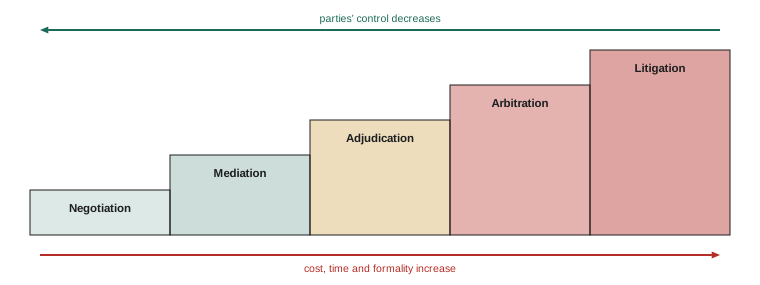
The ladder of dispute resolution
When disagreements persist, contracts usually provide a sequence of steps, from least to most formal:
- Negotiation between project representatives, then senior executives (Lesson 9).
- Mediation: a neutral mediator helps the parties negotiate, exploring interests and options; the mediator does not decide, and any settlement is voluntary. Mediation is fast, inexpensive and confidential, and succeeds in a large share of construction disputes.
- Adjudication: a neutral adjudicator decides the dispute quickly, typically within weeks, on documents and short submissions; the decision is binding on an interim basis (pay now, argue later) unless overturned by arbitration or the courts.
- Arbitration: a private, binding process before one or three arbitrators chosen for their expertise, with procedures agreed by the parties or set by institutional rules. Arbitration is confidential and final, with very limited appeal rights, but can be nearly as expensive and slow as court for large disputes.
- Litigation: proceedings in the courts, public, with full rights of appeal; slow and expensive for complex construction cases.
In Canada, statutory adjudication has been introduced alongside prompt payment legislation: in Ontario, for example, disputes about payment and certain other matters can be referred to adjudication through the Ontario Dispute Adjudication for Construction Contracts authority, with decisions typically issued within weeks; other provinces and the federal government have adopted or are adopting similar regimes. Arbitration is governed by provincial arbitration acts, and CCDC contracts provide for negotiation, mediation and arbitration, with reference to the CCDC 40 rules for mediation and arbitration.
Deciding whether to settle
Choosing between settlement and pursuing a dispute is a decision under uncertainty, best approached with decision analysis: estimate the probabilities and amounts of possible outcomes, add the costs of the process (legal fees, experts, management time), consider the time value of money and the effect on relationships, and compare expected values and the range of outcomes with the settlement on offer.
# A contractor claims 12 M for delay. Compare the owner options by expected cost (million dollars).
options = {
    "settle now at 7 M":       [(1.0, 7.0, 0.2)],
    "mediate":                 [(0.6, 6.0, 0.4), (0.4, None, 0.4)],   # 40 percent fail and go to arbitration
    "arbitrate":               [(0.35, 12.0, 1.5), (0.45, 6.0, 1.5), (0.20, 0.0, 1.5)],
}
arb = sum(p * (award + fees) for p, award, fees in options["arbitrate"])
for name, outcomes in options.items():
    cost = 0.0
    for p, award, fees in outcomes:
        cost += p * ((arb if award is None else award) + fees)
    print(f"{name:20s} expected cost {cost:5.2f} M")
print(f"worst case if arbitrated: {12.0 + 1.5:.1f} M; expected arbitration cost {arb:.2f} M")settle now at 7 M expected cost 7.20 M mediate expected cost 7.36 M arbitrate expected cost 8.40 M worst case if arbitrated: 13.5 M; expected arbitration cost 8.40 M
Settling now at 7 million dollars costs about 7.2 million with fees. Mediation has a slightly higher expected cost, because the 40 % chance of failure leads to arbitration, while arbitration alone has the highest expected cost, 8.4 million, and a worst case of 13.5 million. Unless the owner has strong reasons to believe the claim is weak (which would change the probabilities), settlement is financially attractive, and it frees management time and preserves the relationship with a contractor who may build the next phase. Decision analysis does not replace judgement, but it makes the assumptions explicit and focuses discussion on the probabilities, which is where the parties usually disagree.
Project closeout
Closeout begins long before the last day on site, with planning for documentation and turnover from the start of construction. Key steps include:
- Substantial completion: certification that the work is complete enough to be used for its intended purpose, subject to a list of deficiencies (a punch list). Substantial completion triggers important contract consequences: the start of warranty periods, the end of liquidated damages, and in Canada the start of lien periods for holdback release.
- Commissioning and readiness for service: completion of integrated systems testing and handover to operations, often with a period of supervised operation (DCE-450).
- Deficiency correction: tracking and closing punch list items, with retained amounts to secure completion.
- Documentation: record (as-built) drawings, operation and maintenance manuals, equipment data, test reports, warranties, spare parts and attic stock, and software and controls configurations, organized for the operations team and the asset management system.
- Training: operator training on all systems, recorded for future staff.
- Financial closeout: final quantities and change orders settled, claims resolved, final payment, and release of holdback or retainage after the statutory or contractual period, with lien waivers or statutory declarations confirming that subcontractors and suppliers have been paid.
In Canada, holdback is released after the lien period expires without liens being registered; in Ontario, the lien period is 60 days after substantial completion or certain other trigger events, and the Construction Act provides for annual or phased release of holdback on long projects.
- Lessons learned: a structured review with owner, designers and contractors of what worked and what did not, recorded in a form the next project will actually use, such as updated standard specifications, checklists and risk registers.
Capstone project
The capstone asks you to prepare a project delivery plan for a realistic data centre project. The project: a developer plans a 30 MW (critical IT load) colocation data centre on a 15-hectare site at the edge of a mid-sized city, in two phases of 15 MW each, with phase 1 needed in 30 months because an anchor tenant has signed for 10 MW with penalties for late delivery. The local utility says that 15 MW can be served from an existing substation with upgrades within 24 months, but the second 15 MW requires a new substation that will take 48 months. The site is zoned for light industrial use; data centres are not explicitly listed as a permitted use. Neighbouring land includes farms and a small residential subdivision 500 m away.
Your delivery plan, about 4,000 to 6,000 words with supporting calculations, should include:
- Delivery model selection, with a weighted scoring matrix and sensitivity check (Lesson 2).
- Contract strategy: forms, pricing arrangements, key clause positions (liquidated damages, owner-furnished equipment, changes, limitation of liability) for each major contract (Lesson 3).
- Procurement plan: packaging, prequalification criteria, evaluation method, and long-lead equipment strategy with calculated order dates (Lessons 4 and 8).
- A Level 2 schedule with CPM logic, critical path and float for phase 1, showing utility, permits, equipment and commissioning (Lesson 6).
- A Class 4 cost estimate with owner costs, escalation and a contingency based on a quantitative risk analysis (Lessons 5 and 7).
- A utility negotiation plan: interests, BATNA, objective criteria, proposed ramp schedule and terms for both phases (Lessons 9 and 10).
- A permitting and community engagement plan, including the zoning question, noise and water, and possible community benefits (Lesson 11).
- A risk register with the top ten risks, owners and responses, and a governance structure with authority limits (Lessons 1 and 5).
Assessment focuses on the coherence of the plan (do the choices support each other and the 30-month target?), the quality of the quantitative analysis, the realism of the risk and negotiation strategies, and clear, professional communication suitable for presentation to the developer's investment committee.
Handover to operations
The transition from project team to operations team deserves particular care on data centres, because the operations team will be responsible for keeping critical load running from the first day. Good practice brings operations staff into the project early: reviewing designs for maintainability, witnessing commissioning tests, and owning the readiness-for-service checklist. Before critical load is accepted, the operations team should have approved procedures (standard and emergency operating procedures and methods of procedure), staffing and training, spare parts, service contracts, and monitoring systems in place, and should have practised responses to failures during integrated systems testing. A formal handover meeting, with outstanding items, responsibilities and dates recorded, closes the project phase and opens the operating phase.
Common mistakes
MistakeKeeping poor records until a claim arises.
InsteadKeep contemporaneous daily records, photographs and logs from day one.
MistakeMissing contractual notice deadlines.
InsteadTrack events and give notices within the required periods.
MistakeEscalating straight to arbitration or litigation.
InsteadUse negotiation, mediation and adjudication first.
MistakeDeciding on disputes by emotion or principle alone.
InsteadUse decision analysis of probabilities, amounts, costs and relationships.
MistakeLeaving closeout documentation to the end.
InsteadPlan turnover documentation and training from the start of construction.
Summary and key terms
- Claims require entitlement and quantum, timely notice and contemporaneous records.
- Dispute avoidance uses balanced contracts, prompt decisions, partnering and dispute review boards.
- The resolution ladder runs from negotiation through mediation, adjudication and arbitration to litigation.
- Canadian prompt payment laws add fast statutory adjudication; CCDC contracts use mediation and arbitration.
- Decision analysis compares settlement with pursuing disputes by expected cost and risk.
- Closeout covers substantial completion, deficiencies, documentation, training, financial settlement and lessons learned.
- The capstone integrates delivery, contracts, procurement, schedule, cost, risk and negotiation in one plan.
- Claim
- A formal request for a contract adjustment not agreed by the other party.
- Entitlement
- The contractual basis for a claim.
- Quantum
- The amount of time or money claimed.
- Measured mile
- Comparing productivity on affected and unaffected work.
- Partnering
- A structured process of agreeing goals and issue resolution among parties.
- Dispute review board
- A standing panel that recommends resolutions of disagreements.
- Mediation
- Assisted negotiation by a neutral without power to decide.
- Adjudication
- A fast, interim-binding decision by a neutral.
- Arbitration
- Private, binding dispute resolution by chosen arbitrators.
- Punch list
- A list of deficiencies to be corrected after substantial completion.
Practice problems
Work each problem on paper first, then reveal the answer to check.
What two things must a claim establish?
Show answer
Entitlement and quantum.
What is the measured mile method?
Show answer
Comparing productivity on unaffected and affected portions of work to quantify lost productivity.
Why are contemporaneous records important?
Show answer
They establish facts quickly and support or defeat claims.
What does a dispute review board do?
Show answer
It stays informed throughout the project and recommends resolutions promptly.
How does mediation differ from arbitration?
Show answer
A mediator helps parties agree; an arbitrator decides bindingly.
What does interim-binding mean for adjudication?
Show answer
The decision must be followed now but can be revisited in arbitration or court.
From the output, what is the expected cost of mediation?
Show answer
About 7.36 million dollars.
From the output, what is the worst case if arbitrated?
Show answer
13.5 million dollars.
Name three consequences of substantial completion.
Show answer
Warranty periods start, liquidated damages stop, lien or retainage periods begin.
What should lessons learned produce?
Show answer
Updated standards, checklists and risk registers that the next project uses.
Lesson quiz · 5 questions
Score 60% or more to complete this lesson.
Create a free account to save your progress, take quizzes and earn a certificate.