
DCE-470 · Lesson 10 of 12 · 25 min
Negotiating with utilities and power suppliers
For a modern data centre, the electricity connection is usually the single most important and least controllable input. Utilities in many regions face more requests for large loads than their transmission systems and generation resources can serve, and have responded with study queues, capacity limits, new tariffs for large customers, and requirements for long-term financial commitments. Negotiating with a utility is unlike negotiating with a contractor: much of the relationship is governed by regulated tariffs and procedures that the utility cannot change at will, the utility has obligations to all its customers, and the relationship lasts for decades. This lesson explains how utilities are organized and regulated, the large-load connection process, cost allocation and financial security, minimum demand and contract terms, power supply options, and how to negotiate effectively within these constraints.
How utilities are organized
In Canada, electricity is a provincial responsibility, and structures differ by province. Several provinces have large Crown-owned utilities that generate, transmit and distribute power, such as Hydro-Québec, BC Hydro and Manitoba Hydro, regulated by provincial energy boards. Ontario has a mixed system: Hydro One owns most transmission, local distribution companies serve customers, and the Independent Electricity System Operator (IESO) plans the system and runs the wholesale market, regulated by the Ontario Energy Board. Alberta has a competitive market in which the Alberta Electric System Operator (AESO) plans and operates the transmission system and administers connections, regulated by the Alberta Utilities Commission. Provincial governments also set policy directly; for example, some provinces have created specific processes or allocations for large data centre loads.
Understanding who decides what is the first step in any utility negotiation: the local utility, the transmission owner, the system operator, the regulator and the government may each control part of the outcome.
The large-load connection process
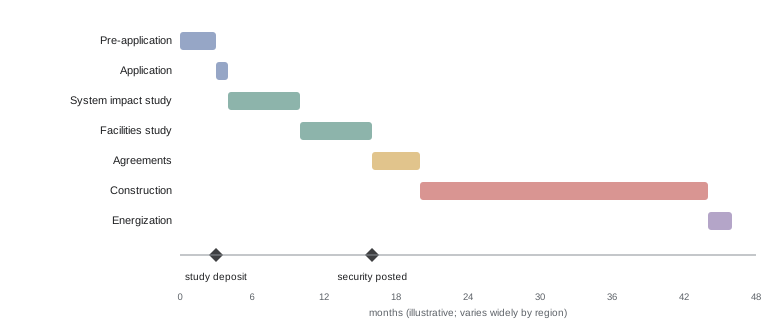
Connecting a large load typically follows a defined process, although names and steps vary:
- Inquiry and pre-application: discussions on location, load size, ramp and timing; the utility gives indications of available capacity.
- Application: a formal request with load details and often a study deposit.
- System impact study: the utility or system operator studies the effect of the load on the transmission and distribution system, identifying upgrades needed for reliability.
- Facilities study: detailed design and cost estimates for the connection facilities and upgrades.
- Connection agreement and service agreement: contractual terms for building the facilities, cost responsibility, security, the in-service date, contracted capacity and ramp, and the terms of electricity service.
- Construction and energization: building substations, lines and upgrades, testing and energization.
In constrained regions, the process has become slow and crowded, with large volumes of speculative requests. Utilities and regulators have responded with queue reforms: higher deposits, readiness requirements (land control, permits), cluster studies that evaluate many requests together, and allocation of limited capacity. For example, in 2025 Alberta's system operator set an interim limit of 1,200 MW for large loads that could connect without major transmission reinforcement, allocated among qualified projects that posted financial security and showed municipal support.
Cost allocation and security
Who pays for the facilities needed to connect a large load is a central question. Typically, the customer pays for facilities used only by it (such as a dedicated substation or line), while costs of network upgrades that benefit the system may be shared, recovered through rates, or partly charged to the customer, depending on the jurisdiction's rules. Many utilities require a capital contribution or customer-funded construction, sometimes with refunds as the load materializes and generates revenue. Because utilities and their other customers are exposed if a data centre is never built or never reaches its contracted load, utilities require financial security: deposits, letters of credit or parent guarantees, sized to cover the investment at risk. Some jurisdictions allow customers to build certain connection facilities themselves (self-build) to the utility's standards and transfer them, which can save time.
Minimum demand and contract terms
To protect other customers from stranded costs, many utilities have introduced large-load tariffs with long contract terms and minimum demand charges: the customer pays for a minimum share of its contracted capacity whether or not it uses it. For example, the Public Utilities Commission of Ohio approved a tariff for AEP Ohio in July 2025 under which new data centres above 25 MW pay for at least 85 % of their subscribed capacity for up to 12 years, with a ramp-up period and exit fees; Virginia's State Corporation Commission created a separate rate class for very large customers, including data centres, with long-term commitments in November 2025. Such terms shift the risk of slower-than-planned growth from the utility to the data centre owner.
# Exposure under a large-load utility contract with a minimum demand charge
contract_mw = 100
min_share = 0.85                      # customer pays for at least 85 percent of contracted demand
demand_rate = 12_000                  # dollars per MW-month of billed demand
ramp_plan = [20, 40, 60, 80, 100]     # contracted MW by year, agreed in the contract
actual = [10, 25, 45, 70, 95]         # load that actually materializes (slower lease-up)
total_paid = total_used = 0
for year, (c, a) in enumerate(zip(ramp_plan, actual), start=1):
    billed = max(a, min_share * c)
    paid, used = billed * demand_rate * 12, a * demand_rate * 12
    total_paid += paid; total_used += used
    print(f"year {year}: contracted {c:3d} MW, used {a:3d} MW, billed {billed:5.1f} MW, "
          f"paid for unused capacity {(paid - used) / 1e6:5.2f} M")
print(f"five-year demand charges {total_paid / 1e6:.1f} M, of which {(total_paid - total_used) / 1e6:.1f} M for unused capacity")year 1: contracted 20 MW, used 10 MW, billed 17.0 MW, paid for unused capacity 1.01 M year 2: contracted 40 MW, used 25 MW, billed 34.0 MW, paid for unused capacity 1.30 M year 3: contracted 60 MW, used 45 MW, billed 51.0 MW, paid for unused capacity 0.86 M year 4: contracted 80 MW, used 70 MW, billed 70.0 MW, paid for unused capacity 0.00 M year 5: contracted 100 MW, used 95 MW, billed 95.0 MW, paid for unused capacity 0.00 M five-year demand charges 38.4 M, of which 3.2 M for unused capacity
With actual load lagging the contracted ramp in the first three years, the owner pays for about 3.2 million dollars of capacity it does not use, roughly 8 % of total demand charges over five years. Once actual load exceeds 85 % of contracted capacity, the minimum no longer binds. The lesson for negotiation is that the contracted ramp schedule, not just the final capacity, determines the exposure: a ramp that matches realistic lease-up, or flexibility to defer ramp steps with notice, can be worth millions.
What can be negotiated
Regulated tariffs limit what a utility can offer, and utilities must treat similar customers alike, so aggressive price bargaining rarely works. But many terms are within discretion or can be shaped within the tariff:
- Contracted capacity and ramp schedule: phasing capacity to match realistic growth, with options to accelerate or defer.
- In-service dates and milestones: linking the utility's construction schedule to the project's, and agreeing interim or temporary service.
- Facilities design: substation location, redundancy (dual feeds from separate sources), metering arrangements, and who builds what.
- Form and timing of financial security, and reductions as load materializes.
- Flexibility: agreements to curtail load during grid emergencies, or to provide on-site generation or storage that supports the grid, in exchange for earlier or larger connections. Studies have suggested that flexible large loads can be connected faster where the grid is constrained.
- Power supply: in competitive markets, energy is bought separately from delivery, through retail contracts or power purchase agreements; in regulated markets, green tariffs or utility-sponsored renewable programs may be available.
Owners often negotiate for these terms jointly with requests to the regulator, or participate in regulatory proceedings that set large-load tariffs, alongside other customers and industry associations.
Power supply strategies
Beyond the connection, owners must secure energy supply, often with sustainability goals (DCE-460):
- Utility standard service under the tariff.
- Green tariffs and renewable energy programs offered by the utility.
- Power purchase agreements (PPAs), physical or virtual, with new renewable or other generation projects.
- On-site or co-located generation: natural gas turbines or engines, fuel cells, batteries and solar, either as backup, as bridging power until the grid connection is ready, or as primary supply. Co-location next to existing power plants has been explored but raises regulatory questions about sharing transmission costs.
- Long-term options such as nuclear, including agreements to restart or extend existing plants and to buy output from proposed small modular reactors.
Each has different cost, timing, emissions and regulatory implications, and each requires negotiation with different counterparties.
Negotiating effectively with utilities
Applying the principles of Lesson 9 to utilities:
- Understand the utility's interests: reliable service to all customers, recovering its investments, avoiding stranded assets, regulatory approval, and, for many, supporting economic development. Proposals that reduce the utility's risk are more likely to succeed.
- Know the rules: read the tariffs, connection procedures and recent regulatory decisions; requests that fit within them move faster.
- Be credible: utilities prioritize projects with land control, permits, financing and realistic load forecasts. Inflated or speculative requests damage credibility.
- Engage early and often: start discussions during site selection; share information about plans and phasing; meet technical staff, not only account managers.
- Improve your BATNA: alternative sites, on-site generation options and phased designs give you choices.
- Think long term: the relationship lasts decades, and the same utility may serve future phases and other sites.
Worked problem
Negotiating a ramp schedule
A developer requests 150 MW at a new campus. The utility offers a service agreement requiring 150 MW from year 3 with an 85 % minimum demand charge for 12 years and a letter of credit covering 60 million dollars of substation costs. The developer expects lease-up of 50 MW in year 3, 100 MW in year 5 and 150 MW in year 7. What should the developer seek?
Show solution
- Exposure: with 150 MW contracted from year 3, the minimum is 127.5 MW billed while only 50 MW is used, a large payment for unused capacity in the early years.
- Interests: the utility wants to recover substation investment and avoid stranding it; the developer wants to pay for capacity it uses.
- Options: a stepped contracted ramp (50, 100, 150 MW in years 3, 5 and 7) with the minimum applied to each step; security reduced as each step is reached; the right to defer a step by a year with notice and a fee.
- Criteria: the utility's own tariff ramp provisions, terms granted to other large customers, and the cost of the substation in phases.
- BATNA: a second site with available capacity, or phased substation construction that reduces initial investment.
Answer: A stepped ramp matched to realistic lease-up, with security reducing as load materializes, protects the utility's investment while reducing the developer's payments for unused capacity. Framing the proposal around the utility's interest in recovering its costs makes agreement more likely.
Common mistakes
MistakeApproaching the utility after buying land.
InsteadEngage utilities during site selection to confirm capacity and timing.
MistakeRequesting inflated capacity to secure a place.
InsteadMake credible, phased requests backed by land, permits and finance.
MistakeFocusing only on the final contracted capacity.
InsteadNegotiate the ramp schedule and minimum demand exposure.
MistakeTreating regulated tariffs as negotiable prices.
InsteadNegotiate terms within discretion and engage in regulatory proceedings.
MistakeIgnoring the utility's interests.
InsteadPropose terms that reduce the utility's stranded cost risk.
Summary and key terms
- Utilities are regulated; know who decides: utility, system operator, regulator, government.
- Large-load connection proceeds through application, studies, agreements and construction.
- Queue reforms add deposits, readiness requirements and capacity allocation.
- Customers often pay for dedicated facilities and post financial security.
- Large-load tariffs impose long terms and minimum demand charges, such as 85 % for up to 12 years.
- Ramp schedules, security, facility design, flexibility and power supply are negotiable.
- Effective utility negotiation is credible, early, informed by rules and focused on the utility's interests.
- System operator
- The organization that plans and operates the transmission grid.
- System impact study
- A study of a new load's effect on the grid.
- Facilities study
- Detailed design and cost of connection facilities.
- Connection agreement
- A contract for building and paying for connection facilities.
- Capital contribution
- A customer payment toward utility facilities.
- Minimum demand charge
- Payment for a minimum share of contracted capacity regardless of use.
- Ramp schedule
- Contracted capacity increasing over time.
- Stranded cost
- Investment not recovered because expected load does not materialize.
- Flexible load
- Load that can be curtailed to support the grid.
- PPA
- Power purchase agreement with a generator.
Practice problems
Work each problem on paper first, then reveal the answer to check.
Why are utilities harder to negotiate with than contractors?
Show answer
Regulated tariffs, duties to all customers and long relationships limit discretion.
Name the main steps of a large-load connection.
Show answer
Pre-application, application, system impact study, facilities study, agreements, construction and energization.
Why do utilities require financial security?
Show answer
To protect other customers if the load does not materialize.
From the output, how much is paid for unused capacity over five years?
Show answer
About 3.2 million dollars.
In which year does the minimum stop binding in the example?
Show answer
Year 4, when actual load exceeds 85 % of contracted capacity.
What did the AEP Ohio tariff approved in 2025 require?
Show answer
New data centres above 25 MW pay for at least 85 % of subscribed capacity for up to 12 years.
Name three terms negotiable within tariffs.
Show answer
Ramp schedule, in-service dates, facility design, security form, flexibility, power supply.
How can load flexibility help a connection?
Show answer
Curtailment during grid stress may allow earlier or larger connection.
What makes a data centre request credible to a utility?
Show answer
Land control, permits, financing and realistic load forecasts.
What is self-build?
Show answer
The customer builds certain connection facilities to utility standards and transfers them.
Lesson quiz · 5 questions
Score 60% or more to complete this lesson.
Create a free account to save your progress, take quizzes and earn a certificate.