
DCE-410 · Lesson 12 of 12 · 25 min
Approvals strategy and a site selection project
The earlier lessons treated each step from site search to construction permits on its own: criteria, market and search, zoning, land and due diligence, environmental approvals, noise and traffic studies, servicing, building permits, power and fuel infrastructure, negotiations, and economic impacts. In practice they run together, compete for the same people and budget, and depend on one another. This final lesson shows how to combine them into an approvals strategy with a realistic schedule and a managed set of risks, and closes with a project in which you choose between three sites and plan the approvals for the chosen one.
Building an approvals strategy
An approvals strategy answers four questions: what approvals are needed, in what order, who will obtain each, and what could go wrong. Its main tools are:
- A permit register listing every approval (land use, environmental, servicing, infrastructure, building, fire, electrical, road access), the authority, the prerequisites, the expected duration, the responsible person and the current status (Lessons 8 and 9).
- A dependency map showing which approvals require others first: site plan approval usually follows rezoning; building permits follow site plan; some environmental approvals need final engineering; the power connection depends on utility studies and long-lead equipment.
- A stakeholder map identifying everyone who influences the outcome: council members and staff, provincial or state agencies, utilities, Indigenous nations or tribes, neighbours and community groups, local businesses and the media, with the issues each cares about.
- A consultation plan coordinating meetings, open houses and submissions so that stakeholders see a coherent project rather than a sequence of disconnected applications (Lesson 10).
- A risk register (below).
Sequencing follows a few principles. Start long-lead items first, especially the power request, which in many markets takes longer than all other approvals combined. Run studies in parallel where one set of field work can serve several applications. Hold pre-application meetings with each authority to agree the scope of studies before spending on them. And do not file incomplete applications: each round of comments costs weeks or months.
Schedule risk
Approval durations are uncertain, and a schedule built from typical durations is optimistic, because delays in one path are not offset by early finishes in another when several paths must all be complete. Probabilistic scheduling replaces single durations with ranges and simulates the schedule many times, giving the probability of meeting each date. Results are reported as percentiles: the P50 date has an even chance of being met, the P90 date a 90% chance.
import numpy as np

rng = np.random.default_rng(12)
N = 20000
def tri(lo, mode, hi):
    return rng.triangular(lo, mode, hi, N)

# Durations in months (low, most likely, high)
land = tri(2, 3, 6)                                    # secure land and start due diligence
studies = tri(4, 6, 10)                                # environmental, noise, traffic, servicing studies
rezoning = tri(6, 9, 18)                               # rezoning and site plan after studies are filed
air = tri(4, 6, 12)                                    # air approval for generators, after studies
power = tri(24, 36, 54)                                # utility studies, upgrades and substation, from land
permits = tri(3, 4, 8)                                 # building permits after rezoning
build = tri(18, 22, 30)                                # construction of the first building after permits

# Construction can finish only when building, air approval and power are all ready
ready_to_build = land + studies + np.maximum(rezoning, air) + permits
energize = np.maximum(ready_to_build + build, land + power)
print(f"first building energized: P50 {np.percentile(energize, 50):.0f} months, P90 {np.percentile(energize, 90):.0f} months")
print(f"power is the controlling path in {np.mean(land + power > ready_to_build + build):.0%} of simulations")

# Starting the utility request at the same time as land, versus waiting until rezoning is done
late_power = land + studies + rezoning + power
energize_late = np.maximum(ready_to_build + build, late_power)
print(f"if the power request waits for rezoning: P50 {np.percentile(energize_late, 50):.0f}, P90 {np.percentile(energize_late, 90):.0f} months")first building energized: P50 50 months, P90 55 months power is the controlling path in 14% of simulations if the power request waits for rezoning: P50 59, P90 69 months
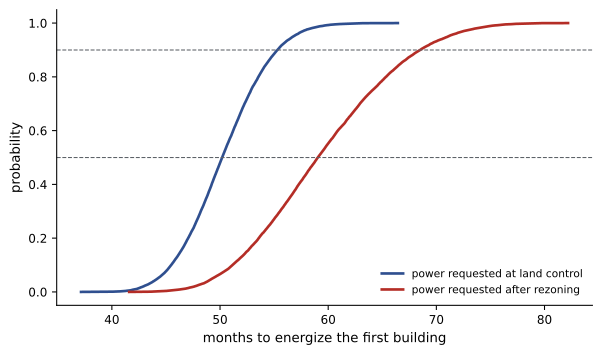
With the power request made at the start, the building path (studies, rezoning, permits and construction) usually controls the schedule, and power controls only in a minority of cases. Delaying the request until rezoning is secured, a tempting way to avoid paying utility deposits on a site that might fail, pushes the median energization back about nine months and the P90 back more than a year. The deposit is usually small compared with the value of that time, which is why experienced developers file utility requests as soon as they control land. The simulation also shows where to focus: since the building path controls, accelerating studies and rezoning is now worth more than accelerating power.
Managing approval risks
A risk register lists each risk with its likelihood, impact, owner and mitigation, and is reviewed regularly. Typical approval risks for a data centre:
| Risk | Typical mitigation |
|---|---|
| Power date slips | early requests, parallel sites, phased energization, on-site bridging power, flexible load agreements |
| Council refuses rezoning | early engagement with staff and council, studies that answer concerns, design commitments, community benefits |
| Organized community opposition | early disclosure, honest information on noise, water and power, liaison committee, responsive design changes |
| Appeal of approvals | thorough record, robust studies, procedural care, settlement discussions where reasonable |
| Species or archaeology finds | early seasonal surveys, flexible layout, avoidance rather than mitigation |
| Water or wastewater capacity | early servicing assessment, dry cooling, reclaimed water, phased demand |
| Changing rules or moratoria | monitor policy, engage with government, secure vested rights by timely applications |
| Long-lead equipment | early procurement, framework agreements with suppliers |
| Cost escalation of conditions | negotiate caps and cost-sharing in development agreements |
Decision gates structure the commitment of money. At each gate (for example, after the first due diligence results, after the utility study, before filing rezoning, before closing on land, before ordering long-lead equipment) the team reviews what it has learned and decides whether to proceed, pause, redesign or withdraw. Each gate releases a defined budget, so that the cost of discovering a fatal flaw stays proportionate to the information gained.
Capstone project: choosing and approving a site
A colocation developer needs a site for a 240 MW campus in four 60 MW buildings, with the first building energized within four years and the campus fully built within eight. It will use liquid cooling with dry coolers and a small evaporative component for peak days. The short list contains three sites:
| Factor | Site A: rural farmland | Site B: industrial park | Site C: former power plant |
|---|---|---|---|
| Area | 80 ha, flat | 35 ha, flat | 60 ha, some contamination |
| Land use status | agricultural; needs rezoning | zoned for industry; site plan only | industrial; brownfield |
| Power | 230 kV line on site; utility estimate 3 years | distribution only; 2 MW now; 6 years for new station | existing 230 kV switchyard; 2 years for reuse |
| Water | wells only | municipal, limited | river water rights, existing intake |
| Neighbours | 12 homes within 500 m | no homes within 800 m | small town 1 km away |
| Fibre | one route, 8 km away | two carriers on site | one route on site |
| Other | wetland and creek on west side | site too small for full campus | ash pond remediation; heritage turbine hall |
Step 1: Screen against the requirements
Site B fails two requirements: it cannot hold 240 MW (its yield is about 120 MW at the planned density, Lesson 4), and its power date of six years misses the deadline. It could serve as a later expansion site but is dropped from the main comparison, unless the developer can phase the campus across two sites.
Step 2: Score and test sensitivity
Scoring Sites A and C on power timing, land and expansion, approvals risk, environmental risk, water, fibre and community (Lessons 1 and 2) typically shows Site C ahead on power and water and Site A ahead on environmental risk and land. The result is sensitive to the weight on environmental risk, so the decision depends on how quickly and cheaply the ash pond can be remediated, which becomes the first due diligence priority.
Step 3: Plan due diligence
For Site C: a second-phase environmental assessment of the ash pond and fuel areas, a remediation cost estimate and regulatory pathway; a structural and heritage assessment of the turbine hall; a utility study on reusing the switchyard; and confirmation of the water rights and intake permits for the new use. For Site A, as the fallback: the utility study, wetland and species surveys in season, and early meetings with the municipality on rezoning (Lesson 4).
Step 4: Plan approvals
For Site C, the land use approvals are likely to be lighter (an official plan and zoning review confirming industrial use, and site plan approval), but brownfield remediation (and a Record of Site Condition if any part changes to a more sensitive use), the heritage designation of the turbine hall, the permit to take water, the Environmental Compliance Approval for air and noise, and consultation with First Nations whose rights may be affected by the river intake must be planned. The reuse of the switchyard needs utility agreements and possibly OEB approval. Generator noise toward the town and truck traffic through it need studies (Lesson 6).
Step 5: Community, fiscal and incentive case
Prepare an honest fiscal impact analysis (Lesson 11) showing tax revenue against servicing costs; a plan for community engagement in the town, emphasizing redevelopment of a derelict industrial site, reuse of the heritage building and water use well below the former plant's; and a negotiation strategy for the development agreement (Lesson 10).
Step 6: Recommendation
Worked problem
Comparing expected energization
For Site C, the team estimates the first building can be energized in 34 months if remediation is straightforward (probability 0.7) and in 50 months if a more complex remedy is required (probability 0.3). For Site A, it estimates 46 months with probability 0.8 and 60 months if the rezoning is appealed (probability 0.2). The deadline is 48 months. Which site gives the better chance of meeting the deadline, and the earlier expected date?
Show solution
- Site C: probability of meeting 48 months \(= 0.7\); expected date \(0.7 \times 34 + 0.3 \times 50 = 38.8\) months.
- Site A: probability \(= 0.8\); expected date \(0.8 \times 46 + 0.2 \times 60 = 48.8\) months.
Answer: Site C is expected to energize about 10 months earlier, but Site A has a slightly higher chance of meeting the 48-month deadline, because Site C's bad case misses badly. The recommendation is to proceed with Site C, while resolving the remediation question within the first four months, and to hold an option on Site A until then. If the investigation reveals the complex case, the two sites are close and the team returns to the decision gate.
The project draws on every lesson in the course: criteria and scoring, market and search, zoning, land and due diligence, environmental approvals, noise and traffic, servicing, building permits, infrastructure approvals, negotiation and fiscal analysis. Site selection and approvals are not a series of hurdles but a design process: each study and conversation shapes the project, and the projects that succeed are those that adapt to what they learn while keeping the community's confidence.
Common mistakes
MistakeScheduling approvals with single most-likely durations.
InsteadUse ranges and simulation; report P50 and P90 dates.
MistakeWaiting for rezoning before requesting power.
InsteadFile utility requests as soon as land is controlled.
MistakeKeeping a risk register that is never reviewed.
InsteadReview risks at every decision gate with owners and mitigations.
MistakeCommitting the full budget before fatal flaws are tested.
InsteadRelease money in stages at decision gates.
MistakeChoosing the site with the best expected date without checking the deadline risk.
InsteadCompare both expected dates and the probability of meeting critical deadlines, and keep fallbacks.
Summary and key terms
- An approvals strategy combines a permit register, dependency map, stakeholder map, consultation plan and risk register.
- Long-lead items, especially power, start first; studies run in parallel; scopes are agreed before spending.
- Probabilistic schedules give P50 and P90 dates and show which path controls.
- Risk registers and decision gates keep spending proportionate to information.
- The capstone compares sites against requirements, scores and tests them, plans due diligence and approvals, and recommends with fallbacks.
- Successful projects treat approvals as a design process that adapts while maintaining community confidence.
- Approvals strategy
- A plan for obtaining all approvals in the right order with managed risk.
- Dependency map
- A diagram of which approvals require others first.
- Stakeholder map
- A list of parties who influence approvals and their interests.
- Critical path
- The sequence of tasks that determines the earliest completion date.
- Monte Carlo schedule
- A schedule simulated many times with uncertain durations.
- P50 / P90
- Dates with 50% and 90% probability of being met.
- Risk register
- A list of risks with likelihood, impact, owner and mitigation.
- Decision gate
- A point where the team decides whether to proceed and releases budget.
- Brownfield
- Previously developed land, often with contamination.
- Fallback site
- An alternative held in reserve in case the preferred site fails.
Practice problems
Work each problem on paper first, then reveal the answer to check.
Name four components of an approvals strategy.
Show answer
Permit register, dependency map, stakeholder map, consultation plan, risk register.
Why are single-value schedules optimistic?
Show answer
Delays on any required path delay completion, while early finishes do not help.
What does a P90 date mean?
Show answer
A 90% probability of being met.
In the simulation, why did delaying the power request cost months?
Show answer
Power then started late and often became the controlling path.
Give a mitigation for the risk of species finds.
Show answer
Early seasonal surveys and flexible layouts that avoid habitat.
What is a decision gate?
Show answer
A review point where the team decides whether to proceed and releases the next budget.
Why was Site B dropped in the project?
Show answer
Too small and power too late for the deadline.
Expected months for outcomes 30 (p = 0.6) and 45 (p = 0.4)?
Show answer
36 months.
Why keep an option on a fallback site?
Show answer
To preserve a path if the preferred site fails due diligence.
Name two advantages of a former power plant site.
Show answer
Existing transmission switchyard, water rights, industrial zoning.
Lesson quiz · 5 questions
Score 60% or more to complete this lesson.
Create a free account to save your progress, take quizzes and earn a certificate.