
DCE-410 · Lesson 1 of 12 · 30 min
Site selection criteria: power, fibre, water, risk
Every data centre project begins with a piece of land, and the choice of that land fixes much of what follows: how much power can be had and how soon, what the electricity will cost for twenty years, how many fibre routes reach the building, whether the cooling design can use outside air or needs water, what natural hazards the facility must withstand, and which governments will approve it. A mediocre building on an excellent site can succeed; an excellent building on a poor site rarely recovers. Site selection has also become much harder. Large campuses now need hundreds of megawatts, communities increasingly push back, and grid capacity, not land, is the scarcest resource in most established markets.
This course follows a project from site search to the start of construction. This lesson covers the technical and commercial criteria for choosing a site; later lessons cover the search itself, land use planning and zoning, land and due diligence, environmental assessment and provincial approvals, technical impact studies, servicing, building permits, power and fuel infrastructure, negotiation with municipalities, economic impacts and the overall approvals strategy, as set out at the end of this lesson. It builds on DCE-200 and connects to the power procurement topics of DCE-420.
Power: capacity, timing and cost
Power is now the first filter. A 100 MW IT campus with a PUE of 1.3 needs a utility service of about 130 MW, plus margin for growth, delivered at transmission voltage through a dedicated substation. The questions to answer early are:
- Capacity: how much load can the existing transmission network accept at this location, and what upgrades are needed? The utility or system operator answers this through load interconnection studies (load flow and fault studies of the kind covered in ELE-380), which can take many months and may require the developer to fund new lines, transformers or substations.
- Timing: when can the power be energized? In constrained markets, utilities quote waits of three to seven years for large loads. A site with available capacity in 18 months can be worth far more than a cheaper site that must wait five years.
- Cost: the energy price, demand charges, transmission tariffs and any special rate class for large or data centre loads. Electricity is the largest operating cost of a data centre, so a difference of 1 ¢/kWh on a 100 MW load is worth almost $9 million a year.
- Reliability and supply diversity: the number of independent transmission sources, the historical outage record, and the stability of the regional supply.
- Carbon intensity and renewable access: many operators have clean-energy commitments, and the regional generation mix and the availability of power purchase agreements affect whether they can meet them.
In Canada, provinces are now setting specific rules for large data centre loads. Alberta's Data Centre Regulation (2026) defines large data centres as 75 MW or more, allocates a limited block of grid capacity to "bridged" projects for up to three years, and otherwise expects data centres to bring their own generation. Ontario's Protect Ontario by Securing Affordable Energy for Generations Act, 2025 allows the province to require ministerial approval before large data centres connect to the grid, and the IESO has issued technical requirements for large computational loads. In Québec, Hydro-Québec has proposed a separate rate for new data centres above 5 MW, and British Columbia offers a limited block of power through a competitive process. These rules are evolving quickly, so current requirements must be confirmed with the province, system operator and utility for every site.
Worked problem
Value of an earlier energization date
Site A can be energized in 2 years; site B, which has electricity 0.8 ¢/kWh cheaper, in 5 years. The campus will draw an average of 80 MW and earn a margin of $1.5 million per MW-year once operating. Compare the value of the three years of earlier operation at site A with the energy cost advantage of site B over a 20-year life (ignore discounting).
Show solution
- Earlier operation at A: \(80 \times 1.5 \times 3 = \$360\) million of margin.
- Energy saving at B: \(80{,}000\ \mathrm{kW} \times 8760\ \mathrm{h} \times \$0.008 = \$5.6\) million per year, or \$112 million over 20 years.
Answer: Site A's head start is worth roughly three times site B's lifetime energy advantage. Discounting would favour A even more, because its benefit comes first. Time to power often dominates site decisions in constrained markets.
Fibre and latency
A data centre is only as useful as its connections. Sites are evaluated for:
- The number of carriers and dark fibre providers with routes nearby, and the cost and time to build laterals to the site.
- Physically diverse routes: at least two, preferably more, entering the site from different directions along separate rights-of-way, so that one backhoe or one bridge failure cannot cut all connectivity (DCE-320).
- Distance and latency to users, cloud regions, internet exchanges and the operator's other sites. Light travels through optical fibre at about two-thirds of its speed in vacuum, about 200 km per millisecond, and fibre routes are typically 1.2 to 1.5 times the straight-line distance.
Latency requirements differ by workload. Interactive applications, financial trading and synchronous storage replication need low latency, typically within a few milliseconds of users or of a partner site. Large AI training clusters are far less sensitive to distance from users, which is why they are increasingly built in remote locations chosen for power, as long as the fibre capacity for loading data and moving models exists.
Worked problem
Latency budget for synchronous replication
A storage system requires a round-trip time below 2 ms between two data centres for synchronous replication, and the equipment adds 0.3 ms. The fibre route is 1.4 times the straight-line distance. What is the maximum straight-line separation?
Show solution
- Time available for propagation: \(2.0 - 0.3 = 1.7\) ms round trip, or 0.85 ms one way.
- Fibre distance: \(0.85 \times 200 = 170\) km.
- Straight-line distance: \(170/1.4 = 121\) km.
Answer: About 120 km. Synchronous pairs are therefore usually built within the same metropolitan region, while asynchronous replication and disaster recovery sites can be much farther away.
Water
Cooling designs vary widely in water use (DCE-330). Evaporative cooling towers and adiabatic coolers consume large volumes, on the order of 1 to 2 litres per kWh of IT energy in hot climates, while air-cooled chillers, dry coolers and closed-loop liquid cooling use little or none. Site selection must therefore match the cooling strategy to local water availability:
- The capacity of the municipal supply and the cost of connection, or the feasibility of wells and their permits.
- Drought risk, competing uses (agriculture, residents) and the likelihood of future restrictions.
- Wastewater capacity for blowdown from cooling towers, and any limits on its temperature and chemistry.
- Opportunities for reclaimed (grey) water, which several operators use to avoid drawing on potable supplies.
Water has become a central issue in community acceptance. A site that requires large potable withdrawals in a water-stressed region may be technically feasible and still fail at the approval stage.
Natural and human-made hazards
The site must be assessed for every hazard that could damage the facility or cut its supplies:
- Flooding: provincial and municipal flood hazard maps define regulatory floodplains, usually based on the 1-in-100-year flood or a historical regional storm, and conservation authorities in Ontario regulate development near rivers and shorelines. Data centres should be well outside regulatory floodplains, with critical equipment above the design flood level and a margin for climate change.
- Earthquakes: the National Building Code of Canada provides seismic hazard values for each location, which are highest on the coast of British Columbia and in parts of Québec and the Ottawa Valley.
- Wind and storms: hurricanes, tornadoes and severe winter storms, which affect both the building and the overhead lines that feed it.
- Wildfire: sites in or near wildland areas face fire, smoke that clogs air intakes and affects economizers, and utility shutoffs to prevent fires.
- Human-made hazards: airport approach paths, rail lines carrying hazardous materials, pipelines, chemical plants, explosives storage and major highways. Setbacks and risk assessments address these.
- Geotechnical conditions: soil bearing capacity, karst (sinkholes), expansive clays, high groundwater and contamination from past uses, which affect foundations and cost (DCE-430).
Worked problem
Flood probability over a facility's life
A site is at the edge of the 1-in-100-year floodplain (1% annual chance of flooding). What is the probability that it floods at least once in a 25-year facility life? What if the site is at the 1-in-500-year level?
Show solution
- 1-in-100: \(1 - 0.99^{25} = 1 - 0.778 = 0.222\).
- 1-in-500: \(1 - 0.998^{25} = 1 - 0.951 = 0.049\).
Answer: A 22% chance over 25 years at the 1-in-100 level, and about 5% at the 1-in-500 level. "100-year flood" does not mean once a century; for critical facilities the 1-in-100 level is far too risky, and designers use the 500-year level or higher, plus allowances for climate change.
Land, climate and other factors
- Land: size for the full build-out plus substations, generator yards, setbacks, stormwater ponds and possible expansion; a regular shape; gentle slopes; and clear title and access. Hyperscale campuses often need 40 to 200 hectares or more.
- Climate: cool, dry climates increase economizer hours and reduce cooling energy and water use, while extreme heat increases peak loads and equipment derating.
- Labour: availability of skilled construction trades during the build, and of operations staff afterwards.
- Taxes and incentives: sales tax exemptions on equipment, property tax treatment and economic development programs, discussed in Lesson 10.
- Regulatory and community climate: whether the jurisdiction welcomes data centres, how long approvals take, and whether local opposition or moratoria are likely. Several established markets have paused or tightened approvals in recent years.
Structuring the decision
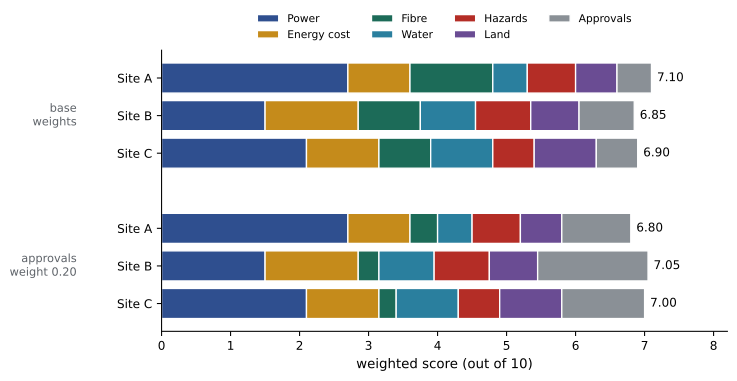
Site selection proceeds by stages: a broad screen of regions against hard constraints (power availability, hazards, latency), a short list of specific parcels, and detailed due diligence on the finalists, including utility studies, title and survey, geotechnical investigation, environmental site assessment, and early meetings with planners and officials. A weighted scoring matrix makes the trade-offs explicit and auditable: each criterion is given a weight reflecting its importance, each site is scored, and the weighted sum ranks the sites. Hard constraints, such as a flood zone or no power before a deadline, eliminate sites regardless of score.
| Criterion | Weight | Site A | Site B | Site C |
|---|---|---|---|---|
| Power capacity and timing | 0.30 | 9 | 5 | 7 |
| Energy cost | 0.15 | 6 | 9 | 7 |
| Fibre and latency | 0.15 | 8 | 6 | 5 |
| Water and cooling | 0.10 | 5 | 8 | 9 |
| Hazards | 0.10 | 7 | 8 | 6 |
| Land and expansion | 0.10 | 6 | 7 | 9 |
| Approvals and community | 0.10 | 5 | 8 | 6 |
| Weighted score | 1.00 | 7.10 | 6.85 | 6.90 |
The three sites are close, which is common, and the result is sensitive to the weights. A good analysis tests how the ranking changes when weights are varied, and records the reasoning so that the decision can be revisited as information arrives. Here, raising the weight on approvals and community from 0.10 to 0.20 (taking it from fibre) would put site B first (7.05, against 7.00 for C and 6.80 for A).
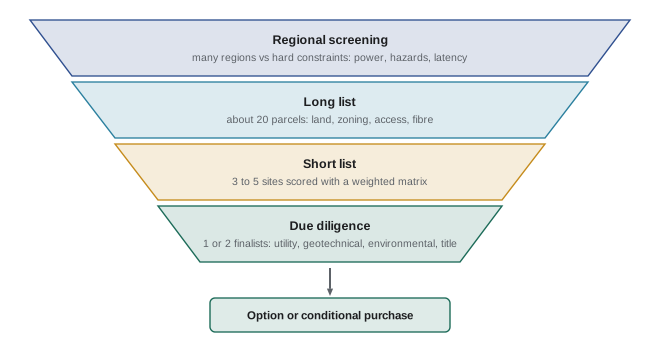
Developers usually secure land with an option agreement or a purchase agreement conditional on approvals and power, so that they do not own a site that cannot be built. They also typically keep their interest confidential until the site is secured, using code names, which can create tension with communities that later feel excluded; Lesson 10 discusses how to manage that.
How this course is organized
The twelve lessons follow a project from the first search to the start of construction:
- Lesson 1 (this lesson): site selection criteria and weighted scoring.
- Lesson 2: data centre markets, latency, organizing the search, confidentiality and robust decisions.
- Lesson 3: zoning, official plans and development approvals.
- Lesson 4: securing land, title, environmental and physical due diligence, and yield studies.
- Lesson 5: environmental assessment and provincial approvals.
- Lesson 6: noise, visual and traffic impact studies.
- Lesson 7: water, wastewater and stormwater servicing.
- Lesson 8: building permits and inspections.
- Lesson 9: permitting substations, transmission, fuel storage, gas supply and on-site generation.
- Lesson 10: negotiating servicing, taxes and community benefits with municipalities and provinces.
- Lesson 11: economic and fiscal impact analysis, incentives and effects on electricity customers.
- Lesson 12: the approvals strategy, schedule risk, and a site selection and approvals project.
Common mistakes
MistakeChoosing a site on land cost and assuming power will follow.
InsteadConfirm grid capacity, upgrade costs and energization dates with the utility or system operator first.
MistakeTreating the 1-in-100-year floodplain boundary as safe.
InsteadA 1% annual chance is a 22% chance over 25 years; site critical facilities well above it.
MistakeMeasuring latency by straight-line distance.
InsteadFibre routes are 1.2 to 1.5 times longer, at about 200 km per millisecond.
MistakeIgnoring water and community concerns until the approval stage.
InsteadMatch the cooling design to local water availability and assess acceptance early.
MistakeTreating a weighted score as a precise answer.
InsteadApply hard constraints first and test the ranking's sensitivity to the weights.
Summary and key terms
- Site choice fixes power, cost, connectivity, cooling, hazards and approvals for the facility's life.
- Power capacity and time to energization are now the first filters; large-load rules are changing rapidly.
- Provinces are adopting data centre connection frameworks (Alberta 2026 regulation, Ontario ministerial approval, Québec rates, BC competitive allocation).
- Fibre: diverse routes and enough carriers; latency of about 5 µs per km of fibre, with routes 1.2 to 1.5 times straight-line distance.
- Water availability must match the cooling design and is central to community acceptance.
- Assess floods, earthquakes, storms, wildfire, human-made hazards and geotechnical conditions.
- Land, climate, labour, taxes and the regulatory climate complete the picture.
- Use staged screening, hard constraints and a weighted scoring matrix with sensitivity analysis; secure land with conditional options.
- Time to power
- The time until the utility can energize the required capacity at a site.
- Load interconnection study
- A utility or system operator study of the network upgrades needed for a new load.
- Large-load tariff
- A utility rate and contract structure for very large customers such as data centres.
- Diverse routes
- Fibre paths following physically separate rights-of-way.
- Latency
- The delay for data to travel between two points, about 5 µs per km in fibre.
- Floodplain
- Land subject to flooding at a defined probability, such as 1% per year.
- Annual exceedance probability
- The chance that a hazard level is reached or exceeded in any one year.
- Weighted scoring matrix
- A tool that ranks options by the weighted sum of criterion scores.
- Hard constraint
- A requirement that eliminates a site regardless of its other merits.
- Due diligence
- Detailed investigation of a site before committing to it.
- Option agreement
- A contract giving the right to buy land later, often conditional on approvals.
Practice problems
Work each problem on paper first, then reveal the answer to check.
A 60 MW IT campus has a design PUE of 1.25. Roughly what utility capacity is needed?
Show answer
75 MW, plus margin for growth.
What is a 0.5 ¢/kWh price difference worth per year on an average 40 MW load?
Show answer
40,000 × 8760 × 0.005 = $1.75 million.
A fibre route is 300 km. What is the round-trip propagation time?
Show answer
300/200 = 1.5 ms one way; 3.0 ms round trip.
Why are AI training campuses often built far from population centres?
Show answer
They need large amounts of power and land more than low latency to users; only enough fibre capacity is required.
What is the probability of at least one 1-in-50-year event in 30 years?
Show answer
1 − 0.98³⁰ = 0.45.
Name three human-made hazards to evaluate.
Show answer
Airport flight paths, rail lines carrying hazardous goods, pipelines, chemical plants, highways.
Why should cooling design be considered during site selection?
Show answer
Water-intensive cooling needs adequate, reliable water and wastewater capacity, which affects feasibility and community acceptance.
In the scoring matrix, compute site C's weighted score.
Show answer
0.3×7 + 0.15×7 + 0.15×5 + 0.1×9 + 0.1×6 + 0.1×9 + 0.1×6 = 6.9.
What is the purpose of a hard constraint?
Show answer
To eliminate unacceptable sites regardless of high scores on other criteria.
Why are land purchases often made conditional?
Show answer
So the developer is not left owning land that cannot obtain approvals or power.
Lesson quiz · 5 questions
Score 60% or more to complete this lesson.
Create a free account to save your progress, take quizzes and earn a certificate.