
DCE-410 · Lesson 10 of 12 · 29 min
Negotiating with municipalities: servicing, taxes and community benefits
Approvals are not only technical. A data centre campus is a major development that asks a lot of its host: roads, water, sewers and power infrastructure; changes to the landscape and soundscape; years of construction traffic. In return, it can offer large property tax revenues, construction jobs, a smaller number of skilled permanent jobs, investment in local infrastructure and sometimes waste heat for community use. Municipalities, and increasingly provinces, negotiate the terms on which they will accept a project. This lesson covers the main subjects of negotiation, servicing and development charges, property and other taxes, incentives, community benefits and Indigenous partnerships, and the principles and practices that lead to durable agreements.
Servicing and infrastructure
A campus needs roads that can carry heavy construction traffic and transformer deliveries, water and wastewater connections sized for its cooling design, stormwater outlets, and, most expensively, transmission lines and substations. Who builds and pays for this infrastructure is a central negotiation:
- Development charges: Ontario municipalities levy development charges under the Development Charges Act to fund growth-related capital costs (roads, water, wastewater, stormwater), calculated per square metre of non-residential floor area. Alberta municipalities levy off-site levies under the Municipal Government Act, and British Columbia municipalities levy development cost charges. For a large data centre, these can reach many millions of dollars, and some municipalities have created specific rates or exemptions for data centres.
- Servicing agreements: where new or upgraded mains, pumping stations or roads are needed, the developer often builds them to municipal standards under a servicing or development agreement, sometimes with credits against development charges or cost recovery from later developers who benefit.
- Electrical infrastructure: connection costs follow the utility's and regulator's rules, such as the Ontario Energy Board's Transmission System Code and Distribution System Code, under which large customers typically fund their own connection assets and may contribute to network upgrades. Provincial frameworks for large data centre loads are adding new obligations and cost allocation rules.
Worked problem
Infrastructure charges for a campus
A municipality's non-residential development charge is $180 per m² of gross floor area. A campus of three buildings totals 72,000 m². The developer also builds a $14 million trunk watermain that the municipality's capital plan had already identified, for which the municipality grants a credit of 70% against the water component of the development charge, which is 30% of the total charge. What does the developer pay in development charges?
Show solution
- Gross charge: \(180 \times 72{,}000 = \$12.96\) million.
- Water component: \(0.30 \times 12.96 = \$3.89\) million; credit: \(0.70 \times 3.89 = \$2.72\) million.
- Net development charges: \(12.96 - 2.72 = \$10.24\) million, plus the $14 million watermain.
Answer: About $10.2 million in development charges plus $14 million of watermain construction. Negotiating credits, timing of payment (at permit issuance or phased with each building), and cost recovery from later users can be worth several million dollars.
Taxes
Property tax is the main way a data centre contributes to municipal finances. In Canada, property is assessed by provincial assessment agencies (for example MPAC in Ontario and BC Assessment) and taxed by municipalities at rates for each property class. Whether and how the IT equipment, electrical and mechanical systems are included in the assessed value varies by province: in some provinces much of the machinery and equipment is not assessable as real property, while in others municipalities may tax machinery and equipment. The classification of the property (industrial, commercial or a special class) and the treatment of equipment can change the tax bill by a large factor, so assessment is often discussed early with the municipality and assessor. Federal GST and provincial HST paid by businesses are generally recoverable through input tax credits, but provincial sales taxes in some provinces apply to equipment purchases and can be a significant cost on servers that are replaced every few years.
Worked problem
Equipment taxes over a facility's life
A campus installs $2.0 billion of IT equipment, replaced every 5 years, over a 15-year period. In a province with a 7% provincial sales tax on this equipment and no exemption, what is the total sales tax? If, instead, the province offered an exemption, what would the developer save?
Show solution
- Equipment purchased over 15 years: three cycles, \(3 \times 2.0 = \$6.0\) billion.
- Sales tax: \(0.07 \times 6.0 = \$420\) million.
- An exemption would save the full $420 million, about $28 million a year.
Answer: About $420 million, a large cost for a sector whose equipment turns over quickly. This is why tax treatment of equipment features prominently in competition between jurisdictions, and why developers compare provinces on total cost of ownership, not just electricity price.
Incentives in Canada
Canadian incentives for data centres have historically been more limited and more provincial than in the US. They have included competitive industrial electricity rates (now under review for data centres in several provinces), provincial economic development funds, municipal tax increment equivalent grants or community improvement plan incentives in Ontario, and federal and provincial support for related investments in clean power or AI infrastructure. Provinces are also increasingly selective, using connection approvals, rate classes and allocation processes to favour projects with local economic, strategic or sovereignty benefits, such as domestic data hosting.
Development agreements and community benefits
Commitments negotiated with a municipality are typically secured in a development agreement or site plan agreement registered on title, with financial security. Beyond the legally required elements, many projects now include community benefits:
- Infrastructure that serves the community as well as the project, such as road improvements, upgraded water mains or a new substation that also strengthens local supply.
- Operational commitments: noise limits with continuous monitoring and a complaint line, daytime-only generator testing, light shielding, landscaping maintenance, and water use limits or reclaimed water.
- Waste heat recovery to district heating systems, greenhouses, aquaculture or public buildings, more common in Europe and growing in Canada and the northern US, where heat demand is high (DCE-460).
- Local hiring, apprenticeships, procurement from local businesses, and partnerships with colleges for technician training.
- Community funds, parks, trails or donations, sometimes tied to the project's size or revenue.
- Decommissioning commitments for the end of the facility's life.
Partnerships with First Nations and Métis communities are increasingly central in Canada, including equity participation in power supply or the data centre itself, employment and training agreements, and joint ventures. Such partnerships can be the basis of a project's long-term social licence, and in some provinces they are encouraged or expected for projects on traditional territories.
Negotiation principles
Negotiations with governments and communities are repeated, public and multi-issue. A few principles apply:
- Interests, not positions: the municipality's position may be "no generators within 300 m of homes", but its interest is protecting residents from noise and emissions. A layout with a 200 m setback, a sound wall, quieter enclosures and daytime-only testing may meet the interest better than a bigger setback.
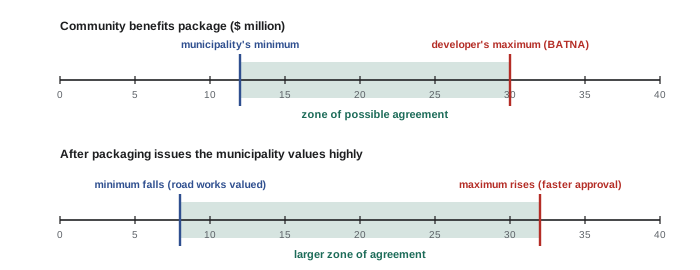
- Know the alternatives: each side's best alternative to a negotiated agreement (BATNA) sets the limits. The developer's BATNA is its next-best site; the municipality's is another use for the land, or no development. The zone of possible agreement lies between what the developer can afford to give and what the municipality must receive.
- Package issues: trading across issues (for example, a longer phasing period for development charges in exchange for a road improvement that the municipality values highly) creates more value than haggling over each one separately.
- Make commitments measurable and enforceable: "reasonable efforts to reduce noise" invites disputes; "no more than 45 dBA at the property line at night, verified by continuous monitoring with public reporting" builds trust.
- Balance confidentiality and transparency: developers often keep site searches confidential under non-disclosure agreements, sometimes with municipal staff, but communities that learn of a large project late often react with distrust. Early, honest engagement once the site is secured usually costs less than repairing a damaged relationship.
Note also that municipal records are subject to provincial freedom of information legislation, such as Ontario's Municipal Freedom of Information and Protection of Privacy Act, so confidentiality agreements with public bodies have limits.
Worked problem
Comparing two sites including negotiated terms
Site X offers a property tax abatement worth $4 million a year for 10 years but requires $25 million of road and water works. Site Y has no abatement but its municipality will build the infrastructure, and asks for a $10 million community benefits package. Ignoring discounting and other differences, which is better over 10 years?
Show solution
- Site X: \(10 \times 4 - 25 = +\$15\) million net benefit to the developer.
- Site Y: \(-\$10\) million.
Answer: Site X is $25 million better on these terms. With discounting at, say, 8%, the abatement is worth about $27 million in present value, so X is still better by about $12 million. But the decision must include the probability and timing of approval: if site Y's community is supportive and site X faces strong opposition, the expected value can reverse.
Community engagement and moratoria
Communities in many established markets have become more sceptical of data centres, citing noise, transmission lines, water use, electricity rates, loss of farmland and the small number of permanent jobs relative to the land and infrastructure used. Several jurisdictions have paused or restricted approvals while they revise their rules, and elected officials have campaigned on the issue. A credible engagement strategy is therefore part of the project, not an afterthought:
- Open houses and information sessions early, with realistic renderings, noise and traffic studies, and clear answers on water and power.
- A community liaison committee meeting throughout construction and operation.
- Construction management plans for traffic, hours, dust and noise, with a responsive contact.
- Public reporting on commitments such as noise monitoring and water use.
- Honest discussion of benefits, avoiding inflated job claims that undermine credibility.
A project that has earned local support also strengthens the developer's position with higher levels of government that increasingly influence power allocation and approvals.
Lesson 11 shows how to quantify the economic and fiscal effects that underpin these negotiations, and Lesson 12 combines all the approvals into a single strategy and schedule.
Common mistakes
MistakeTreating servicing costs as fixed.
InsteadCredits, phasing, cost sharing and cost recovery for infrastructure are all negotiable.
MistakeComparing sites on electricity price alone.
InsteadInclude equipment taxes, property taxes, infrastructure charges and incentives over the facility's life.
MistakeNegotiating each issue separately.
InsteadPackage issues so that each side gains on what it values most.
MistakeMaking vague commitments to win approval.
InsteadMake measurable, monitored commitments that build trust and avoid disputes.
MistakeKeeping communities in the dark until a formal application.
InsteadEngage early once the site is secured; late disclosure breeds distrust and opposition.
Summary and key terms
- Development charges, off-site levies or development cost charges, and servicing agreements fund local infrastructure; credits and phasing are negotiable.
- Electrical connection costs follow regulator codes and new provincial large-load frameworks.
- Property tax depends on provincial assessment rules and equipment treatment; provincial sales tax on equipment can be large.
- Incentives are mainly provincial and municipal, and provinces increasingly favour projects with local and strategic benefits.
- Community benefits include shared infrastructure, operational commitments, heat reuse, local hiring and community funds.
- Partnerships with First Nations and Métis communities are increasingly central.
- Negotiate on interests, know each side's BATNA, package issues and make commitments measurable.
- Early, honest engagement is essential as communities and governments scrutinize data centres more closely.
- Infrastructure charge
- A fee on new development to fund growth-related infrastructure, such as a development charge or levy in Canada or an impact fee in the US.
- Servicing agreement
- An agreement under which a developer builds or funds municipal infrastructure.
- Credit
- A reduction in fees in recognition of infrastructure built by the developer.
- Sales tax exemption
- Relief from sales tax on qualifying equipment purchases.
- Clawback
- Repayment of incentives if performance commitments are not met.
- Development agreement
- A contract securing a developer's and municipality's obligations.
- Community benefits agreement
- An agreement providing specific benefits to a host community.
- BATNA
- Best alternative to a negotiated agreement.
- Zone of possible agreement
- The range of outcomes acceptable to both parties.
- Social licence
- Ongoing acceptance of a project by its community.
Practice problems
Work each problem on paper first, then reveal the answer to check.
A development charge of $150/m² applies to 50,000 m². What is the charge?
Show answer
$7.5 million.
Why are equipment taxes so significant for data centres?
Show answer
IT equipment is very valuable and replaced every few years, so sales and property taxes on it recur.
$1.2 billion of servers is bought every 4 years over 12 years with a 6% sales tax. What is the total tax?
Show answer
3 × 1.2 × 0.06 = $216 million.
What is the purpose of a clawback provision?
Show answer
To recover incentives if the company fails to meet investment, job or other commitments.
Give three community benefits that also improve the project's acceptance.
Show answer
Noise monitoring and limits, daytime-only generator testing, heat reuse, local hiring, shared infrastructure, community funds.
Restate this position as an interest: "No generators within 300 m of homes."
Show answer
Residents should not be disturbed by generator noise or emissions.
The developer's next-best site costs it $18 million more. The municipality needs $8 million in benefits. What is the zone of possible agreement?
Show answer
Between $8 million and $18 million of benefits.
Rewrite "We will use reasonable efforts to minimize noise" as a measurable commitment.
Show answer
For example: "No more than 45 dBA at the nearest residential property line between 10 p.m. and 7 a.m., with continuous monitoring and monthly public reports."
Why is early engagement often better than strict confidentiality?
Show answer
Late disclosure breeds distrust and organized opposition, which can delay or block approval.
Why might a province favour some data centre projects over others when allocating power?
Show answer
To prioritize projects with local jobs, strategic value or domestic data hosting, given limited grid capacity and ratepayer impacts.
Lesson quiz · 5 questions
Score 60% or more to complete this lesson.
Create a free account to save your progress, take quizzes and earn a certificate.