
CRE-430 · Lesson 9 of 12 · 27 min
Platform enforcement: strikes, demonetization, bans and account recovery
For most creators, platforms are both the shop and the landlord. A platform can remove a video, cut off monetization, stop recommending content, block uploads or terminate a channel entirely, often with little warning and limited explanation. Sometimes enforcement is a consequence of a real mistake; sometimes it results from automated systems getting it wrong, mass reporting by critics, or a hacked account. Either way, losing access to a channel or its income is one of the most serious reputational and financial events a creator can face. This lesson explains how enforcement systems generally work, how to appeal, how to protect accounts from compromise, and how to recover them. Platform policies change often, so treat the details below as a snapshot at the time of writing (October 2026) and always check the current rules.
Types of enforcement
Platforms use a range of actions, roughly in order of severity.
- Content removal: a specific video, post or comment is taken down.
- Age restriction or limited visibility: content stays up but is shown to fewer people or only to signed-in adults.
- Reduced recommendation: content is not shown in recommendation feeds, though followers may still see it.
- Limited or no ads: content stays up but earns less or nothing from advertising.
- Feature restrictions: the account cannot livestream, post, comment or use certain tools for a period.
- Strikes: formal penalties that accumulate and lead to escalating restrictions.
- Monetization suspension: the account is removed from a partner or revenue program.
- Account termination: the account is removed, sometimes with a ban on creating new accounts.
Strike systems
Most large platforms use some form of strike or penalty-point system, where each violation adds to a record that expires after a set period. Details vary and change, but the general pattern is consistent: a warning or first strike brings a short restriction, repeated strikes bring longer restrictions, and too many strikes within a period or a single severe violation can end the account.
| Platform | How strikes generally work (October 2026) |
|---|---|
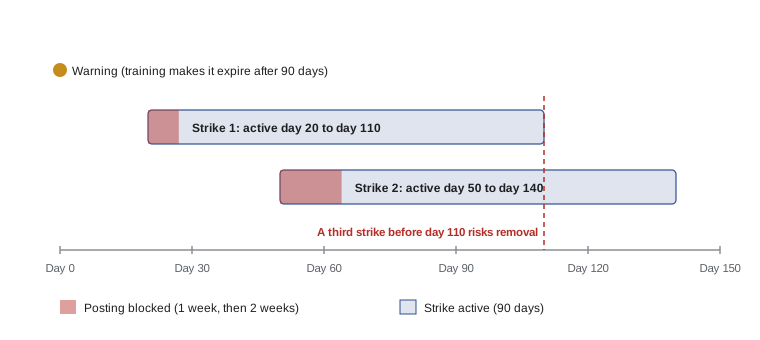
| YouTube | A first Community Guidelines violation usually brings a warning; optional policy training can make it expire after 90 days. A first strike blocks uploads, livestreams and other posting for one week; a second strike within 90 days blocks posting for two weeks; three strikes within 90 days may lead to channel removal. Each strike lasts 90 days. Severe abuse can lead to termination without warning. |
| TikTok | Strikes are added when violating content is removed and generally expire after 90 days. Reaching a threshold within a policy area or a feature, or accumulating many strikes overall, can lead to a permanent ban; some severe violations bring a ban on the first strike. An account status page shows strikes and allows appeals. |
| Instagram and Facebook | Meta counts strikes for most violations and applies escalating restrictions, such as temporary limits on posting, as strikes accumulate; strikes generally expire after a set period. Severe violations can lead to immediate disabling. Account Status pages show violations and appeal options. |
Copyright enforcement usually runs on a separate track. YouTube, for example, issues copyright strikes when it receives a valid removal request from a rights holder; three active copyright strikes can lead to termination. Copyright strikes are resolved differently from community guideline strikes, through retractions by the claimant, counter notifications or expiry after completing required steps.
Worked problem
Working out strike windows
A YouTube channel receives a first strike on March 3 and a second strike on April 10. Each strike lasts 90 days. Until what date would a third strike put the channel at risk of removal under the three-strikes-in-90-days rule, and when will the channel be clear of all current strikes if no more arrive?
Show solution
- First strike expires 90 days after March 3: March has 28 days left after the 3rd, April 30, May 31, so 28 + 30 + 31 = 89 days takes us to May 31; one more day is June 1.
- Second strike expires 90 days after April 10: April has 20 days left, May 31, June 30, so 20 + 31 + 30 = 81 days reaches June 30; 9 more days is July 9.
- A third strike before June 1 would mean three active strikes in the 90-day window.
- After June 1, only the second strike remains active until July 9.
Answer: A third strike before June 1 could lead to removal. The channel is clear of all current strikes on July 9 if no new strikes arrive. Keeping a dated log of every strike, with expiry dates, prevents mistakes during a stressful period.
Demonetization
Monetization rules are often stricter than community guidelines. Content that is allowed on a platform may still be unsuitable for most advertisers. On YouTube, advertiser-friendly content guidelines govern which videos earn full ad revenue; videos with strong language, graphic content, controversial issues or sensitive events may receive limited ads or none. Separately, channels can be removed from the YouTube Partner Program for repeated policy problems, such as reused content without significant original commentary, even without community guideline strikes.
During a crisis, creators sometimes see videos discussing the controversy marked as limited for ads, because the topic involves sensitive issues. That is not necessarily a penalty; it reflects advertiser preferences. Creators can request human review of monetization decisions, which often reverses automated mistakes.
Appeals
Every major platform offers appeals, though the process and success rate vary. Appeals work best when they are calm, specific and evidence-based.
- Read the policy the platform says you violated, and identify exactly which part of the content triggered it.
- Decide honestly whether the decision was a mistake. Appealing a correct decision wastes time and can affect credibility with reviewers.
- Explain clearly, with timestamps and context, why the content does not violate the policy, such as educational, documentary or newsworthy context.
- Keep a record of the appeal, including screenshots and reference numbers.
- Use creator support channels or partner managers where available, without pressuring them to bypass normal processes.
Mass reporting by critics can trigger automated enforcement. If you believe a coordinated campaign is behind strikes or removals, document it and include that context in appeals and in reports to creator support.
For copyright removals, Canadian creators can usually use a platform's counter-notification process, which on most major platforms follows the US Digital Millennium Copyright Act procedure because the platforms are US-based. Canada's own Copyright Act uses a separate notice-and-notice regime for internet service providers, in which ISPs forward infringement notices to subscribers rather than removing content. Filing a counter notification can lead to the claimant suing, so get advice if the claim is serious.
Hacked accounts
Account takeovers are a common crisis that has nothing to do with a creator's conduct. Attackers often target creators through fake sponsorship emails containing malware, phishing pages that look like platform logins, or stolen session cookies that bypass passwords. A hacked channel may be renamed, used to stream cryptocurrency scams, or have content deleted, leading to strikes the creator did not earn.
- Use a unique, strong password and a password manager for every account.
- Turn on two-step verification, preferring passkeys or security keys over text messages.
- Treat unexpected attachments in sponsorship offers with suspicion, and open files in a safe environment.
- Limit who has access to accounts, use platform role features instead of sharing passwords, and remove access when people leave.
- Keep recovery email addresses and phone numbers current and secure.
- Know the platform's hacked-account recovery process before you need it.
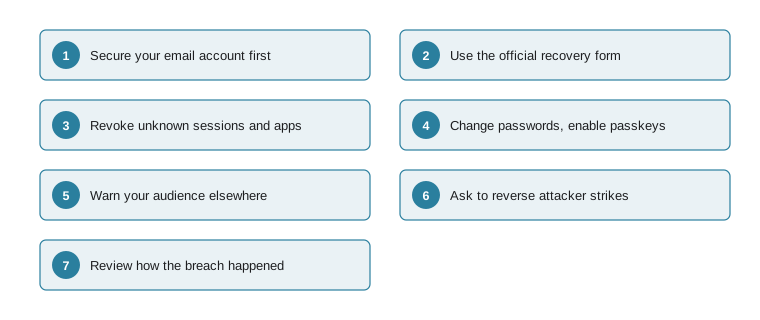
If an account is compromised, act quickly: secure the linked email account first, use the platform's official recovery process, revoke unknown sessions and connected apps, and warn your audience through another channel not to engage with scam content. Ask the platform to reverse strikes or removals caused by the attacker. Afterwards, review how the breach happened and fix the weakness.
Reducing dependence on any one platform
No appeal process can fully protect a business that depends entirely on one platform. Diversifying reduces the impact of enforcement errors and account loss: an email list, a website, presence on more than one platform, and income streams such as memberships or products that do not depend on a single partner program. CRE-301 and CRE-302 cover owned channels and diversified income; from a crisis perspective, the key point is that owned channels let you reach your audience even when a platform account is suspended.
Mistaken enforcement and false reports
Automated moderation systems process enormous volumes of content and make mistakes. A documentary video about a violent historical event may be flagged as violent; a medical explanation may be flagged as graphic; a video discussing hate speech in order to criticize it may be flagged as hateful. Context matters, and most platforms have exceptions for educational, documentary, scientific and artistic content, though applying them requires human judgment. When appealing, describe the context clearly and point to the relevant exception in the policy.
False reports are a related problem. Critics or rivals sometimes report content in bulk or file false copyright claims to get videos removed. Platforms generally prohibit abusive reporting and fraudulent copyright claims, and creators can report this abuse. Document patterns, such as many reports arriving at once from new accounts, and include them in appeals.
Keeping an enforcement log
| Field | Example entry |
|---|---|
| Date and time | March 3, 10:42 a.m. |
| Platform and content | YouTube, video titled Wiring basics part 2 |
| Action | Removed; first Community Guidelines strike |
| Stated policy | Harmful or dangerous content |
| Expiry | June 1 (90 days) |
| Appeal | Submitted March 3, 4:15 p.m., reference number recorded |
| Outcome | Pending |
Worked problem
Estimating lost revenue from an upload restriction
A creator usually publishes two long videos a week, each earning about $900 in ad revenue and $1,500 in sponsorship over its life. A first strike blocks uploads for one week, and a planned sponsored video is delayed. If the delayed videos are published later and earn the same amounts, the main cost is timing. If the sponsor cancels its video because of the delay, with a 25 % kill fee on a $1,500 fee, what is lost?
Show solution
- Ad revenue: delayed, not lost, if the videos are published later.
- Sponsorship: the $1,500 fee is lost, but the kill fee returns 25 % × $1,500 = $375.
- Net loss: $1,500 − $375 = $1,125.
Answer: If the sponsor cancels, the creator loses $1,125. Telling the sponsor promptly about the restriction and proposing a new date often avoids cancellation.
Platforms sometimes offer creators a way to reduce or remove penalties through education, such as YouTube's policy training for warnings. Taking these options when available is usually worthwhile, both to reduce penalties and to understand the rules better.
Common mistakes
MistakeAppealing every enforcement decision automatically.
InsteadRead the policy, judge honestly whether it was a mistake, and appeal with specific evidence.
MistakeNot tracking strike dates and expiry.
InsteadKeep a dated log of every strike, warning and appeal.
MistakeSharing passwords with editors and assistants.
InsteadUse platform role features and remove access when people leave.
MistakeRelying on text message codes for account security.
InsteadUse passkeys or security keys for two-step verification where available.
MistakeDepending on one platform for audience and income.
InsteadBuild an email list, website and other income streams you control.
Summary and key terms
- Platform enforcement ranges from content removal and limited ads to strikes, suspension and termination.
- Strike systems usually escalate restrictions with repeated violations and expire after a set period, such as 90 days on YouTube and TikTok.
- Copyright enforcement runs on a separate track with its own strikes and counter-notification process.
- Monetization rules are often stricter than community guidelines, and human review can reverse automated errors.
- Effective appeals are calm, specific, evidence-based and used only when a decision seems wrong.
- Hacked accounts can be prevented with passkeys, role-based access and caution with sponsorship attachments.
- Owned channels and diversified income reduce the impact of enforcement and account loss.
- Community guidelines
- A platform's rules about what content and behaviour are allowed.
- Strike
- A formal penalty recorded against an account for a policy violation.
- First warning
- A first-level notice of a violation, usually without lasting penalties.
- Demonetization
- Removing or limiting a creator's ability to earn advertising revenue on content or a channel.
- Advertiser-friendly guidelines
- Rules setting which content is suitable for full advertising.
- Appeal
- A request asking a platform to review an enforcement decision.
- Counter notification
- A formal response asking a platform to restore content removed after a copyright claim.
- Account takeover
- Unauthorized access to and control of an account by an attacker.
- Passkey
- A phishing-resistant sign-in method using cryptographic keys stored on a device.
- Mass reporting
- Many users reporting the same content, sometimes in a coordinated campaign.
Practice problems
Work each problem on paper first, then reveal the answer to check.
Name four types of platform enforcement.
Show answer
Content removal, limited ads, strikes and account termination.
How long does a YouTube strike last?
Show answer
90 days.
What may happen after three YouTube strikes in 90 days?
Show answer
The channel may be removed.
A strike is issued on January 10. When does it expire after 90 days?
Show answer
April 10 in a non-leap year, or April 9 in a leap year.
Why might a video about a controversy get limited ads?
Show answer
It discusses sensitive topics that many advertisers avoid.
Give two features of a good appeal.
Show answer
Specific references to the policy and evidence such as timestamps and context.
How do copyright strikes differ from guideline strikes?
Show answer
They come from rights holders' claims and are resolved through retractions, counter notifications or expiry steps.
Name two ways attackers take over creator accounts.
Show answer
Malware in fake sponsorship emails and phishing pages.
What should be secured first after a hack?
Show answer
The linked email account.
Why build an email list?
Show answer
To reach your audience even if a platform account is suspended.
Lesson quiz · 5 questions
Score 60% or more to complete this lesson.
Create a free account to save your progress, take quizzes and earn a certificate.