
CRE-430 · Lesson 3 of 12 · 27 min
Prevention: audits, policies and review
The cheapest crisis is the one that never happens. Lesson 2 showed that many reputational risks are predictable, especially old content, partnerships and team conduct. This lesson turns that insight into routines: auditing an archive, writing simple policies, building a review step before publishing, vetting partners, and understanding the contract clauses that govern what happens if something goes wrong. None of these routines guarantees safety, but together they remove most of the avoidable problems and make the remaining ones easier to handle.
The content audit
A content audit is a structured review of everything you have published, looking for material that could cause harm or embarrassment if found and shared today. The aim is not to erase your history or pretend you never made mistakes. It is to find problems before others do, so you can decide calmly what to do with them instead of reacting under pressure.
A good audit has five steps.
- Inventory: list every channel and account, including old or abandoned ones, along with their content counts.
- Prioritize: start with content that is most viewed, most recent, or from periods when you know your standards were looser.
- Review: watch, read or search the content, noting anything that would not meet your current standards or platform rules.
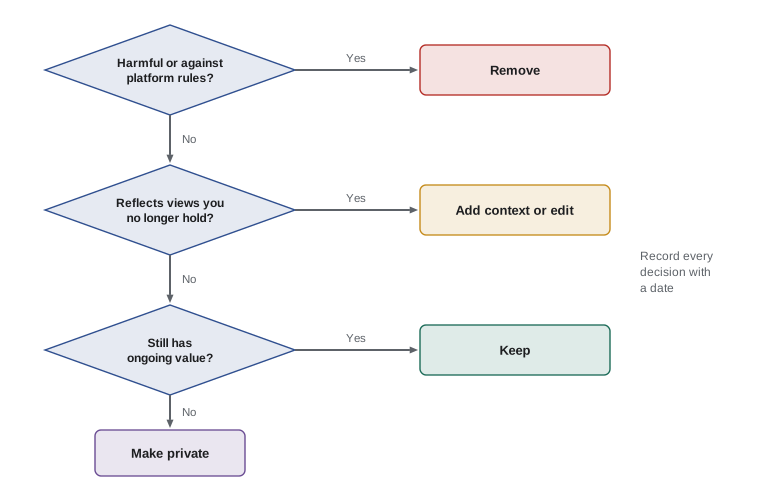
- Decide: for each flagged item, choose to keep, add context, edit, make private or remove.
- Document: record what you found and what you decided, with dates, so you can explain your choices if asked.
Search tools make audits faster. Auto-generated transcripts can be searched for slurs, insults and sensitive terms. Comment sections and old community posts can be exported. For livestream archives, chat logs and transcripts are often more useful than rewatching hours of footage.
Worked problem
Planning an archive audit
A creator has 1,200 videos averaging 14 minutes, plus 300 livestream archives. They plan to review transcripts rather than watch everything: about 2 minutes per video for keyword search and skimming, plus 10 minutes per flagged video for a full watch. They expect about 8 % of videos to be flagged. For streams, they plan 6 minutes each for transcript search, with 15 % flagged for a 30-minute focused review. How many hours will the audit take?
Show solution
- Video screening: 1,200 × 2 min = 2,400 min.
- Flagged videos: 8 % × 1,200 = 96 videos; 96 × 10 min = 960 min.
- Stream screening: 300 × 6 min = 1,800 min.
- Flagged streams: 15 % × 300 = 45 streams; 45 × 30 min = 1,350 min.
- Total: 2,400 + 960 + 1,800 + 1,350 = 6,510 min ≈ 108.5 hours.
Answer: About 108 hours, or roughly three working weeks for one person. Splitting it into two-hour sessions over two to three months, or sharing the screening with a trusted team member, makes it manageable.
Deciding what to do with flagged content
Not every flagged item needs to be deleted. Deleting content can look like hiding evidence, especially if it happens suddenly during a controversy. Each option has trade-offs.
| Option | When it fits | Risks |
|---|---|---|
| Keep as is | Content was fine in context and still meets current standards | Others may still clip it without context |
| Add context | Content reflects outdated views you have since changed | Requires a clear, honest note |
| Edit | A small segment is the problem and the rest has value | Edits can look like concealment if done during a controversy |
| Make private or unlisted | Content has little value and some risk | Copies may already exist elsewhere |
| Remove | Content is harmful, breaks platform rules or hurts identifiable people | Removal during a crisis can look like a cover-up |
Timing matters. Decisions made quietly during a routine audit, with documented reasons, look very different from mass deletions after a critic starts posting clips. If old content reflects views you have genuinely changed, addressing it proactively can build trust; some creators publish a short note explaining that their early work includes material they would not make today and why.
Simple written policies
Policies sound bureaucratic, but even a one-page document saves time and prevents mistakes. Written policies help most when a creator works with other people, because they make expectations clear before anything goes wrong.
- Sponsorship policy: categories you will not promote, required disclosures and approval steps.
- Content standards: topics that need extra care, jokes and language you avoid, and how you handle sensitive subjects.
- Community and moderation policy: rules for comments and community spaces, and how moderators enforce them.
- Corrections policy: how you correct errors, where corrections appear and how quickly.
- Team conduct policy: expected behaviour for staff and contractors, including how they represent you.
- Social media policy for the team: what staff may post about your business and how to handle their own personal accounts.
Policies should be short, specific and actually used. A two-page document that every editor and moderator reads beats a twenty-page handbook nobody opens.
Pre-publication review
A pre-publication review is a final check before content goes live. For a solo creator, it might be a checklist run while the video exports. For a team, it might mean a second person reviews every sponsored video and anything on a sensitive topic. The goal is to catch problems while they are still cheap to fix.
- Facts and claims: are statistics, quotes and product claims accurate and sourced?
- Disclosure: are sponsorships, gifts and affiliate links clearly disclosed?
- People: does the content show identifiable people who did not consent, or children?
- Context: could any segment be clipped to mean something very different?
- Rights: is music, footage and imagery licensed or used within the law?
- Tone: would you be comfortable if your most critical viewer, a sponsor and a journalist all watched it?
Sensitivity review means asking someone with relevant lived experience or expertise to review content that touches on identity, culture, religion, disability, trauma or other sensitive areas. It is not about avoiding difficult topics; it is about covering them accurately and respectfully. Paying for this expertise when it is professional work is good practice.
Vetting partners
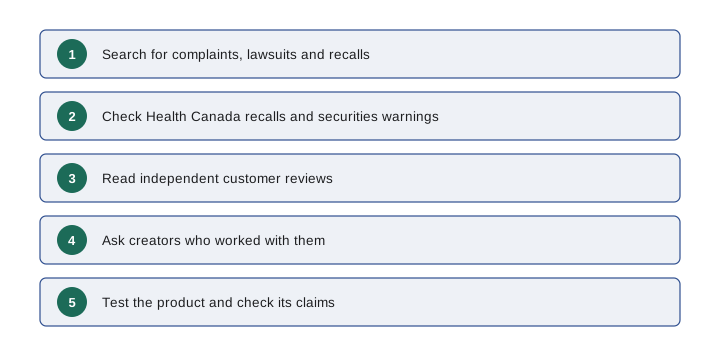
Before agreeing to a sponsorship or collaboration, a short due diligence check can reveal obvious problems.
- Search the brand or person with terms such as scam, recall, lawsuit, complaint and controversy.
- Check regulator databases where relevant, such as product recall lists, securities regulators for financial products, and health regulators for supplements and devices.
- Read customer reviews on independent sites, looking for patterns rather than single complaints.
- Ask other creators who have worked with them.
- Try the product yourself and check claims you will be asked to repeat.
In Canada, useful sources include Health Canada's Recalls and Safety Alerts database, provincial securities commission warnings and the Canadian Securities Administrators' investor alerts, and the Competition Bureau's announcements of enforcement actions.
Morals clauses and exit rights
Many sponsorship contracts include a morals clause, which lets a brand end the deal, withhold payment or demand content removal if the creator does something that brings the brand into disrepute. Creators should understand these clauses before signing, because their wording matters. A broad clause that lets a brand terminate for any conduct the brand dislikes gives the brand a great deal of power; a narrower clause tied to specific behaviour, such as criminal charges or breaches of law, is fairer.
Creators can also ask for reverse morals clauses, which let the creator exit if the brand becomes involved in a scandal, such as a product safety crisis or unethical practices. Other useful terms include how quickly content must be removed after termination, whether fees already paid must be returned, and who decides whether a clause has been triggered. CRE-330 covers contract negotiation in detail; the point here is that these clauses shape what happens in a crisis, so they belong in prevention planning.
| Clause | What it does | What to look for |
|---|---|---|
| Morals clause | Lets the brand end the deal for creator conduct | Narrow, specific triggers; fair process |
| Reverse morals clause | Lets the creator end the deal for brand conduct | Ability to exit without repaying fees for work done |
| Termination for convenience | Lets either side end without a reason | A notice period and payment for work completed |
| Content removal | Sets what happens to published content after termination | Reasonable timelines; archive rules |
| Approval rights | Lets the brand approve content before publishing | Clear turnaround times; limits on changes |
Building prevention habits
Prevention works best as routine rather than a one-off project. Many creators schedule a light archive review each year, a risk register update every six months, a policy refresh when the team changes, and a vetting checklist for every new partner. These habits take a few hours a month and remove a large share of the risks that would otherwise become crises.
Livestream safeguards
Livestreams deserve their own prevention routines, because there is no edit step. Practical safeguards include a short delay on the stream so a producer can cut away from an accident, a moderator with authority to end the stream if something goes wrong, clear rules for guests about language and topics, filters for chat, and a habit of checking what is visible on screen and in the background before going live, such as open browser tabs, documents, notifications and windows showing your location. Creators should also decide in advance which situations will end a stream, such as a guest becoming abusive, a medical emergency, or a raid of hateful messages.
Team onboarding
Prevention depends on everyone who works on the channel. When a new editor, moderator or assistant joins, onboarding should include the relevant policies, examples of past mistakes and how they were handled, who to contact if they notice a problem, and what they may and may not say publicly about the business. A short conversation about values, such as how the creator wants fans treated, often prevents more problems than any document.
- Share the content standards, moderation policy and corrections policy.
- Explain escalation: who to tell, and how quickly, if something looks wrong.
- Give access through platform roles rather than shared passwords.
- Set expectations for personal social media when it touches the business.
- Review the onboarding checklist when someone leaves, removing access the same day.
Worked problem
Estimating the cost of a second reviewer
A creator publishes four long videos a month, of which two are sponsored. A second reviewer charges $40 an hour and needs about 45 minutes per video. The creator decides to have every sponsored video and any video on a sensitive topic reviewed, which adds about one more video a month. What is the monthly cost?
Show solution
- Videos reviewed: 2 sponsored + 1 sensitive = 3.
- Time: 3 × 45 min = 135 min = 2.25 hours.
- Cost: 2.25 × $40 = $90 a month.
Answer: About $90 a month, or $1,080 a year, is a small cost compared with the revenue at risk from a single disclosure failure or offensive segment.
Prevention routines should be proportionate. A small channel does not need the same processes as a media company with dozens of staff. Start with the risks at the top of your register, add controls that address them, and grow the system as the business grows.
Common mistakes
MistakeDeleting large amounts of old content during a controversy.
InsteadAudit proactively and document decisions, so changes are not seen as a cover-up.
MistakeWriting long policies that nobody reads.
InsteadKeep policies short, specific and part of onboarding and daily work.
MistakeSkipping review for sponsored or sensitive content to save time.
InsteadUse a checklist and a second reviewer for high-risk content.
MistakeSigning contracts without reading the morals clause.
InsteadNegotiate narrow triggers, fair processes and a reverse morals clause.
MistakeRelying on a brand's own marketing during vetting.
InsteadCheck independent reviews, regulator databases and other creators' experiences.
Summary and key terms
- A content audit inventories, prioritizes, reviews, decides and documents what to do with archive material.
- Flagged content can be kept, contextualized, edited, made private or removed, and timing affects how changes are perceived.
- Short written policies set expectations for sponsorships, content, moderation, corrections and team conduct.
- A pre-publication review checks facts, disclosure, people, context, rights and tone before content goes live.
- Sensitivity review uses relevant expertise to cover difficult topics accurately and respectfully.
- Due diligence on partners uses searches, regulator databases, reviews, peer advice and product testing.
- Morals clauses, reverse morals clauses and exit terms determine what happens in a crisis, so negotiate them early.
- Content audit
- A structured review of published material to find content that could cause harm or embarrassment.
- Inventory
- A complete list of channels, accounts and content to be reviewed.
- Pre-publication review
- A final check of content before it goes live.
- Sensitivity review
- Review by someone with relevant lived experience or expertise for content on sensitive topics.
- Corrections policy
- A creator's stated approach to fixing errors and how corrections are shown.
- Morals clause
- A contract term letting a brand end a deal if the creator's conduct brings disrepute.
- Reverse morals clause
- A contract term letting a creator exit if the brand becomes involved in scandal.
- Termination for convenience
- A contract right to end an agreement without giving a reason.
- Approval rights
- A partner's right to review and approve content before it is published.
- Due diligence
- Research done before a partnership to identify problems.
Practice problems
Work each problem on paper first, then reveal the answer to check.
List the five steps of a content audit.
Show answer
Inventory, prioritize, review, decide and document.
600 videos at 2 minutes each for screening take how long?
Show answer
1,200 minutes, or 20 hours.
Why can deleting content during a crisis backfire?
Show answer
It can look like hiding evidence, and copies may already exist.
Name three written policies useful for a creator team.
Show answer
Sponsorship, moderation and corrections policies (also content standards and team conduct).
Give three items on a pre-publication checklist.
Show answer
Facts, disclosure and consent of people shown (also context, rights and tone).
What is a sensitivity review?
Show answer
Review of content on sensitive topics by someone with relevant lived experience or expertise.
Name two sources for vetting a supplement sponsor.
Show answer
Regulator recall or warning databases and independent customer reviews.
What does a morals clause allow?
Show answer
It lets a brand end a deal if the creator's conduct brings disrepute.
What protection does a reverse morals clause give?
Show answer
It lets the creator exit if the brand becomes involved in scandal.
Why keep a record of audit decisions?
Show answer
To explain choices later and show changes were routine, not a cover-up.
Lesson quiz · 5 questions
Score 60% or more to complete this lesson.
Create a free account to save your progress, take quizzes and earn a certificate.