
CRE-430 · Lesson 11 of 12 · 27 min
Rebuilding trust and long-term reputation repair
When public attention moves on, the real work of recovery begins. Sponsors decide whether to return, search results continue to show coverage, audiences watch to see whether promised changes happen, and the creator has to decide how and when to return to normal content. Recovery is rarely quick. It depends on the seriousness of what happened, how the creator responded, whether commitments are kept, and whether the creator's behaviour genuinely changes. This lesson covers the stages of recovery, keeping commitments, returning after a break, rebuilding partner relationships, managing search results honestly, measuring recovery, and knowing when a reputation may not fully recover.
Stages of recovery
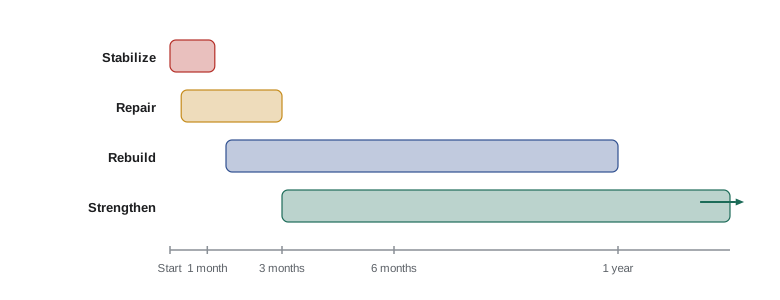
Recovery can be thought of in four overlapping stages.
- Stabilize: stop further damage by keeping statements consistent, pausing risky content, and supporting anyone harmed.
- Repair: carry out the actions promised in the apology or response, such as refunds, content changes, training or new policies.
- Rebuild: return to regular content and partnerships gradually, demonstrating change through behaviour.
- Strengthen: build systems and habits that make a repeat less likely, and earn new trust over time.
Keeping commitments
The most powerful recovery tool is doing what you said you would do. Audiences, journalists and critics remember promises made in apologies and often check later. A creator who promised to donate, change moderation policies or review old content should do so and report back with specifics: what was done, when and what changed. A short update a month or two later, such as here is what I have done since my statement, signals that the apology was more than words.
Do not over-promise. Commitments made under pressure, such as never making a certain type of content again or giving all profits to charity, can be hard to sustain. It is better to make fewer, specific, achievable commitments and keep them than to make sweeping promises that later look broken.
| Commitment | How to show it was kept |
|---|---|
| Refund affected customers | Report the number of refunds processed and the total amount |
| Review old content | Describe the audit, what was changed and when it was completed |
| Change moderation | Publish the new community rules and moderator training |
| Education or training | Share what you learned and how it changed your work, without making it about you |
| Support affected communities | Describe the ongoing relationship, not just a one-time donation |
Returning after a break
Some creators step back from content after a serious controversy. A break can show seriousness, give time for reflection and protect wellbeing. It can also look like waiting for the story to blow over, especially if the creator returns as if nothing happened. There is no universal right length; what matters is what happens during the break and how the return is handled.
A thoughtful return acknowledges what happened briefly, explains what has changed, and then returns to content that reflects those changes. Returning with an unrelated, high-energy video can read as dismissive. Returning with a long video that reopens the controversy can restart the cycle. Many creators find that a short acknowledgment followed by consistent, well-made content works best. Expect some lingering criticism and avoid engaging defensively with it.
Rebuilding partner relationships
Sponsors that paused or ended partnerships will watch the recovery. Re-engaging them should be patient and professional. After a reasonable period, share a short, factual update: what happened since, what has changed, and current audience and performance data. Do not pressure partners to return or criticize those who left. Some may return; others may not. New partners will often check how a creator handled the controversy, so a well-handled crisis can eventually become evidence of maturity.
Expect partnership income to recover more slowly than views. Brands are often cautious, and their decision-makers may need time and evidence before approving a creator again. Diversified income, such as memberships and products, can carry the business through this period.
Managing search results honestly
Search results for a creator's name may show articles and videos about a controversy for years. Creators often want these results gone. Some approaches are legitimate; others can backfire.
- Create new, genuine content and pages, such as a personal website, interviews about your work and updated profiles, so that search results reflect the full picture.
- Ask publishers to update articles with corrections or follow-ups when facts have changed, especially if you have kept commitments or been cleared of allegations.
- Use platform and search engine processes for content that violates their policies, such as private information or impersonation.
- Use legal options, such as defamation claims or de-indexing rights where they exist, only with advice and for genuinely unlawful or harmful content.
Avoid deceptive tactics, such as fake reviews, fake news sites or networks of low-quality pages designed to push down legitimate coverage. These tactics often violate platform and search engine rules, can breach consumer protection laws, and when discovered, become a second scandal.
Measuring recovery
Recovery should be measured, not guessed. Useful indicators include views and watch time compared with pre-crisis baselines, subscriber growth or loss, the sentiment ratio from lesson 4, sponsor renewals and new partnership inquiries, membership numbers, product sales and the tone of search results. Different indicators recover at different speeds, so tracking several gives a fuller picture.
Worked problem
Estimating a recovery timeline
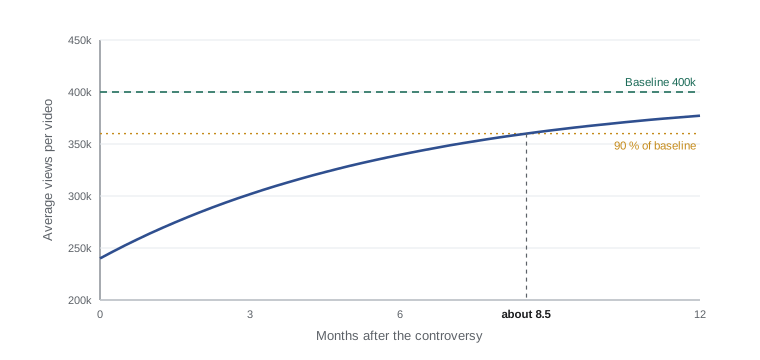
Before a controversy, a creator averaged 400,000 views per video. Immediately afterwards, views fell to 240,000. Since then, the gap between current views and the old baseline has been closing by about 15 % each month. How many months until views reach at least 90 % of the old baseline (360,000), if this pattern continues?
Show solution
- Initial gap: 400,000 − 240,000 = 160,000.
- Target gap: 400,000 − 360,000 = 40,000, which is one quarter of the initial gap.
- Each month the gap is multiplied by 0.85. We need 0.85^n ≤ 0.25.
- n = ln(0.25) ÷ ln(0.85) ≈ −1.386 ÷ −0.1625 ≈ 8.5.
- So about 9 months.
Answer: Views would reach 90 % of the old baseline after about 9 months. This model assumes steady recovery; new controversies, platform changes or seasonal effects can speed it up or slow it down. Tracking actual monthly numbers against the model shows whether recovery is on track.
Community re-engagement
Rebuilding trust with an audience happens through many small interactions. Respond thoughtfully to genuine questions, show behind-the-scenes evidence of changes where appropriate, highlight community members and collaborators, and keep moderation consistent. Some creators hold a live question-and-answer session after a period of change; this works when the creator is prepared, calm and willing to hear criticism, and backfires when it becomes defensive.
It also helps to listen. Surveys, polls and conversations with moderators and long-time community members can reveal whether trust is returning and what still concerns people. Treat critical feedback as information, not attack.
When reputations do not fully recover
Some reputational damage is lasting. When conduct caused serious harm, especially to vulnerable people, or when a pattern of behaviour was revealed, audiences and partners may never return to previous levels of trust, and some should not. Recovery in those cases may mean rebuilding a smaller, different business, changing niche, working behind the scenes, or stepping away from public content. Accepting this honestly is healthier than trying to force a comeback that the audience does not want.
Wellbeing matters throughout. Being the subject of a controversy, even a deserved one, can cause anxiety, depression and isolation. Creators should seek support from trusted people and professionals during recovery. CRE-350 covers creator wellbeing and support resources.
Learning from the crisis
After any significant incident, run a review, sometimes called an after-action review or post-mortem. What happened? What went well in the response? What went badly? What would we do differently? Which risks and controls need updating? Write down the answers, update the risk register and crisis plan, and share lessons with the team. Treat the review as learning, not blame.
Rebuilding with the people affected
When a crisis involved harm to particular people or communities, rebuilding trust with them matters more than rebuilding numbers. That may mean an ongoing relationship rather than a one-time gesture: inviting their input into future content, paying experts from affected communities for consultation, supporting their work, and accepting that some may not want any involvement. Rebuilding should never be done in a way that uses affected people as props in content designed to repair the creator's image.
Sustaining change
Changes made under pressure can fade once attention moves on. Building them into systems helps them last.
- Add new rules to written policies and onboarding.
- Assign owners and review dates in the risk register.
- Schedule the commitments you made, with reminders.
- Check progress at quarterly business reviews.
- Ask a trusted outsider to check periodically whether changes have stuck.
Worked problem
Comparing two recovery rates
Two creators each lose 30 % of their average views after a controversy. Creator A's gap closes 20 % per month; Creator B's closes 8 % per month. How much of the original gap remains for each after six months?
Show solution
- Creator A: 0.80⁶ ≈ 0.262, so about 26 % of the gap remains.
- Creator B: 0.92⁶ ≈ 0.606, so about 61 % of the gap remains.
- With an initial gap of 30 % of views, Creator A is down about 8 % and Creator B about 18 % after six months.
Answer: Creator A has recovered most of the loss within six months, while Creator B has recovered less than half. Differences like this often reflect how well commitments were kept and how consistently the creator returned to quality content.
Recovery is not linear. There may be setbacks when the controversy resurfaces, when a commentary video revisits it, or when the creator reaches a new audience that learns about it for the first time. Consistent behaviour over time is what eventually makes the controversy one chapter in a longer story rather than the defining fact about the creator.
A recovery dashboard
Many creators find it useful to keep a simple monthly dashboard during recovery. Rows list the indicators: average views per video against baseline, subscriber change, sentiment ratio, number of active sponsors, new partnership inquiries, membership count, product sales and the share of first-page search results that mention the controversy. Columns show each month. Colour-coding cells green, amber or red against targets makes trends visible at a glance and helps the team decide where to focus.
| Indicator | Before | Month 1 | Month 3 | Month 6 |
|---|---|---|---|---|
| Average views per video | 400,000 | 240,000 | 300,000 | 345,000 |
| Sentiment ratio (negative to positive) | 0.20 | 0.90 | 0.45 | 0.28 |
| Active sponsors | 4 | 1 | 2 | 3 |
| Controversy results on first search page | 0 | 6 | 5 | 3 |
The dashboard in this example shows a typical pattern: sentiment recovers fastest, views recover steadily, sponsors return slowly, and search results change slowest of all. Knowing this pattern helps creators set realistic expectations and avoid giving up on recovery work too early.
Common mistakes
MistakeReturning to content as if nothing happened.
InsteadAcknowledge what happened briefly and show what has changed.
MistakeMaking sweeping promises you cannot keep.
InsteadMake fewer, specific commitments and report back on them.
MistakePressuring sponsors to return quickly.
InsteadShare factual updates patiently and accept their decisions.
MistakeUsing fake sites or reviews to bury coverage.
InsteadBuild genuine content and use legitimate correction and removal processes.
MistakeSkipping a post-crisis review.
InsteadRun an after-action review and update the risk register and crisis plan.
Summary and key terms
- Recovery moves through stabilizing, repairing, rebuilding and strengthening, which overlap.
- Keeping specific commitments and reporting back is the most powerful recovery tool.
- A thoughtful return after a break acknowledges what happened and shows change without reopening the controversy.
- Partnership income usually recovers more slowly than views, so patience and diversified income help.
- Legitimate search result management uses genuine content, corrections and proper processes, not deceptive tactics.
- Measure recovery with several indicators compared with pre-crisis baselines.
- Some reputations do not fully recover, and after-action reviews help prevent repeats.
- Stabilization
- Stopping further damage in the early period after a crisis.
- Repair
- Carrying out actions that address harm and fulfil commitments.
- Rebuild
- Gradually returning to normal content and partnerships while demonstrating change.
- Commitment report
- An update showing how promised actions were carried out.
- Search result management
- Efforts to ensure search results give an accurate, current picture.
- Recovery indicator
- A metric used to track reputation recovery against a baseline.
- Recovery rate
- The share of the remaining gap to baseline that closes in each period.
- Community re-engagement
- Rebuilding audience relationships through consistent, honest interaction.
- After-action review
- A structured review of what happened and what to change after an incident.
- Post-mortem
- Another name for an after-action review.
Practice problems
Work each problem on paper first, then reveal the answer to check.
List the four stages of recovery.
Show answer
Stabilize, repair, rebuild and strengthen.
What is the most powerful recovery tool?
Show answer
Keeping commitments and reporting back on them.
Why can a high-energy unrelated return video backfire?
Show answer
It can read as dismissive of what happened.
Why does partnership income often recover slowly?
Show answer
Brands are cautious and need time and evidence before returning.
Name one legitimate way to improve search results.
Show answer
Create genuine new content and ask publishers to update articles where facts changed.
Gap 100,000 closing 20 % a month. Gap after 2 months?
Show answer
64,000.
Name three recovery indicators.
Show answer
Views versus baseline, sentiment ratio and sponsor renewals.
Why avoid fake review sites to bury coverage?
Show answer
They break rules and can become a second scandal.
When might a reputation not fully recover?
Show answer
When serious harm was caused or a pattern of behaviour was revealed.
What questions does an after-action review ask?
Show answer
What happened, what went well, what went badly and what to change.
Lesson quiz · 5 questions
Score 60% or more to complete this lesson.
Create a free account to save your progress, take quizzes and earn a certificate.