
CRE-430 · Lesson 1 of 12 · 25 min
Reputation as a creator's most valuable asset
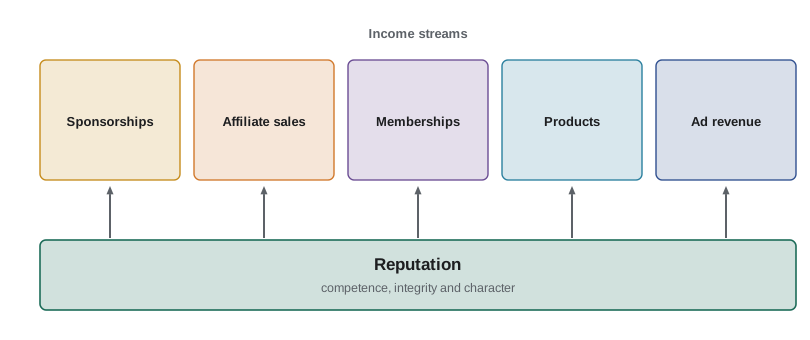
Every creator business runs on something that never appears on a balance sheet: reputation. Views, subscribers, sponsorships, affiliate sales, memberships and product launches all depend on whether people believe a creator is who they appear to be, will do what they say, and will treat their audience fairly. A creator with a strong reputation can survive a bad video, a failed product or an algorithm change. A creator whose reputation collapses can lose most of their income in a week, even if their content library and follower count stay exactly the same. This course is about protecting that asset: understanding where reputational risk comes from, preventing the avoidable problems, spotting trouble early, responding well when something goes wrong, and rebuilding trust afterwards.
This first lesson explains what reputation is, why it matters so much more for creators than for many traditional businesses, and how to think about it in practical terms. Later lessons build the toolkit: risk registers, audits, monitoring, response plans, apologies, platform enforcement, legal options and long-term repair. Throughout, the course draws on composite examples rather than real controversies involving named people, because the goal is to learn patterns, not to judge individuals. Nothing in this course is legal advice; lesson 10 explains when to involve a lawyer.
What reputation is
Reputation is the set of beliefs other people hold about you, based on what they have seen, heard and experienced. It is not the same as your self-image or your brand guidelines. You can design a logo, a colour palette and a channel description, but you cannot directly control what viewers, brands, platforms, journalists and other creators believe about you. You can only influence it through consistent behaviour over time.
It helps to break reputation into three components that audiences and partners judge separately.
- Competence: do you know what you are talking about, and is your work good? A cooking creator's recipes should work; a tech reviewer's claims should hold up.
- Integrity: are you honest? Do you disclose sponsorships, admit mistakes, keep promises and avoid misleading people?
- Character and values: how do you treat others, including your audience, collaborators, team members and people you disagree with?
These components fail differently. A competence failure, such as a recipe that does not work or a product review that missed a defect, usually causes disappointment that a correction can fix. An integrity failure, such as hiding a paid relationship or faking results, damages trust much more deeply because it makes people question everything else you have said. A character failure, such as cruelty toward a fan or offensive past content, can trigger strong moral reactions that spread far beyond your audience.
Why creators are especially exposed
Traditional companies have reputations too, but creators face a sharper version of the problem for several reasons.
- The person is the product. When a creator is criticized, the criticism lands on a human being and their whole business at once. There is no separate corporate brand to absorb the damage.
- Parasocial relationships. Audiences often feel they know a creator personally, even though the relationship is one-sided. That feeling builds loyalty, but it also means fans can feel personally betrayed when they learn something unexpected.
- Permanent, searchable archives. Years of videos, livestreams, posts and comments are available to anyone who wants to search them, often without the context in which they were made.
- Speed and scale. A clip can reach millions of people in hours, far outside the creator's usual audience, where nobody knows the creator's history or good intentions.
- Concentrated income. Many creators depend on a handful of sponsors and one or two platforms. If those partners step away at the same time, income can fall faster than costs.
The parasocial point deserves extra attention. Researchers use the term parasocial relationship for the sense of closeness an audience member feels toward a media figure who does not know them individually. For creators, this closeness is often the reason audiences buy recommended products, join memberships and defend the creator in comment sections. The same closeness raises expectations: viewers who feel like friends expect honesty and consistency, and they can react with intensity when those expectations are broken.
Reputation as an economic asset
Reputation becomes concrete when you look at where a creator's money comes from. Sponsors pay for access to an audience that trusts the creator's recommendations. Affiliate income depends on viewers believing a product suggestion is genuine. Memberships and paid communities depend on people wanting to keep supporting the creator. Even platform ad revenue depends indirectly on reputation, because advertisers can avoid channels associated with controversy and platforms can remove monetization for content that breaks their rules.
Worked problem
Revenue at risk from a trust shock
A creator earns $180,000 a year: $90,000 from sponsorships, $30,000 from affiliate links, $24,000 from memberships, $20,000 from a product line and $16,000 from platform ads. After a serious integrity failure, assume sponsorship falls 70 %, affiliate income falls 40 %, memberships fall 30 %, product sales fall 25 % and ad revenue falls 10 % for the next year. How much income is at risk?
Show solution
- Sponsorship loss: 70 % × $90,000 = $63,000.
- Affiliate loss: 40 % × $30,000 = $12,000.
- Membership loss: 30 % × $24,000 = $7,200.
- Product loss: 25 % × $20,000 = $5,000.
- Ad revenue loss: 10 % × $16,000 = $1,600.
- Total: $63,000 + $12,000 + $7,200 + $5,000 + $1,600 = $88,800, or about 49 % of annual income.
Answer: About $88,800, roughly half of the creator's income, is at risk even though the follower count may barely change. The income streams that depend most directly on trust, especially sponsorships, fall furthest.
The percentages in this example are illustrative, not industry averages. Real outcomes depend on the severity of the issue, how the creator responds, and how dependent each income stream is on trust. The pattern, however, is consistent: income tied to recommendations and partnerships is far more sensitive than income tied to passive viewing.
Trust is built slowly and lost quickly
A common observation in reputation management is that trust accumulates slowly through many small consistent actions and can be lost suddenly through a single visible breach. Creators build trust through hundreds of videos where they disclose sponsorships, admit when they were wrong, and treat their community well. A single discovery that they faked a result or hid a paid deal can undo years of that work, because audiences reinterpret past behaviour in light of the new information.
This asymmetry has two practical consequences. First, prevention is far cheaper than repair: an hour spent checking a claim or disclosing a relationship clearly is worth much more than weeks spent apologizing afterwards. Second, a long track record of honesty is genuine protection. Audiences and partners are more willing to give the benefit of the doubt to creators who have handled smaller mistakes openly in the past.
| Behaviour | Effect on trust | Typical recovery |
|---|---|---|
| Correcting a factual error quickly and visibly | Often increases trust | Immediate |
| A product recommendation that turns out poorly, disclosed honestly | Small, temporary dip | Weeks |
| An insensitive joke, followed by a genuine apology | Moderate damage | Weeks to months |
| Hidden paid promotion discovered by viewers | Serious damage to integrity | Months to years |
| Deception that harmed viewers financially or physically | Severe, sometimes permanent | Years, if ever |
The attention economy and outrage
Creators operate in an attention economy, where platforms compete for time and attention and recommendation systems reward content that people engage with. Controversy generates engagement: people comment, share, quote-post and make response videos. This creates two risks. Creators may be tempted to use provocative content to grow, which can attract the wrong audience and build up future risk. And when a creator becomes the subject of controversy, the same systems can amplify criticism far beyond the original audience, because outrage spreads well.
Understanding this dynamic does not mean every criticism is just outrage chasing. Many controversies involve real harm and legitimate concerns. It does mean that the size of an online reaction is not always a reliable measure of how serious an issue is, and that creators need calm processes for judging what actually happened before responding. Lessons 4 to 6 build those processes.
Stakeholders who judge your reputation
A creator's reputation is held by several groups, each with different concerns.
- Core audience: long-time viewers who know your history and values.
- Casual and new viewers: people who encounter a single clip without context.
- Brands and agencies: partners who care about brand safety and their own customers' reactions.
- Platforms: companies that enforce community guidelines and monetization policies.
- Other creators and collaborators: peers who decide whether to work with you.
- Media: journalists and commentary channels who may cover a controversy.
- Team members and contractors: people whose own reputations are linked to yours.
A response that satisfies one group may not satisfy another. Core fans may want you to defend yourself; brands may want silence or a clear apology; platforms care about whether rules were broken. Good crisis management considers all stakeholders, which is why later lessons emphasize planning before a crisis arrives.
Reputation is a long game
The strongest protection is a reputation built deliberately over time: consistent quality, honest disclosure, fair treatment of people, and visible accountability for mistakes. Creators who invest in these habits do not avoid every problem, but they enter difficult moments with credit in the bank. The rest of this course assumes that foundation and builds the specific skills needed to protect it.
A quick reputation self-assessment
Before moving on, it is worth taking stock of where your reputation stands today. A simple self-assessment asks a handful of honest questions and notes any weak spots to address in the prevention lesson.
- Would your audience be surprised by any of your paid relationships if they learned the full details?
- Is there content in your archive you would be uncomfortable seeing clipped and shared without context?
- Have you made promises to your community, such as release dates or giveaways, that you have not kept?
- Do collaborators and team members describe working with you positively?
- What share of your income would disappear if your two largest sponsors left at once?
There are no scores for these questions. Their value is in prompting action: disclosing more clearly, reviewing old content, keeping or formally retracting promises, improving how you treat collaborators, and diversifying income. Creators who do this exercise once a year tend to find and fix small problems long before anyone else notices them.
Common mistakes
MistakeTreating follower count as a measure of reputation.
InsteadTrack trust signals such as sponsor renewals, comment sentiment and audience feedback, not just audience size.
MistakeAssuming a good brand design protects reputation.
InsteadRecognize that reputation comes from behaviour over time, not from logos or slogans.
MistakeIgnoring small integrity issues because they seem minor.
InsteadFix disclosure gaps, errors and broken promises promptly, because integrity failures do the most damage.
MistakeUsing outrage or provocation as a growth strategy.
InsteadGrow through value and consistency; provocative content builds future risk and attracts a volatile audience.
MistakeRelying on one or two sponsors for most income.
InsteadDiversify income so a single reputational shock does not remove most of your revenue at once.
Summary and key terms
- Reputation is the set of beliefs others hold about a creator, built from competence, integrity and character.
- Integrity failures do more damage than competence failures because they cast doubt on everything else.
- Creators are especially exposed because the person is the product, archives are permanent and content spreads quickly.
- Parasocial relationships build loyalty but raise expectations, so betrayals feel personal to fans.
- Trust-dependent income such as sponsorships and affiliates is most sensitive to reputational damage.
- Trust builds slowly and can be lost quickly, so prevention is far cheaper than repair.
- Different stakeholders judge reputation differently, so crisis planning must consider all of them.
- Reputation
- The beliefs other people hold about a person or organization, based on their observed behaviour.
- Competence
- The quality and accuracy of a creator's work and knowledge.
- Integrity
- Honesty, transparency and keeping promises.
- Parasocial relationship
- A one-sided sense of closeness an audience member feels toward a media figure.
- Attention economy
- An environment where platforms and creators compete for limited human attention.
- Stakeholder
- Any group affected by, or able to affect, a creator's business and reputation.
- Brand safety
- An advertiser's concern that its ads or sponsorships not appear alongside harmful or controversial content.
- Trust shock
- A sudden event that significantly reduces audience or partner trust.
- Revenue at risk
- The portion of income that could be lost if a reputational event occurs.
- Track record
- A history of past behaviour that shapes how people interpret new events.
Practice problems
Work each problem on paper first, then reveal the answer to check.
Name the three components of reputation.
Show answer
Competence, integrity and character or values.
Which type of failure usually does the most damage?
Show answer
Integrity failures, such as hidden promotion or deception.
Why do parasocial relationships raise expectations?
Show answer
Fans feel they know the creator personally, so they expect honesty and consistency.
Sponsorships are $50,000 and fall 60 %. What is lost?
Show answer
$30,000.
Why is follower count a poor reputation measure?
Show answer
Followers can stay while trust, sponsors and sales fall.
Give two reasons creators are more exposed than companies.
Show answer
The person is the product, and archives are permanent and searchable.
What does the asymmetry of trust mean?
Show answer
Trust builds slowly but can be lost quickly.
Name four stakeholder groups.
Show answer
Core audience, brands, platforms and media (also new viewers, peers and team members).
Why can the size of an online reaction mislead?
Show answer
Outrage spreads well, so volume does not always match seriousness.
What is the cheapest form of reputation management?
Show answer
Prevention through consistent honest behaviour.
Lesson quiz · 5 questions
Score 60% or more to complete this lesson.
Create a free account to save your progress, take quizzes and earn a certificate.