
CRE-430 · Lesson 6 of 12 · 27 min
Crisis response planning
When a crisis hits, there is no time to decide who is in charge, who checks the facts, who talks to sponsors or what the first statement should say. Creators who have answered those questions in advance make better decisions under pressure, respond faster and avoid the mistakes that make crises worse. A crisis response plan is a short document, prepared during calm times, that sets out the team, their roles, how decisions are made, what to say in the first hours, and how to communicate with each group of stakeholders. This lesson shows how to build one that fits a creator business of any size.
Why plan ahead
Under stress, people make predictable errors: responding too quickly with emotional statements, freezing and saying nothing for days, contradicting each other, forgetting to tell sponsors before they read the news, or deleting content in panic. A plan reduces these errors by turning hard decisions into checklists. It also protects the creator's wellbeing: being the subject of intense criticism is distressing, and a plan lets others share the load.
The response team
Even a solo creator needs a response team, though it may be small. The roles below can be filled by a few people, and one person may hold more than one role.
| Role | Responsibilities | Who might fill it |
|---|---|---|
| Decision-maker | Makes final calls on statements and actions | The creator, or the creator with a business partner |
| Coordinator | Runs the process, tracks tasks and keeps everyone informed | Manager or operations lead |
| Fact-finder | Establishes what actually happened, gathers evidence | Trusted team member or adviser |
| Communications lead | Drafts statements and handles media questions | Manager, publicist or experienced team member |
| Partner liaison | Briefs sponsors, agencies, platforms and collaborators | Manager or agent |
| Community lead | Manages comments, moderators and community spaces | Community manager or head moderator |
| Legal adviser | Advises on legal risk, defamation and contracts | A lawyer, engaged when needed |
| Wellbeing support | Checks on the creator and team, arranges breaks and support | A trusted friend, family member or professional |
Write down names and contact details for each role, including backups. Agree on how the team will communicate privately, such as a dedicated group chat, and remind everyone that internal messages can sometimes become public or be requested in legal proceedings, so they should be factual and professional.
The first hours
The first hours after an issue escalates are usually the most important. The plan should spell out what happens in that window.
- Pause scheduled posts and sponsored content that could look insensitive.
- Convene the response team and assign roles.
- Establish the facts: what happened, what evidence exists, what is being claimed, and what is still unknown.
- Assess severity using the escalation ladder from lesson 4.
- Decide whether to issue a holding statement.
- Brief key partners before they learn from others.
- Brief moderators on how to handle comments.
- Do not delete content or comments unless they break rules or put people at risk, and record anything that is removed.
Holding statements
A holding statement is a short public message that acknowledges an issue while the facts are being established. It buys time without committing to a position that might later prove wrong. A good holding statement is honest, brief and specific about what happens next.
An example: I've seen the concerns about my video from Tuesday. I'm taking them seriously and looking into what happened. I'll share an update by Friday. A holding statement should never deny something you have not checked, attack critics or make promises you cannot keep. Prepare templates in advance for common scenarios, such as concerns about old content, product problems and account compromise, so they can be adapted quickly.
Sometimes a holding statement is unnecessary or unwise. If an issue is small and fading, a statement can draw attention to it. If the facts are already clear, a full response may be better than a delay. The plan should give guidance, not rigid rules.
Response time targets
Response time targets set expectations for how quickly the team will act at each escalation level. They help the team move fast enough without rushing decisions that need care.
| Level | Team convened | Partners briefed | Public response |
|---|---|---|---|
| Level 1: watch | Within 24 hours | If asked | Usually none |
| Level 2: active issue | Within 2 hours | Within 6 hours | Holding statement within 12 hours if needed |
| Level 3: crisis | Within 1 hour | Within 3 hours | Holding statement within 3 hours; full response within 48 hours |
Worked problem
Checking response time against targets
A Level 3 issue is detected at 8:40 p.m. The team convenes at 9:25 p.m. The two main sponsors are emailed at 12:10 a.m. A holding statement is posted at 11:20 p.m. Which targets were met?
Show solution
- Team convened: 9:25 − 8:40 = 45 minutes, within the 1-hour target.
- Holding statement: 11:20 − 8:40 = 2 hours 40 minutes, within the 3-hour target.
- Sponsors briefed: 12:10 a.m. − 8:40 p.m. = 3 hours 30 minutes, which misses the 3-hour target by 30 minutes.
Answer: Two of three targets were met. Sponsors heard after the public statement, which risks them learning from social media first. The team should brief partners before or at the same time as public statements in future.
Decision trees
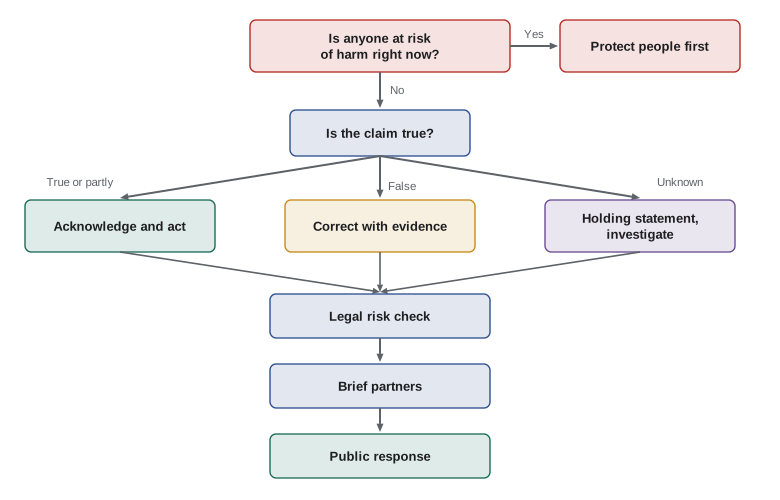
A decision tree guides the team through key choices in a consistent order. It does not replace judgment, but it reduces the chance of skipping an important question.
- Is anyone at risk of harm right now? If yes, address safety first: contact affected people, remove dangerous content, involve authorities if needed.
- Is the core claim true, partly true, false or unknown?
- If true or partly true: acknowledge, apologize where appropriate and explain what you will do.
- If false: correct calmly with evidence; consider legal advice if the claim is seriously damaging.
- If unknown: issue a holding statement and investigate.
- Are there legal risks, such as defamation, privacy, contracts or regulatory issues? If yes, get legal advice before making detailed statements.
- Who needs to hear from you directly before a public statement?
Who speaks, and where
Consistency matters. Decide in advance who speaks publicly for the business. Usually the creator should speak personally for anything involving their own conduct, because statements from a manager or a company account can seem evasive. For operational issues, such as a product delay or an account hack, a business account or team member may be appropriate.
Choose the channel thoughtfully. A pinned post or community post reaches core followers; a video allows tone and sincerity to come through but can attract more attention; a written statement is precise and easy to quote accurately. Many creators use a written statement first and a video later if needed. Avoid posting different versions on different platforms, which invites comparison and confusion.
Legal review
Some statements carry legal risk. Admitting fault can affect insurance or contract positions; describing other people's conduct can raise defamation concerns; discussing private information can raise privacy issues. Legal review does not mean letting lawyers write in legal language, which audiences often see as cold and evasive. It means checking a sincere statement for legal problems before it goes out. Lesson 10 covers when to involve a lawyer.
Testing and maintaining the plan
A plan that sits in a folder is less useful than one the team has practised. Run a short tabletop exercise once or twice a year: describe a realistic scenario, walk through the plan step by step, and note what was unclear or missing. Update contact details whenever the team changes, refresh holding statement templates, and review the plan after every real incident.
Holding statement templates
Templates save time and prevent emotional wording. Each template should leave space for specifics and be adapted to the situation, never posted word for word.
| Scenario | Template opening |
|---|---|
| Concerns about old content | I've seen the clips from my [year] streams that people are sharing. I'm reviewing them now and will share a fuller response by [day]. |
| Product problem | We've received reports about [issue] with [product]. Please stop using it while we investigate. We'll update you by [day], and refunds are available at [link]. |
| Allegation about conduct | I'm aware of the allegations posted today. I take them seriously and need a little time to respond properly. I'll say more by [day]. |
| Hacked account | My [platform] account was compromised. Please don't click links or join giveaways posted there. I'm working with the platform to recover it. |
Protecting the people involved
Crisis plans often focus on reputation and forget people. If a crisis involves someone who was harmed, such as a fan, collaborator or team member, the plan should include contacting them privately, offering support, respecting their privacy and wishes, and never revealing their identity or private information without consent. If the crisis involves the creator's own safety, such as threats or doxxing, safety measures and reporting to police take priority over public statements.
The creator's wellbeing is part of the plan too. Being at the centre of a crisis can cause sleeplessness, anxiety and panic, which in turn lead to poor decisions. The wellbeing role checks in, encourages breaks, keeps the creator away from reading every comment, and connects them with professional support if needed. Crisis lines are available in both countries: 9-8-8 in Canada and 988 in the United States.
Worked problem
Staffing a crisis rota
A Level 3 crisis is expected to need active monitoring 16 hours a day for five days. Each team member should work no more than 8 hours a day on monitoring to avoid burnout. How many person-days of monitoring are needed, and how many people are needed each day?
Show solution
- Monitoring hours: 16 × 5 = 80 hours.
- Person-days at 8 hours each: 80 ÷ 8 = 10 person-days.
- People per day: 16 ÷ 8 = 2.
Answer: Ten person-days, with two people each day covering 8-hour shifts. A small team may need to bring in a trusted contractor or volunteer moderator, which is easier if the plan names backups in advance.
After the crisis, record what each role did and how long tasks took. This information makes the next plan more realistic.
Keeping the plan accessible
A crisis plan is only useful if the team can find it quickly, including when someone is travelling or a laptop is unavailable. Store it somewhere every team member can reach from a phone, keep a printed copy of the contact list, and make sure it does not depend on access to an account that could be compromised in the crisis itself, such as the channel's main email. Review who has access when the team changes. A plan that lives in one person's private folder can disappear at exactly the wrong moment.
Common mistakes
MistakeDeciding roles in the middle of a crisis.
InsteadAssign roles, backups and contact details in a written plan before anything happens.
MistakePosting an emotional statement within minutes.
InsteadConvene the team, establish facts and use a holding statement if needed.
MistakeLetting sponsors learn about a crisis from social media.
InsteadBrief key partners before or alongside public statements.
MistakeHaving a manager speak for the creator's personal conduct.
InsteadThe creator should usually speak personally for their own actions.
MistakeNever practising the plan.
InsteadRun tabletop exercises and update the plan after real incidents.
Summary and key terms
- A crisis response plan sets out the team, roles, decisions, first-hour steps and communications in advance.
- Core roles include decision-maker, coordinator, fact-finder, communications, partner liaison, community, legal and wellbeing support.
- The first hours focus on pausing posts, establishing facts, assessing severity and briefing partners.
- Holding statements acknowledge an issue honestly while facts are established, without denying or attacking.
- Response time targets by escalation level keep the team fast without rushing careful decisions.
- Decision trees put safety first, then truth of the claim, legal risk and who needs to hear first.
- Plans should be tested with tabletop exercises and updated after incidents and team changes.
- Crisis response plan
- A document setting out the team, roles, decisions and communications for a crisis.
- Response team
- The people who manage a crisis, each with defined roles.
- Decision-maker
- The person with final authority over crisis statements and actions.
- Partner liaison
- The person who communicates with sponsors, agencies and platforms during a crisis.
- Holding statement
- A short interim message acknowledging an issue while facts are established.
- Response time target
- A pre-agreed deadline for actions at a given escalation level.
- Decision tree
- A structured sequence of questions guiding crisis decisions.
- Tabletop exercise
- A practice session walking through a realistic crisis scenario using the plan.
- Template
- A pre-written statement that can be adapted quickly to a specific situation.
- Legal review
- Checking statements for legal risks before they are published.
Practice problems
Work each problem on paper first, then reveal the answer to check.
Name five roles in a crisis response team.
Show answer
Decision-maker, coordinator, fact-finder, communications lead and partner liaison.
What should happen to scheduled posts in a crisis?
Show answer
Pause them, especially sponsored or light-hearted content.
Give one thing a holding statement should never do.
Show answer
Deny something unchecked, attack critics or make promises you cannot keep.
Issue detected at 3:15 p.m.; team convened at 4:05 p.m. Within a 1-hour target?
Show answer
Yes, 50 minutes.
What is the first question in the decision tree?
Show answer
Is anyone at risk of harm right now?
Who should usually speak about the creator's own conduct?
Show answer
The creator personally.
Why should internal crisis messages stay factual?
Show answer
They can become public or be requested in legal proceedings.
What is a tabletop exercise?
Show answer
A practice walk-through of a realistic crisis scenario using the plan.
When might a holding statement be unwise?
Show answer
When an issue is small and fading, or facts are already clear.
Why avoid different statements on different platforms?
Show answer
It invites comparison and confusion.
Lesson quiz · 5 questions
Score 60% or more to complete this lesson.
Create a free account to save your progress, take quizzes and earn a certificate.