
CRE-420 · Lesson 7 of 12 · 29 min
Personal finance and investing
Personal finance content helps people budget, save, pay down debt, buy homes, plan for retirement, file taxes and invest. It has some of the highest ad rates and sponsorship fees of any niche, because banks, brokerages, credit card issuers, insurers and fintech apps pay well to reach people making financial decisions. That same value makes it one of the most regulated niches. Content that recommends specific investments can amount to giving investment advice, which in both Canada and the United States is a registered activity. Paid promotion of securities and crypto assets carries strict disclosure rules, and pump-and-dump schemes are illegal. This lesson explains where the lines are for creators, often called finfluencers.
Personal finance versus investment advice
Most personal finance content is general education: how compound interest works, how to build a budget, the difference between a registered account and a taxable account, how credit scores work, or what an index fund is. This kind of content is generally not regulated as investment advice, although it must still be accurate and its sponsorships disclosed. The risk rises as content moves from general education towards recommending specific securities, telling viewers when to buy or sell, or tailoring advice to individuals.
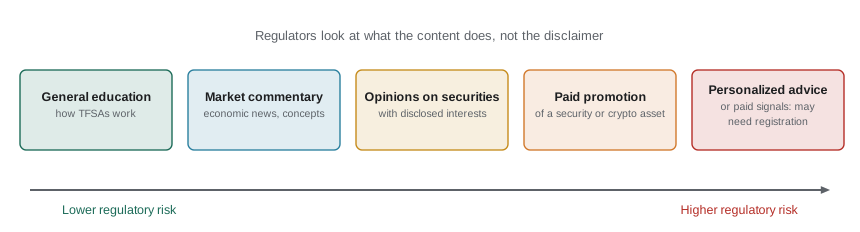
A disclaimer such as this is not financial advice does not change what the content actually does. Regulators look at the substance: whether you recommend specific investments, whether you do it regularly, whether you are paid or expect to benefit, and whether viewers are likely to act on it. A creator who posts daily buy and sell calls on penny stocks with a not-financial-advice line at the end is still giving recommendations.
Securities regulators and finfluencers in Canada
Securities in Canada are regulated by provincial and territorial securities commissions, which coordinate through the Canadian Securities Administrators (CSA), and by the Canadian Investment Regulatory Organization (CIRO), which oversees investment dealers and mutual fund dealers. In December 2025 the CSA and CIRO published Joint Staff Notice 31-369, which explains how securities law applies to finfluencers. Its key points are that anyone in the business of advising on or trading securities must register unless an exemption applies; that advising includes recommending investments or giving opinions that could reasonably be seen as encouraging an investment, including promotional content; that a not-financial-advice disclaimer does not avoid registration by itself; and that the principles apply whatever the platform and even to AI-generated content and avatars.
The notice explains that factual information about markets or basic investing concepts is typically not advice. Creators who give general opinions not tailored to individuals may rely on the general advice exemption in some situations, but only if they clearly disclose any financial or other interest in the securities they discuss. Paid promotion must be clearly and conspicuously disclosed, including who is paying, what security is involved and the nature of the compensation. Disclosures buried at the end of a post or hidden behind extra clicks are not enough. Firms and issuers that use finfluencers are expected to have written agreements, training, oversight and monitoring.
Misrepresentation, manipulation and pump and dump
Whether or not a creator needs to register, securities laws prohibit misrepresentations and market manipulation. A pump and dump is a scheme in which promoters buy a thinly traded stock or crypto asset, hype it to their audience to drive the price up, and then sell at the higher price, leaving followers with losses. Creators have been charged in both countries for coordinating such schemes on social media. Even without a deliberate scheme, promoting a security you own without disclosure and selling into your audience's buying can raise serious legal and ethical problems.
Provincial securities acts prohibit misrepresentations about securities and conduct that results in an artificial price or a misleading appearance of trading. Securities commissions can impose penalties, order disgorgement of profits and ban people from participating in markets, and courts can impose criminal penalties under the Criminal Code for fraud and market manipulation.
Worked problem
Seeing how a pump and dump hurts followers
A promoter buys 100,000 shares of a small company at $0.20, then hypes it to followers. The price rises to $0.50 as followers buy, and the promoter sells all shares. The price then falls to $0.15. A follower bought 2,000 shares at $0.45. Calculate the promoter's profit and the follower's loss.
Show solution
- Promoter cost: 100,000 × $0.20 = $20,000; sale: 100,000 × $0.50 = $50,000; profit = $30,000.
- Follower cost: 2,000 × $0.45 = $900; value after the fall: 2,000 × $0.15 = $300.
- Follower loss: $900 − $300 = $600, or 67 %.
Answer: The promoter profits $30,000 while the follower loses $600, two thirds of their money. Multiplied across thousands of followers, this is why regulators treat these schemes as serious fraud.
Crypto assets
Crypto content is popular and particularly risky. Many crypto assets have collapsed, platforms have failed, and regulators in both countries have taken enforcement action against unregistered platforms and promoters. The legal status of specific crypto assets has been contested, and rules have changed quickly.
In Canada, crypto trading platforms must register with securities regulators, and the CSA has set rules for platforms, including restrictions on certain products and limits on how much non-accredited investors can buy of crypto assets other than major ones. Promoting unregistered platforms to Canadians, or promoting crypto assets that are securities without proper disclosure, can breach securities law, and the finfluencer principles in Staff Notice 31-369 apply to crypto content.
For creators, the practical rules are simple: disclose any holdings and payments clearly and up front, never promise returns, explain risks honestly, avoid promoting new tokens or platforms you cannot verify, and be very wary of offers to promote projects in exchange for tokens. Payment in tokens is still compensation that must be disclosed.
Affiliate programs for financial products
Credit cards, bank accounts, brokerages, robo-advisers, budgeting apps and insurance all offer generous affiliate programs. A single credit card or brokerage signup can pay tens or even hundreds of dollars. These are legitimate when disclosed and when the product suits the audience, but they create strong incentives to recommend whatever pays most. Financial products also carry regulatory rules about how they are advertised, such as required disclosures of interest rates and fees.
| Product | Illustrative affiliate payment | Key consideration |
|---|---|---|
| Credit card | $50–$200 per approved application | Interest rates and fees; suitability for viewers with debt |
| Brokerage or robo-adviser | $25–$100 per funded account | Fees; whether the promotion counts as advice |
| Budgeting app | $5–$20 per signup or trial | Data privacy |
| Bank account | $25–$75 per account | Fees and conditions |
| Insurance quote service | $10–$50 per lead | Licensing rules for insurance advice |
Worked problem
Weighing an affiliate offer
A credit card pays a creator $150 per approved application. Another card that the creator believes is better for viewers carrying balances pays $40. If 30 viewers would be approved for either, what is the difference in earnings, and how should the creator decide?
Show solution
- Card A: 30 × $150 = $4,500.
- Card B: 30 × $40 = $1,200.
- Difference: $4,500 − $1,200 = $3,300.
Answer: Card A earns $3,300 more. The creator should still recommend the card that best suits viewers' needs, disclose all affiliate relationships, and explain how they choose products. Recommending the higher-paying card when it is worse for viewers damages trust and can be deceptive.
Taxes, registered accounts and country-specific content
Personal finance advice is highly country-specific. Canadian viewers use TFSAs, RRSPs, FHSAs and RESPs, while American viewers use 401(k)s, IRAs, Roth IRAs, HSAs and 529 plans. Tax brackets, contribution limits, government benefits and housing rules differ, and figures change every year. Content made for one country can mislead viewers in the other. Creators should state which country their content applies to, date their figures, update or pin corrections when limits change, and avoid presenting tax strategies as suitable for everyone.
Some activities need a licence regardless of how they are presented. Giving personalized tax advice may be restricted to certain professionals in some situations, and selling or advising on insurance requires a provincial or state insurance licence. Creators who are licensed professionals, such as certified financial planners or accountants, must follow their professional body's rules, which often include standards on advertising, conflicts of interest and testimonials.
Disclosure that works
Securities regulators, the Competition Bureau and the FTC all agree that disclosures must be clear, prominent and close to the claim. In finance, good disclosure states what you own, who paid you, how much or what kind of compensation, and any affiliate relationships, at the start of the content and in the description. A creator who says I own shares in this company and I am not being paid to discuss it, or this video is sponsored by a brokerage, and I earn a fee if you open an account, gives viewers what they need to judge the content.
Disclaimers that do not work include a not financial advice line used to cover specific recommendations, disclosures only in a linked website, disclosures that come after the pitch, and vague statements like I may have positions. The safest approach for creators who want to discuss specific investments is to stay general, disclose everything, avoid trading calls and time-sensitive buy or sell signals, and get legal advice before offering paid signal groups, model portfolios or personalized guidance.
Building a finance channel responsibly
Successful finance creators often focus on education that does not depend on specific product picks: how to build an emergency fund, how interest and fees work, how to compare accounts, how to read a pay stub or how to think about risk. This content is evergreen, broadly useful and lower risk. When creators discuss investing, explaining principles such as diversification, fees and time horizon serves viewers better than tips on individual stocks.
Worked problem
Showing the effect of fees
Two funds earn the same 6 % return before fees on a $10,000 investment over one year. One charges a 0.25 % annual fee and the other 2 %. How much does each investor have after one year?
Show solution
- Low-fee fund: 6 % − 0.25 % = 5.75 % net; $10,000 × 1.0575 = $10,575.
- High-fee fund: 6 % − 2 % = 4 % net; $10,000 × 1.04 = $10,400.
- Difference after one year: $175.
Answer: The low-fee investor has $175 more after one year, and the gap grows each year as returns compound. Explaining fees in this way is useful, general education that does not recommend a specific security.
Finance creators should also be honest about their own experience and results. Showing only winning trades or presenting a short period of gains as a strategy creates a false impression. Sharing losses, uncertainty and the role of luck helps viewers understand that investing involves risk.
Finally, finance creators should remember that their audiences include people under stress, such as those in debt or facing job loss. Content that respects that reality, avoids shaming and points to free help, such as non-profit credit counselling, serves viewers well.
Common mistakes
MistakeRelying on a not-financial-advice disclaimer while giving specific buy and sell calls.
InsteadRecognize that regulators look at substance; stay general or seek registration advice.
MistakePromoting a stock or token without disclosing payment or holdings.
InsteadDisclose compensation, its source and your holdings clearly and up front.
MistakeRecommending the highest-paying affiliate product.
InsteadRecommend products that suit viewers and explain how you choose them.
MistakeMixing Canadian and US account and tax rules.
InsteadState the country, date figures and update content when limits change.
MistakeJoining paid promotion groups for small-cap stocks or new tokens.
InsteadAvoid schemes that look like pump and dumps and verify any project before discussing it.
Summary and key terms
- General financial education is lower risk; specific recommendations and paid promotion are regulated.
- Disclaimers do not change the substance of content that recommends investments.
- Canadian finfluencers are guided by CSA and CIRO Staff Notice 31-369 on registration and disclosure.
- US finfluencers must follow Section 17(b) disclosure, adviser registration rules and FINRA rules for firms.
- Pump and dumps and misrepresentations are illegal and harm followers.
- Crypto content needs particular caution, clear disclosure and honest risk explanations.
- Finance affiliates are lucrative but must be disclosed and suited to viewers' needs.
- Finfluencer
- A social media creator who shares financial or investment content.
- Investment advice
- Recommendations or opinions about buying or selling securities.
- Registration
- Becoming licensed with a securities regulator to advise on or trade securities.
- CSA
- The Canadian Securities Administrators, the umbrella group of provincial securities regulators.
- CIRO
- The Canadian Investment Regulatory Organization, which oversees dealers.
- Section 17(b)
- A US Securities Act provision requiring paid promoters to disclose compensation.
- FINRA
- The Financial Industry Regulatory Authority, which oversees US broker-dealers.
- Pump and dump
- A scheme that hypes an asset to raise its price so promoters can sell.
- General advice exemption
- A Canadian exemption for non-tailored advice with clear disclosure of interests.
- Crypto asset
- A digital asset recorded on a blockchain, such as a token or coin.
Practice problems
Work each problem on paper first, then reveal the answer to check.
Why doesn't a disclaimer protect a creator who gives trading calls?
Show answer
Regulators look at what the content does, not the label.
What did Staff Notice 31-369 address?
Show answer
How Canadian securities law applies to finfluencers.
What must a US paid promoter of a security disclose under Section 17(b)?
Show answer
The nature, source and amount of compensation.
A promoter buys 50,000 shares at $0.10 and sells at $0.30. Profit?
Show answer
$10,000.
A follower buys 1,000 shares at $0.40 that fall to $0.10. Loss?
Show answer
$300, or 75 %.
Is payment in tokens compensation that must be disclosed?
Show answer
Yes.
20 approved applications at $120 each earn what?
Show answer
$2,400.
Name two Canadian and two US registered account types.
Show answer
TFSA, RRSP; 401(k), Roth IRA (also FHSA, RESP, IRA, HSA, 529).
Where should financial disclosures appear?
Show answer
At the start of the content, near claims and in the description.
What kind of finance content is generally lower risk?
Show answer
General education about concepts, not specific recommendations.
Lesson quiz · 5 questions
Score 60% or more to complete this lesson.
Create a free account to save your progress, take quizzes and earn a certificate.