
CRE-420 · Lesson 6 of 12 · 27 min
Health and medical creators
Health content is one of the fastest-growing and most consequential niches. Physicians, nurses, pharmacists, dietitians, psychologists, physiotherapists and other professionals now explain conditions, debunk myths and share what their work is like. Patients and caregivers share lived experience of illness and disability. Health journalists and science communicators translate research. Done well, this content improves health literacy and reaches people who struggle to get reliable information elsewhere. Done badly, it spreads misinformation, breaches patient privacy, crosses professional rules or exploits fear. This lesson covers the responsibilities that come with health content, especially for regulated professionals.
Who makes health content
Health creators fall into three broad groups, each with different responsibilities. Regulated health professionals must follow the rules of the body that licenses them, wherever they publish. People with lived experience bring authenticity and community but must avoid presenting personal experience as general medical advice. Communicators, journalists and enthusiasts without clinical training need to be careful about accuracy, sources and the limits of their knowledge.
- Regulated professionals: bound by professional codes, advertising rules and privacy duties.
- Lived-experience creators: share personal stories of illness, disability or caregiving.
- Science and health communicators: explain research and public health without clinical practice.
Audiences often cannot tell these groups apart, so all health creators should be clear about who they are, what qualifies them, and where their knowledge ends. A short statement in a channel description and in videos, such as I am a registered nurse in Ontario, but this video is general information and not medical advice for your situation, helps viewers interpret content correctly.
Professional regulation follows you online
For regulated professionals, social media is not a private hobby that sits outside their professional obligations. Regulators expect members to follow their codes of conduct, advertising rules and privacy requirements in all public communication. Breaches can lead to complaints, investigations and discipline, even when content was meant as entertainment.
In Canada, health professions are regulated provincially by colleges, such as the College of Physicians and Surgeons of Ontario, the College of Nurses of Ontario, provincial pharmacy colleges and colleges of dietitians, under laws such as Ontario's Regulated Health Professions Act. Many colleges have social media guidance and advertising standards. Common rules include not using testimonials from patients in advertising, not making claims of superiority over other practitioners, not making unverifiable statements, and avoiding conflicts of interest such as promoting products you sell to patients. Some colleges restrict endorsing products altogether. Rules differ by profession and province, so check your own college's standards.
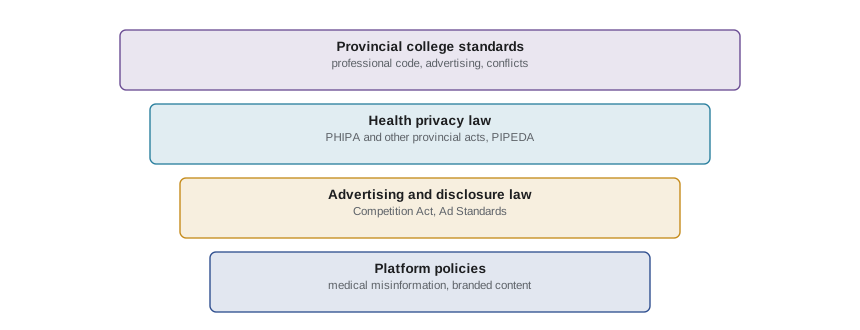
Endorsements by health professionals deserve extra care because viewers trust them more. If a pharmacist promotes a supplement or a physician promotes a telehealth service, their professional authority makes the endorsement more persuasive and the conflict of interest more serious. Disclosure is required but may not be enough: professional rules can prohibit some endorsements entirely, and promoting products you also recommend or sell to patients raises additional concerns.
Patient privacy
Patient stories are compelling, but sharing them can breach privacy law and professional duties even if names are removed. A combination of details, such as the date, location, condition, age and an unusual event, can identify a patient to people who know them. Filming in clinical settings can capture patients, charts or screens in the background. Some health workers have been disciplined or lost their jobs over videos mocking patients or describing cases in identifiable ways.
In Canada, health information privacy is governed by provincial laws such as Ontario's Personal Health Information Protection Act (PHIPA), Alberta's Health Information Act and similar laws in other provinces, along with federal and provincial private-sector privacy laws such as PIPEDA. These laws restrict how health information custodians and their agents use and disclose personal health information. Professional colleges also treat breaches of confidentiality as professional misconduct.
Safe practices include never sharing information about identifiable patients without explicit written consent; changing or combining details only when you are confident no one could recognize the patient; never filming in clinical areas without permission from your employer and any people captured; avoiding content that mocks patients; and following your employer's social media policy. When in doubt, tell a general educational story rather than a real case.
Accuracy, evidence and misinformation
Health misinformation can cause real harm, from people avoiding effective treatments to trying dangerous ones. Platforms have adopted medical misinformation policies that remove or restrict content contradicting health authority guidance on certain topics, such as vaccines and specific treatments, and that label authoritative sources. YouTube, for example, labels and prioritizes content from accredited health sources it has verified.
Good health creators show their sources, describe the strength of evidence, distinguish between established consensus and emerging research, and explain uncertainty honestly. A single small study is not proof; observational studies show associations, not causes; animal and laboratory studies may not apply to people. When guidance changes, explain why. Correct mistakes visibly. These habits make content more trustworthy and more resilient to criticism.
| Evidence type | What it can show | Limits |
|---|---|---|
| Systematic review or meta-analysis of trials | Overall effect across many studies | Quality depends on included studies |
| Randomized controlled trial | Whether an intervention causes an effect | May be small, short or in narrow groups |
| Observational study | Associations in real populations | Cannot prove cause; confounding |
| Case report or case series | Unusual events and hypotheses | No comparison group |
| Laboratory or animal study | Possible mechanisms | May not apply to people |
| Expert opinion or personal experience | Context and lived reality | Not evidence of general effects |
Worked problem
Interpreting a relative risk headline
A headline says a food doubles the risk of a rare condition. The baseline risk is 2 in 10,000 people, and the study found a relative risk of 2. What is the absolute risk increase?
Show solution
- Baseline risk: 2 ÷ 10,000 = 0.02 %.
- Risk with the food: 2 × 0.02 % = 0.04 %.
- Absolute increase: 0.04 % − 0.02 % = 0.02 %, or 2 extra cases per 10,000 people.
Answer: Doubling sounds alarming, but the absolute increase is 2 extra cases per 10,000 people. Explaining both relative and absolute risk helps viewers understand health news without fear or false reassurance.
Mental health and safe messaging
Mental health content needs particular care. Talking openly about mental health reduces stigma, but content about suicide, self-harm and eating disorders can harm vulnerable viewers if handled badly. Safe messaging guidelines recommend not describing methods, not presenting suicide as a solution or as inevitable, emphasizing that help is available and recovery is possible, using non-judgmental language such as died by suicide, and including crisis resources.
For Canadian audiences, include 9-8-8, the Suicide Crisis Helpline, available by phone or text, and local emergency services at 911 for immediate danger.
Creators without clinical training should not diagnose viewers or give treatment advice in comments or direct messages. When viewers disclose distress, respond with empathy, encourage them to contact professional services or crisis lines, and avoid becoming a substitute for care. Professionals who create mental health content should follow their regulators' rules on dual relationships and avoid providing therapy through social media.
Health products, telehealth and sponsorships
Sponsors in the health niche include telehealth services, pharmacies, health apps, medical devices, supplements and insurance. Each brings specific rules. Prescription drug advertising to the public is restricted in Canada, where the Food and Drug Regulations allow only limited reminder or price advertising for prescription drugs. In the United States, prescription drug promotion, including by paid influencers, must meet FDA requirements for fair balance and risk information, and the FDA has sent warning letters over influencer posts that omitted risks.
Medical devices, such as fitness trackers that claim to detect health conditions, also have regulatory boundaries. Claims that a device diagnoses or monitors a disease may need regulatory authorization. Health apps that collect sensitive data raise privacy issues, and in the United States the FTC's Health Breach Notification Rule applies to many health apps not covered by HIPAA. Before taking a health sponsorship, ask what claims are authorized, what risks must be stated, and what data the product collects.
Worked problem
Weighing a telehealth sponsorship
A physician creator is offered $4,000 to promote a telehealth weight-loss service. Their college's rules prohibit endorsing services where they have a financial interest that could influence patient care, and the script describes a prescription medication without risk information. List the issues.
Show solution
- Conflict of interest: payment from a service the physician's audience may use for medical care.
- Professional rules: the college may prohibit or restrict such endorsements.
- Prescription drug promotion rules: restricted in Canada and requiring risk information in the US.
- Disclosure: required, but not sufficient if the endorsement itself breaches rules.
Answer: The offer raises serious professional and regulatory issues. The physician should decline or seek advice from their regulator or legal counsel before considering any version of it.
Lived-experience creators
Creators who share their own experience of chronic illness, disability, mental health or caregiving build supportive communities and reduce isolation. They can be powerful advocates. They should still frame personal experience as personal, avoid recommending treatments as if they work for everyone, be cautious with sponsors that target vulnerable audiences, and protect their own privacy and wellbeing. Communities of people with serious conditions are often targeted by unproven treatments, and creators can help protect them by being skeptical of products that promise cures.
Handling comments and questions
Health creators receive a steady stream of personal questions in comments and messages: should I stop this medication, is this rash serious, what dose should I take. Answering them individually can create professional relationships, breach scope of practice and lead to harm if the answer is wrong for that person. A consistent approach protects both viewers and creators.
- Pin a comment explaining that you cannot give individual medical advice and suggesting where to get help.
- Answer general questions in future videos, framed for a broad audience.
- Direct urgent symptoms to emergency services and crisis concerns to crisis lines.
- Remove comments that spread dangerous misinformation, and explain your moderation policy.
Moderation also protects viewers from each other. Health communities attract people selling unproven cures or sharing harmful advice in comments. Creators can set rules against selling and against promoting treatments, use keyword filters, and appoint trusted moderators.
Sources and citations
Showing sources is one of the simplest ways to build trust. Health creators can list studies, clinical guidelines and public health sources in descriptions, show key figures on screen, and explain why they chose particular sources. Linking to guidance from bodies such as Health Canada, the Public Health Agency of Canada, the US Centers for Disease Control and Prevention or professional associations helps viewers check information for themselves and signals that the creator is not inventing claims.
When a source is weak or a question is unsettled, saying so plainly is a strength. Viewers who see a creator acknowledge uncertainty, update their views when evidence changes and credit other experts are more likely to trust that creator on the topics where the evidence is strong.
Common mistakes
MistakeAssuming professional rules do not apply to personal channels.
InsteadFollow your regulator's code, advertising standards and privacy duties in all public content.
MistakeSharing patient stories with details removed but still identifiable.
InsteadGet written consent or use general, composite educational examples.
MistakePresenting a single study as proof.
InsteadDescribe the evidence type, its strength and its limits, and explain absolute risk.
MistakePromoting prescription treatments without risk information.
InsteadCheck prescription drug promotion rules and professional restrictions before any health sponsorship.
MistakeGiving clinical advice in comments or messages.
InsteadRespond with empathy and direct viewers to professionals and crisis lines.
Summary and key terms
- Health creators include regulated professionals, lived-experience creators and communicators, each with different duties.
- Professional regulators' rules apply to members' social media content wherever it is published.
- Patient privacy laws and professional duties prohibit sharing identifiable patient information without consent.
- Good health content shows sources, explains evidence strength and uses absolute as well as relative risk.
- Mental health content should follow safe messaging guidelines and include crisis resources.
- Prescription drugs, devices and health apps carry specific advertising and privacy rules.
- Lived-experience creators should frame experience as personal and protect vulnerable communities.
- Regulated health professional
- A practitioner licensed by a regulatory body, such as a college or state board.
- College
- In Canada, the provincial body that regulates a health profession.
- State board
- In the United States, the body that licenses a profession in a state.
- PHIPA
- Ontario's Personal Health Information Protection Act.
- HIPAA
- The US Health Insurance Portability and Accountability Act, including its Privacy Rule.
- Medical misinformation
- False or misleading health information that contradicts established evidence.
- Relative risk
- The ratio of risk in one group to risk in another.
- Absolute risk
- The actual probability of an outcome in a group.
- Safe messaging
- Guidelines for discussing suicide and self-harm in ways that reduce harm.
- Conflict of interest
- A situation where personal gain could influence professional judgment.
Practice problems
Work each problem on paper first, then reveal the answer to check.
Name the three broad groups of health creators.
Show answer
Regulated professionals, lived-experience creators and communicators.
Why can removing a patient's name be insufficient?
Show answer
Other details can still identify them to people who know them.
Baseline risk 5 in 10,000 and relative risk 1.5. Absolute increase?
Show answer
2.5 extra cases per 10,000.
Which evidence type best shows cause and effect?
Show answer
Randomized controlled trials, ideally combined in systematic reviews.
Give one safe messaging practice for suicide.
Show answer
Do not describe methods; include crisis resources; say help is available.
What crisis number serves Canada?
Show answer
9-8-8.
What crisis number serves the United States?
Show answer
988.
Why are professional endorsements more sensitive?
Show answer
Viewers trust professionals more, increasing influence and conflicts.
What must US prescription drug promotion include?
Show answer
Fair balance including risk information.
How should a creator respond to a viewer disclosing distress?
Show answer
With empathy, directing them to professional help and crisis lines.
Lesson quiz · 5 questions
Score 60% or more to complete this lesson.
Create a free account to save your progress, take quizzes and earn a certificate.