
CRE-420 · Lesson 11 of 12 · 28 min
Education, B2B and expertise-based creators
Expertise-based creators build audiences around knowledge and skills: teachers and tutors, software developers, engineers, designers, marketers, lawyers, accountants, tradespeople, researchers and business owners. Their content includes tutorials, explainers, career advice, industry analysis and professional commentary on platforms such as YouTube, LinkedIn, newsletters, podcasts and online course sites. This niche often earns less from ads than entertainment but more from courses, consulting, speaking, sponsorships from business software and recruiting, and the careers and clients that visibility brings. It also brings questions about credentials, professional rules, liability and accuracy. This lesson covers how expertise-based creators build authority and business, and the responsibilities that come with being trusted for knowledge.
Formats and platforms
Educational creators teach skills step by step, explain concepts, solve problems on screen, review tools and share how they work. Business-to-business, or B2B, creators speak to professionals in an industry, offering analysis, opinions, case studies and career advice. Platforms differ: YouTube suits long tutorials and courses, LinkedIn suits professional commentary and networking, newsletters suit in-depth analysis with a direct audience relationship, podcasts suit interviews and industry conversations, and course platforms suit structured paid learning.
| Platform | Strength for expertise creators | Main revenue |
|---|---|---|
| YouTube | Search-driven tutorials and courses | Ads, sponsorships, course sales |
| Professional reach and credibility | Clients, jobs, speaking, B2B sponsorships | |
| Newsletter | Owned audience and depth | Subscriptions, sponsorships |
| Podcast | Long conversations and guests | Sponsorships, consulting leads |
| Course platform or own site | Structured paid learning | Course sales, cohorts, memberships |
B2B audiences are often small but valuable. A newsletter with 5,000 engaged procurement managers or a channel with 20,000 data engineers can earn more from sponsorships, consulting and courses than a general channel with ten times the audience, because the sponsors and clients are buying expensive products and services.
Worked problem
Valuing a B2B audience
A newsletter for cybersecurity managers has 6,000 subscribers with a 50 % open rate. A software sponsor pays a CPM of $80 per thousand opens per issue, and the newsletter sends four issues a month. The creator also lands one consulting client a month from the newsletter at $3,000. Estimate monthly revenue.
Show solution
- Opens per issue: 6,000 × 50 % = 3,000.
- Sponsorship per issue: 3,000 ÷ 1,000 × $80 = $240. Monthly: 4 × $240 = $960.
- Consulting: $3,000.
- Total: $960 + $3,000 = $3,960 a month.
Answer: About $3,960 a month from only 6,000 subscribers. In B2B niches, the indirect value of trust, such as consulting and clients, often exceeds direct sponsorship revenue.
Building authority honestly
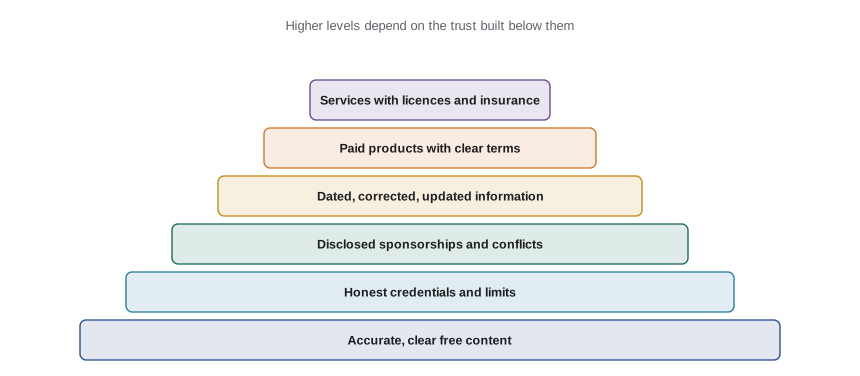
Authority comes from demonstrated knowledge: clear explanations, useful examples, accurate information, honest acknowledgment of limits and a track record of good advice. Credentials help but are not the only source. A self-taught developer who ships real projects and explains them well can be as credible as someone with a degree. What matters is that creators represent their background accurately.
Misrepresenting credentials is both unethical and, in many cases, illegal. Many professional titles are protected by law. In Canada, provincial laws protect titles such as engineer, professional engineer, chartered professional accountant, lawyer, notary, architect, registered nurse and physician, and using them without a licence can lead to prosecution. In the United States, states license and protect titles such as professional engineer, certified public accountant, attorney, architect and many health professions. Calling yourself an engineer in a channel name without being licensed, for example, can breach the law in some provinces and states even if you work in technology.
In Canada, engineering regulators such as Professional Engineers Ontario and Engineers and Geoscientists BC have taken action against unlicensed use of the title engineer, including in job titles in technology. Chartered Professional Accountants are regulated provincially, and lawyers and Quebec notaries by provincial law societies and the Chambre des notaires. Before using a title in your channel name, bio or content, check whether it is protected where you live and work.
Professional rules for licensed creators
Licensed professionals who create content must follow their profession's rules. Lawyers have rules on advertising, client confidentiality, conflicts of interest, and avoiding giving legal advice to people who are not clients. Accountants have rules on independence and advertising. Engineers have duties to public safety and codes of ethics that apply to public statements. Teachers may be bound by school board or district policies on social media and on conduct involving students.
- Do not create a professional relationship accidentally: avoid giving specific advice to individuals in comments or messages.
- Protect confidentiality: never share client, patient or student information without consent.
- Follow advertising rules: avoid testimonials, guarantees or superiority claims if your profession restricts them.
- Manage conflicts: disclose sponsorships and avoid promoting products that conflict with your professional duties.
- Use clear disclaimers: general information, not advice for your situation, and the jurisdiction your knowledge applies to.
Disclaimers help viewers understand the nature of content but, as with finance content, they do not override what the content actually does. A lawyer who tells a specific commenter exactly what to do in their dispute may have created a lawyer-client relationship regardless of a disclaimer in the channel description.
Liability for advice and information
Educational content can cause losses if it is wrong. A tutorial that teaches insecure code, a tax explainer with outdated figures or a construction how-to that ignores code requirements could lead viewers to suffer financial loss or injury. Courts have generally been reluctant to hold publishers of general information liable to the public at large, but liability is more likely where a creator gives specific advice to identifiable people who rely on it, sells paid courses or consulting, or holds themselves out as an expert in a regulated field.
Practical risk management includes keeping content accurate and up to date, dating content that depends on changing rules, correcting mistakes visibly, adding safety warnings to how-to content involving electricity, structural work, gas, chemicals or heights, recommending licensed professionals where the law requires them, and using clear terms for paid courses and consulting. Professional liability insurance, sometimes called errors and omissions insurance, is worth considering for creators who sell advice-based products or services.
Selling courses and education products
Courses, cohorts, workshops, templates and memberships are major revenue sources in this niche. CRE-302 covered digital product economics. In the education niche specifically, buyers expect results, so honest marketing matters. Claims about outcomes, such as get a six-figure job in 90 days, double your income or pass the exam guaranteed, are performance claims that need evidence, and income claims attract regulators' attention.
In Canada, the Competition Act prohibits false or misleading representations, including about earnings potential and testimonials, and requires adequate and proper testing for performance claims. Provinces regulate private career colleges and vocational training; for example, Ontario's Career Colleges Act, 2005 governs certain vocational programs, so creators offering formal job training with promised credentials should check whether rules apply. Consumer protection laws in each province, including Quebec's, set rules for online contracts, cancellations and refunds.
Worked problem
Testing an earnings claim
A course creator wants to advertise that students earn $5,000 a month after the course. Of 400 students surveyed, 20 report earning $5,000 or more a month, 60 report earning something less, and the rest report no earnings from the skill or did not respond. What share achieved the claimed result, and is the claim supportable?
Show solution
- Share earning $5,000 or more: 20 ÷ 400 = 5 %.
- Share earning anything: (20 + 60) ÷ 400 = 20 %.
- Share with no earnings or no response: 320 ÷ 400 = 80 %.
Answer: Only 5 % achieved the claimed result, so presenting $5,000 a month as typical would be misleading. An honest approach is to describe what the course teaches, share typical outcomes with evidence, and present exceptional results clearly as atypical.
Refund policies, accessibility, and accurate descriptions of course content also matter. Courses should state prerequisites, time commitment, format and what is and is not included. Accessible courses with captions, transcripts and clear structure serve more learners and meet growing accessibility expectations.
Sponsorships, conflicts and LinkedIn culture
B2B sponsors include software companies, cloud providers, recruiting platforms, training providers and industry events. These sponsorships are disclosed like any other, but conflicts of interest can be subtle. A creator who reviews software while consulting for a competitor, or recommends tools from an employer, has a conflict that viewers should know about. Employees who post about their employer's products have a material connection that platforms and regulators expect them to disclose.
Professional platforms have their own culture. LinkedIn content that exaggerates achievements, invents stories or uses engagement bait can damage credibility. Fabricated testimonials and fake case studies are deceptive. Expertise creators thrive on reputation, and their professional networks remember. Honest stories, credit to collaborators and specific, useful insight outperform hype over the long term.
Teachers and education creators
Teachers who create content face particular issues. School boards and districts often have social media policies that limit what teachers can post about students, colleagues and their workplace, and professional regulators for teachers, such as provincial colleges of teachers in some provinces and state licensing bodies, expect professional conduct online. Filming in classrooms requires permission from the school and parents. Selling lesson materials may raise questions about who owns materials created as part of employment. Teachers should check their contracts and policies before monetizing content related to their work.
Repurposing expertise across formats
Expertise creators can multiply their reach by turning one piece of thinking into several formats: a long tutorial becomes a newsletter article, a LinkedIn post, a podcast episode and short clips. Each format reaches a different part of the audience. Planning repurposing from the start, for example by recording a tutorial with clear chapters that work as stand-alone clips, saves time.
Worked problem
Estimating time saved by repurposing
Creating a tutorial from scratch takes 10 hours, a newsletter article from scratch 4 hours and a LinkedIn post 1 hour. Repurposing the tutorial into the article and post takes 1.5 hours and 0.25 hours. How much time does repurposing save?
Show solution
- From scratch: 10 + 4 + 1 = 15 hours.
- With repurposing: 10 + 1.5 + 0.25 = 11.75 hours.
- Time saved: 15 − 11.75 = 3.25 hours.
Answer: Repurposing saves about 3.25 hours per tutorial, or roughly 22 %. Over a year of weekly tutorials, that is more than 160 hours.
Repurposing should still adapt content to each platform's audience and style, and check that any disclosures, sources and dates carry over correctly. A sponsored tutorial that is clipped without its disclosure can become misleading.
Expertise creators should also review older content periodically. Tutorials for software, tax rules, codes and standards date quickly, and an outdated video that still ranks well in search can mislead many viewers. Adding a pinned note, updating the description or publishing a revised version keeps the library trustworthy and protects the creator's reputation.
Common mistakes
MistakeUsing a protected title such as engineer without a licence.
InsteadCheck whether the title is protected where you work and describe your background accurately.
MistakeGiving specific professional advice to commenters.
InsteadKeep content general and direct individuals to retain a professional.
MistakeAdvertising typical results that only a few students achieve.
InsteadBase outcome claims on evidence and present exceptional results as atypical.
MistakeHiding employment or consulting relationships when reviewing tools.
InsteadDisclose employers, clients and sponsors that create conflicts.
MistakeLeaving outdated tutorials uncorrected.
InsteadDate content, update it when rules change and correct mistakes visibly.
Summary and key terms
- Expertise-based creators earn from courses, consulting, speaking and B2B sponsorships as well as ads.
- Small, specialized B2B audiences can be highly valuable.
- Authority comes from demonstrated knowledge and honest representation of credentials.
- Many professional titles are legally protected in Canada and the United States.
- Licensed professionals must follow their profession's rules on advertising, confidentiality and conflicts.
- Accurate, dated and corrected content and appropriate insurance reduce liability risk.
- Course and earnings claims must be supported by evidence and not overstate typical outcomes.
- B2B creator
- A creator who serves professionals and businesses in an industry.
- Protected title
- A professional title that only licensed people may legally use.
- Professional regulator
- A body that licenses and disciplines members of a profession.
- Lawyer-client relationship
- A professional relationship that creates duties, which can arise from specific advice.
- Errors and omissions insurance
- Insurance covering claims of negligent advice or services.
- Earnings claim
- A statement about how much money a buyer can make.
- Typical results
- Outcomes that most buyers can generally expect.
- Open rate
- The share of newsletter recipients who open an issue.
- Conflict of interest
- A relationship that could bias a creator's recommendations.
- Business Opportunity Rule
- An FTC rule requiring disclosures for certain business opportunities.
Practice problems
Work each problem on paper first, then reveal the answer to check.
A newsletter has 10,000 subscribers, 40 % open rate and $60 CPM per opens. Revenue per issue?
Show answer
4,000 opens × $60 ÷ 1,000 = $240.
Name three professional titles protected in Canada or the US.
Show answer
Engineer, CPA, lawyer, architect, registered nurse, physician.
Why can giving advice in comments be risky for lawyers?
Show answer
It may create a lawyer-client relationship and liability.
15 of 300 students reached a claimed income. What share is that?
Show answer
5 %.
Is 5 % a typical result?
Show answer
No, it is atypical.
What should how-to content involving electricity include?
Show answer
Safety warnings and advice to use licensed professionals where required.
Why disclose consulting for a competitor when reviewing software?
Show answer
It is a conflict of interest that could bias the review.
What does errors and omissions insurance cover?
Show answer
Claims that advice or services were negligent.
Name two things a course description should state.
Show answer
Prerequisites, time commitment, format, inclusions.
Why should teachers check policies before monetizing content?
Show answer
School policies, regulators and ownership of materials may restrict it.
Lesson quiz · 5 questions
Score 60% or more to complete this lesson.
Create a free account to save your progress, take quizzes and earn a certificate.