
CRE-420 · Lesson 5 of 12 · 27 min
Fitness and wellness
Fitness and wellness content includes workouts, training programs, sports skills, yoga, mobility, nutrition, sleep, stress management and general healthy living. It attracts motivated audiences and strong sponsors, from equipment and apparel to apps, gyms and supplements. It also carries real risks. Viewers may injure themselves following unsuitable exercises, take supplements that interact with medications, or adopt extreme diets. Health claims are tightly regulated, and content about weight and body image can harm vulnerable viewers. This lesson covers how to build a fitness or wellness channel responsibly, with a focus on claims, supplements, safety and eating-disorder-safe content.
Formats and earning
Fitness creators make follow-along workouts, technique tutorials, training logs, transformation stories, gym culture content, sport-specific coaching and wellness routines. Some build communities around a particular practice such as running, powerlifting, calisthenics or yoga; others target specific groups such as new parents, older adults, people with disabilities or beginners. Coaching is a major revenue stream: many fitness creators sell programs, online coaching, apps or memberships, and sponsors include equipment, apparel, wearables, gyms, meal services and supplement brands.
| Revenue stream | Typical model | Key responsibility |
|---|---|---|
| Programs and apps | One-time or subscription purchase | Safety guidance, realistic promises, refund terms |
| Online coaching | Monthly fee per client | Scope of practice, health screening, privacy |
| Equipment and apparel sponsors | Flat fees and affiliates | Honest reviews and disclosure |
| Supplement sponsors | Flat fees, affiliates or codes | Authorized claims only; no disease claims |
| Gym or studio partnerships | Referrals or ambassador fees | Disclose relationships |
Worked problem
Pricing an online coaching program
A fitness creator plans to coach 25 clients at $120 a month. Each client needs about 1.5 hours a month of check-ins and program updates, and the creator pays $180 a month for coaching software. What is the creator's effective hourly income?
Show solution
- Revenue: 25 × $120 = $3,000 a month.
- Net of software: $3,000 − $180 = $2,820.
- Hours: 25 × 1.5 = 37.5 hours.
- Effective hourly income: $2,820 ÷ 37.5 = $75.20 an hour.
Answer: About $75 an hour before taxes and other costs. Coaching scales with time, so many creators combine it with programs or memberships that do not require one-on-one hours.
Qualifications and scope of practice
Anyone can call themselves a fitness creator, but viewers often assume expertise. Certifications from recognized organizations, such as those offered by the Canadian Society for Exercise Physiology (CSEP), the American College of Sports Medicine (ACSM), the National Strength and Conditioning Association (NSCA) and others, show training in safe exercise prescription. They are not legally required to post workouts in most places, but they improve your knowledge and credibility, and some insurers and gyms require them.
Scope of practice matters more than titles. Fitness professionals generally should not diagnose injuries, treat medical conditions or prescribe diets for diseases. Those tasks belong to regulated professionals such as physicians, physiotherapists, registered dietitians and, in some provinces and states, kinesiologists. Protected titles are regulated by law: in Canada, titles such as dietitian and physiotherapist are protected by provincial legislation, and in the United States, states license dietitians and physical therapists. Do not use a protected title unless you hold it, and refer viewers to professionals for medical questions.
Exercise safety and liability
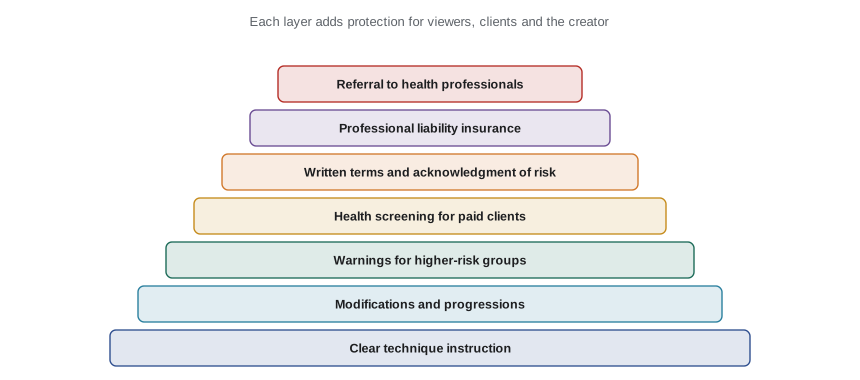
Follow-along content is used by viewers you cannot see or assess. Good practice is to offer modifications and progressions, explain correct technique and common errors, warn about exercises that are risky for certain groups, encourage viewers to stop if they feel pain, and suggest talking to a health professional before starting a new program, especially for people with health conditions, during pregnancy or after injury. These practices reduce harm and show that you took reasonable care.
For paid programs and coaching, creators often use health screening questionnaires and written terms that include an acknowledgment of risk. In Canada, many fitness professionals use the Get Active Questionnaire developed by CSEP, and in the United States the PAR-Q+ or similar tools are common. Liability waivers can help but do not protect against negligence everywhere, and enforceability varies by province and state; Quebec, for example, limits the exclusion of liability for bodily injury. Professional liability insurance is important for anyone coaching clients.
Health and fitness claims
Claims about results are the main legal risk in fitness content. Promising that a program will make viewers lose ten kilograms in a month, cure back pain, reverse diabetes or boost immunity is a health claim that needs strong evidence and may be illegal altogether. Transformation photos raise the same problems as beauty before-and-afters: dramatic results may come from factors other than the program, such as diet, dehydration, lighting, posture or drugs, and are rarely typical.
In Canada, the Competition Act prohibits false or misleading representations and requires that performance claims be based on adequate and proper testing done before the claim is made. Ad Standards' Canadian Code requires that advertising not exaggerate results. Claims that a product or program treats, prevents or cures a disease listed in Schedule A.1 of the Food and Drugs Act, such as diabetes, cancer or heart disease, are prohibited in advertising to the public unless authorized.
Safer ways to talk about results include describing your own experience as personal, giving realistic ranges based on evidence, emphasizing effort and consistency, and showing a variety of outcomes rather than only the most dramatic. Avoid disease claims entirely unless you are a qualified professional discussing evidence, and even then follow your professional rules.
Supplements: the most regulated sponsorships
Supplement sponsorships are common in fitness and wellness and among the most legally risky. Protein powders, pre-workouts, creatine, vitamins, herbal products and weight-loss aids all fall under specific regimes, and creators who repeat unsupported claims can share responsibility with the brand.
In Canada, most supplements are natural health products under the Natural Health Products Regulations. Each must have a product licence and an eight-digit natural product number (NPN) or homeopathic number (DIN-HM), and it may only be advertised with the claims Health Canada authorized for that product. Some products, such as protein powders and many sports drinks, are regulated as foods, including supplemented foods, which cannot make health claims beyond those allowed for foods. Since 2023, Health Canada has had stronger powers over natural health products, including the ability to order recalls and impose larger penalties. Creators should check a product's NPN in Health Canada's Licensed Natural Health Products Database and stick to its authorized claims.
| Claim type | Example | Generally acceptable? |
|---|---|---|
| Authorized or supported structure/function | Helps build muscle when combined with resistance training (protein) | Yes, if authorized in Canada or supported in the US |
| General wellness | A convenient source of protein | Usually |
| Performance claim | Increases strength by 20 % in four weeks | Only with strong evidence |
| Disease claim | Prevents heart disease or cures depression | No, not for supplements |
| Weight loss claim | Burns fat while you sleep | Very high risk; usually unsupported |
Worked problem
Scoring a supplement script for compliance
A sponsor script includes five claims: (1) a convenient source of 25 g of protein, (2) supports recovery after exercise, (3) clinically proven to double muscle growth, (4) boosts immunity against colds and flu, and (5) tastes great. The authorized or supported claims are 1, 2 and 5. Score the script as the share of compliant claims and identify fixes.
Show solution
- Compliant claims: 1, 2 and 5 = 3 of 5.
- Compliance score: 3 ÷ 5 = 60 %.
- Claim 3 needs strong evidence and probably overstates any study; remove or replace with an authorized claim.
- Claim 4 is a disease prevention claim that a supplement generally cannot make; remove it.
Answer: The script is 60 % compliant. Removing claims 3 and 4 brings it to 100 %. Ask the brand for its licence or substantiation before agreeing to any script.
Sports supplements also carry doping risks for athletes. Contaminated products have caused positive tests. Competitive athletes, and creators who coach them, should look for third-party tested products and check the Canadian Centre for Ethics in Sport (CCES) or the US Anti-Doping Agency (USADA) for guidance.
Weight, body image and eating-disorder-safe content
Fitness and nutrition content can harm viewers who have, or are at risk of, eating disorders. Calorie counts, before-and-after body photos, what I eat in a day videos, extreme cutting diets and language that moralizes food can all trigger unhealthy behaviour. Platforms restrict content promoting eating disorders and may limit the reach of weight-loss content to minors.
Eating-disorder-safe practices include focusing on strength, energy, skills and wellbeing rather than weight or appearance; avoiding specific low calorie numbers and extreme restriction; not labelling foods as good or bad; avoiding numbers such as body weight or measurements in titles and thumbnails; including content warnings where relevant; and pointing viewers to support resources. If a viewer discloses an eating disorder, respond with care and direct them to professional help rather than giving advice.
Canadian viewers can be directed to the National Eating Disorder Information Centre (NEDIC), which provides information and a helpline, and to provincial services. Anyone in crisis can call or text 9-8-8, the Suicide Crisis Helpline.
Wellness trends and misinformation
Wellness content often overlaps with alternative health. Detoxes, cleanses, unregulated hormone protocols, extreme fasting, unproven devices and supplements claiming to cure chronic conditions are common, and some can cause real harm. Creators should evaluate trends critically: look for good evidence, consult qualified sources, and be clear about uncertainty. Sharing personal experiences is fine when framed as personal and not as medical advice.
Medication trends require special caution. Prescription drugs such as GLP-1 weight-loss medications attract enormous interest, and some creators have promoted compounded or online versions without proper prescriptions. Prescription drug advertising to the public is restricted in Canada, and in the United States, prescription drug promotion is regulated by the FDA with specific requirements for balance and risk information. Creators should not promote prescription medications or telehealth services without understanding these rules and disclosing any relationship.
Wearables, apps and data
Fitness creators often review or promote wearables and apps that track heart rate, sleep, steps, menstrual cycles and other health data. These products collect sensitive personal information. When promoting them, creators should be honest about accuracy, which varies widely between devices and measurements, and should point viewers to the product's privacy settings. Claims that a consumer device detects or diagnoses medical conditions may require regulatory authorization, so repeat only claims the brand can show are authorized.
Creators who run their own coaching apps or collect client data, such as weights, photos, injuries or health conditions, must protect that information under privacy law, collect only what they need, store it securely and explain how it is used. A data breach involving client health information can damage trust and lead to legal consequences.
Common mistakes
MistakePromising specific weight loss or disease cures.
InsteadDescribe personal experience, give evidence-based ranges and avoid disease claims.
MistakeRepeating supplement claims from a sponsor's script without checking.
InsteadCheck the product licence or substantiation and use only authorized or supported claims.
MistakeUsing protected titles such as dietitian without the credential.
InsteadUse only titles you hold and refer medical questions to qualified professionals.
MistakePosting extreme calorie targets and body-check content.
InsteadFollow eating-disorder-safe practices and focus on strength, skill and wellbeing.
MistakeCoaching clients without screening or insurance.
InsteadUse health screening, written terms and professional liability insurance.
Summary and key terms
- Fitness creators earn from programs, coaching, equipment and apparel sponsors and supplements.
- Scope of practice and protected titles limit what non-professionals may do and claim.
- Safety guidance, modifications, screening, written terms and insurance manage risk.
- Health and results claims need strong evidence; disease claims are generally prohibited.
- Canada regulates most supplements as natural health products with authorized claims; the United States regulates them under DSHEA with FTC evidence standards.
- Eating-disorder-safe content avoids weight focus, extreme numbers and food moralizing.
- Wellness trends and prescription medications require caution and evidence.
- Scope of practice
- The activities a professional is trained and permitted to perform.
- Protected title
- A professional title that may legally be used only by licensed members.
- Health screening questionnaire
- A form identifying health risks before exercise, such as the Get Active Questionnaire or PAR-Q+.
- Liability waiver
- A document in which a participant accepts certain risks and limits claims.
- Natural health product
- In Canada, a regulated product such as a vitamin, herbal or probiotic supplement.
- NPN
- The natural product number shown on licensed natural health products in Canada.
- DSHEA
- The US Dietary Supplement Health and Education Act of 1994.
- Structure/function claim
- A claim that a product affects normal body structure or function.
- Disease claim
- A claim that a product diagnoses, treats, cures or prevents disease.
- Eating-disorder-safe content
- Content designed to avoid triggering disordered eating.
Practice problems
Work each problem on paper first, then reveal the answer to check.
20 clients at $100 a month needing 2 hours each, with $100 software, earn what per hour?
Show answer
($2,000 − $100) ÷ 40 = $47.50.
Name two ways to make follow-along workouts safer.
Show answer
Modifications, technique cues, risk warnings, advice to stop if pain occurs.
What number shows a licensed natural health product in Canada?
Show answer
An eight-digit NPN (or DIN-HM for homeopathics).
Can a US supplement claim to prevent the flu?
Show answer
No, that is a disease claim.
What evidence does the FTC expect for health claims?
Show answer
Competent and reliable scientific evidence, generally randomized controlled trials.
Two of five script claims are disease claims. What is the compliance score?
Show answer
3 ÷ 5 = 60 %.
Name one eating-disorder-safe practice.
Show answer
Avoid calorie targets in titles, avoid moralizing food, focus on strength and wellbeing.
Why are transformation photos risky?
Show answer
Results may come from other factors and are rarely typical.
Why should competitive athletes check supplements?
Show answer
Contaminated products can cause positive doping tests.
Who should answer viewers' questions about injuries?
Show answer
Qualified health professionals such as physicians or physiotherapists.
Lesson quiz · 5 questions
Score 60% or more to complete this lesson.
Create a free account to save your progress, take quizzes and earn a certificate.