
CRE-420 · Lesson 4 of 12 · 27 min
Beauty, cosmetics and fashion
Beauty and fashion are among the most commercial creator niches. Tutorials, hauls, reviews, get-ready-with-me videos, skin care routines, styling advice and outfit inspiration attract large audiences and steady sponsorship and affiliate income. Brands spend heavily on creator marketing because viewers want to see products used on real faces and bodies before buying. The niche also carries specific responsibilities: product claims are regulated, before-and-after images can mislead, retouching and filters affect what viewers think is achievable, and fast fashion raises ethical and environmental questions. This lesson covers how beauty and fashion creators earn and how to stay honest and compliant.
Formats, audiences and earning
Beauty content ranges from makeup tutorials and product reviews to skin care science, nail art, hair care and grooming. Fashion content includes hauls, styling, lookbooks, thrift flips, sustainable fashion and trend analysis. Audiences are broad, and inclusive creators who show a range of skin tones, ages, body types, genders and abilities have found strong communities that mainstream brands long ignored.
Earning in this niche leans heavily on brand deals and affiliates. Beauty and fashion affiliate programs are plentiful, and many retailers offer creator storefronts where viewers can shop a creator's picks. Gifting is very common: brands send products in the hope of coverage, often in public relations, or PR, packages. Creators may also launch their own product lines, which brings the full set of manufacturing, labelling and safety rules covered below.
| Model | Typical terms | Things to watch |
|---|---|---|
| Affiliate links and storefronts | Commission of roughly 2–20 % per sale, varying by retailer and category | Disclose; cookie windows and returns reduce earnings |
| Gifted PR packages | Free products, no payment | A material connection when you post about them |
| Paid sponsorship | Flat fee for a dedicated or integrated video | Claims must be ones the brand can support |
| Ambassadorships | Longer-term deals with exclusivity | Exclusivity limits other beauty partnerships |
| Own product line | Creator-branded products made by a manufacturer | Full regulatory responsibility for safety, labels and claims |
Worked problem
Comparing affiliate programs
A creator sells $8,000 of products a month through a beauty retailer paying 6 % commission, with 15 % of orders later returned and the commission reversed. A second retailer offers 10 % but the creator expects only $4,500 of sales and a 25 % return rate. Which earns more?
Show solution
- Retailer 1 net sales: $8,000 × (1 − 0.15) = $6,800. Commission: 6 % × $6,800 = $408.
- Retailer 2 net sales: $4,500 × (1 − 0.25) = $3,375. Commission: 10 % × $3,375 = $337.50.
Answer: The 6 % program earns about $408 against $337.50, despite the lower rate, because of higher sales and fewer returns. Compare programs on expected net commission, not headline rates.
Cosmetic or drug? Why claims matter
The single most important legal idea in beauty content is the difference between a cosmetic and a drug. In both Canada and the United States, how a product is classified depends largely on what it is claimed to do. A product that cleans, beautifies, moisturizes or changes appearance is generally a cosmetic. A product claimed to treat or prevent disease, or to affect the structure or function of the body, is generally a drug, which faces much stricter approval rules. The same cream can cross the line depending on the words used to sell it.
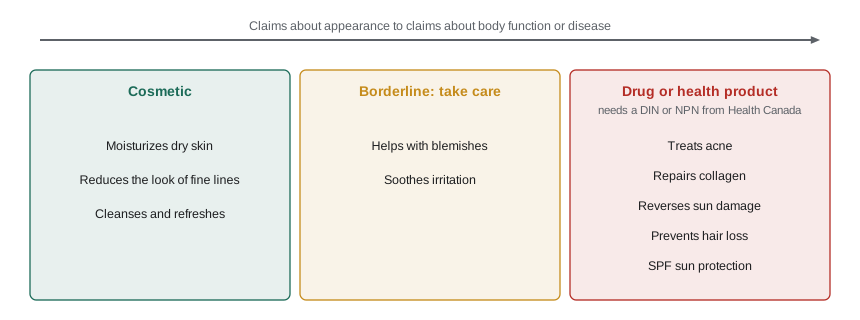
In Canada, cosmetics are regulated under the Food and Drugs Act and the Cosmetic Regulations. Manufacturers and importers must notify Health Canada within ten days of first selling a cosmetic, list ingredients, avoid prohibited and restricted ingredients on Health Canada's Cosmetic Ingredient Hotlist, and label products in English and French. Amendments to the Cosmetic Regulations require certain fragrance allergens to be named on labels, phased in from April 2026. Health Canada's guidance on products at the cosmetic-drug interface explains which claims are acceptable for cosmetics. Products such as sunscreens, anti-dandruff shampoos and acne treatments are regulated as drugs or natural health products and need a drug identification number (DIN) or natural product number (NPN). The Competition Act separately prohibits false or misleading claims.
For creators, this means words matter. You may say a moisturizer leaves your skin feeling softer, or that a serum makes your skin look brighter. You should not say a product cures acne, heals eczema, repairs collagen or reverses ageing unless it is an authorized drug with those claims, and you should not repeat brand claims that cross the line. Regulators have warned brands about drug claims made through influencers, because the influencer's words count as the brand's advertising.
| Generally cosmetic wording | Generally drug or health wording |
|---|---|
| Moisturizes and softens skin | Treats eczema or psoriasis |
| Reduces the appearance of fine lines | Stimulates collagen production |
| Cleanses pores | Kills acne bacteria or cures acne |
| Makes lashes look longer and fuller | Grows new lashes or hair |
| Gives a healthy-looking glow | Protects against sunburn (unless an authorized sunscreen) |
Substantiating claims and testing products
Any objective claim, such as lasts 24 hours, 93 % saw results, waterproof, clinically proven or dermatologist tested, needs evidence. If a brand gives you claims to repeat, ask what evidence supports them. If you make your own claims, base them on your genuine experience and describe it as such. Saying this lasted all day on me through a twelve-hour shift is an honest personal observation. Saying this lasts 24 hours on everyone is a general claim needing evidence.
Results in a single video are not typical results. If you show dramatic improvements, make sure they are real, that they came from the product you are promoting, and that viewers can reasonably expect similar results. Endorsement rules in both countries require that endorsements reflect the endorser's honest opinion and experience, and that claims about typical results be supported. Avoid language like clinically proven unless the brand can show you the study.
Before-and-after images, filters and retouching
Before-and-after images are powerful and easily misleading. Changes in lighting, angle, makeup, camera settings, timing or editing can make a product look far more effective than it is. Advertising standards in both countries treat misleading before-and-after images as deceptive. Beauty filters and retouching raise the same problem in a different form: showing a mascara on lashes enhanced by a filter, or a foundation on skin smoothed in editing, misrepresents the product.
In Canada, the Competition Act prohibits representations that are false or misleading in a material respect, considering the general impression they create, and Ad Standards' Canadian Code of Advertising Standards includes rules on accuracy and on not exaggerating product performance. Ad Standards has upheld complaints about influencer and brand content that used filters or editing to exaggerate cosmetic results. Disclosures cannot cure a misleading demonstration: if the result shown is not achievable with the product, a small note does not fix it.
Good practice for beauty creators: do not use filters or retouching on the area where a product's effect is shown, show the product under consistent lighting, explain what you used, and if you edit for creative reasons, say so clearly. Many creators now state no filter on product application segments, which builds trust.
Inclusive representation and body image
Beauty and fashion content shapes how viewers feel about their own appearance. Research has linked heavy exposure to idealized and edited images with body dissatisfaction, particularly among teenagers. Creators can reduce harm by showing real skin texture, a range of body types, and honest results; by avoiding language that shames features such as wrinkles, pores or body size; and by being careful with weight-loss content, which overlaps with the fitness rules in lesson 5.
Inclusive content is also good business. Viewers who rarely see themselves represented are loyal to creators who serve them, and brands increasingly seek creators who reach diverse audiences. When working with brands, ask whether their shade ranges and sizes match your audience; recommending products that do not work for many of your viewers damages trust.
Fashion, hauls and sustainability
Fashion hauls, where a creator shows a large batch of new purchases, are popular but controversial. Ultra-fast fashion brands have used haul creators to drive impulse buying of inexpensive clothing, raising concerns about waste, working conditions and environmental impact. Some creators now focus on thrifting, capsule wardrobes, repairs and rewearing, or are open about the trade-offs of the brands they promote.
Environmental claims are regulated. Describing products as eco-friendly, sustainable, carbon neutral or recyclable is a claim that needs evidence. CRE-320 covered green claims in general; in fashion, common problems include vague sustainability language, claims about a single eco collection that suggest the whole brand is sustainable, and recyclability claims for items that most local programs do not accept. Ask brands for specifics before repeating these claims.
Worked problem
Estimating the true cost per wear
A fashion creator compares a $25 fast-fashion top expected to last 8 wears with a $90 top expected to last 120 wears. Calculate the cost per wear of each.
Show solution
- Fast-fashion top: $25 ÷ 8 = $3.13 per wear.
- Higher-quality top: $90 ÷ 120 = $0.75 per wear.
Answer: The more expensive top costs about $0.75 per wear against $3.13. Cost per wear is a simple, honest way for fashion creators to discuss value and sustainability without unsupported environmental claims.
Launching your own beauty product
Many beauty creators eventually launch their own products. This changes your role from endorser to brand owner, with full legal responsibility. You need a reputable manufacturer, safety assessment of the formula, compliant ingredient lists and labels, claims you can support, registration or notification with the regulator, adverse event handling, and product liability insurance. Mistakes in a creator-led launch, such as an unlabelled allergen or a drug claim on a cosmetic, can lead to recalls, warning letters and lawsuits.
In Canada, the brand owner must ensure the cosmetic notification is filed, the label is bilingual and complete, ingredients comply with the Hotlist, claims stay within cosmetic limits, and any drug or natural health product has the required authorization. Products sold in Quebec must also meet the Charter of the French Language. Health Canada can request safety evidence and order recalls under the Canada Consumer Product Safety Act and the Food and Drugs Act.
Reviewing products honestly
Beauty audiences value reviews that test products properly. Useful practices include wearing a product for a full day before judging longevity, testing it on more than one skin type when possible, showing the product in natural and artificial light, noting the price and shade range, and revisiting products after weeks of use. Negative reviews, delivered fairly, are as valuable as positive ones and show viewers that a creator's recommendations mean something.
Patch testing deserves mention in skin care content. Encouraging viewers to test new products on a small area first, and to stop using products that cause irritation, is responsible practice, especially for products with active ingredients such as acids or retinoids. Creators should avoid recommending prescription-strength products or advising viewers to treat skin conditions themselves; those questions belong with a pharmacist or physician.
Common mistakes
MistakeRepeating a brand's claim that a cream cures acne or repairs collagen.
InsteadUse cosmetic wording about look and feel unless the product is an authorized drug with that claim.
MistakeUsing filters on the area where a product is applied.
InsteadShow product results without filters or retouching and under consistent lighting.
MistakeCalling products clinically proven without seeing evidence.
InsteadAsk brands for substantiation and describe your own experience as personal.
MistakePosting about PR packages without disclosure.
InsteadDisclose gifted products as material connections when you feature them.
MistakeLaunching a product without regulatory preparation.
InsteadPlan for safety assessment, notification or registration, compliant labels and insurance.
Summary and key terms
- Beauty and fashion creators earn mainly from sponsorships, affiliates, gifting and sometimes their own products.
- Claims decide whether a product is treated as a cosmetic or a drug in both countries.
- Canada regulates cosmetics under the Food and Drugs Act and Cosmetic Regulations; the United States under the FD&C Act and MoCRA.
- Objective claims need evidence; personal experience should be described as personal.
- Filters, retouching and staged before-and-after images can make content deceptive.
- Inclusive representation reduces harm and builds loyal audiences.
- Green claims and creator product launches carry specific legal responsibilities.
- PR package
- Free products sent to creators by brands in the hope of coverage.
- Cosmetic
- A product meant to clean, beautify or change appearance without treating disease.
- Drug claim
- A claim that a product treats, prevents or changes a body structure or function.
- Cosmetic notification
- In Canada, the form manufacturers file with Health Canada within ten days of first sale.
- Cosmetic Ingredient Hotlist
- Health Canada's list of prohibited and restricted cosmetic ingredients.
- MoCRA
- The US Modernization of Cosmetics Regulation Act of 2022.
- Safety substantiation
- Evidence that a cosmetic is safe under its intended use.
- Before-and-after image
- A comparison image meant to show a product's effect.
- Cost per wear
- The price of an item divided by the number of times it is worn.
- Responsible person
- Under MoCRA, the company whose name is on the cosmetic label.
Practice problems
Work each problem on paper first, then reveal the answer to check.
Is "moisturizes dry skin" a cosmetic or drug claim?
Show answer
Cosmetic.
Is "treats acne" a cosmetic or drug claim?
Show answer
Drug (or natural health product in Canada).
$6,000 of sales with 20 % returns at 8 % commission earn what?
Show answer
$6,000 × 0.8 × 0.08 = $384.
Within how many days must Canadian cosmetics be notified to Health Canada?
Show answer
Ten days of first sale.
Name two MoCRA requirements.
Show answer
Facility registration, product listing, adverse event reporting, safety substantiation.
Why can a filter make a product video misleading?
Show answer
It exaggerates results that the product alone cannot achieve.
A $60 jacket lasts 150 wears. Cost per wear?
Show answer
$0.40.
Why is "sustainable collection" risky wording?
Show answer
It is a vague green claim that needs evidence and may imply more than is true.
Is a gifted PR package a material connection?
Show answer
Yes, when you post about the products.
What does a Canadian beauty label need for national sale?
Show answer
English and French labelling, ingredient list, compliant claims.
Lesson quiz · 5 questions
Score 60% or more to complete this lesson.
Create a free account to save your progress, take quizzes and earn a certificate.