
CRE-410 · Lesson 6 of 12 · 28 min
Avatars, digital twins and synthetic presenters
Some AI tools go beyond helping a creator make content and start standing in for the creator. An avatar tool can turn a script into a video of a realistic presenter speaking it. A digital twin is a model trained on one real person's face, voice and mannerisms, able to produce new video of that person saying things they never recorded. Virtual influencers are entirely synthetic characters with their own names, personalities and followings. These technologies can multiply a creator's output, enable new formats and make content in many languages, but they also raise the deepest questions in this course about consent, authenticity and trust.
Three kinds of synthetic presenter
- Stock avatars: realistic presenters supplied by a tool provider, usually based on paid actors who agreed to have their likeness licensed. They are commonly used for training videos, explainers and corporate content.
- Digital twins: avatars built from a specific real person, often the creator, trained on recorded video and voice samples. They can deliver new scripts in the person's likeness and, combined with dubbing, in other languages.
- Virtual characters: fully synthetic personalities, from cartoon mascots to photorealistic virtual influencers, that may be voiced and written by a team and sometimes animated with performance capture.
Each raises different issues. Stock avatars depend on the original actors' licences. Digital twins depend on the consent and control of the person they copy. Virtual characters raise questions of disclosure: audiences may not realize a realistic influencer is not a real person, or that a team or a brand is behind them.
What creators use them for
Creators and media companies use synthetic presenters in several ways:
- Scaling evergreen content: turning written guides into short video explainers without filming each one.
- Localization: having a digital twin deliver content in languages the creator does not speak.
- Corrections and pick-ups: fixing a line, updating a price or replacing an outdated fact without reshooting.
- Personalized messages: generating many short greetings or thank-you videos for supporters.
- Characters and mascots: running a branded character across platforms, sometimes with live interaction.
- Accessibility and continuity: allowing a creator to keep publishing during illness or recovery, with clear disclosure.
Not every use is wise. Audiences often follow creators because of real, unscripted presence. Replacing that with a twin, especially without saying so, can feel like a betrayal when discovered. Many creators limit twins to clearly labelled, practical uses, such as translations or corrections, and keep personal and opinion content human.
Consent and control for digital twins
A digital twin of yourself is a powerful asset and a serious risk. If it is misused, leaked or controlled by someone else, it can make you appear to say or endorse anything. Before creating one, consider:
- Who owns and controls the model: you, the tool provider, your company or a business partner?
- What the provider may do with your face and voice data, including training other models, and whether you can delete them.
- Who on your team may generate content with the twin, and what approval is required before publishing.
- What happens to the twin if you leave a company, sell your business, or die.
- How you will mark twin-generated content so audiences and platforms can tell it apart.
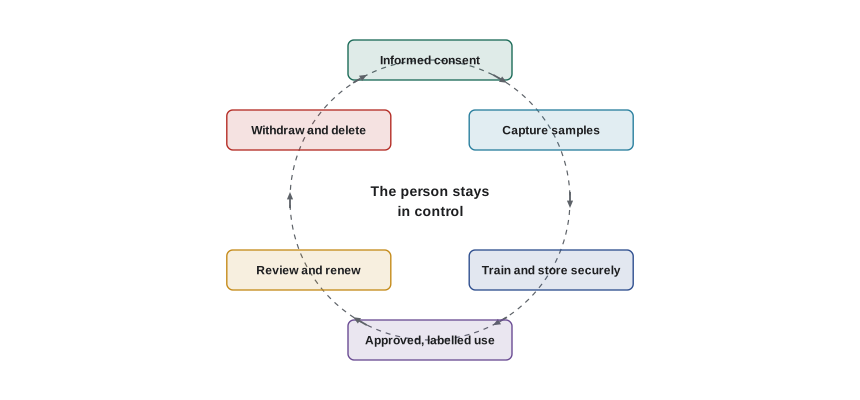
For any digital twin of another person, such as a co-host, presenter or employee, written consent is essential and should cover the same points the lesson 5 voice consent covered: purpose, scope, duration, payment, approval rights, withdrawal and deletion. Employment and contractor agreements should state clearly whether the company may create or use a person's likeness after the working relationship ends; many jurisdictions now treat broad, vague grants of digital replica rights with suspicion, as lesson 10 explains.
Virtual influencers and disclosure
Virtual influencers can build large followings and attract brand deals. The disclosure questions are layered. First, is the audience aware the character is not a real person? Second, if the character promotes a product, is the material connection with the brand disclosed? Third, who is actually speaking: a creative team, an agency, or the brand itself?
Advertising regulators in both countries apply the same endorsement rules to virtual and AI influencers as to human ones. In Canada, the Ad Standards Influencer Marketing Disclosure Guidelines (updated October 2025) state that AI-generated influencers must follow the same material connection disclosure rules, and recommend as best practice disclosing that the spokesperson is virtual, using tags such as #VirtualInfluencer or #AIinfluencer. In the United States, the FTC Endorsement Guides apply to endorsements regardless of the technology used, and the FTC has warned that a virtual influencer cannot honestly claim personal experience with a product it cannot use.
| Question | Why it matters |
|---|---|
| Is it clear the presenter is synthetic? | Audiences may form trust based on believing a real person is speaking |
| Is any brand connection disclosed? | Endorsement rules apply to virtual influencers too |
| Are claims of personal experience truthful? | A synthetic character cannot honestly say it tried a product |
| Is a real person's likeness involved? | Consent and publicity rights apply |
| Could young viewers be confused? | Children may struggle to recognize synthetic presenters and advertising |
The economics of a digital twin
Digital twins promise to cut production time, but they come with their own costs: subscription or per-minute generation fees, script writing, review and editing, and the risk of lower audience engagement. A simple comparison helps decide where they make sense.
Worked problem
Twin versus filming for short explainers
A creator makes 12 short explainer videos a month. Filming each takes 1.5 hours of the creator's time plus 1 hour of editing at $40 an hour. With a digital twin, each video needs 0.25 hours of creator review plus 0.5 hours of editing, and generation costs $8 per video plus a $99 monthly plan. The creator values their own time at $80 an hour. What is the monthly saving?
Show solution
- Filming cost per video: 1.5 × $80 + 1 × $40 = $160. Monthly: 12 × $160 = $1,920.
- Twin cost per video: 0.25 × $80 + 0.5 × $40 + $8 = $48. Monthly: 12 × $48 + $99 = $675.
- Saving: $1,920 − $675 = $1,245 a month.
Answer: About $1,245 a month on paper. The creator must also weigh whether viewers engage as well with twin videos; a 30 % drop in views could wipe out much of the benefit.
Worked problem
Engagement-adjusted value
The creator's filmed explainers average 20,000 views each at a total value (ads plus leads) of $12 per thousand views. Twin videos average 14,000 views. What is the monthly revenue difference across 12 videos, and is the twin still worthwhile?
Show solution
- Filmed revenue: 12 × 20 × $12 = $2,880.
- Twin revenue: 12 × 14 × $12 = $2,016.
- Revenue lost: $864.
- Net effect: $1,245 cost saving − $864 revenue loss = $381 better off.
Answer: The twin still comes out ahead by about $381 a month, but much less than the cost saving alone suggested, and long-term audience trust is not captured in the numbers.
Live and interactive avatars
Some tools let an avatar or AI character respond to viewers in real time, in live streams, chats or comment replies. Interactive avatars raise further issues: the AI may say things the creator would never say, give harmful advice, form parasocial bonds with lonely or young viewers, or be manipulated by users into offensive statements. If you deploy an interactive character, set clear limits on topics, monitor it, make its AI nature obvious, provide a way to reach a human and keep logs. Lesson 7 covers AI in community management more generally.
Deceased performers and legacy likenesses
Technology can now recreate people who have died, from historical figures to creators' own relatives or late collaborators. Laws in some places protect the likeness of deceased people for a period after death, and families and audiences can react strongly to unexpected recreations. Avoid recreating a real deceased person without the permission of whoever controls their estate or likeness rights, and be cautious and transparent even when you have permission.
A digital twin agreement checklist
Whether you are creating a twin of yourself with a vendor or of a team member for your company, put the terms in writing. A practical checklist for the agreement includes:
- Parties and purpose: who is creating the twin, for what kinds of content, and on which platforms.
- Scope: languages, topics that are allowed and topics that are excluded, such as political statements, sponsored endorsements or personal messages.
- Approval: who must approve each script and finished video before publishing.
- Payment: a fee per use, per minute generated or a flat licence, and how it changes over time.
- Duration and termination: how long the licence lasts and what happens to existing content when it ends.
- Data and security: where face and voice data are stored, who can access them, and whether they can be used for training other models.
- Withdrawal and deletion: how the person can withdraw consent and confirm the model and data are deleted.
- Disclosure: how twin content will be labelled to audiences.
- Succession: what happens if the person dies, becomes unable to work or the business is sold.
Some creators keep their twin model with a vendor under an account they control, rather than one controlled by an agency or network, so they can move or delete it later.
Audience reactions and testing
Before relying on a twin, test audience reactions. Publish a small number of clearly labelled twin videos, read the comments, compare retention with similar human-presented videos and ask your community directly. Some audiences find twins useful for translations and quick updates; others feel distanced. The data, not the tool's marketing, should decide how far to go.
Worked problem
Retention comparison
Human-presented short explainers keep 48 % of viewers at the halfway point; labelled twin explainers on similar topics keep 41 %. What is the relative drop in mid-point retention?
Show solution
- Drop: 48 − 41 = 7 percentage points.
- Relative drop: 7 ÷ 48 ≈ 14.6 %.
Answer: Mid-point retention is about 15 % lower for twin videos, a meaningful cost to weigh against production savings.
Labelling twin content clearly
Good labelling for twin content uses several layers: the platform's AI label, a short line in the description such as "This video is presented by my AI digital twin, from a script I wrote and approved", and, for longer videos, a brief on-screen note at the start. Being specific about what is human, such as the script and the approval, helps audiences understand that the creator is still responsible for the content.
Common mistakes
MistakeUsing a digital twin for personal content without telling the audience.
InsteadLimit twins to labelled, practical uses and keep personal content human.
MistakeLetting a provider keep broad rights to your face and voice.
InsteadRead data terms, keep control and confirm deletion rights.
MistakeCreating a twin of a co-host without written consent.
InsteadGet written consent covering scope, duration, pay, approval and deletion.
MistakeLetting a virtual influencer claim to have tried a product.
InsteadAvoid personal-experience claims a synthetic character cannot truthfully make.
MistakeCounting only cost savings when evaluating twins.
InsteadInclude changes in views, engagement and long-term trust.
Summary and key terms
- Synthetic presenters include stock avatars, digital twins of real people and fully virtual characters.
- Useful applications include evergreen explainers, localization, corrections and personalized messages.
- A digital twin needs clear ownership, access controls, data terms, succession plans and labelling.
- Twins of other people require informed, written consent with withdrawal and deletion rights.
- Endorsement disclosure rules apply to virtual and AI influencers in both Canada and the United States.
- Economic comparisons must adjust for engagement as well as production savings.
- Interactive avatars and recreations of deceased people need strict limits, monitoring and permission.
- Avatar
- A digital representation of a presenter or character.
- Digital twin
- An AI model of a specific real person's face, voice and mannerisms.
- Digital replica
- A realistic synthetic reproduction of a real person's likeness or voice.
- Virtual influencer
- A fully synthetic social media personality.
- Stock avatar
- A licensed synthetic presenter supplied by a tool provider.
- Performance capture
- Recording an actor's movements and expressions to animate a character.
- Material connection
- A relationship between an endorser and a brand, such as payment or free products.
- Parasocial relationship
- A one-sided sense of personal connection a viewer feels toward a presenter.
- Likeness
- Recognizable features of a person, such as face, voice or name.
- Pick-up
- A short reshoot or fix to replace part of a recording.
Practice problems
Work each problem on paper first, then reveal the answer to check.
Name the three kinds of synthetic presenter.
Show answer
Stock avatars, digital twins and virtual characters.
Give two practical, low-risk uses of a creator's own twin.
Show answer
Labelled translations, corrections, evergreen explainers.
What should consent for a co-host's twin cover?
Show answer
Purpose, scope, duration, pay, approval, withdrawal and deletion.
Do endorsement rules apply to virtual influencers?
Show answer
Yes, in both Canada and the United States.
Filming costs $150 per video and a twin $50; 10 videos plus a $100 plan. Saving?
Show answer
$1,500 − ($500 + $100) = $900.
If twin videos lose $600 of revenue, what is the net effect?
Show answer
$900 − $600 = $300 better off.
Why can a virtual influencer not say it tried a product?
Show answer
A synthetic character cannot have personal experience.
Name two risks of interactive avatars.
Show answer
Harmful statements, manipulation, parasocial bonds, confusion.
What should happen to a twin when a creator leaves a company?
Show answer
It should be settled by contract, often deletion or return of control.
Why be careful recreating a deceased person?
Show answer
Likeness rights, estate permission and strong audience reactions.
Lesson quiz · 5 questions
Score 60% or more to complete this lesson.
Create a free account to save your progress, take quizzes and earn a certificate.