
CRE-410 · Lesson 11 of 12 · 28 min
Ethics of AI content: consent, authenticity, labour and the environment
Law sets the minimum. Ethics asks what a creator should do even where the law is unclear, silent or still catching up. AI raises ethical questions that audiences, collaborators and the wider creative community care about deeply: whether people consented to how their faces, voices and work are used, whether audiences are being deceived, what happens to the workers whose jobs are changing, and what the environmental cost of generating content is. This lesson offers frameworks for thinking these questions through and making defensible choices.
Four questions for any AI use
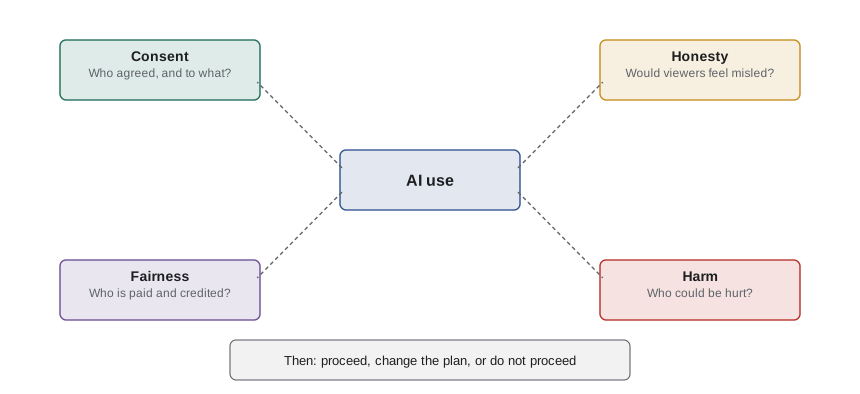
A simple ethical check before using AI in a project asks four questions:
- Consent: has everyone whose likeness, voice, words or creative work is used agreed, with a real understanding of how it will be used?
- Honesty: would a reasonable viewer feel misled if they knew how this content was made?
- Fairness: does this use treat collaborators, workers and other creators fairly, including credit and pay?
- Harm: could this content harm someone, such as by spreading false information, enabling scams, harassing a person or reinforcing stereotypes?
If any answer is uncomfortable, change the plan: get consent, add disclosure, pay or credit people, or choose not to use AI for that task.
Consent beyond the legal minimum
Legal consent can be a signature on a broad release. Ethical consent is informed, specific and revocable. Ask whether the person really understood what they agreed to. A guest who signed a release in 2022 for a podcast episode did not imagine their voice being cloned for a dubbed version in 2026. Older releases and contracts often did not contemplate AI uses at all; when in doubt, ask again.
Consent matters for groups as well as individuals. Communities may have collective interests in how their cultural knowledge, languages, sacred imagery or traditional designs are used. Indigenous communities in Canada and the United States, for example, have raised concerns about AI models trained on or generating cultural material without involvement or benefit. Generating imagery or voices that imitate a specific culture's traditions calls for consultation and respect, not just technical capability.
Authenticity and audience trust
Audiences build relationships with creators based on a sense of who they are and how they work. Surveys in recent years have generally found that many people are uneasy about AI-generated content that is not disclosed and value transparency, although attitudes vary by age, platform and type of content. Several practices protect trust:
- Be open about your process. Some creators publish an AI policy explaining what they use AI for and what they never use it for.
- Label synthetic people and realistic scenes, even where a platform does not strictly require it.
- Keep opinions, reviews and personal stories genuinely yours.
- Never fabricate testimonials, comments, reaction footage or evidence.
- Correct mistakes publicly, including mistakes introduced by AI tools.
Authenticity does not mean avoiding AI. Many audiences are comfortable with AI used for editing, captions, translation or illustration, especially when creators explain how it helps them make better content. What damages trust is deception: presenting synthetic work as something it is not.
Deepfakes and harm
Deepfakes, realistic synthetic videos or audio of real people, can be used for satire and art, but also for fraud, harassment, political manipulation and sexual abuse. Non-consensual intimate deepfakes cause serious harm overwhelmingly to women and girls, and many jurisdictions now criminalize them. Creators should never create sexual or degrading deepfakes of anyone, should be cautious even with obvious satire of public figures, and should think about how a clip could be cut down and shared without its context or label.
Creators are also targets. Scammers clone popular creators' voices and faces to promote fake giveaways, investment schemes or products. Monitoring for impersonation, using platform likeness-detection and reporting tools, telling audiences how you will and will not contact them, and responding quickly protect both you and your viewers. CRE-350 covered impersonation and harassment in more depth.
Labour: editors, voice actors, illustrators and others
AI tools change who does creative work and how they are paid. Editors, voice actors, translators, illustrators, musicians, writers and thumbnail designers have seen demand for some tasks fall and rates come under pressure, while new roles such as AI producers, reviewers and prompt specialists have grown. Performers' unions have negotiated AI protections: SAG-AFTRA's contracts, including its 2025 video game agreement, require consent and disclosure for digital replicas and payment for their use, and ACTRA has pursued similar consent and compensation provisions in Canadian agreements. Working conditions and rights for non-union freelancers depend more on individual contracts.
Creators who employ or hire others face real choices. Ethical approaches include being transparent with collaborators about how AI will be used in their work, not using a freelancer's past work to train a model without permission and payment, offering training so team members can work with new tools, sharing productivity gains rather than simply cutting rates, and continuing to hire human performers where their contribution matters to the audience.
Worked problem
Sharing productivity gains
An editor previously billed 10 hours per video at $45 an hour. AI tools now let them finish in 7 hours. Option A: the creator pays for 7 hours. Option B: the creator agrees a fixed $380 per video. What does each option mean for the creator's cost and the editor's effective hourly rate?
Show solution
- Old cost: 10 × $45 = $450.
- Option A: 7 × $45 = $315; creator saves $135; editor earns $45 an hour but $135 less per video.
- Option B: $380; creator saves $70; editor earns $380 ÷ 7 ≈ $54.29 an hour.
Answer: Option B splits the gain: the creator saves $70 per video and the editor's hourly earnings rise by about 21 %. Sharing gains can keep skilled collaborators loyal while still lowering costs.
The environmental cost of AI
Training and running AI models uses electricity and water, mainly in data centres. The impact of a single text query is small, but image and especially video generation use much more energy, and creators may generate thousands of drafts. Published estimates vary widely and are often uncertain. In August 2025 Google reported that a median text prompt to its Gemini assistant used about 0.24 watt-hours. Independent researchers have estimated far higher figures for image generation and especially for video; one widely reported 2025 analysis estimated that generating a five-second video clip with an open-source model could use close to one kilowatt-hour.
The carbon impact also depends on the electricity grid powering the data centre. Grids with more hydro, nuclear, wind and solar power emit far less carbon per kilowatt-hour than those relying on coal or gas.
Worked problem
Estimating the footprint of a month of generation
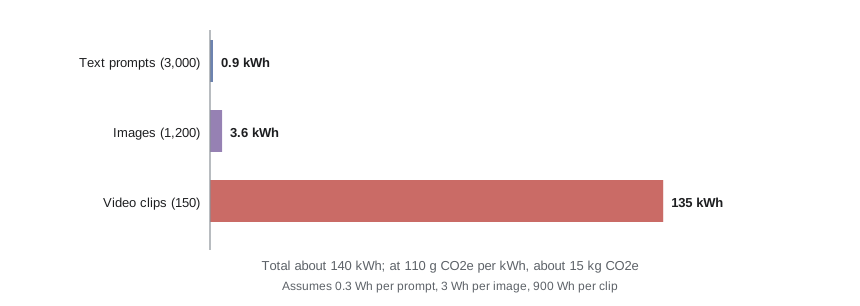
A creator's team generates, in a month, 3,000 text prompts, 1,200 images and 150 five-second video clips. Assume 0.3 Wh per text prompt, 3 Wh per image and 900 Wh per video clip, and an average grid intensity of 110 grams of CO₂-equivalent per kilowatt-hour, roughly in line with Canada's national average. What are the energy use and emissions?
Show solution
- Text: 3,000 × 0.3 = 900 Wh. Images: 1,200 × 3 = 3,600 Wh. Video: 150 × 900 = 135,000 Wh.
- Total: 139,500 Wh ≈ 139.5 kWh.
- Emissions: 139.5 × 110 g ≈ 15,345 g ≈ 15 kg CO₂e.
Answer: About 140 kWh and roughly 15 kg CO₂e under these assumptions, with video generation responsible for about 97 % of the energy. Cutting unnecessary video drafts makes by far the biggest difference. Real figures depend on the models used and where they run, which is often outside Canada.
Proportionate action matters more than guilt. Generate fewer, better-planned drafts; reuse assets; prefer smaller or more efficient models for simple tasks; and recognize that a single flight for a shoot may emit far more than a month of text prompts. Creators who make environmental content in particular should be thoughtful and transparent about their own footprint.
Writing a personal AI ethics statement
Many creators find it useful to write down their principles. A short statement, perhaps half a page, might cover what you use AI for, what you will never use it for, how you disclose it, how you treat collaborators, and how viewers can raise concerns. Publishing it in your channel description or website signals respect for your audience and gives your team a clear reference. Lesson 12 builds this into a full disclosure policy.
Ethics in practice: three short cases
Case one: a cooking creator wants to use AI to generate a realistic image of a finished dish for a thumbnail because the real one looked unappetizing. Running the four questions: consent is not an issue, but honesty is. Viewers will expect the dish to look like the thumbnail. A better choice is to reshoot with better lighting or styling, or use a clearly illustrative graphic.
Case two: a history channel wants to animate old photographs so historical figures appear to blink and smile. Consent from long-dead subjects is impossible, but descendants and communities may have views, and honesty requires making clear the motion is artificial. Many channels using such tools label the animated sequences and avoid animating photographs of atrocities or victims.
Case three: a creator's assistant suggests training a model on a former freelance illustrator's thumbnails to keep the channel's style consistent after the illustrator left. Fairness and consent both point the same way: ask the illustrator, offer payment, or develop a new style. Using their past work to replace them without permission would be unfair even where the legal position is unclear.
Worked problem
Weighing a recurring ethical cost
A creator could save $300 a month by replacing a human voice actor with a stock synthetic voice for a series intro. Audience surveys suggest 15 % of regular viewers would view the change negatively, and the creator estimates a 2 % drop in watch time worth about $90 a month. What is the net monthly financial effect?
Show solution
- Saving: $300.
- Estimated revenue loss: $90.
- Net: $300 − $90 = $210 better off.
Answer: About $210 a month on paper, but the creator must still weigh fairness to the actor and the 15 % of viewers who object, which numbers alone do not settle.
Bias and representation as an ethical issue
AI tools can reproduce and amplify stereotypes in images, voices, translations and recommendations. A translation tool may default to masculine forms for professions; a voice library may offer few accents; an image generator may show narrow ideas of beauty. Creators shape what large audiences see, so reviewing AI output for bias is part of ethical practice. Prompt deliberately, review results with diverse team members or advisers where possible, and correct problems before publishing.
Common mistakes
MistakeRelying on old releases for new AI uses.
InsteadAsk again when a use was not contemplated when consent was given.
MistakeAssuming legal means ethical.
InsteadRun the consent, honesty, fairness and harm check even where the law is unclear.
MistakeTreating all AI use as equally suspect or equally acceptable.
InsteadDistinguish production help from deceptive synthetic content.
MistakeTraining a model on a freelancer's past work without permission.
InsteadAsk, and pay, before using anyone's work to train a model.
MistakeIgnoring the energy cost of mass video generation.
InsteadPlan drafts, reuse assets and choose efficient tools.
Summary and key terms
- Four questions guide ethical AI use: consent, honesty, fairness and harm.
- Ethical consent is informed, specific and revocable; old releases may not cover new AI uses.
- Communities, including Indigenous communities, may have collective interests in cultural material.
- Trust depends on avoiding deception: disclose synthetic content and keep opinions genuine.
- Deepfakes can cause serious harm; never create sexual or degrading fakes and watch for impersonation.
- AI reshapes creative labour; consent, payment and shared gains support fair treatment.
- Video generation dominates AI energy use; emissions depend on the grid powering data centres.
- Informed consent
- Agreement given with a real understanding of how something will be used.
- Revocable consent
- Consent that can be withdrawn later.
- Authenticity
- Being genuine and not misleading about who made content and how.
- Deepfake
- Realistic synthetic media depicting a real person saying or doing something they did not.
- Non-consensual intimate image
- A sexual image of a person shared or created without their consent.
- Digital replica
- A realistic synthetic reproduction of a person's voice or likeness.
- Productivity gain
- An increase in output per hour of work.
- Watt-hour (Wh)
- A unit of energy equal to one watt used for one hour.
- Grid intensity
- Greenhouse gas emissions per unit of electricity generated.
- AI ethics statement
- A public summary of a creator's principles for using AI.
Practice problems
Work each problem on paper first, then reveal the answer to check.
Name the four ethical questions.
Show answer
Consent, honesty, fairness and harm.
Why might a 2022 podcast release not cover a 2026 voice clone?
Show answer
The guest could not have understood or contemplated that use.
Give two practices that protect audience trust.
Show answer
Publish an AI policy, label synthetic content, keep opinions genuine, correct mistakes.
An editor saves 4 hours on a $50-an-hour, 12-hour job. What is the cost saving if paid hourly?
Show answer
$200.
If instead paid a fixed $500 for 8 hours, what is the editor's hourly rate?
Show answer
$62.50.
200 images at 3 Wh each use how much energy?
Show answer
600 Wh, or 0.6 kWh.
What emissions does 10 kWh produce at 110 g per kWh?
Show answer
1.1 kg CO₂e.
Which type of generation usually uses the most energy?
Show answer
Video.
Name one way to cut AI energy use.
Show answer
Fewer drafts, reuse assets, smaller models for simple tasks.
What should a personal AI ethics statement cover?
Show answer
Uses, prohibited uses, disclosure, collaborators and how to raise concerns.
Lesson quiz · 5 questions
Score 60% or more to complete this lesson.
Create a free account to save your progress, take quizzes and earn a certificate.