
CRE-220 · Lesson 8 of 12 · 25 min
Nerves, confidence and performing under pressure
Almost everyone feels nervous in front of a camera or an audience at first, and many experienced presenters still do. Surveys regularly find that public speaking is among the most common fears, and speaking to a camera adds the discomfort of seeing and hearing yourself played back. Nerves are not a sign that you are unsuited to the work; they are a normal physical response that can be managed and even used. This lesson covers why nerves happen, the physical and mental symptoms, preparation as the foundation of confidence, physical techniques for calming the body, mental techniques for managing thoughts, reframing nerves as energy, dealing with mistakes, the discomfort of watching yourself, building confidence through exposure, and when anxiety may need more support.
Why nerves happen
Speaking in front of others triggers the body's threat response, often called fight-or-flight. The brain interprets being watched and judged as a social risk and releases stress hormones such as adrenaline, which raise heart rate, increase breathing, tense muscles and sharpen attention. These responses evolved to prepare the body for physical danger, not for presenting a cooking tutorial, which is why they can feel so unhelpful. For creators, additional pressures include the permanence of recorded content, the possibility of public criticism in comments, comparison with other creators and the feeling that each video's performance reflects personal worth. Understanding that nerves are a predictable physiological response, not a personal weakness, is the first step to managing them.
Symptoms of nerves
Nerves show up in the body and the mind. Physical symptoms include a racing heart, shaky hands or voice, dry mouth, sweating, shallow breathing, butterflies in the stomach, blushing and muscle tension, especially in the shoulders, jaw and throat. On camera, these produce a tight, high or wavering voice, rushed speech, stiff posture, fidgeting, darting eyes and forced smiles. Mental symptoms include racing or blank thoughts, catastrophizing ("everyone will think I'm stupid"), self-monitoring ("my voice sounds weird"), perfectionism and avoidance, such as endlessly postponing filming. Recognizing your own pattern of symptoms helps you choose techniques that target them.
Preparation as the foundation
The most reliable source of confidence is preparation. Knowing your content well, having a clear structure (Lesson 2), and rehearsing out loud reduce the mental load during recording, leaving more capacity to manage nerves and connect with viewers. Effective preparation includes knowing your opening lines and key points thoroughly, since nerves are usually strongest at the start; rehearsing aloud several times, ideally on camera; preparing your setup in advance so that technical problems do not add stress; and planning what you will do if you lose your place, such as glancing at a bullet list. Over-preparation has a limit: memorizing every word can increase anxiety about forgetting, and many presenters find that knowing the ideas thoroughly while keeping wording flexible gives the best balance.
Calming the body
Physical techniques work directly on the stress response:
- Slow breathing: breathing out for longer than you breathe in, for example in for four counts and out for six to eight, activates the body's calming parasympathetic system. Box breathing, in for four, hold for four, out for four, hold for four, is another popular method. A few minutes before recording can lower heart rate and steady the voice.
- Movement: shaking out the hands and arms, rolling the shoulders, stretching, or brief exercise such as a walk or a few jumping jacks can discharge adrenaline.
- Progressive muscle relaxation: tensing and releasing muscle groups in turn to release stored tension, particularly in the jaw, shoulders and hands.
- Vocal warm-ups: humming, lip trills and gentle sirens (Lesson 4) relax the throat and steady the voice.
- Hydration and routine: drinking water for dry mouth, avoiding too much caffeine before recording, eating something light, and sleeping well the night before.
| Technique | How it works | When to use |
|---|---|---|
| Extended exhale breathing | Activates calming nervous system | Minutes before recording, between takes |
| Box breathing | Regular rhythm steadies breathing | Before recording or going live |
| Shaking out and stretching | Discharges adrenaline and tension | Before each session |
| Progressive muscle relaxation | Releases muscle tension | Before sessions, especially jaw and shoulders |
| Vocal warm-ups | Relaxes throat, steadies voice | Before recording |
Managing thoughts
Mental techniques address the thoughts that fuel anxiety. Shifting focus from yourself to your viewer is powerful: instead of asking "how do I look?", ask "what does this person need from me?". Anxiety often comes from self-monitoring, and directing attention outward toward helping someone reduces it. Challenging catastrophic thoughts helps too: "if I stumble, everyone will think I'm an idiot" can be replaced by a more realistic thought, "if I stumble, I can do another take, and viewers forgive small mistakes". Visualization, mentally rehearsing a successful recording in detail, is used by athletes and performers to build confidence. And setting process goals, such as "I will make eye contact during my opening", rather than outcome goals, such as "this video must get 100,000 views", keeps attention on what you can control.
Reframing nerves as energy
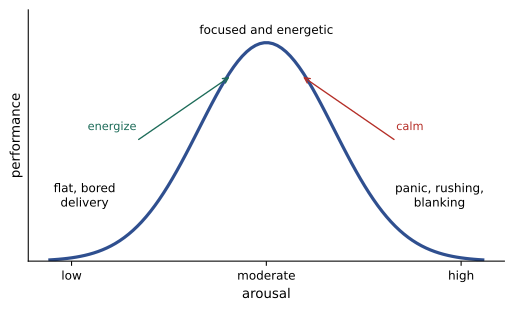
The physical symptoms of nervousness, a raised heart rate and heightened alertness, are very similar to those of excitement. Research by Alison Wood Brooks and others has suggested that people who reappraise anxiety as excitement, for example by telling themselves "I am excited" rather than trying to calm down, can perform better in some stressful tasks, such as public speaking and singing. The idea is not to eliminate arousal, which is often impossible and not even desirable, but to channel it. Moderate arousal sharpens performance, while too little produces flat delivery and too much causes panic, an inverted-U relationship often linked to the Yerkes–Dodson law. Many experienced presenters describe their pre-recording nerves as fuel that gives their delivery energy.
Dealing with mistakes
Fear of making mistakes is one of the strongest sources of on-camera anxiety. In recorded content, mistakes are easy to fix: pause, restart the sentence and edit (Lesson 5). Treating mistakes as normal parts of the process, rather than failures, reduces pressure. Many creators keep small mistakes in their videos, a laugh at a stumble or a self-deprecating comment, because they make the creator feel human and relatable. In live content, the key is to acknowledge mistakes briefly, if at all, and keep going; audiences rarely notice small slips and forget them quickly unless the presenter dwells on them. A useful rule is that the audience takes its cue from you: if you treat a mistake lightly, so will they.
Worked problem
A pre-recording routine
A new creator feels intense nerves before filming, with a shaky voice, a racing heart and a tendency to rush their opening. What routine might help?
Show solution
- The night before: prepare the setup, outline and opening lines; sleep well.
- Thirty minutes before: light snack, water, limited caffeine; check equipment.
- Ten minutes before: shake out the body, roll shoulders, vocal warm-ups.
- Two minutes before: extended-exhale breathing (in for four, out for seven), visualize a successful opening, tell yourself "I am excited to share this".
- Recording: start with the opening several times, pausing between takes, focusing on one viewer rather than on yourself.
Answer: Prepare the night before, warm up the body and voice, breathe with long exhales, reframe nerves as excitement and record the opening several times.
Watching yourself
Many people find watching and hearing their own recordings uncomfortable. Part of the reason is physical: we normally hear our voice through the bones of the skull as well as through the air, which makes it sound deeper and fuller to us than recordings do. Another part is attention: we notice our own flaws far more than other people do, a tendency researchers call the spotlight effect. Strategies include watching recordings regularly until the discomfort fades, which it usually does with exposure; watching with a specific, constructive goal, such as checking eye contact, rather than judging everything; watching with the sound off and then with audio only, separating visual and vocal feedback; and remembering that viewers see your content, not your flaws.
Building confidence through exposure
Confidence on camera grows through repetition. Gradual exposure, a principle used in psychology to reduce fears, means starting with less threatening tasks and building up: recording short clips that no one will see, then sharing with a friend, then posting short videos, then longer ones, and eventually going live. Each successful step reduces anxiety for the next. Regular practice matters more than occasional big efforts: recording something every day for a month, even a one-minute practice clip, builds comfort faster than one long video a month. Joining groups such as Toastmasters, improv classes or creator communities provides practice with supportive feedback. Many confident presenters describe their early videos as awkward; confidence came from making many of them.
When anxiety needs more support
For most people, nerves are uncomfortable but manageable, and they diminish with experience. For some, anxiety about speaking or being seen is intense enough to cause significant distress, panic attacks or avoidance that interferes with work or daily life; this may be social anxiety disorder or another anxiety condition. Effective treatments exist, including cognitive behavioural therapy, which has strong evidence for social anxiety, and in some cases medication prescribed by a doctor. If anxiety is severely affecting you, talking to a doctor, a psychologist or another mental health professional is a sensible step. Seeking support is a strength, and many successful creators have spoken openly about managing anxiety.
Imposter feelings
Many creators, including successful ones, experience imposter feelings: the sense that they are not really qualified, that they will be "found out", or that their success is luck. These feelings are common among people who are learning new skills or working in visible roles, and they are not evidence of inadequacy. Helpful responses include recognizing the feeling as common, keeping a record of positive feedback and accomplishments, focusing on what you can offer viewers rather than on comparison with others, and being honest about the limits of your expertise, which audiences usually respect. Remember that viewers are often looking for a guide who is a few steps ahead of them, not a world authority.
Comparison and criticism
Comparison with other creators, especially those with larger audiences, more polish or more confidence, can undermine your own confidence. Remember that you are comparing your behind-the-scenes struggles with others' edited highlights, and that many confident presenters went through the same awkward early stages. Criticism in comments can also hurt. Useful approaches include separating constructive criticism, which you can learn from, from hostility, which says more about the commenter; limiting how often and when you read comments; asking a trusted person to screen comments when you are vulnerable; and using moderation tools. CRE-350 covers harassment and wellbeing in more depth.
Confidence routines that last
Confidence is built by routines rather than moments of inspiration. Consistent pre-recording routines, regular practice, celebrating small improvements, and reflecting on what went well after each session gradually change how you feel in front of the camera. Many creators find that their anxiety decreases noticeably after a few dozen videos, though it may return in new situations, such as a first live stream or a large event, which is normal.
Nerves before going live
Live content can feel more nerve-racking than recorded content because there are no retakes. Starting with short, low-stakes live sessions, preparing a clear plan for the first five minutes, and having a friend or moderator in the chat for support all help. Many presenters find that nerves fade within the first few minutes once interaction begins.
Supporting others with nerves
Creators who host guests or co-hosts can help them manage nerves: explain the process, start with easy questions, reassure them that mistakes can be edited, and keep the atmosphere relaxed.
Common mistakes
MistakeTreating nerves as proof you are unsuited.
InsteadRecognize nerves as a normal, manageable response.
MistakeMemorizing every word to feel safe.
InsteadKnow the ideas thoroughly and keep wording flexible.
MistakeTrying to eliminate all arousal.
InsteadReframe it as excitement and channel it.
MistakeDwelling on mistakes.
InsteadPause, restart, or acknowledge lightly and continue.
MistakeAvoiding recording until you feel ready.
InsteadBuild confidence through regular, gradual exposure.
Summary and key terms
- Nerves are the body's threat response to being watched and judged.
- Symptoms affect voice, posture, breathing and thoughts.
- Preparation is the foundation of confidence.
- Slow breathing, movement and warm-ups calm the body.
- Shift focus to the viewer, challenge catastrophic thoughts and set process goals.
- Reframing nerves as excitement channels arousal into energy.
- Treat mistakes lightly, build exposure gradually and seek support for severe anxiety.
- Fight-or-flight
- The body's automatic threat response.
- Adrenaline
- Stress hormone that raises heart rate and alertness.
- Catastrophizing
- Imagining the worst possible outcome.
- Box breathing
- Breathing in equal counts with holds.
- Progressive muscle relaxation
- Tensing and releasing muscle groups.
- Reappraisal
- Reinterpreting anxiety as excitement.
- Yerkes–Dodson law
- Inverted-U relation between arousal and performance.
- Spotlight effect
- Overestimating how much others notice us.
- Gradual exposure
- Building up to feared tasks step by step.
- Social anxiety disorder
- Intense, persistent fear of social evaluation.
Practice problems
Work each problem on paper first, then reveal the answer to check.
What causes the physical symptoms of nerves?
Show answer
The fight-or-flight response and stress hormones.
Name three on-camera signs of nerves.
Show answer
Shaky voice, rushing, stiff posture, darting eyes.
Why know your opening especially well?
Show answer
Nerves are usually strongest at the start.
Describe extended-exhale breathing.
Show answer
Breathing out longer than in, such as 4 in and 7 out.
What does shifting focus to the viewer do?
Show answer
Reduces self-monitoring and anxiety.
What is a process goal?
Show answer
A goal about actions you control, like eye contact.
What does reappraisal involve?
Show answer
Telling yourself you are excited rather than anxious.
Why do our voices sound strange on recordings?
Show answer
We normally hear them through bone as well as air.
What is gradual exposure?
Show answer
Building from easy to harder tasks.
Which therapy has strong evidence for social anxiety?
Show answer
Cognitive behavioural therapy.
Lesson quiz · 5 questions
Score 60% or more to complete this lesson.
Create a free account to save your progress, take quizzes and earn a certificate.