
CRE-220 · Lesson 10 of 12 · 25 min
Interviewing guests on camera
Interviews bring new voices, expertise and stories into creator content, and they introduce creators to their guests' audiences. A great interview feels like an engaging conversation in which the guest reveals something genuine; a poor one feels like a list of questions read to a nervous or bored guest. Interviewing is a skill with a long tradition in journalism, broadcasting and documentary, and many of its techniques transfer directly to creator video and podcasts. This lesson covers choosing and inviting guests, research and preparation, writing questions, building rapport, listening and follow-up questions, handling difficult interviews, on-camera setups and eyelines for interviews, consent and recording law, releases and editing ethics, and remote interviews. CRE-240 covers podcast production; this lesson focuses on the interviewer's craft on camera.
Choosing and inviting guests
Good guests bring something your audience values: expertise, an unusual experience, a strong perspective, or simply great storytelling ability. Relevance to your audience matters more than fame; a lesser-known expert who explains clearly may make a better interview than a celebrity who gives rehearsed answers. When inviting guests, be specific and respectful: explain who you are, why you want them in particular, what the conversation will cover, the format and length, where and when it will be published, and what they gain, such as exposure to your audience or a chance to share their work. Make it easy to say yes, with clear scheduling and technical instructions. Be honest about your audience size and the nature of your content, and respect a refusal.
Research and preparation
Preparation distinguishes good interviewers. Research your guest's work, previous interviews, writing and social media, so that you do not ask questions they have answered many times and can go deeper. Identify what is distinctive about their story or expertise, and what your audience would most want to know. Decide on the purpose and shape of the interview: an expert explainer, a personal life story, a debate, a practical how-to. Prepare a short pre-interview call or message, where appropriate, to discuss topics, establish rapport and agree any boundaries, such as topics they do not want to discuss. Share practical details in advance: location or link, technical requirements, what to wear, how long it will take, and how the recording will be used.
Writing questions
Effective interview questions are mostly open questions, which invite description and stories, rather than closed questions, which can be answered with yes or no. "What was going through your mind when the deal fell through?" invites a story; "Were you disappointed?" invites "yes". Other useful types include story prompts ("Tell me about the first time ..."), specific questions ("What did you do the morning after?"), hypothetical questions ("If you were starting again today, what would you do differently?"), and audience questions gathered in advance. Avoid long, multi-part questions, which confuse guests and let them choose the easiest part; leading questions, which suggest the answer; and questions you could have answered with research. Organize questions into a flow, typically starting with easier, warm-up questions and moving to deeper or more challenging ones, then ending with a forward-looking or reflective question. Keep the list as a guide, not a script.
| Question type | Example | Use |
|---|---|---|
| Closed | "Did you enjoy it?" | Confirming facts quickly (use sparingly) |
| Open | "What was that experience like?" | Inviting description and stories |
| Story prompt | "Tell me about the day you ..." | Drawing out narratives |
| Specific | "What did you say to her?" | Getting vivid detail |
| Hypothetical | "If you started again today ..." | Reflection and advice |
| Follow-up | "What do you mean by ...?" | Going deeper on answers |
Building rapport
Guests share more when they feel comfortable and respected. Rapport begins before recording: greeting the guest warmly, explaining the process, offering water, checking their comfort with the setup and chatting informally about something unrelated. Many interviewers start recording during this warm-up, since natural moments often appear before guests think the interview has started, though guests should know the camera is rolling. During the interview, show genuine interest through eye contact, nodding and brief verbal acknowledgements (though too many "mm-hmms" can clutter the audio), and react naturally to what they say. Use their name occasionally, refer back to things they said earlier, and share brief relevant experiences of your own when they help the conversation, without taking over.
Listening and follow-up questions
The most important interviewing skill is listening. Interviewers who focus on their next prepared question miss the best moments: a passing remark that hints at a story, an emotion, a contradiction or a surprising fact. Follow-up questions dig into these: "You mentioned you almost quit; what happened?", "Why did that matter so much to you?", "Can you give me an example?". Silence is a powerful tool: after a guest finishes an answer, waiting a few seconds before speaking often prompts them to add something more reflective or revealing. Paraphrasing, summarizing what the guest said in your own words, confirms understanding and invites elaboration. Be willing to abandon your question list when the conversation goes somewhere more interesting.
Worked problem
Following up instead of moving on
An interviewer asks a chef, "How did you get started?". The chef replies: "Well, I was studying accounting, and then my grandmother got sick, and I started cooking for the family, and I guess it went from there." The next prepared question is about the chef's signature dish. What should the interviewer do?
Show solution
- Notice the potential story: a career change triggered by a family crisis.
- Follow up: "Tell me about cooking for your grandmother. What did you make?"
- Wait after the answer, allowing silence for reflection.
- Ask for meaning: "How did that change what you wanted to do with your life?"
- Return to the signature dish later, perhaps connecting it to the grandmother's recipes.
Answer: Follow the story with specific and reflective follow-up questions, using silence, before returning to prepared questions.
Handling difficult interviews
Some interviews are challenging: a nervous guest who gives one-word answers, a talkative guest who never stops, a guest who avoids questions, or a tense conversation about a controversial topic. For nervous guests, start with easy, familiar topics, ask story prompts and reassure them that mistakes can be edited. For talkative guests, use brief, polite interruptions to steer ("That's fascinating; I want to make sure we get to ..."). For evasive answers, rephrase the question, ask for a specific example, or note politely that the question was not answered. For contentious topics, prepare carefully, stay calm, focus on facts and the guest's reasoning rather than personal attacks, and give the guest a fair chance to respond. Challenging interviews require fairness: quote people accurately, avoid ambush tactics that misrepresent your intentions, and allow guests to respond to serious allegations.
On-camera setups and eyelines
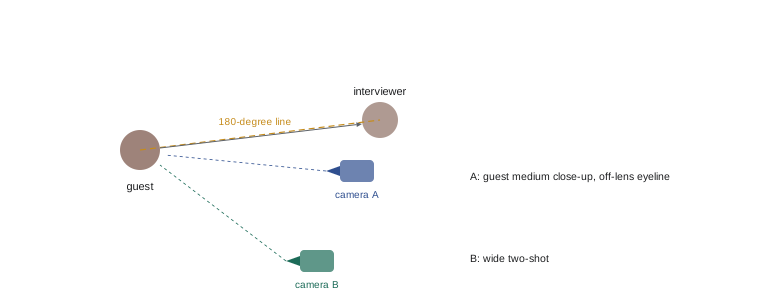
Interviews can be filmed in several ways. In the classic documentary setup, the guest looks at the interviewer, who sits just beside the camera, so that the guest's eyeline is slightly off-lens; viewers observe the conversation (Lesson 5). The interviewer may be off camera entirely, with questions edited out, which requires guests to answer in complete sentences that include the question ("The reason I started the company was ..."); ask them to do this at the start. In conversational setups, common for podcasts and creator collaborations, both people are on camera, often with a wide two-shot and individual close-ups from separate cameras. Position the interviewer so that the guest's eyeline matches the intended framing, and keep the 180-degree rule in mind so that eyelines cut together (CRE-130). CINE-320 covers documentary interview cinematography.
Consent and recording law
Guests should always know that they are being recorded, how the recording will be used and where it will be published. Recording conversations secretly, even where legally permitted, damages trust and can be unethical.
In Canada, the Criminal Code generally makes it lawful to record a private conversation when at least one party to it, which can be the interviewer, consents; recording conversations you are not part of without consent can be an offence. Privacy laws, such as PIPEDA and provincial statutes like Quebec's Law 25, can also apply when a business collects, uses or publishes personal information, and Quebec law protects a person's right to their image. For interviews intended for publication, obtain clear consent from guests to record and publish.
This is general information rather than legal advice; laws change and vary, and creators with specific concerns should consult a lawyer. CRE-320 covers creator law in more depth.
Releases and editing ethics
A guest release, a short written agreement, confirms that the guest consents to being recorded and that you may edit and publish the recording on specified platforms, now and in the future, and often to use clips for promotion. Releases protect both sides and are commonly required by platforms, broadcasters and sponsors. Discuss editing openly: guests may ask to review the edit or to remove particular comments; decide in advance whether you offer approval, and be clear about it. When editing, preserve the meaning of what guests said: cutting answers so that they appear to say something different, or pairing an answer with a different question, misrepresents them and can damage your reputation and theirs. Trimming for length and clarity is normal; distortion is not.
Remote interviews
Many creator interviews take place remotely, using video calling software or dedicated remote recording platforms that record each participant locally in high quality and upload the files, avoiding the compression and dropouts of live calls. Good practice includes sending guests a short technical guide in advance (headphones to prevent echo, a quiet room, a camera at eye level, window light in front of them, a stable internet connection); doing a quick technical check before recording; recording a backup of the call; and agreeing on a plan if the connection drops. Many guests are unfamiliar with on-camera setups, so patience and clear, friendly instructions help. The same principles of preparation, rapport and listening apply as in person, though reading body language and timing interjections can be harder with lag, so pause slightly longer before speaking.
Interviewing vulnerable people
Some interviews involve people in difficult circumstances: survivors of trauma, people experiencing illness, grief, poverty or discrimination, or young people. These interviews require extra care. Explain the purpose and use of the interview fully and in plain language, ensure consent is informed and voluntary, allow guests to pause, skip questions or stop at any time, avoid pressing for graphic details, and consider how publication might affect them, including online reactions. For minors, obtain consent from a parent or guardian as well as the young person's agreement. Trauma-informed interviewing practices, used by journalists and documentary makers, emphasize safety, choice and respect, and many organizations publish guidance that creators can learn from.
Ending an interview well
The end of an interview matters as much as the beginning. Useful closing questions include "Is there anything I haven't asked that you would like to talk about?", which often produces surprising material, and a forward-looking or reflective question. Thank the guest sincerely, explain what happens next, such as editing and publication dates, and keep recording for a few moments, since relaxed final remarks are sometimes the best part. Afterwards, send the guest a thank-you message, share the finished content and tag them, which strengthens relationships and encourages future collaborations.
Interviewing experts for clarity
Experts often speak in jargon and assume knowledge that your audience may not have. Asking for examples, analogies and simple explanations ("How would you explain that to someone new to the topic?") helps make expert interviews accessible without talking down to viewers.
Preparing guests for camera
Brief guests on what to expect on camera: where to look, how long answers should be, and that they can restart answers if they stumble.
Common mistakes
MistakeAsking closed, multi-part or leading questions.
InsteadAsk short, open questions and story prompts.
MistakeSticking rigidly to the question list.
InsteadListen and follow up on promising answers.
MistakeFilling every silence immediately.
InsteadPause to invite deeper answers.
MistakeRecording without clear consent.
InsteadExplain the recording and use, and get a release.
MistakeEditing answers to change their meaning.
InsteadTrim for clarity while preserving meaning.
Summary and key terms
- Choose guests for relevance and value, and invite them specifically and honestly.
- Research guests deeply and agree purpose and boundaries.
- Ask mostly open questions, story prompts and specific follow-ups.
- Build rapport before and during the interview.
- Listening, silence and follow-up questions produce the best moments.
- Set up eyelines and cameras deliberately for the format.
- Obtain consent and releases, edit fairly and prepare guests for remote recording.
- Open question
- Question inviting a descriptive answer.
- Closed question
- Question answerable with yes or no.
- Leading question
- Question suggesting its answer.
- Story prompt
- Request to tell a specific story.
- Follow-up question
- Question building on a previous answer.
- Rapport
- Comfortable, trusting connection.
- Paraphrasing
- Restating what someone said in your own words.
- One-party consent
- Recording allowed with one participant's consent.
- Guest release
- Written consent to record, edit and publish.
- Local recording
- Recording each participant's audio and video on their own device.
Practice problems
Work each problem on paper first, then reveal the answer to check.
What matters more than fame in choosing guests?
Show answer
Relevance and value to your audience.
What should an invitation include?
Show answer
Who you are, why them, topics, format, publication, benefits.
Convert "Were you scared?" into an open question.
Show answer
"What was going through your mind?"
Why avoid multi-part questions?
Show answer
Guests choose the easiest part and get confused.
How does silence help interviews?
Show answer
It prompts guests to add more.
How do you handle a talkative guest?
Show answer
Polite, brief interruptions to steer.
Why ask guests to include the question in their answer?
Show answer
So answers stand alone when questions are cut.
What is the recording consent rule in your country?
Show answer
One-party in Canada; one-party federally and in most US states, all-party in some.
What does a guest release cover?
Show answer
Consent to record, edit, publish and promote.
Why use local recording for remote interviews?
Show answer
Higher quality without call compression and dropouts.
Lesson quiz · 5 questions
Score 60% or more to complete this lesson.
Create a free account to save your progress, take quizzes and earn a certificate.