
CRE-220 · Lesson 2 of 12 · 25 min
Narrative structures for creators
Structure is the order and shape in which a story unfolds. The same events can be told in a way that grips viewers or in a way that loses them within seconds, depending on where the story starts, how tension builds, when information is revealed and how it ends. Storytellers have developed many structures over centuries, from ancient drama to modern screenwriting, and several translate well to creator content. This lesson introduces the classic three-act structure, the story spine, the "and, but, therefore" pattern, the story circle and the hero's journey, structures for explainers, reviews and case studies, nonlinear openings, and how to choose and adapt a structure for a specific video. It focuses on story shape; CRE-210 and CRE-211 cover the editing and retention mechanics of short and long videos.
The three-act structure
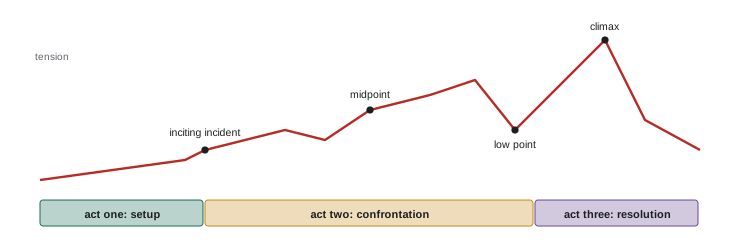
The most widely used structure divides a story into three parts:
- Act one, the setup: introduces the character, the situation and the want, and ends with an inciting incident or turning point that sets the story in motion.
- Act two, the confrontation: the character pursues the goal and meets obstacles that escalate, often with a midpoint that raises the stakes or changes the direction, and ends with a low point or crisis.
- Act three, the resolution: the climax, where the central conflict is resolved, followed by a brief resolution that shows what has changed.
In feature films, act two is the longest, about half the running time. In a creator video, the same proportions often apply: a short setup, a longer middle of attempts and complications, and a satisfying payoff. The structure is so familiar that viewers sense when a story is missing one of its parts, such as a payoff that arrives without any struggle.
The story spine
The story spine, an improvisation exercise developed by playwright Kenn Adams and later popularized by former Pixar story artist Emma Coats, is a simple template that captures the essential shape of a story:
- Once upon a time there was ...
- Every day, ...
- One day ...
- Because of that, ...
- Because of that, ...
- Until finally ...
- And ever since then ...
The spine forces a story into cause and effect: each event happens because of the previous one, rather than simply after it. For creators, it is a fast way to test whether an idea is a story or just a sequence of events. A travel vlog that runs "we went to the market, then we went to the beach, then we had dinner" has no spine; one that runs "every day we ate at the hotel, until one day a taxi driver told us about his aunt's restaurant; because of that we got lost in the old town; because of that we met ..." does.
And, but, therefore
Scientist and filmmaker Randy Olson, building on observations by the creators of the animated series South Park, popularized the "and, but, therefore" (ABT) template for communicating ideas: "We know this AND this, BUT there is a problem, THEREFORE we did this." The key insight is that stories advance through "but" and "therefore", contradiction and consequence, rather than through "and then", which merely adds events. Replacing "and then" with "but" or "therefore" in an outline is a quick way to add tension and logic. ABT works particularly well for openings, pitches, explainers and video descriptions.
Worked problem
Applying ABT to a product review
A creator reviewing a budget microphone has an outline: "I bought this microphone, and then I tested it, and then I compared it with my usual one, and then I decided it was good." How could ABT strengthen it?
Show solution
- And: "Most creators are told they need a $300 microphone, and I believed that for years."
- But: "But a viewer challenged me to try a $40 microphone for a week without telling anyone."
- Therefore: "Therefore I recorded every video this week on it; let us see whether you noticed."
- Payoff: reveal the comparison, with honest strengths and weaknesses, and the verdict.
Answer: An "and, but, therefore" opening creates a contradiction and consequence that give the review tension and a reason to watch to the end.
The story circle and the hero's journey
Mythologist Joseph Campbell described a recurring pattern in myths around the world, which he called the monomyth or hero's journey: a hero leaves the ordinary world, faces trials, gains something and returns transformed. Screenwriters adapted it, and television writer Dan Harmon simplified it into an eight-step story circle: a character is in a zone of comfort; they want something; they enter an unfamiliar situation; they adapt to it; they get what they wanted; they pay a heavy price for it; they return to their familiar situation; and they have changed. The circle is useful for transformation stories: learning a skill, moving to a new country, starting a business, a fitness or creative challenge. Creators who document a long project, such as building a cabin or learning a language, often find their footage naturally follows this shape, and editing it around the circle makes the journey clearer.
| Structure | Core idea | Best for |
|---|---|---|
| Three acts | Setup, confrontation, resolution | Most stories and projects |
| Story spine | Cause and effect from routine to change | Testing ideas, short stories |
| And, but, therefore | Context, contradiction, consequence | Openings, explainers, pitches |
| Story circle | Comfort, journey, price, return changed | Transformation and challenge stories |
| Problem, solution, result | Pain point, method, outcome | Tutorials and case studies |
Structures for explainers, tutorials and reviews
Informational content benefits from structures adapted to its purpose:
- Problem, solution, result: show a problem the viewer recognizes, demonstrate the solution, and show the result. Many tutorials and product demonstrations follow this pattern.
- Question and answer: pose a question that the audience genuinely wants answered, explore possible answers, and deliver the real one, with surprises along the way.
- Myth and reality: present a common belief, test or examine it, and reveal what is actually true.
- Before and after: show the starting state, the process and the transformation, popular in renovation, makeover, cleaning and fitness content (with honest representation of results).
- Case study: follow one real example in depth to illustrate a broader point.
Each of these has a built-in question that creates curiosity, a middle that delivers value, and a payoff.
Nonlinear openings
Stories do not have to be told in chronological order. Starting at a dramatic or intriguing moment, then going back to explain how the character got there, is called beginning in medias res ("in the middle of things") or using a flash-forward. It is common in creator content because it gives viewers an immediate reason to stay: a cold open showing a flooded kitchen before explaining the renovation, or a moment of triumph before the story of the struggle. Other nonlinear devices include framing the story as a memory or reflection, telling two stories in parallel that meet at the end, and revealing a key fact late that reframes everything before it. Nonlinear structures must remain easy to follow: clear signals of time, such as "three weeks earlier", help viewers orient themselves.
Beginnings, middles and endings
Each part of a story has particular challenges for creators. Beginnings must establish the character, want and stakes quickly while making a promise about what the viewer will get; starting too early, with background and context, is the most common mistake. Middles must escalate: each obstacle should raise the stakes or change the situation, rather than repeating the same difficulty; varying the type of obstacle, introducing setbacks and revealing new information keep momentum. Endings must deliver on the promise of the beginning, show the change clearly and leave a feeling or idea behind; long goodbyes and unrelated calls to action after the emotional peak dilute the ending. A useful test is whether the ending answers the question raised at the beginning.
Choosing and adapting a structure
Structures are tools, not rules. Choose one that fits the story and the format: a transformation suits the story circle, a surprising finding suits myth and reality, a tutorial suits problem, solution, result. Combine structures freely; a long video might use ABT for its opening, three acts for its main story and before-and-after for a segment. Outline the structure before filming where possible, so that you capture the moments each part needs, such as the starting state in a before-and-after or the low point in a challenge. For documentary and vlog content, you may discover the structure in editing, but knowing the shapes helps you recognize the story in your footage. Above all, test the outline by telling the story aloud in under a minute: if it does not hold your listener's interest in that form, it will not hold viewers in a longer one.
Kishōtenketsu and conflict-free structures
Not every story needs conflict. Kishōtenketsu, a structure traditionally associated with Chinese and Japanese poetry and narrative, has four parts: ki introduces the situation, shō develops it, ten introduces an unexpected twist or new element, and ketsu brings the parts together in a reconciliation that reveals a connection. It creates interest through contrast and surprise rather than opposition. For creators, it suits gentle, reflective and observational content: a day-in-the-life video that turns on an unexpected discovery, a cooking video in which an unusual ingredient transforms a familiar dish, or a travel story in which a chance encounter reframes a place. It is a useful reminder that tension can come from curiosity and surprise as well as from struggle.
Structure in series and episodic content
Many creators publish series, where structure operates at two levels: each episode has its own arc, and the series has a larger arc across episodes. A renovation series might have a season-long goal (finishing the house) with each episode covering one room, its own problem and its own payoff. Ending episodes with a question or a new problem, a cliffhanger, encourages viewers to watch the next. Recurring structural elements, such as a familiar opening, a regular segment or a signature ending, help viewers settle into each episode. CRE-210 discusses recurring formats; the storytelling principle is that both the episode and the season should have a want, obstacles and change.
Common structural problems
Diagnosing problems in a story outline is easier with a checklist. A story that feels flat often lacks a clear want or stakes. A story that drags usually has a middle that repeats the same obstacle. A story that confuses viewers often has unclear time jumps or too many characters. A story that feels unsatisfying often has an ending that does not answer the opening question or arrives without struggle. And a story that feels manipulative often has a twist or emotional peak that the earlier parts did not set up. Fixing these issues at the outline stage is far easier than fixing them in editing.
Outlining a story on one page
Many creators outline stories on a single page or index card before filming. A one-page outline might list the opening hook, the setup in one sentence, three or four escalating beats in the middle, the turning point, the resolution and the closing line, each with a note of the shot or scene needed. Keeping the outline short forces clarity: if the story cannot be summarized on one page, it may be trying to do too much. The outline also helps on set, ensuring that each structural moment is captured, and in editing, where it serves as a map for assembling footage into the intended shape.
Matching structure to platform
Platforms shape how structures are used. Short-form platforms reward stories that establish the situation within a second or two and reach the turn quickly, often looping back to the start. Long-form platforms allow full three-act structures with subplots and reflection. Podcasts allow slower setups and digressions, as long as the main thread remains clear. Newsletters and text posts favour stories with a strong first line and a short, clear payoff. Choosing a structure with the platform in mind, then adapting it rather than copying it unchanged between platforms, gives each version the best chance of holding attention.
Common mistakes
MistakeConnecting events with "and then".
InsteadUse "but" and "therefore" for tension and cause.
MistakeStarting with long background.
InsteadBegin near the action or the question.
MistakeRepeating the same obstacle in the middle.
InsteadEscalate and vary obstacles.
MistakeAn ending that ignores the opening promise.
InsteadAnswer the question raised at the start.
MistakeConfusing nonlinear timelines.
InsteadSignal time jumps clearly.
Summary and key terms
- Structure is the order and shape in which a story unfolds.
- Three acts: setup, escalating confrontation and resolution.
- The story spine builds cause and effect from routine to change.
- "And, but, therefore" adds contradiction and consequence.
- The story circle suits transformation and challenge stories.
- Explainers use problem-solution, question-answer, myth-reality and before-after.
- Nonlinear openings hook viewers; choose and combine structures to fit the story.
- Structure
- Order and shape of a story.
- Three-act structure
- Setup, confrontation and resolution.
- Inciting incident
- Event that sets the story in motion.
- Midpoint
- Turn in the middle of act two.
- Climax
- Moment the central conflict is resolved.
- Story spine
- Template from routine through causes to change.
- ABT
- And, but, therefore template.
- Story circle
- Eight-step transformation structure.
- In medias res
- Beginning in the middle of the action.
- Payoff
- Delivery of what the story promised.
Practice problems
Work each problem on paper first, then reveal the answer to check.
Name the three acts.
Show answer
Setup, confrontation, resolution.
Which act is usually longest?
Show answer
Act two.
What does the story spine force?
Show answer
Cause and effect between events.
What words advance stories in ABT?
Show answer
"But" and "therefore".
Who simplified the hero's journey into a story circle?
Show answer
Dan Harmon.
Name two explainer structures.
Show answer
Problem-solution-result, myth-reality, question-answer, before-after.
What is in medias res?
Show answer
Starting in the middle of the action.
What is the most common beginning mistake?
Show answer
Starting too early with background.
How should middles work?
Show answer
Escalate and vary obstacles.
How can you test an outline?
Show answer
Tell it aloud in under a minute.
Lesson quiz · 5 questions
Score 60% or more to complete this lesson.
Create a free account to save your progress, take quizzes and earn a certificate.