
CRE-220 · Lesson 4 of 12 · 25 min
Voice: breath, pitch, pace and clarity
Your voice carries most of what viewers receive from you, whether they are watching a talking-head video, listening to a podcast or hearing a voiceover over B-roll. A clear, expressive voice keeps attention and conveys confidence and warmth; a strained, monotonous or rushed voice loses viewers, however good the content. Voice is a physical instrument that can be trained, much as singers and actors train theirs. This lesson covers how the voice works, breathing for speech, pitch and intonation, pace and pauses, volume and projection for the microphone, articulation and clarity, emphasis and vocal variety, accents and authenticity, vocal habits to watch, and looking after your voice. CRE-130 covers microphones and recording; this lesson is about the voice itself.
How the voice works
Speech begins with breath. Air from the lungs passes through the larynx, where the vocal folds vibrate to create sound; the pitch depends on how fast they vibrate. The sound then resonates in the throat, mouth and nasal cavities, which shape its tone, and the tongue, lips, teeth and palate shape it into words. Each part of this system can be trained: breath for support and stamina, the vocal folds for pitch range and health, resonance for warmth and fullness, and articulation for clarity. Tension anywhere in the body, especially in the shoulders, neck, jaw and tongue, constricts the voice, which is why warming up and relaxing before recording matter.
Breathing for speech
Many people breathe shallowly into the upper chest, especially when nervous, which produces a thin, strained voice and runs out of air quickly. Diaphragmatic breathing, breathing low into the abdomen so that the belly and lower ribs expand while the shoulders stay still, gives more air, better control and a fuller sound. A simple exercise is to place one hand on the chest and one on the belly, then breathe in slowly through the nose so that only the lower hand moves, and breathe out on a long, steady "sss" sound. Practising this daily builds the habit. When speaking, take breaths at natural pauses, such as the ends of sentences and ideas, rather than gasping mid-phrase, and plan breath points in scripted lines. Good posture, standing or sitting tall with relaxed shoulders, allows the lungs to expand fully.
Pitch and intonation
Pitch is how high or low the voice sounds; intonation is the pattern of rising and falling pitch across a sentence. Each person has a natural, comfortable pitch, often called their optimal or habitual pitch, where the voice is most resonant and least tiring. Speaking much lower or higher than this, for example to sound more authoritative or more energetic, strains the voice over time. Intonation conveys meaning and emotion: a falling pitch at the end of a sentence sounds certain and complete, while a rising pitch sounds like a question. Habitual rising intonation on statements, sometimes called uptalk, is common and not inherently wrong, but if every sentence rises, viewers may hear uncertainty. Varying pitch, rising for questions and excitement and falling for conclusions, keeps speech lively; monotone delivery, where pitch barely changes, is one of the main reasons talking-head videos feel dull.
Pace and pauses
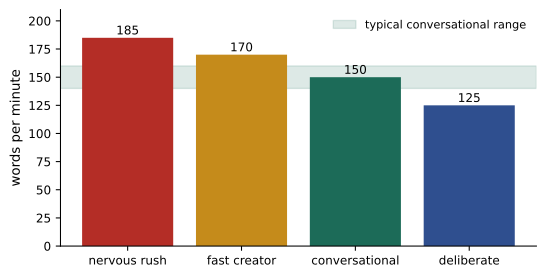
Conversational speech in English typically runs at about 140 to 160 words per minute, though individuals vary widely and fast-paced creators may speak at 180 words per minute or more. Speaking too fast, common when nervous or reading a script, makes content hard to follow and gives viewers no time to absorb ideas; speaking too slowly can feel sluggish. More important than average pace is variation: slowing down for important points, complex ideas and emotional moments, and speeding up slightly for lighter material and lists. Pauses are powerful tools. A pause before a key point creates anticipation; a pause after it gives viewers time to absorb it; a pause at a turning point in a story builds tension. Many creators edit out every pause to keep energy high, but cutting all pauses can make delivery breathless and reduce the impact of important lines.
Worked problem
Estimating script length
A creator has written a script of 1,050 words for a YouTube video. At a comfortable pace of 150 words per minute, how long will the video be? What happens if nerves push the pace to 185 words per minute?
Show solution
- At 150 words per minute: 1,050 / 150 = 7 minutes.
- At 185 words per minute: 1,050 / 185 ≈ 5.7 minutes.
- The faster delivery is about 1.3 minutes shorter, which usually also means less clarity and fewer pauses for emphasis.
- Rehearse with a timer and mark pauses in the script to keep the pace near the intended rate.
Answer: About 7 minutes at 150 words per minute, but under 6 minutes if nerves push the pace to 185, so rehearse and mark pauses.
Volume and projection for the microphone
Projection means producing a voice with enough energy and support to carry, not simply shouting. On stage, speakers project to reach the back of the room; on camera, with a microphone close to the mouth, very loud projection sounds unnatural and can distort. The goal for most creator content is a supported, conversational voice: imagine speaking to one person sitting across a table, with enough energy to sound engaged. Speaking too quietly into a microphone often produces a breathy, low-energy sound, and raising the level in editing raises background noise too (CRE-130). Keep a consistent distance from the microphone, and avoid dropping volume at the ends of sentences, a common habit that makes the last words hard to hear.
Articulation and clarity
Articulation is how clearly sounds are formed. Mumbled or slurred speech, swallowed consonants and dropped word endings make content hard to understand, especially for viewers listening on phone speakers, in noisy places, at faster playback speeds or in a second language. Clear articulation does not mean exaggerated or theatrical speech; it means fully forming consonants, opening the mouth enough for vowels, and finishing words. Tongue twisters, reading aloud slowly with deliberate articulation, and exercises with a cork or pen held lightly between the teeth (a technique some voice coaches use, with care) build clarity. Recording yourself and listening back, especially at 1.5× speed, reveals unclear passages quickly.
| Element | What to aim for | Common problem |
|---|---|---|
| Breath | Low, relaxed, planned breaths | Shallow chest breathing, gasping |
| Pitch | Natural range with variation | Monotone, or strained high or low |
| Pace | About 140–160 wpm with variation | Rushing, especially when nervous |
| Pauses | Before and after key points | No pauses, or filled with "um" |
| Volume | Supported conversational level | Fading at sentence ends |
| Articulation | Fully formed consonants and endings | Mumbling, swallowed words |
Emphasis and vocal variety
Emphasis highlights the most important words in a sentence, using a combination of slightly higher pitch, greater volume, longer duration and a small pause before the word. The same sentence changes meaning with emphasis: "I never said she stole the money" means seven different things depending on which word is stressed. Scripted delivery often sounds flat because readers emphasize words evenly or at random. Marking key words in scripts, and speaking the meaning rather than the words, helps. Vocal variety combines changes in pitch, pace, volume and tone across a piece, matching the content: brighter and quicker for exciting news, slower and lower for serious moments, warmer for personal stories. Listeners interpret this variety as enthusiasm and sincerity; without it, even fascinating content sounds uninterested.
Accents and authenticity
Everyone speaks with an accent, and regional, national and second-language accents are part of who people are. There is no single correct accent for creators, and audiences increasingly value diverse voices. The goal is clarity, not changing your accent: slowing slightly, articulating fully and avoiding very local slang or idioms when your audience is broad helps people from different backgrounds understand you. Some creators choose to adjust their speech for particular audiences or work with accent coaches, which is a personal choice; others make their accent part of their identity. What matters is that viewers can understand you and that your voice sounds like you.
Vocal habits to watch
Several habits commonly weaken delivery:
- Filler words such as "um", "uh", "like", "you know" and "so", which in small numbers sound natural but in large numbers distract. Replacing fillers with brief silent pauses is the most effective cure, achieved through practice and awareness.
- Vocal fry, a low, creaky sound at the ends of phrases when breath runs low; occasional fry is normal, but constant fry can sound tired and is harder to hear on small speakers.
- Upspeak on every sentence, discussed above.
- Throat clearing and lip smacks, picked up clearly by close microphones; drinking water and avoiding dairy before recording helps some people.
- Reading voice, a flat, sing-song or overly formal tone that appears when reading scripts, discussed in Lesson 5.
Recording and listening back is the best way to identify your own habits.
Looking after your voice
Creators who record daily, stream for hours or present at events place heavy demands on their voices. Vocal health habits include drinking plenty of water throughout the day; warming up before recording with humming, lip trills, gentle sirens through your pitch range and tongue twisters; resting the voice between long sessions; avoiding shouting, whispering for long periods and speaking over loud noise; limiting irritants such as smoke and excessive alcohol and caffeine; and using a microphone setup that lets you speak at a comfortable volume. Persistent hoarseness, pain or voice changes lasting more than two or three weeks should be checked by a doctor or a speech-language pathologist, who can also help with voice training.
A daily vocal warm-up
A short warm-up of five to ten minutes before recording prepares the voice and reduces tension. A typical sequence: relax the body with shoulder rolls, neck stretches and a few deep breaths; breathe in through the nose and out on a long "sss" or "fff" to engage breath support; hum gently on a comfortable pitch, feeling vibration in the lips and face; do lip trills (blowing air through loosely closed lips while making a sound) sliding up and down your range; glide through your pitch range on "ng" or "oo" like a siren; stretch the jaw and tongue; and finish with tongue twisters such as "red leather, yellow leather" or "unique New York", starting slowly and building speed. Doing the same routine regularly builds consistency and helps the voice recover between sessions.
Voice for different formats
Different formats call for different vocal approaches. Voiceovers, heard without seeing the speaker, rely entirely on the voice, so clarity, warmth and variety matter even more; many narrators record standing, which supports breathing. Short-form videos often use a brighter, quicker delivery to match fast pacing, while long-form educational content benefits from a calmer, more varied pace that viewers can listen to for many minutes. Podcasts favour an intimate, conversational tone, close to the microphone. Live streams require stamina, so pacing your energy and resting your voice during breaks matters. Adapting your voice to the format, while keeping it recognizably yours, is part of developing a presenting style.
Recording yourself to improve your voice
Self-recording is the most effective way to improve vocal delivery. Record a short passage, such as the opening of a script, then listen for pace, pauses, pitch variation, clarity and fillers. Re-record with one change at a time, such as slowing down or adding pauses before key words, and compare. Many presenters keep a recording from their first month and listen to it every few months to hear their progress.
Marking a script for delivery
Simple marks make scripts easier to deliver: a slash for a short pause, a double slash for a longer one, underlining for emphasis, an arrow for rising or falling intonation, and a breath mark where you will breathe. Marking takes a few minutes and noticeably improves pacing and clarity.
Common mistakes
MistakeBreathing shallowly into the chest.
InsteadBreathe low and plan breath points.
MistakeSpeaking in a monotone.
InsteadVary pitch, pace and volume with the content.
MistakeRushing when nervous.
InsteadRehearse with a timer and mark pauses.
MistakeFading at the ends of sentences.
InsteadSupport the voice through the last word.
MistakeRecording long sessions without warming up.
InsteadWarm up, hydrate and rest the voice.
Summary and key terms
- The voice relies on breath, vocal folds, resonance and articulation.
- Diaphragmatic breathing gives support, control and stamina.
- Speak near your natural pitch and vary intonation.
- Conversational pace is about 140–160 wpm; vary it and use pauses.
- Aim for a supported, conversational volume at the microphone.
- Clear articulation helps viewers on small speakers and at faster speeds.
- Emphasis and variety convey meaning; care for your voice.
- Vocal folds
- Tissue in the larynx that vibrates to make sound.
- Diaphragmatic breathing
- Breathing low into the abdomen.
- Pitch
- How high or low the voice sounds.
- Intonation
- Pattern of rising and falling pitch.
- Uptalk
- Rising intonation at the end of statements.
- Pace
- Speed of speech in words per minute.
- Projection
- Supported vocal energy that carries.
- Articulation
- Clarity of speech sounds.
- Vocal fry
- Low creaky sound at the bottom of the range.
- Filler words
- Words such as um and like that fill pauses.
Practice problems
Work each problem on paper first, then reveal the answer to check.
What starts the speech process?
Show answer
Breath from the lungs.
Describe diaphragmatic breathing.
Show answer
Breathing low so the belly and lower ribs expand.
What does a falling pitch at a sentence end convey?
Show answer
Certainty and completion.
Typical conversational pace?
Show answer
About 140–160 words per minute.
Length of a 900-word script at 150 wpm?
Show answer
6 minutes.
Where should pauses go?
Show answer
Before and after key points, at turning points.
Why avoid fading at sentence ends?
Show answer
The last words become hard to hear.
How can you check articulation?
Show answer
Record and listen back, including at 1.5×.
What is the best cure for filler words?
Show answer
Replacing them with silent pauses through practice.
When should voice problems be checked by a professional?
Show answer
If hoarseness or pain lasts more than two or three weeks.
Lesson quiz · 5 questions
Score 60% or more to complete this lesson.
Create a free account to save your progress, take quizzes and earn a certificate.