
CON-410 · Lesson 5 of 12 · 26 min
The Last Planner System II: look-ahead planning, constraints and make-ready
The phase plan from lesson 4 sets out what should happen and in what order. Between that plan and the crew's weekly work lies the most important step in the Last Planner System: making the work ready. A task is ready when everything it needs is in place, so that a crew assigned to it can start and finish without interruption. Making work ready is not something that happens by itself. It needs a regular process that looks a few weeks ahead, identifies what stands in the way of each upcoming task and assigns someone to remove each obstacle in time. This is the look-ahead process. Done well, it turns the hope in a schedule into a pipeline of ready work. This lesson covers how the look-ahead window works, how constraints are identified and logged, and how teams measure whether they are making work ready fast enough.
The look-ahead window
The look-ahead plan covers a rolling window, typically four to eight weeks, with six weeks a common choice. Each week the window rolls forward: a new week of tasks enters from the phase plan at the far end, and the nearest week becomes the basis for next week's work plan. The length of the window should match the longest lead time of the constraints the team expects to remove. If submittals take four weeks to approve and fabricated items take three more, a window shorter than seven weeks will expose tasks to constraints that can no longer be cleared in time.
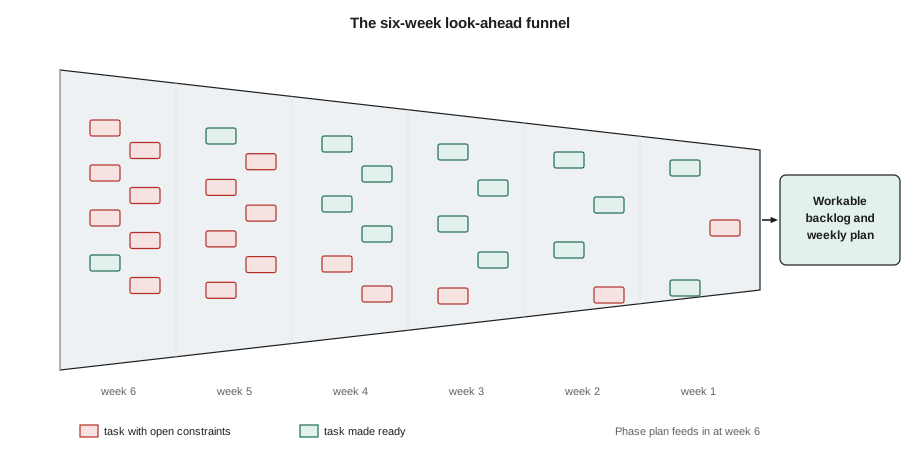
Tasks in the look-ahead are broken down to a finer level than in the phase plan, usually into the operations a crew would actually perform, located by zone or area: for example, 'mechanical rough-in, floor 4, zones A and B' rather than 'mechanical rough-in, residential floors'. Each task is screened for constraints. Tasks whose constraints cannot be removed in time are moved later rather than left in the plan to fail.
The seven preconditions
Lauri Koskela identified seven preconditions that every construction task needs before it can be done well. They provide a checklist for screening tasks. If any precondition is missing, the task is constrained.
| Precondition | Question to ask | Typical constraint |
|---|---|---|
| Information | Are drawings, specifications and answers available and current? | Open RFI, unapproved shop drawing, design change pending |
| Materials | Is the material approved, delivered and accessible? | Long-lead equipment not shipped, wrong delivery |
| Labour | Is a crew of the right size and skill committed? | Trade short of workers, crew on another site |
| Equipment and tools | Are hoists, lifts, scaffold and tools available? | Hoist fully booked, scissor lift broken |
| Prerequisite work | Is the preceding work complete and accepted? | Rough-in not finished, deficiencies outstanding |
| Space | Is the work area free and safe for this crew? | Area occupied by another trade, material stored in the way |
| External conditions | Are permits, inspections, weather and approvals in place? | Inspection not booked, permit pending, temperature too low |
Some teams add safety as an eighth precondition: is the task planned so that it can be done safely, with the right protection, permits and hazard assessment in place? Including it in the screen means that safety constraints, such as an unprotected floor edge or a missing hot work permit, are cleared before the crew arrives rather than discovered when they do.
The constraint log
Each constraint identified in the look-ahead is recorded in a constraint log with a description, the task it affects, the person responsible for removing it and the date by which it must be removed. The date is worked back from the task's planned start, allowing for the lead time of the action. The log is reviewed at the weekly look-ahead meeting: constraints removed are closed, new ones are added and any that are at risk are escalated. A well-run constraint log is one of the most useful documents on a site, because it turns vague worries ('we might not have the panels in time') into specific actions with owners and dates.
| ID | Task | Constraint | Type | Owner | Need by | Status |
|---|---|---|---|---|---|---|
| C-041 | Board floor 4 zone A | In-wall inspection not booked | External | Northgate super | Week 14 Mon | Open |
| C-042 | Electrical rough-in floor 5 | Revised panel schedule (RFI 118) | Information | Architect / EOR | Week 14 Wed | Open |
| C-043 | Plumbing rough-in floor 5 | Two plumbers short next week | Labour | Plumbing foreperson | Week 14 Mon | At risk |
| C-044 | Hang kitchen cabinets floor 3 | Cabinets on site, not hoisted | Materials | Northgate logistics | Week 15 Mon | Open |
| C-045 | Tape and mud floor 3 | Temporary heat below 10 °C | External | Northgate super | Week 14 Mon | Closed |
# Constraint log health check: overdue, at-risk and average age (illustrative data)
from datetime import date
today = date(2026, 3, 30)
log = [  # id, type, raised, need_by, closed (or None)
    ("C-031", "Information", date(2026, 2, 23), date(2026, 3, 16), date(2026, 3, 13)),
    ("C-035", "Materials",   date(2026, 3, 2),  date(2026, 3, 23), date(2026, 3, 25)),
    ("C-038", "Crew",      date(2026, 3, 9),  date(2026, 3, 30), None),
    ("C-041", "External",    date(2026, 3, 16), date(2026, 4, 6),  None),
    ("C-042", "Information", date(2026, 3, 16), date(2026, 4, 8),  None),
    ("C-043", "Crew",      date(2026, 3, 23), date(2026, 4, 6),  None),
    ("C-044", "Materials",   date(2026, 3, 23), date(2026, 4, 13), None),
    ("C-039", "Prerequisite", date(2026, 3, 9), date(2026, 3, 27), None),
]
open_items = [c for c in log if c[4] is None]
overdue = [c[0] for c in open_items if c[3] < today]
due_week = [c[0] for c in open_items if 0 <= (c[3] - today).days <= 7]
late_closed = [c[0] for c in log if c[4] and c[4] > c[3]]
ages = [(today - c[2]).days for c in open_items]
print("Open constraints:", len(open_items))
print("Overdue (need-by date passed):", overdue)
print("Due within 7 days:", due_week)
print("Closed after their need-by date:", late_closed)
print(f"Average age of open constraints: {sum(ages) / len(ages):.1f} days")Open constraints: 6 Overdue (need-by date passed): ['C-039'] Due within 7 days: ['C-038', 'C-041', 'C-043'] Closed after their need-by date: ['C-035'] Average age of open constraints: 14.0 days
The health check shows what a superintendent should look for each week: constraints whose need-by date has passed (the affected task should be moved out of next week's plan unless the constraint can be cleared immediately), constraints due within the week (which need confirmation from their owners) and constraints that were cleared late (whose causes are worth discussing). A growing average age is an early warning that the make-ready process is falling behind.
Screening, making ready and shielding
Ballard described the look-ahead process with three actions. Screening examines each task for constraints. Making ready assigns and pursues the actions that remove them. Shielding protects crews from work that is not ready by keeping constrained tasks out of the weekly work plan. Shielding is the action most often skipped. When a task's constraint is not cleared, the temptation is to leave it in the plan and hope; lean practice is to defer it, so that the crew is assigned work it can actually do and the failure becomes visible in the constraint log rather than as an idle crew.
| Action | What it means | Common failure |
|---|---|---|
| Screen | Check every task in the window against the preconditions | Screening only the next week, too late to act |
| Make ready | Assign and pursue constraint-removal actions with dates | Actions with no owner or vague due dates |
| Shield | Keep constrained tasks out of the weekly work plan | Assigning blocked work and hoping it clears |
The workable backlog
Tasks whose constraints have all been removed form the workable backlog: work that is ready and could be done if a crew were assigned. A healthy backlog holds somewhat more ready work than crews can complete in a week, typically one to two weeks of work for each trade. Too little backlog means that if a planned task is blocked at the last moment, the crew has nothing else to do. Too much means that the team has made work ready far ahead of need, tying up materials and effort and risking rework if plans change. The backlog is a buffer of readiness: it protects crews from the variability in the make-ready process.
Worked problem
Sizing the workable backlog
The Willowmere drywall crew can hang board on about two zones per week. The board crew's workable backlog currently holds three zones whose framing, rough-in, inspections and insulation are complete. Is the backlog adequate if the target is between one and two weeks of work?
Show solution
- One week of work = 2 zones; two weeks = 4 zones.
- Backlog = 3 zones = 1.5 weeks.
Answer: Yes: three ready zones is 1.5 weeks of work, within the target range. If an inspection fails on one zone, the crew can still be fully loaded next week.
Measuring make-ready performance
Two metrics, proposed in lean construction research, measure how well the look-ahead process is working. Tasks Anticipated (TA) measures how well the look-ahead predicted the work: of the tasks that appear in a week's work plan, what fraction were in the look-ahead two or more weeks earlier? Tasks Made Ready (TMR) measures how well constraints were removed: of the tasks in the look-ahead for a given week a few weeks ago, what fraction ended up ready and in that week's plan? Low TA means the team is planning reactively, with new work appearing at the last moment. Low TMR means constraints are not being cleared in time.
# Tasks Anticipated (TA) and Tasks Made Ready (TMR) for week 14 (illustrative)
lookahead_wk12_for_wk14 = {"board 4A", "board 4B", "elec 5A", "elec 5B", "plumb 5A", "plumb 5B",
                           "mech 5A", "cabinets 3A", "cabinets 3B", "tape 3C"}
plan_wk14 = {"board 4A", "elec 5A", "elec 5B", "plumb 5A", "mech 5A", "cabinets 3A",
             "cabinets 3B", "tape 3C", "firestop 2D", "touch-up 2A"}
ta = len(plan_wk14 & lookahead_wk12_for_wk14) / len(plan_wk14)
tmr = len(plan_wk14 & lookahead_wk12_for_wk14) / len(lookahead_wk12_for_wk14)
print(f"Tasks Anticipated: {ta:.0%}")
print(f"Tasks Made Ready:  {tmr:.0%}")
print("Anticipated but not made ready:", sorted(lookahead_wk12_for_wk14 - plan_wk14))
print("In the plan but not anticipated:", sorted(plan_wk14 - lookahead_wk12_for_wk14))Tasks Anticipated: 80% Tasks Made Ready: 80% Anticipated but not made ready: ['board 4B', 'plumb 5B'] In the plan but not anticipated: ['firestop 2D', 'touch-up 2A']
Here 80 % of week 14's tasks were anticipated two weeks earlier, and 80 % of the anticipated tasks were made ready. The two that appeared without warning, firestopping and touch-up, may be legitimate small tasks, or they may show that deficiency work is not being planned. The two anticipated tasks that were not made ready, board on zone 4B and plumbing on zone 5B, should each be traced to a constraint in the log.
The look-ahead meeting
Most teams hold a weekly look-ahead meeting, separate from or combined with the weekly work planning meeting covered in lesson 6. A typical agenda reviews the phase plan for changes, rolls the window forward a week, screens new tasks for constraints, reviews the constraint log item by item and confirms the workable backlog for each trade. The meeting should be short and disciplined, with the constraint log on a screen or wall and each owner reporting on their items. Design team members, suppliers and inspectors may attend when their constraints are on the agenda.
| Agenda item | Time | Lead |
|---|---|---|
| Safety moment and changes since last week | 5 min | Superintendent |
| Roll window forward; new tasks from phase plan | 10 min | Superintendent, field engineer |
| Screen new tasks against preconditions | 15 min | Trade forepersons |
| Constraint log review by owner | 20 min | Each constraint owner |
| Workable backlog by trade | 5 min | Trade forepersons |
| Escalations and decisions needed | 5 min | Project manager |
Link to workface planning and short-interval plans
The look-ahead process overlaps with workface planning, which is widely used on industrial projects and breaks work into installation work packages that are released to the field only when all their constraints are cleared. The ideas are compatible: both insist that work is ready before it is released. CON-335 covers trade coordination and short-interval planning at the field level, including detailed workface planning and coordination meetings; this course focuses on the Last Planner System as a whole.
Common mistakes
MistakeMaking the look-ahead window shorter than the longest constraint lead time.
InsteadSize the window so constraints can still be removed in time, often six weeks or more.
MistakeLeaving constrained tasks in next week's plan and hoping they clear.
InsteadShield crews by deferring tasks whose constraints are not removed.
MistakeRecording constraints without an owner or a need-by date.
InsteadGive every constraint a named owner and a date worked back from the task start.
MistakeHolding almost no workable backlog.
InsteadKeep about one to two weeks of ready work per trade so crews stay loaded when a task is blocked.
MistakeScreening only for materials and prerequisite work.
InsteadCheck all seven preconditions, and safety as well.
Summary and key terms
- The look-ahead process turns the phase plan into ready work by removing constraints over a rolling window, often six weeks.
- Tasks are screened against seven preconditions: information, materials, labour, equipment, prerequisite work, space and external conditions; many teams add safety.
- The constraint log records each constraint with an owner and a need-by date and is reviewed weekly.
- Screen, make ready and shield: constrained tasks are kept out of the weekly plan.
- The workable backlog of ready tasks, about one to two weeks per trade, protects crews from last-minute blockages.
- Tasks Anticipated and Tasks Made Ready measure the quality of the look-ahead process.
- The weekly look-ahead meeting is short, disciplined and driven by the constraint log.
- Look-ahead plan
- A rolling plan, typically four to eight weeks, used to identify and remove constraints.
- Constraint
- Anything that would stop a task from starting or finishing as planned.
- Constraint log
- A register of constraints with owners, need-by dates and status.
- Make-ready process
- The actions taken to remove constraints before work is assigned.
- Screening
- Checking upcoming tasks for constraints.
- Shielding
- Protecting crews by keeping constrained tasks out of their plans.
- Workable backlog
- Tasks with all constraints removed, ready to be assigned.
- Tasks Anticipated
- The fraction of a week's planned tasks that appeared in the look-ahead in advance.
- Tasks Made Ready
- The fraction of tasks in the look-ahead for a week that were made ready for that week.
- Preconditions
- The things a task needs before it can be done: information, materials, labour, equipment, prerequisite work, space and external conditions.
Practice problems
Work each problem on paper first, then reveal the answer to check.
Submittal approval takes 3 weeks and fabrication 4 weeks. What is the minimum sensible look-ahead window?
Show answer
At least 7 weeks, so those constraints can still be cleared.
Name the seven preconditions.
Show answer
Information, materials, labour, equipment, prerequisite work, space, external conditions.
A task is scheduled for Monday of week 16 and the action to clear its constraint takes 6 working days. What is the need-by date to start the action?
Show answer
About Friday of week 14 (six working days before Monday of week 16).
What is shielding?
Show answer
Keeping tasks whose constraints are not removed out of the weekly work plan.
A crew completes 3 zones a week. How large should its workable backlog be?
Show answer
About 3 to 6 zones (one to two weeks).
10 tasks are in this week's plan and 7 were in the look-ahead two weeks earlier. What is TA?
Show answer
70 %.
12 tasks were in the look-ahead for this week and 9 were made ready. What is TMR?
Show answer
75 %.
What does a rising average age of open constraints suggest?
Show answer
The make-ready process is falling behind.
Why might teams add safety as a precondition?
Show answer
So safety constraints are cleared before the crew starts rather than discovered on arrival.
What is the risk of too large a workable backlog?
Show answer
Work is made ready too early, tying up resources and risking rework if plans change.
Lesson quiz · 5 questions
Score 60% or more to complete this lesson.
Create a free account to save your progress, take quizzes and earn a certificate.