
CON-410 · Lesson 11 of 12 · 26 min
Continuous improvement and lean culture
The fifth lean principle, pursue perfection, is the one that keeps the other four alive. A site can introduce pull planning, a constraint log and a takt board, and still slide back into old habits within months if nobody is learning from what happens. Continuous improvement, kaizen in Toyota's vocabulary, is the habit of looking at every problem as a chance to make the system better, and doing so in small steps, all the time, with the people who do the work. This lesson covers the main tools of continuous improvement on a construction project: the plan-do-check-act cycle, A3 problem solving, the five whys, Gemba walks, first-run studies, standard work, visual management, plus-delta reviews and Choosing by Advantages. It ends with the cultural conditions that let these tools work, including the close link between lean and safety.
Plan, do, check, act
The plan-do-check-act (PDCA) cycle, associated with Walter Shewhart and W. Edwards Deming, is the basic pattern of improvement. Plan: understand the problem, find its causes and choose a countermeasure. Do: try the countermeasure, often on a small scale. Check: measure whether it worked. Act: adopt it as the new standard if it worked, or try something else if it did not, then start the cycle again. On a construction site, cycles are short. A team might plan a change to how inspections are booked, try it on two floors for two weeks, check whether in-wall inspection delays fall and then adopt the change for the whole building.
| Step | Questions | Willowmere example |
|---|---|---|
| Plan | What is the problem? What is the root cause? What will we try? | In-wall inspections often late; booking had no owner; try a booking owner and 3-day lead time |
| Do | Try the countermeasure on a small scale | Apply on floors 4 and 5 for two weeks |
| Check | Did it work? Compare with the baseline | Late inspections fell from 5 of 8 to 1 of 8 |
| Act | Standardize, spread, or try again | Add to the constraint log template for all floors |
A3 problem solving
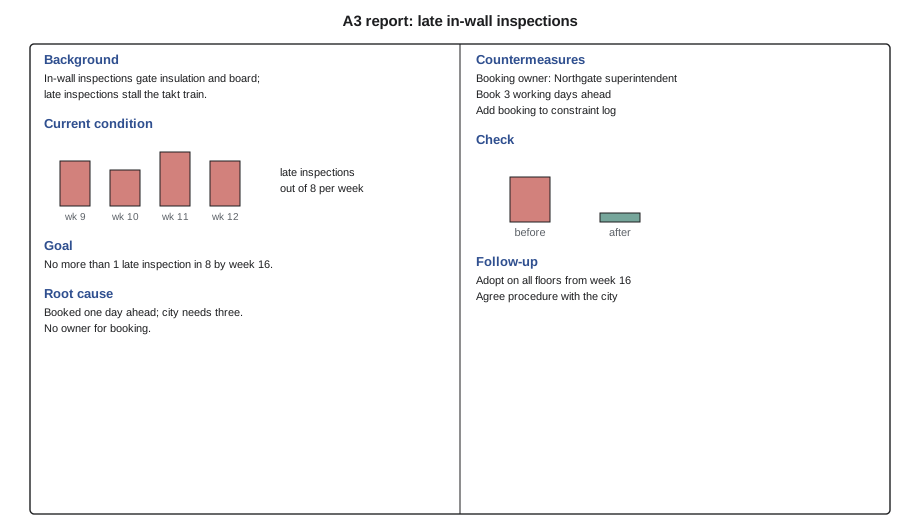
An A3 report, named after the international paper size of 297 by 420 mm, is a single sheet that tells the story of a problem and its solution in PDCA order. Toyota uses A3s for problem solving, proposals and status reports. The discipline of fitting the whole story on one sheet forces clarity: the problem must be stated concisely, the current condition shown with data, the root cause identified and the countermeasures and follow-up made specific. An A3 is usually written by the person closest to the problem, coached by someone more experienced, and reviewed with the people affected. It is as much a tool for developing problem solvers as for solving problems.
| A3 section | Content |
|---|---|
| Background | Why this problem matters to the project |
| Current condition | What is happening now, with data and a simple diagram |
| Goal | A specific, measurable target condition |
| Root cause analysis | Five whys, fishbone diagram or other analysis |
| Countermeasures | What will be changed, by whom, by when |
| Check | How results will be measured and what they show |
| Follow-up | Standardization, spreading to other areas, open issues |
The five whys and fishbone diagrams
The five whys technique, which lesson 6 used on a missed commitment, asks why a problem happened, then why that cause happened, and so on until the answer points to something in the system that can be changed. Five is a guideline, not a rule; sometimes three questions reach the root, sometimes seven are needed. The technique works best in a group that includes the people involved, and it fails when it stops at a person ('the insulator was slow') rather than a process. A fishbone (Ishikawa) diagram complements it by organizing possible causes into categories such as people, methods, materials, equipment, environment and information, so that the team considers causes beyond the first one that comes to mind.
| Weak five whys | Stronger five whys |
|---|---|
| Why was the ceiling grid installed wrong? The installer misread the drawing. | Why was the grid wrong? It followed the architectural reflected ceiling plan. |
| Why? He was careless. | Why was that a problem? The plan had not been updated for the revised diffuser locations. |
| Countermeasure: warn the installer. | Why? Mechanical revisions were issued without a coordination check against architectural drawings. |
| Why? No step in the RFI and revision process required it. | |
| Countermeasure: add a cross-discipline check to the revision process; confirm with a field walk before grid starts. |
Gemba walks
Gemba is a Japanese word for the actual place, where value is created. On a construction project, the gemba is the workface, not the site office. A Gemba walk is a structured visit by managers to the workface to observe how work is done, ask questions and learn about problems, not to inspect, criticize or give orders. Managers who regularly walk the work with forepersons see constraints that never appear in reports: material stored in the wrong place, a hoist queue, a confusing detail on a drawing, a safety hazard that crews have learned to work around. A good Gemba walk has a purpose, involves listening more than talking and ends with follow-up on what was learned.
| Do | Do not |
|---|---|
| Go with a purpose, such as following material flow | Wander without focus |
| Ask open questions: "What slows you down?" | Give instructions or criticize |
| Observe the work in its actual conditions | Arrange a cleaned-up tour |
| Record what you learn and follow up | Forget it once back in the office |
| Thank people for showing you problems | Blame people for problems you see |
First-run studies
A first-run study plans, observes and reviews the first time a repeated operation is performed, so that the best method is worked out before the operation is repeated many times. On Willowmere, the first bathroom pod set, the first installation of a corridor rack and the first zone of board hanging were each run as first-run studies. The team planned the method with the crew, identified the materials, tools, safety requirements and quality checks, observed the first run (often on video, with the crew's agreement), then met to review what went well and what could be improved, and wrote the improved method as standard work for later runs. A first-run study is a short PDCA cycle aimed at the start of the learning curve from lesson 10.
# Value of a first-run study on corridor rack installation (illustrative)
racks = 56                         # corridor racks on residential floors
hours_without_frs = [14.0, 12.6, 11.9, 11.5] + [11.0] * (racks - 4)   # crew-hours per rack, slow learning
frs_cost = 24                      # crew-hours spent planning and reviewing the first run
hours_with_frs = [13.0, 10.4, 9.8] + [9.4] * (racks - 3)              # better method found early
saved = sum(hours_without_frs) - sum(hours_with_frs) - frs_cost
print(f"Without first-run study: {sum(hours_without_frs):.0f} crew-hours")
print(f"With first-run study:    {sum(hours_with_frs) + frs_cost:.0f} crew-hours (including {frs_cost} for the study)")
print(f"Net saving: {saved:.0f} crew-hours, {saved / sum(hours_without_frs):.0%}")Without first-run study: 622 crew-hours With first-run study: 555 crew-hours (including 24 for the study) Net saving: 67 crew-hours, 11%
Standard work and visual management
Standard work is the current best known method for doing a task, written down simply so that everyone does it the same way and so that it can be improved. It is the baseline against which improvement is measured: without a standard, there is nothing to improve, only variation. In construction, standard work often takes the form of a short method statement with photos, a checklist or a sequence card for repeated operations. Standard work is not fixed forever; it is updated each time the team finds a better way.
Visual management makes the state of the work visible at a glance, so problems can be seen and acted on quickly. Examples on a lean site include the pull planning wall and takt board, zone status boards on each floor showing which wagon is in which zone, colour-coded material staging areas, shadow boards for shared tools, marked walkways and laydown areas, and a big-room wall with PPC, the constraint log and the improvement backlog. The 5S method from BUS-230 lesson 11 (sort, set in order, shine, standardize, sustain) applies directly to gang boxes, laydown areas and work floors.
| Visual tool | What it shows | Where |
|---|---|---|
| Takt board | Which wagon is in which zone; status of each | Site office and each floor |
| Zone status card | Zone ready, in progress, released, accepted | Entrance to each zone |
| Constraint log wall | Open constraints, owners, due dates | Big room |
| PPC and reasons chart | Planning reliability and causes | Big room |
| Material staging marks | Where each delivery goes | Floors and laydown |
| Shadow board | Which shared tools are present or missing | Tool crib, gang boxes |
Plus-delta and Choosing by Advantages
Many lean teams end meetings and phases with a quick plus-delta review: what went well (plus) and what should change (delta). It takes five minutes, gives everyone a voice and, if the deltas are tracked and acted on, keeps meetings and processes improving. Larger decisions, such as choosing between prefabricated and site-built bathrooms or between two site logistics plans, benefit from a structured method. Choosing by Advantages (CBA), developed by Jim Suhr and widely used in lean projects, compares alternatives by the importance of their advantages rather than by scoring factors with arbitrary weights. The team identifies the factors that matter, describes the attributes of each alternative on each factor, determines the advantage of each alternative over the least preferred attribute, judges how important each advantage is, and chooses the alternative with the greatest total importance of advantages, considering cost separately.
# Choosing by Advantages: two site logistics plans for Willowmere (illustrative importance scores)
# For each factor, the advantage belongs to the better alternative; importance is judged 0-100
factors = {
    # factor: (alternative with the advantage, description, importance)
    "hoist waiting":       ("B", "second hoist cuts peak queue from ~40 to ~10 min", 90),
    "crane time for pods": ("A", "tower crane stays 6 weeks longer, no mobile crane days", 55),
    "laydown space":       ("B", "uses rented lot; frees podium deck for staging", 40),
    "community impact":    ("A", "no street closures for mobile crane", 35),
    "worker safety":       ("B", "fewer loads swung over occupied floors", 70),
}
cost = {"A": 410_000, "B": 465_000}
total = {"A": 0, "B": 0}
for f, (alt, desc, imp) in factors.items():
    total[alt] += imp
    print(f"{f:<20} advantage {alt}: {desc} (importance {imp})")
for alt in "AB":
    print(f"Plan {alt}: total importance of advantages {total[alt]:>3}, cost ${cost[alt]:,}")
extra = cost["B"] - cost["A"]
print(f"Is {total['B'] - total['A']} more importance worth ${extra:,} more? The team decides.")hoist waiting advantage B: second hoist cuts peak queue from ~40 to ~10 min (importance 90) crane time for pods advantage A: tower crane stays 6 weeks longer, no mobile crane days (importance 55) laydown space advantage B: uses rented lot; frees podium deck for staging (importance 40) community impact advantage A: no street closures for mobile crane (importance 35) worker safety advantage B: fewer loads swung over occupied floors (importance 70) Plan A: total importance of advantages 90, cost $410,000 Plan B: total importance of advantages 200, cost $465,000 Is 110 more importance worth $55,000 more? The team decides.
CBA does not produce a mechanical answer. It structures the conversation so that the team sees clearly what it gets for the extra cost of one alternative, and records why it chose as it did. In the example, Plan B's advantages carry much more importance, mainly because of hoist waiting and safety, for $55,000 more. Most teams would choose B, but the decision belongs to the people accountable for it.
Lean and safety
Lean and safety are closely linked. Many of the conditions that waste time also create hazards: congested work areas, material stored in walkways, crews rushing to recover lost time, work started before the area is ready, ad hoc methods instead of planned ones. Reliable planning reduces the pressure to cut corners. First-run studies and standard work include safety in the method. Daily huddles combine planning and hazard discussion. Gemba walks find hazards that reports miss. And the lean principle of stopping to fix problems, rather than working around them, is the same principle that underlies a strong safety culture in which anyone can stop unsafe work. Several contractors that adopted lean planning have reported improved safety performance alongside productivity, although it is hard to separate the effect of lean from other safety programs. The safety leadership course CON-355 and HSE-401 develop these ideas further.
| Lean practice | Safety benefit |
|---|---|
| Make-ready and constraint removal | Crews start work with protection, access and permits in place |
| Zone-based flow with one trade per zone | Less stacking of trades and congestion |
| Reliable weekly plans | Less rushing to recover lost time |
| First-run studies and standard work | Hazards designed out of repeated tasks |
| Gemba walks and daily huddles | Hazards seen and discussed early |
| Stop and fix problems | Supports stop-work authority and reporting |
Building a lean culture
Lean tools are easy to copy; lean culture is not. Organizations that have sustained lean practices over many years share several features: leaders who model the behaviour by going to the gemba, asking questions and accepting bad news; respect for the trades as partners rather than adversaries; patience to let improvements accumulate; investment in training and coaching; and a focus on learning rather than blame. Trade partners need to see a benefit, such as steadier work, fewer delays and fair treatment, or they will see lean as another way for the general contractor to squeeze them.
In Canada, LCI-Canada, a special committee of the Canadian Construction Association since 2015, provides training, communities of practice and conferences, and a growing number of owners, including some health authorities and public agencies, encourage lean practices on their projects. University research groups in several provinces study lean implementation and productivity.
| Maturity stage | Typical signs |
|---|---|
| Starting | A few tools tried on one project; PPC around 50 %; enthusiasm mixed with doubt |
| Practising | Last Planner System used on most projects; constraint logs and huddles routine; PPC rising |
| Integrating | Takt and prefabrication planned in design; trades partner across projects; A3 thinking common |
| Sustaining | Continuous improvement is how the company works; leaders coach; learning shared across projects |
Common mistakes
MistakeStopping a five whys analysis at a person.
InsteadKeep asking until the answer points to a process that can be changed.
MistakeUsing Gemba walks to inspect and criticize.
InsteadGo to observe, ask open questions, listen and follow up.
MistakeRepeating an operation dozens of times before reviewing the method.
InsteadRun a first-run study and write standard work early.
MistakeRecording plus-delta items and never acting on them.
InsteadTrack deltas and assign actions.
MistakeTreating lean and safety as separate programs.
InsteadUse reliable planning, standard work and stop-and-fix to improve both.
Summary and key terms
- Continuous improvement follows the plan-do-check-act cycle in short, frequent steps.
- An A3 report tells the story of a problem and its solution on one sheet and develops problem solvers.
- The five whys and fishbone diagrams trace problems to system causes, not individuals.
- Gemba walks take managers to the workface to observe and learn.
- First-run studies find the best method for repeated operations before the method is repeated.
- Standard work, visual management, plus-delta reviews and Choosing by Advantages support improvement and decisions.
- Lean and safety reinforce each other, and a lean culture rests on leadership, respect and learning.
- Kaizen
- Continuous improvement through small, frequent changes.
- PDCA cycle
- Plan, do, check, act: the basic cycle of improvement.
- A3 report
- A one-sheet problem-solving report following PDCA.
- Five whys
- Asking why repeatedly to reach a root cause.
- Fishbone diagram
- A diagram organizing possible causes of a problem by category.
- Gemba walk
- A visit by managers to the workplace to observe and learn.
- First-run study
- Planning, observing and reviewing the first instance of a repeated operation.
- Standard work
- The current best known method for a task, documented so it can be followed and improved.
- Visual management
- Making the status of work and problems visible at a glance.
- Choosing by Advantages
- A decision method that compares alternatives by the importance of their advantages.
Practice problems
Work each problem on paper first, then reveal the answer to check.
Name the four steps of the PDCA cycle.
Show answer
Plan, do, check, act.
Why is an A3 limited to one sheet?
Show answer
It forces concise, clear thinking about the problem and solution.
What is wrong with a five whys analysis ending in 'the worker was careless'?
Show answer
It stops at a person instead of a system cause that can be changed.
Name four categories often used on a fishbone diagram.
Show answer
Any four of people, methods, materials, equipment, environment, information.
What should a manager do on a Gemba walk?
Show answer
Observe, ask open questions, listen and follow up.
When is a first-run study most valuable?
Show answer
For operations that will be repeated many times.
Why does improvement need standard work?
Show answer
Without a standard there is only variation, and nothing to measure improvement against.
What two questions does a plus-delta review ask?
Show answer
What went well, and what should change.
How does Choosing by Advantages treat cost?
Show answer
Separately, after comparing the importance of advantages.
Give two ways lean planning improves safety.
Show answer
Any two of work started only when ready, less congestion, less rushing, hazards designed into standard work, early hazard discussion.
Lesson quiz · 5 questions
Score 60% or more to complete this lesson.
Create a free account to save your progress, take quizzes and earn a certificate.