
CON-365 · Lesson 7 of 12 · 19 min
Recruiting, hiring and onboarding the workforce
A construction company's workforce changes constantly. Calder Ridge's field crews grew from about 60 workers when Elmwood's excavation started to 220 at the peak of the concrete and framing work, and will shrink again as the building closes in. Every one of those workers had to be found, checked, hired, oriented and put to work safely, often within days of being needed. Hiring in construction is fast, high-volume and legally sensitive, and the decisions are often made by superintendents and foremen rather than by human resources staff. This lesson covers how construction workers are recruited, the legal rules that apply, and how to bring new workers onto a site so that they stay safe and stay with the company.
Where construction workers come from
A unionized contractor like Calder Ridge gets most of its carpenters and labourers from the union hiring halls. The agreement typically lets the employer request workers by name, up to a set proportion of the crew or for workers who have worked for it recently, and otherwise the hall dispatches workers from its out-of-work list in order. Calder Ridge also keeps a core of long-service workers who move from project to project with it. Open shop contractors recruit directly: through referrals from current workers, job postings, colleges and pre-apprenticeship programs, staffing agencies and, increasingly, social media.
| Source | Strengths | Watch for |
|---|---|---|
| Core workers who follow the company | Known skills and reliability, know company systems | Ageing workforce; retention depends on continuous work |
| Union hiring hall | Fast access to certified workers; training and benefits already in place | Quality varies; dispatch rules limit choice |
| Referrals from current workers | Good fit and retention | Can reproduce a workforce that looks like the existing one |
| Pre-apprenticeship and community programs | Prepared new entrants; supports diversity and community targets | Need mentoring and patience in the first months |
| Colleges and trade schools | Some technical training already done | May lack site experience |
| Staffing agencies | Fast for short peaks | Higher cost; less control over training; shared safety responsibility |
| Workers from other regions or countries | Fill shortages in specialized trades | Travel costs, immigration rules, integration |
The legal rules for hiring
Every province's human rights law prohibits discrimination in employment, including in advertising, application forms, interviews and hiring decisions. In Ontario, the Human Rights Code protects against discrimination on grounds including race, ancestry, place of origin, colour, ethnic origin, citizenship, creed, sex (including pregnancy), sexual orientation, gender identity and expression, age, marital and family status, disability and record of offences. An employer may set genuine occupational requirements, such as holding a trade certificate or being able to work at heights with fall protection, but it must accommodate workers with disabilities or other protected needs up to the point of undue hardship.
Ontario's employment standards law added new hiring rules that took effect on January 1, 2026 for employers with 25 or more employees. Publicly advertised job postings must state the expected pay or pay range, must say whether artificial intelligence is used to screen or select applicants, and may not require Canadian work experience. Employers must also tell interviewed applicants whether a hiring decision has been made, generally within 45 days of the last interview. Calder Ridge updated its posting templates and its applicant tracking process before the rules took effect.
Union hiring halls must also follow the law. A union that operates a hiring hall must dispatch fairly according to its rules and may not discriminate on protected grounds or against workers who are not members, and an employer that takes part in a discriminatory referral system can share responsibility.
What supervisors may and may not ask
Superintendents and foremen often interview candidates informally, on site, in a few minutes. Grace trains them to focus on the job and to avoid questions that suggest a protected ground played a part in the decision.
| Instead of asking | Ask |
|---|---|
| Where are you from originally? | Are you legally entitled to work in Canada? |
| How old are you? When do you plan to retire? | Can you perform the essential duties of the job, such as climbing and lifting to the stated limits, with or without accommodation? |
| Do you have children? Who looks after them when you work early? | This job starts at 7 a.m. and sometimes needs Saturday work. Can you meet that schedule? |
| Have you ever made a workers' compensation claim? | Do you hold the required safety training, such as working at heights? |
| What religion are you? Will you need time off for holidays? | Are there any days you cannot work that we should plan around? |
| Is your English good enough? | Can you read and follow the safety instructions and signs on this site? (Asked of everyone) |
Asking every candidate the same questions, writing down the answers and the reason for the decision, and keeping the notes protects both the company and the candidate. It also improves the decision, because it forces the supervisor to think about what the job actually requires.
Pre-employment checks
Construction employers commonly check trade certificates, safety training (such as Ontario's mandatory working at heights training for workers who use fall protection), driver's licences for workers who will drive, and references. Drug and alcohol testing is more limited in Canada than many supervisors assume. After the Supreme Court of Canada's 2013 decision in Irving Pulp & Paper, random testing in a unionized workplace generally requires evidence of a significant problem at that workplace, although testing after an incident or for reasonable cause is more widely accepted, and pre-access testing required by some owners has been the subject of arbitration. Any testing program must also accommodate workers with substance use disorders, which are disabilities under human rights law.
Getting the number right
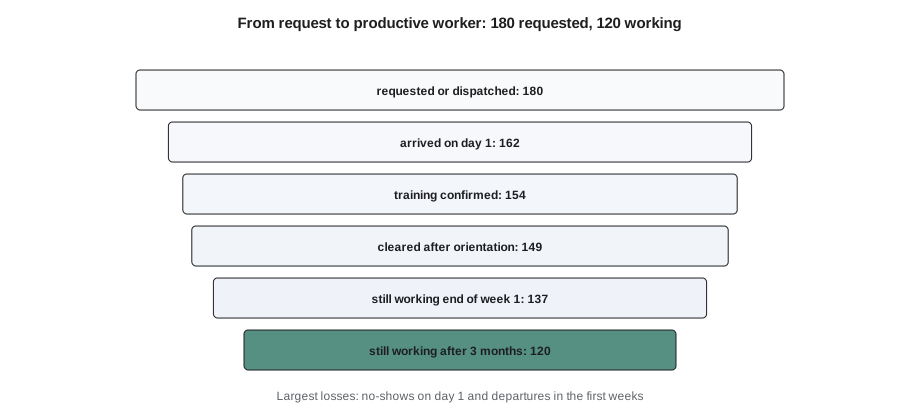
When Luis needs 30 more carpenters on Monday for the start of the tower's framing cycle, requesting exactly 30 almost never produces 30 productive workers by the end of the first week. Some dispatched workers do not show up, some lack required training, some do not complete orientation, and some leave in the first days. Grace tracked these losses on Elmwood and uses them to size requests.
# How many carpenters to request to have 30 productive by the end of week 1 (rates from Elmwood records)
show_up = 0.90          # share of dispatched or recruited workers who arrive on day 1
training_ok = 0.95      # share who hold required safety training or can complete it on day 1
orientation_ok = 0.97   # share who complete orientation and are cleared to work
stay_week1 = 0.92       # share still working at the end of week 1
need = 30
yield_rate = show_up * training_ok * orientation_ok * stay_week1
request = need / yield_rate
print(f"yield from request to productive worker: {yield_rate:.1%}")
print(f"request {request:.1f} -> round up to {int(-(-request // 1))} workers")
for n in (30, 36, 40):
print(f"requesting {n}: expect about {n * yield_rate:.1f} productive by end of week 1")yield from request to productive worker: 76.3% request 39.3 -> round up to 40 workers requesting 30: expect about 22.9 productive by end of week 1 requesting 36: expect about 27.5 productive by end of week 1 requesting 40: expect about 30.5 productive by end of week 1
With a yield of about 76 percent, Luis needs to request 40 workers to have 30 working at the end of the week. Requesting more is not free: the extras who do show up and stay must be paid and kept busy, and a hiring hall will not appreciate repeated over-requests. The better long-term answer is to raise the yield: confirm training before dispatch, send clear start information, and make the first week a good one, so that fewer workers leave.
Onboarding: the first week decides a lot
Construction has high early turnover, and new workers are also much more likely to be injured in their first weeks on a site. Both problems have the same causes: unfamiliarity with the site, the crew and the company's expectations, and a reluctance to ask questions. Calder Ridge's onboarding has five parts, building on the site orientation described in CON-355.
- Before day 1: a text or call with the start time, location, parking, what to bring, who to ask for, and the required training documents.
- Day 1, first hours: site orientation covering hazards, emergency procedures, rules and the right to refuse unsafe work; payroll and benefits paperwork; a tour of the work area.
- Day 1, at the work face: introduction to the foreman and the crew, and a named buddy who works alongside the new worker for the first week.
- End of week 1: a ten-minute conversation with the foreman: how is it going, what is unclear, what does the worker need?
- End of month 1: a check by Grace's team on paperwork, training and any concerns, and for apprentices, a meeting with their mentor.
New workers are marked with a coloured hard-hat sticker for their first month so that everyone on site knows to look out for them. Luis found that the stickers also made experienced workers more willing to stop and explain things, because they could see who was new.
Retention: keeping the people you hired
Turnover is expensive. Each departure costs recruiting time, orientation, lost productivity while a replacement learns the site, and often a gap in the crew. In a tight labour market, good workers have choices, and they leave contractors where the work is disorganized, the supervisors are disrespectful or the next job is uncertain. Calder Ridge tracks turnover by crew and by length of service, and asks every worker who leaves voluntarily why.
# Voluntary departures on Elmwood by length of service (12 months, illustrative)
departures = {"under 1 month": 21, "1 to 3 months": 14, "3 to 12 months": 9, "over 12 months": 4}
headcount_avg = 180
total = sum(departures.values())
print(f"voluntary turnover: {total} departures / {headcount_avg} average headcount = {total / headcount_avg:.0%} per year")
cum = 0
for band, n in departures.items():
    cum += n
    print(f"  {band:15s} {n:3d}  ({n / total:4.0%}, cumulative {cum / total:4.0%})")
reasons = {"left for higher pay or overtime": 15, "commute or travel": 9, "crew or supervisor": 11, "left the trade": 6, "other": 7}
print("top reasons:", ", ".join(f"{k} ({v})" for k, v in sorted(reasons.items(), key=lambda kv: -kv[1])))voluntary turnover: 48 departures / 180 average headcount = 27% per year under 1 month 21 ( 44%, cumulative 44%) 1 to 3 months 14 ( 29%, cumulative 73%) 3 to 12 months 9 ( 19%, cumulative 92%) over 12 months 4 ( 8%, cumulative 100%) top reasons: left for higher pay or overtime (15), crew or supervisor (11), commute or travel (9), other (7), left the trade (6)
Almost three-quarters of voluntary departures happened in the first three months, which points to hiring and onboarding rather than pay as the main lever. The second most common reason, problems with the crew or supervisor, led Grace to look at which foremen's crews had the highest early turnover and to pair those foremen with coaching in how to bring new workers in. Pay and travel were real reasons too, but harder for one project to change.
Common mistakes
MistakeAsking candidates about age, family, origin or religion in informal site interviews.
InsteadAsk every candidate the same job-related questions and record the answers and reasons.
MistakeRequesting exactly the number of workers needed.
InsteadSize requests using known yields, and work to improve the yield by checking training and improving the first week.
MistakeAssuming random drug testing is always allowed.
InsteadRandom testing in unionized workplaces generally needs evidence of a workplace problem; any program must accommodate substance use disorders.
MistakeTreating the first day as paperwork and a video.
InsteadPlan the first week: contact before day 1, a buddy, a week-one check-in and a month-one review.
MistakeBlaming turnover on pay alone.
InsteadTrack when and why workers leave; early departures usually point to hiring and onboarding.
Summary and key terms
- Construction workers come from core crews, hiring halls, referrals, community programs, colleges, agencies and other regions.
- Human rights law prohibits discrimination in hiring; Ontario added pay range, AI disclosure and no-Canadian-experience rules in 2026.
- Hiring halls must refer fairly; employers can share responsibility for discriminatory referral.
- Supervisors should ask the same job-related questions of every candidate and record their reasons.
- Pre-employment checks and testing must follow the law and the collective agreement.
- Size worker requests using known yields from request to productive worker.
- A planned first week reduces early injuries and early departures.
- Track turnover by length of service and reason to find what to fix.
- Name request
- An employer's request to the hiring hall for a specific worker, allowed within limits by the agreement.
- Out-of-work list
- The hiring hall's list of unemployed members, from which workers are dispatched in order.
- Bona fide occupational requirement
- A job requirement that is genuinely necessary and can justify a distinction, subject to accommodation.
- Duty to accommodate
- The obligation to adjust work for people with protected needs, such as disabilities, up to undue hardship.
- Yield
- The share of requested or recruited workers who become productive on site.
- Onboarding
- The process of bringing a new worker into the company, site and crew.
- Voluntary turnover
- Departures initiated by workers, as a share of average headcount.
Practice problems
Work each problem on paper first, then reveal the answer to check.
Why should every candidate be asked the same questions?
Show answer
It keeps the focus on job requirements, avoids questions touching protected grounds, and creates a record that supports the decision.
With a yield of about 76 percent, how many workers should be requested to have 30 productive?
Show answer
40.
What share of Elmwood's voluntary departures happened in the first three months?
Show answer
About 73 percent (35 of 48).
What did the departure reasons suggest Grace should do first?
Show answer
Focus on onboarding and on foremen whose crews had high early turnover.
Name three parts of Calder Ridge's onboarding.
Show answer
Any three: contact before day 1, site orientation, a buddy at the work face, a week-one check-in, a month-one review.
What was Elmwood's annual voluntary turnover rate?
Show answer
About 27 percent: 48 departures on an average headcount of 180.
Lesson quiz · 5 questions
Score 60% or more to complete this lesson.
Create a free account to save your progress, take quizzes and earn a certificate.