
CON-365 · Lesson 6 of 12 · 22 min
Project labour agreements and community benefits
Most collective agreements cover a trade and an employer for all of its work. A project agreement is different: it covers every contractor and every trade on one project, setting common terms for the life of that project. Owners use project agreements to secure labour peace and a reliable supply of skilled workers on large, long or critical projects. Governments increasingly attach community benefits to them: targets for apprentices, local residents, Indigenous workers, women and other groups under-represented in the trades. Supporters say they deliver projects on time and spread the benefits of public spending; critics say they shut out open shop contractors and raise costs. This lesson explains how these agreements work and how a contractor manages under one.
What a project agreement contains
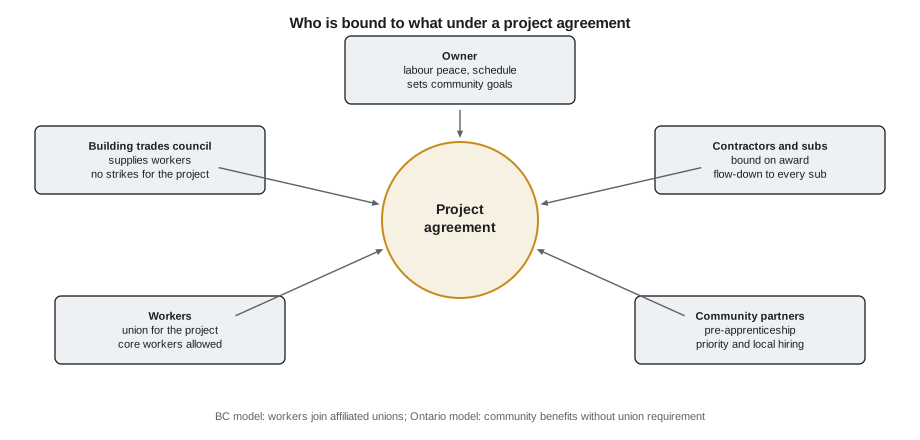
Project agreements vary widely, but most include a familiar set of terms. They are usually negotiated before bidding between the owner, or a construction manager acting for it, and a council of building trades unions, and every contractor that wins work on the project must agree to be bound.
| Term | Typical content | Why it matters |
|---|---|---|
| Scope | Which work on which site, for how long | Defines which contractors are bound |
| Recognition | The signatory unions represent the craft workers on the project | Non-union contractors must work under union terms for this project |
| No strike, no lockout | No work stoppages for the life of the project, including when local agreements expire | The owner's main reason for the agreement |
| Uniform conditions | Common hours, shifts, holidays and work rules across trades | Reduces friction between trades with different agreements |
| Wages and benefits | Usually the local agreements' rates, sometimes with project-specific premiums | Sets labour cost for bidders |
| Referral and core workers | Workers through the hiring halls, often with a number of a contractor's own core employees allowed | Lets non-union contractors keep some of their workforce |
| Jurisdiction | A dispute procedure that keeps work going | Prevents stoppages between trades |
| Grievances | Expedited procedures and arbitration | Fast resolution on a large site |
| Workforce goals | Apprentice, local hire and equity targets with reporting | Community benefits obligations |
Project agreements and community benefits in Canada
Canada has used project agreements for decades on large industrial and energy projects, such as nuclear refurbishments, hydroelectric dams and oil sands plants, where a work stoppage would be extremely costly. More recently, provincial governments have used them for public infrastructure, often combined with community benefits commitments.
British Columbia's Community Benefits Agreement, introduced in 2018, is the best-known example. On designated public projects, workers are employed through BC Infrastructure Benefits, a Crown corporation, and must join one of the building trades unions affiliated with the agreement within a set period after starting, although their employers need not be unionized. The agreement sets priority hiring for local residents, Indigenous people, women and apprentices, with a target share of trade hours for apprentices. The province says the agreement has trained thousands of apprentices and broadened access to the trades; open shop and CLAC-affiliated contractors and some policy researchers argue that it limits competition and raises costs, and a legal challenge to the mandatory union membership was dismissed by the courts.
In Ontario, public owners have taken a different route. Metrolinx and Infrastructure Ontario have included community benefits programs in major transit and hospital contracts, typically with goals for apprentices and for workers from historically disadvantaged and equity-deserving groups, and for local and social procurement, but without requiring workers to join particular unions. Several Ontario municipalities, including Toronto, have community benefits frameworks for their own projects. Federal infrastructure funding programs have also asked for community employment benefits reporting on larger projects. Indigenous participation agreements are common on resource and infrastructure projects on or near Indigenous lands.
Arguments for and against
The debate over project agreements is one of the most heated in construction policy, and both sides cite studies. A construction manager should understand the arguments without assuming either side is simply right.
| Argument for | Argument against |
|---|---|
| Labour peace: no stoppages for the life of the project, even when local agreements expire | Stoppages on large projects are rare anyway; no-strike clauses in local agreements already apply |
| A reliable supply of trained workers through the hiring halls | Open shop contractors, who employ most construction workers in many regions, must change how they staff |
| Uniform conditions reduce friction between trades | Fewer bidders can mean higher prices |
| Apprenticeship and equity commitments spread the benefits of public spending | Non-union workers may have to pay into benefit plans they will not stay in long enough to benefit from |
| Better safety and quality through trained workforces | Evidence on cost and quality is mixed and contested |
Research on costs is genuinely mixed. Studies sponsored by each side tend to support that side, and independent studies are hard to design because no two projects are alike. Nadia's view is practical: when an owner decides to use an agreement, the contractor's job is to price it accurately and perform under it well.
Pricing and bidding under a project agreement
For a unionized contractor like Calder Ridge, a project agreement usually changes less than for an open shop contractor, because the wages and benefits are often those of the agreements it already works under. The differences are in the details: different hours or shift rules, project holidays, additional reporting, apprentice ratios, and the community benefits targets. For an open shop contractor, the change is larger. It must pay the project rates and contributions, take most of its workers from the hiring halls, and decide which core employees it can bring under the agreement's rules.
Before bidding any project with an agreement, Calder Ridge's estimators answer a short list of questions: which agreements and rates apply; whether there are project-specific premiums, holidays or shift rules; what apprentice ratios and community targets apply and whether the company can meet them with its normal workforce; what reporting is required and who will prepare it; and how subcontractors will be bound, because every subcontract must flow the agreement down.
Meeting workforce targets
Elmwood's owner, the regional hospital, had no project agreement, but its contract with Calder Ridge included a community benefits schedule required by the provincial funding agreement: 15 percent of trade hours worked by apprentices, 10 percent by workers from equity-deserving groups including Indigenous workers, women and newcomers, and quarterly reporting. Targets like these are only met with planning, because they depend on every subcontractor's workforce, not just the general contractor's.
# Quarterly workforce report against Elmwood's community targets (illustrative data)
targets = {"apprentice": 0.15, "priority": 0.10}
subs = {
    # employer: (total trade hours, apprentice hours, priority-group hours)
    "Calder Ridge":        (61_200, 10_400, 7_300),
    "Brightline Electric": (28_500, 5_900, 2_100),
    "Keystone Mechanical": (31_800, 4_100, 2_600),
    "Apex Sheet Metal":    (11_900, 1_300, 900),
    "Norfield Drywall":    (19_600, 1_200, 2_900),
    "Steelcraft Erectors": (6_400, 700, 300),
}
tot = [sum(v[i] for v in subs.values()) for i in range(3)]
print(f"project: apprentice {tot[1] / tot[0]:.1%} (target {targets['apprentice']:.0%}), priority {tot[2] / tot[0]:.1%} (target {targets['priority']:.0%})")
for name, (h, a, p) in sorted(subs.items(), key=lambda kv: kv[1][1] / kv[1][0]):
    flags = []
    if a / h < targets["apprentice"]: flags.append(f"apprentice gap {targets['apprentice'] * h - a:,.0f} h")
    if p / h < targets["priority"]: flags.append(f"priority gap {targets['priority'] * h - p:,.0f} h")
print(f" {name:20s} apprentice {a / h:5.1%} priority {p / h:5.1%} " + ("; ".join(flags) or "on target"))project: apprentice 14.8% (target 15%), priority 10.1% (target 10%) Norfield Drywall apprentice 6.1% priority 14.8% apprentice gap 1,740 h Apex Sheet Metal apprentice 10.9% priority 7.6% apprentice gap 485 h; priority gap 290 h Steelcraft Erectors apprentice 10.9% priority 4.7% apprentice gap 260 h; priority gap 340 h Keystone Mechanical apprentice 12.9% priority 8.2% apprentice gap 670 h; priority gap 580 h Calder Ridge apprentice 17.0% priority 11.9% on target Brightline Electric apprentice 20.7% priority 7.4% priority gap 750 h
At the project level Elmwood was just below the apprentice target and just above the priority-group target, but the breakdown shows where the work is. Calder Ridge and Brightline carried the apprentice numbers, while Norfield, Apex, Steelcraft and Keystone were below; Norfield and Calder Ridge carried the priority hiring, while Brightline, Keystone, Apex and Steelcraft were below. Grace met each subcontractor below target, asked for a plan, and connected them with the pre-apprenticeship programs and community agencies Calder Ridge works with. She also made sure the subcontracts for the remaining trades, not yet awarded, included the targets and the reporting requirement.
Worked problem
Closing an apprentice gap
Elmwood has about 260,000 trade hours left to work, and the project is 0.2 percentage points below its 15 percent apprentice target on the 159,400 hours worked so far. How many apprentice hours must the remaining work include for the project to finish exactly on target?
Show solution
- Total hours at completion: 159,400 + 260,000 = 419,400.
- Apprentice hours needed at completion: 15 percent of 419,400 = 62,910.
- Apprentice hours so far: 23,600.
- Apprentice hours still needed: 62,910 - 23,600 = 39,310, which is 15.1 percent of the remaining 260,000 hours.
Answer: The remaining work must run at about 15.1 percent apprentices. The shortfall is small now, but if it is ignored for two more quarters it will be much harder to recover.
Reporting and verification
Workforce targets bring paperwork, and the paperwork has to be right. Owners and funders usually ask for monthly or quarterly reports of hours by employer, trade, classification and group, and some require certified payroll records or third-party verification. Self-identification as a member of an equity-deserving or priority group must be voluntary and handled confidentially, with access limited to the people preparing the report. Calder Ridge collects the information through a short, optional form at orientation, explains why it is collected and how it is protected, and reports only totals to the owner.
Subcontractors often find the reporting burdensome, especially small firms without payroll staff. Grace provides a simple template, checks the first submission from each subcontractor with them, and follows up on late reports within a week. Reports that arrive late or wrong are the most common reason a project misses its targets on paper even when its workforce is doing well in practice.
Making community benefits work, not just counting them
Hitting a percentage is not the same as helping people build careers. Workers recruited to meet a target and then laid off at the end of the project, or placed on crews where they are not welcome, rarely stay in the trades. Calder Ridge's approach has three parts: recruit through partners that prepare people well, such as pre-apprenticeship programs and Indigenous and community employment agencies; assign every new apprentice a mentor and make sure foremen understand their role; and try to carry good workers forward to the next project rather than releasing them when the targets are met. Lesson 8 on apprenticeship and lesson 10 on respect and inclusion develop these ideas.
Common mistakes
MistakeAssuming a project agreement changes nothing for a unionized contractor.
InsteadCheck hours, shifts, holidays, ratios, targets and reporting, which often differ from the usual agreements.
MistakeBidding without a plan to meet workforce targets.
InsteadEstimate the targets against the company's and subcontractors' likely workforce before bidding.
MistakeForgetting to flow the agreement or targets down to subcontractors.
InsteadInclude them in every subcontract with reporting requirements.
MistakeTreating community targets as a counting exercise.
InsteadRecruit through good partners, mentor new workers and keep them beyond one project.
MistakeTaking either side's cost studies as settled fact.
InsteadRecognize that evidence is mixed; price the agreement accurately when an owner chooses one.
Summary and key terms
- Project agreements cover all contractors and trades on one project with common terms, including no-strike commitments.
- BC's Community Benefits Agreement requires workers on designated projects to join affiliated unions and sets priority hiring; Ontario uses community benefits programs without union requirements.
- Indigenous participation agreements and federal community employment benefits add further obligations.
- Arguments for and against are strongly held and evidence on cost is mixed.
- Contractors must price each agreement's specific terms and flow it down to subcontractors.
- Workforce targets depend on every subcontractor and need tracking by employer.
- Real community benefits come from good recruitment, mentoring and carrying workers forward.
- Project agreement
- A collective agreement covering all contractors and trades on a single project.
- Community benefits agreement
- An agreement or contract schedule that commits a project to hiring, training or procurement benefits for a community or groups.
- BC Infrastructure Benefits
- The BC Crown corporation that employs trade workers on projects under the province's Community Benefits Agreement.
- Equity-deserving groups
- Groups that face barriers to employment, such as Indigenous people, women, racialized people, newcomers and people with disabilities.
- Core workers
- A contractor's own regular employees allowed to work on a project under an agreement's rules.
- Flow-down
- Including the obligations of a prime contract or agreement in each subcontract.
- Indigenous participation agreement
- An agreement setting employment, training and contracting commitments for Indigenous communities on a project.
Practice problems
Work each problem on paper first, then reveal the answer to check.
What is the owner's main reason for a project agreement?
Show answer
Labour peace for the life of the project, plus a reliable supply of skilled workers.
Which Elmwood subcontractors were below the apprentice target?
Show answer
Norfield Drywall, Apex Sheet Metal, Steelcraft Erectors and Keystone Mechanical.
How many apprentice hours short of target was Norfield Drywall?
Show answer
About 1,740 hours (15 percent of 19,600 is 2,940; it had 1,200).
Why must workforce targets be included in subcontracts not yet awarded?
Show answer
The project targets depend on every subcontractor's workforce, and only subcontract terms make them binding.
Name the three parts of Calder Ridge's approach to making community benefits real.
Show answer
Recruit through good partners, mentor new workers, and carry good workers forward to the next project.
What share of the remaining Elmwood hours must be worked by apprentices for the project to finish on its 15 percent target?
Show answer
About 15.1 percent: 39,310 apprentice hours out of the remaining 260,000.
How should information about workers' membership in equity-deserving or priority groups be collected?
Show answer
Voluntarily, with an explanation of why it is collected, kept confidential with limited access, and reported to the owner only as totals.
Lesson quiz · 5 questions
Score 60% or more to complete this lesson.
Create a free account to save your progress, take quizzes and earn a certificate.