
CON-365 · Lesson 4 of 12 · 18 min
Collective agreements: reading and applying the terms
A collective agreement is the rulebook for a unionized crew. It tells the superintendent what each worker must be paid, when overtime starts, how long the lunch break is, who gets called back first, what happens when it rains, and how disputes are settled. Most grievances on construction sites are not about big principles; they are about a foreman who did not know what the agreement said about a small thing. This lesson walks through the main parts of a construction agreement, using the carpenters' agreement that covers Calder Ridge's crews on Elmwood as the example.
The structure of a construction agreement
Construction agreements in Ontario's ICI sector have a fairly standard structure, although the wording and numbers differ by trade. The province-wide agreement is often accompanied by local appendices that set regional wage rates and local practices. Grace gives every new supervisor a two-page summary of each agreement they will work under, and keeps the full text, with its appendices and memoranda, on the project file.
| Article | What it covers | Why supervisors care |
|---|---|---|
| Recognition and scope | Who the union represents, which work and where | Defines whose work is covered and by which agreement |
| Union security and dues | Membership requirements, dues deduction (the Rand formula) | New hires may need to be referred or join; dues must be deducted correctly |
| Hiring and referral | Use of the hiring hall, name requests, notice to the union | Determines how the crew is staffed |
| Management rights | Employer's right to direct work, hire, discipline, subject to the agreement | Confirms what supervisors can decide |
| Wages and classifications | Rates for journeypersons, foremen, apprentices by year | Sets pay; misclassification is a common grievance |
| Benefits and funds | Contributions to pension, health, training and other funds | Unpaid contributions are serious breaches |
| Hours, overtime and shifts | Standard day and week, overtime rates, shift premiums | Drives schedule and labour cost decisions |
| Travel, board and allowances | Zone pay, travel time, room and board, tool allowances | Applies to remote or out-of-town work |
| Show-up and call-out | Minimum pay when work is cancelled after workers report | Matters for weather days |
| Subcontracting | Limits on subcontracting covered work to non-signatory firms | Affects buyout and procurement |
| Apprentices | Ratios to journeypersons, wage progression, training | Limits crew composition |
| Stewards | Appointment, rights, protection from layoff | Supervisors must work with them |
| Grievance and arbitration | Steps, time limits, arbitration | Controls how disputes are resolved |
| No strike or lockout | No work stoppages during the term | Protects schedule |
| Term | Start and expiry dates, scheduled increases | Drives escalation and strike risk |
Wages, classifications and the total package
Construction agreements set an hourly rate for each classification: journeyperson, foreperson (usually a fixed amount or percentage above the journeyperson rate), general foreperson, and apprentices at a percentage of the journeyperson rate that rises with each period of training. On top of the wage, the employer pays vacation and statutory holiday pay, usually as a percentage of wages paid to the worker or into a fund each pay period, and contributions per hour worked to the pension, health and welfare, training and industry funds. The total is called the package. Estimators price labour at the package rate plus the employer's payroll costs, such as Canada Pension Plan and Employment Insurance contributions, the employer health tax and WSIB premiums.
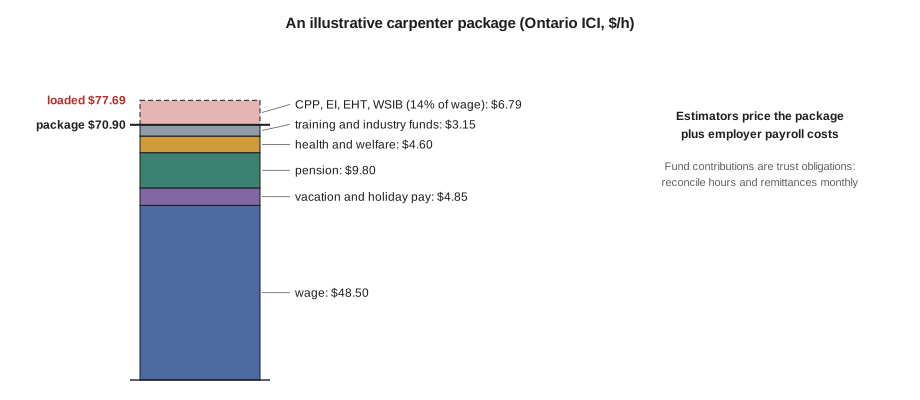
Classification errors are among the most common payroll mistakes. Apprentices move up a wage step when they complete a period of hours or a level of in-school training, and the agreement says which. If the payroll system is not told that Aisha Rahman has finished her second period, she will be underpaid until someone notices, and the grievance will claim the difference back to the date she qualified. Calder Ridge asks every apprentice to send proof of each completed level to Grace, and payroll checks apprentice progress monthly against the training records.
Benefit contributions are trust obligations. If a contractor fails to remit them, the trustees of the funds can audit the employer's payroll records, claim the unpaid amounts with interest and penalties, and in some cases pursue the company's owners personally. Grace's payroll team reconciles every month's hours with the contributions remitted, by worker and by fund, before the remittance deadline.
Hours, overtime and premiums
Most ICI agreements set a standard workday of eight hours and a standard week of forty, worked Monday to Friday between set hours. Work beyond the standard day, before or after the normal hours, or on weekends and statutory holidays, is paid at overtime rates, often time and a half for the first hours and double time after that and on Sundays and holidays. Many agreements allow a compressed schedule, such as four ten-hour days, by agreement or notice. Shift work, when two or three crews work in sequence, earns a shift premium. The details vary by trade, which is why Luis checks each agreement before he plans weekend work.
Overtime is expensive in two ways. The premium rate raises the cost of each hour, and, as lesson 9 explains, sustained overtime reduces productivity, so each premium hour produces less work. Luis uses overtime deliberately: for a concrete pour that cannot stop, for recovering a specific delay, or for work that must be done when the hospital's existing building is quiet. He avoids routine overtime as a way to run the whole job.
# Weekly cost of a 12-carpenter crew: standard week vs a weekend pour (illustrative ICI rules)
wage, benefits_per_hour = 48.50, 22.40   # wage and hourly fund contributions
vacation_pct = 0.10                       # vacation and holiday pay on wages, including overtime wages
payroll_pct = 0.14                        # CPP, EI, EHT, WSIB on wages (illustrative)
def cost(regular, ot_15, ot_2, crew=12):
    wages = wage * (regular + 1.5 * ot_15 + 2.0 * ot_2)
    hours = regular + ot_15 + ot_2
    total = wages * (1 + vacation_pct + payroll_pct) + benefits_per_hour * hours
    return crew * hours, crew * total
for label, r, a, b in [("standard 5 x 8", 40, 0, 0), ("plus Saturday 8 h at 1.5x", 40, 8, 0), ("plus Saturday and Sunday (2x)", 40, 8, 8)]:
    h, c = cost(r, a, b)
print(f"{label:30s} {h:4d} worker-hours ${c:9,.0f} ${c / h:6.2f} per hour")standard 5 x 8 480 worker-hours $ 39,619 $ 82.54 per hour plus Saturday 8 h at 1.5x 576 worker-hours $ 50,430 $ 87.55 per hour plus Saturday and Sunday (2x) 672 worker-hours $ 64,127 $ 95.43 per hour
Adding a Saturday raises the average cost of every hour worked that week by about 6 percent, and working the whole weekend raises it by about 15 percent, before counting any loss of productivity. The premium hours themselves cost far more: a Sunday hour at double time costs about two-thirds to three-quarters more than a regular hour once benefits and payroll costs are included. Some agreements calculate fund contributions on hours worked and others on hours paid, which changes the result; Grace's estimating template follows each agreement's rule.
Show-up pay, weather and call-outs
Rain, snow, wind and extreme heat stop outdoor work. Most construction agreements protect workers who report to the site and are sent home: they must be paid a minimum number of hours, often two to four, unless they were told in advance not to come. Some agreements require payment for time actually worked plus a minimum, and many say that a worker who starts work and is then stopped by weather is paid for the time worked or a minimum, whichever is greater.
On Elmwood in November, Luis watches the forecast closely. If wind is forecast above the crane's operating limit for the whole morning, he has the foremen call or text the crews the evening before. If the forecast is uncertain, he has inside work ready: forming on lower floors under cover, stocking material, or training. One winter morning a foreman forgot to notify a crew of 14 about a cancelled pour, and the company paid four hours' show-up pay to each worker for no production.
Subcontracting clauses
Many ICI agreements restrict the employer from subcontracting work that falls within the union's scope to contractors that are not bound to an agreement with the same union or another building trades union. These clauses matter at buyout: if Calder Ridge's carpenters' agreement covers drywall framing and acoustic ceilings, Ben must check whether awarding that work to an open shop subcontractor would breach the agreement. A breach can lead to a grievance claiming the wages the union's members would have earned.
On Elmwood the drywall subcontractor, Norfield, is non-union. Before the award, Grace confirmed that the carpenters' agreement's subcontracting clause did not cover Norfield's scope as written in the subcontract, which included the interior framing that the clause might arguably reach, and documented her reasons. It was the kind of question that is cheap to answer before an award and expensive after.
Stewards and the union on site
Agreements give the union the right to appoint a steward on each site or crew. The steward is a working member of the crew who also represents the union: answering members' questions, raising complaints with the foreman, monitoring compliance with the agreement, and attending investigations and disciplinary meetings when a worker asks. Agreements often protect stewards from layoff while their trade is still working on the site, and many require the employer to allow reasonable time for steward duties. Union business representatives may visit the site, usually with notice to the superintendent.
Luis treats Tom Kowalski, the carpenters' steward, as an early-warning system. Tom tells him when the crew is unhappy about something small, such as the distance to the washrooms or a foreman who rotates overtime unfairly, before it becomes a grievance. In return, Luis tells Tom about schedule changes, layoffs and new procedures before he announces them to the crew. The relationship does not mean the two always agree, but it means disagreements are handled early and calmly.
Applying the agreement fairly and consistently
Agreements cannot answer every question, and supervisors apply them every day to situations their drafters never imagined. Three principles keep Calder Ridge's supervisors out of trouble. First, read the agreement before deciding, and ask if the language is unclear. Second, apply it the same way to everyone, because inconsistency creates past practice that an arbitrator may later enforce, and it breeds resentment. Third, when the agreement is silent or ambiguous, do not invent a rule; talk to Grace and the steward. A practice that a supervisor allows for months, such as paying travel time that the agreement does not require, can become binding.
| Situation on Elmwood | What the agreement said | What the supervisor did |
|---|---|---|
| A foreman offered Saturday overtime only to his regular crew | Overtime to be distributed as equally as practicable among qualified workers on the site | Grace set up a rotation list that the steward could see |
| An apprentice was asked to lead a small crew | Apprentices may not work without journeyperson supervision | Luis assigned a journeyperson lead and coached the foreman |
| Crane wind delay at 9 a.m. after crews started | Paid for time worked, minimum of two hours, if work stopped by weather | Payroll paid the minimum; crews were moved to inside work where possible |
| A carpenter was moved to labourers' work for a day | Workers performing work of a higher-paid classification get the higher rate; no reduction for lower-paid work | Paid at the carpenter rate; assignment discussed with both stewards |
Common mistakes
MistakePlanning weekend work without checking each trade's overtime and premium rules.
InsteadRead each agreement's hours and overtime articles and price the premium before deciding.
MistakeFailing to notify crews when weather cancels work.
InsteadNotify crews the evening before when the forecast is clear; have inside work ready when it is not.
MistakeAwarding covered work to a non-signatory subcontractor without checking the subcontracting clause.
InsteadReview the clause and the scope before award, and document the decision.
MistakeTreating the steward as an opponent.
InsteadUse the steward as an early-warning system and share information early.
MistakeAllowing an informal practice that the agreement does not require.
InsteadApply the agreement consistently; long-standing practices can become binding.
Summary and key terms
- A collective agreement sets the rules for wages, hours, hiring, benefits, apprentices, stewards, subcontracting and disputes.
- The package is the wage plus benefit and fund contributions; loaded labour cost adds the employer's payroll costs.
- Unremitted benefit contributions are serious breaches with audit and recovery rights.
- Overtime and weekend premiums raise the cost per hour and sustained overtime lowers productivity.
- Show-up pay protects workers sent home for weather; advance notice avoids the cost.
- Subcontracting clauses can limit awards to non-signatory subcontractors; check before award.
- Stewards are working members who represent the union; a good relationship surfaces problems early.
- Apply the agreement consistently and ask when it is unclear; informal practices can become binding.
- Package
- The total hourly cost of wages, vacation and holiday pay, and benefit and fund contributions under an agreement.
- Classification
- A job category in an agreement with its own rate, such as journeyperson, foreperson or second-year apprentice.
- Rand formula
- The rule that all employees in a unit pay union dues whether or not they join the union.
- Show-up pay
- Minimum pay for workers who report to work and are sent home.
- Subcontracting clause
- An agreement term limiting subcontracting of covered work to firms bound to a union agreement.
- Steward
- A working member who represents the union on the site.
- Past practice
- A consistent, known and accepted way of doing things that an arbitrator may treat as part of the agreement.
Practice problems
Work each problem on paper first, then reveal the answer to check.
Name four articles of a construction agreement that supervisors use daily.
Show answer
Any four: hours and overtime, show-up pay, apprentices, stewards, wages and classifications, hiring and referral, grievance procedure.
By roughly what share did working the whole weekend raise the average hourly cost in the crew example?
Show answer
About 14 to 16 percent compared with a standard week.
A crew of 14 was not notified of a cancelled pour and was paid four hours' show-up pay. How many paid hours produced nothing?
Show answer
56 hours.
Why did Grace review the subcontracting clause before awarding drywall to Norfield?
Show answer
To confirm the award would not breach the carpenters' agreement and avoid a grievance claiming lost wages.
Why should supervisors avoid informal practices the agreement does not require?
Show answer
Consistent, accepted practices can become binding on the employer as past practice.
Lesson quiz · 5 questions
Score 60% or more to complete this lesson.
Create a free account to save your progress, take quizzes and earn a certificate.