
CON-365 · Lesson 3 of 12 · 20 min
Certification and bargaining structure in construction
Before a union can bargain for workers, the law has to decide that it represents them. Before a contractor can bid a job, it needs to know what its labour costs will be. In construction these two needs pull against each other, because the workers who will build a project usually have not been hired when the price is set. Canadian provinces resolve the tension with special certification rules for construction and, in Ontario's ICI sector, with collective agreements bargained for an entire trade across the province. This lesson explains how a construction union comes to represent workers, how bargaining is organized, and what that means for Calder Ridge.
How a union is certified in Ontario construction
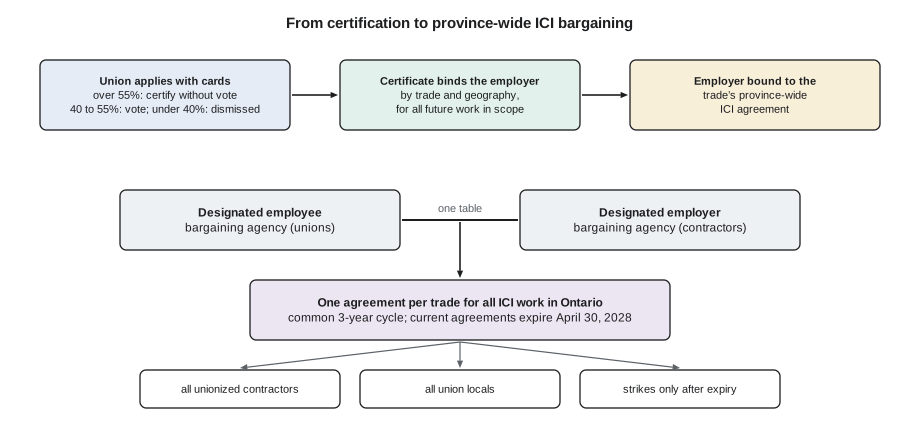
A union becomes the exclusive bargaining agent for a group of workers by being certified by the labour board. In most Ontario industries, certification requires a secret ballot vote. Construction is different: under the construction provisions of the Labour Relations Act, 1995, a union that files an application supported by membership cards from more than 55 percent of the employees in the proposed bargaining unit on the application date can be certified without a vote. If its support is between 40 and 55 percent, the board holds a vote, usually within five working days. Below 40 percent the application is dismissed.
The bargaining unit in a construction certification is defined by trade and geography: for example, all carpenters and carpenters' apprentices employed by the employer in all sectors of the construction industry in a particular board area, and in the ICI sector throughout the province. Once certified, the employer is bound by the agreement that applies to that trade, and in the ICI sector that means the province-wide agreement described below. The certificate does not end when the project ends; it attaches to the employer and covers every future job in its scope until the union's bargaining rights are terminated.
Other provinces take different approaches. British Columbia returned to card-based certification for all industries in 2022, with a 55 percent threshold. Alberta requires a vote in most cases. Quebec does not certify construction unions employer by employer at all: workers choose among five representative associations in a province-wide vote held periodically, and the associations bargain together by sector. A contractor working in several provinces must know each system.
What employers may and may not do during an application
Once an application is filed, the terms and conditions of employment are frozen: the employer may not change wages, benefits or working conditions without the union's consent, except in the normal course of business. The OLRB treats construction applications urgently, because workforces change quickly; the board determines the voter list or count as of the application date, and disputes about who was in the unit are resolved afterwards. Unfair labour practices during a campaign, such as firing a union supporter, can lead the board to order reinstatement and, in serious cases, to certify the union even without majority support.
| Point | Card-based (Ontario construction) | Vote-based (most industries) |
|---|---|---|
| Threshold for automatic certification | More than 55 percent membership cards | Majority of votes cast |
| Vote held when | Support is 40 to 55 percent | Always |
| Timing | Very fast, decided on application-date count | Several days to weeks |
| Risk of employer interference | Lower, little time to campaign | Higher, campaign period |
| Criticism | Workers may sign under pressure, no secret ballot | Campaign period allows pressure from either side |
Calder Ridge's carpenters were certified this way in the 1990s, and the certificate has bound the company ever since. A union can lose its bargaining rights, for example through a termination application supported by employees during an open period, or if the board finds the union has abandoned the unit, but in practice most construction certificates last for decades.
Province-wide bargaining in Ontario's ICI sector
Ontario's ICI sector has a bargaining structure found nowhere else in North America. For each trade, the Minister of Labour designates one employee bargaining agency (the trade's provincial council of unions) and one employer bargaining agency (an association representing unionized contractors in that trade). The two agencies bargain one province-wide agreement that binds every employer and union in the trade's ICI work across Ontario, sometimes with regional wage zones. All the ICI agreements run on a common three-year cycle ending on April 30, so the whole sector bargains at once; the agreements bargained in 2025 run to April 30, 2028. Strikes and lockouts are only possible province-wide, after the common expiry, and are rare.
The structure gives Ontario's unionized ICI contractors a level playing field: Calder Ridge knows that every union carpentry contractor bidding against it pays the same rates. It also gives the unions bargaining power concentrated at one table. Outside the ICI sector, bargaining is organized differently: residential construction in the Greater Toronto Area has its own agreements, roads, sewer and watermain, and heavy engineering are bargained by sector, and some trades bargain locally.
What gets bargained and how
Construction bargaining usually covers wages and fringe benefits first, because they drive bid prices, followed by working conditions such as hours, overtime, shift premiums, travel and board allowances, apprenticeship ratios and training contributions, and language on subcontracting, jurisdiction and grievances. The negotiations are shaped by the construction calendar. Unions have the most leverage when work is plentiful and the building season is beginning; contractors have more when work is scarce.
In the 2025 round of ICI bargaining, settlements reflected a tight labour market and recent inflation, with several trades agreeing to wage and benefit increases totalling well over 15 percent across the three years. Grace builds the escalation in each agreement into Calder Ridge's estimating rates for every bid that extends past the next increase date.
# Escalating a carpenter package for a bid that runs through future increases (illustrative)
# Package = wage + benefits; increases take effect each May 1 under the ICI agreement.
package = 70.90          # $/h total package for the current year
increases = {"2027-05-01": 3.10, "2028-05-01": 3.25}   # assumed future package increases, $/h
hours_by_period = {      # planned carpenter hours on Elmwood by period
    "to 2027-04-30": 96_000,
    "2027-05-01 to 2028-04-30": 132_000,
    "after 2028-04-30": 41_000,
}
rates = [package, package + 3.10, package + 3.10 + 3.25]
total = 0
for (period, hours), rate in zip(hours_by_period.items(), rates):
    cost = hours * rate
    total += cost
    print(f"{period:26s} {hours:8,d} h at ${rate:6.2f} = ${cost:12,.0f}")
flat = sum(hours_by_period.values()) * package
print(f"total ${total:,.0f}; at today's rate only ${flat:,.0f}; escalation ${total - flat:,.0f} ({(total - flat) / flat:.1%})")to 2027-04-30 96,000 h at $ 70.90 = $ 6,806,400 2027-05-01 to 2028-04-30 132,000 h at $ 74.00 = $ 9,768,000 after 2028-04-30 41,000 h at $ 77.25 = $ 3,167,250 total $19,741,650; at today's rate only $19,072,100; escalation $669,550 (3.5%)
Ignoring the scheduled increases would have understated the carpenter labour cost by about $670,000. Because the increase after April 30, 2028 is not yet bargained, Grace uses an assumed figure and flags it as a risk in the bid.
Worked problem
Counting support on the application date
A union applies to represent the carpenters of a framing contractor in Hamilton. On the application date the contractor employs 38 carpenters and apprentices on its sites; 3 more were laid off two weeks earlier and 2 were hired the morning of the application. The union files 21 membership cards.
Show solution
- Use the employees in the unit on the application date: the 38 working that day, including the 2 hired that morning; the 3 laid off are not counted.
- Support: 21 / 38 = 55.3 percent.
- This is more than 55 percent, so the board can certify without a vote, subject to any challenges to individual cards or employees.
- If even one card were disallowed, support would fall to 20 / 38 = 52.6 percent, and a vote would be held.
Answer: Certification without a vote is likely, but only just; challenges to single cards can change the outcome.
Changing or ending bargaining rights
Bargaining rights can change in several ways. A group of employees can apply to terminate a union's rights during an open period, usually in the last months of an agreement's term. A rival union can apply to displace the incumbent during the same window, which is how building trades unions and CLAC have competed for some employers. If a business is sold, the successor employer provisions of the Act bind the buyer to the seller's certificates and agreements, so a contractor buying a unionized competitor inherits its union obligations. And as lesson 2 explained, related businesses can be declared a single employer. Each of these is decided by the labour board, often with strict timelines, and each can change a contractor's labour costs overnight.
For Calder Ridge the practical lesson is that the company's labour relations status is an asset and a liability that must be managed deliberately. Before buying another contractor, opening a new division or entering a new market, Nadia asks Grace and the company's labour counsel what bargaining obligations the move would bring with it.
A bargaining checklist for contractors
Even contractors that bargain through an association have work to do before and during each round. Grace's checklist, prepared a year before each expiry, keeps Calder Ridge ready:
- List every agreement, its expiry date and the association or agency that bargains it.
- Review the bids and backlog that extend past the expiry, and estimate the cost of different settlement levels.
- Gather field input: which clauses caused grievances, disputes or productivity problems, and which worked well.
- Send priorities to the association before its bargaining committee sets its proposals.
- Plan the schedule around the expiry: critical pours, lifts and deliveries before the date, and contingency plans for a stoppage.
- Prepare supervisors: what to say and not say, and who to call.
- After settlement, update estimating rates, payroll and the project cost reports the same week.
Strikes, lockouts and the site
A construction strike in Ontario's ICI sector can only happen after the common expiry date, and a strike by one trade can still stop much of a site. Collective agreements, including Calder Ridge's, normally contain no-strike clauses for their term, and strikes during the term are unlawful. Picketing is regulated by the labour board and the courts. When a strike is possible, Nadia's team plans ahead: critical concrete pours are scheduled before April 30, materials are stocked, and owners are warned of the risk in the project schedule.
Luis keeps a simple rule for supervisors: if anyone mentions a strike, picket, work stoppage or slowdown, call Grace immediately and do not say anything to workers about it until she has advised. The legal consequences of a mistake are often far larger than the event itself.
What the structure means on site
For a superintendent, the bargaining structure shows up in practical ways. Every Calder Ridge carpenter on Elmwood is paid under the same province-wide agreement as carpenters on every other unionized ICI site in Ontario, so there is little point in a worker asking Luis for a better rate, and no point in Luis offering one: wages above the agreement are possible but create expectations across the crew and are rarely worth it. When a subcontractor's workers are covered by a different trade's agreement, their hours, breaks and overtime rules may differ from Calder Ridge's, and Luis plans shared activities such as concrete pours and crane lifts with those differences in mind. And when a worker asks a question about union membership, dues, or whether a new hire must join, Luis sends it to the steward or to Grace rather than guessing.
Common mistakes
MistakeAssuming a construction certification ends when the project ends.
InsteadThe certificate attaches to the employer and covers future work in its scope until bargaining rights are terminated.
MistakeChanging wages or conditions after a certification application is filed.
InsteadConditions are frozen during an application except in the normal course of business.
MistakeBidding a multi-year job at this year's labour rates.
InsteadBuild scheduled and assumed package increases into the estimate and flag unbargained increases as a risk.
MistakeSupervisors commenting to workers about strikes or picketing.
InsteadCall labour relations staff first; mistakes have large legal consequences.
Summary and key terms
- Ontario construction certification can be card-based: over 55 percent cards certifies without a vote, 40 to 55 percent triggers a vote.
- Construction bargaining units are defined by trade and geography, and certificates bind the employer for future work.
- Other provinces differ: BC uses card check, Alberta mostly votes, and Quebec uses a province-wide representation vote among five associations.
- Ontario ICI agreements are bargained province-wide by designated agencies on a common three-year cycle ending April 30.
- Bids must include scheduled and assumed labour package increases.
- Strikes are possible only after expiry; supervisors should leave strike issues to labour relations staff.
- Certification
- A labour board order recognizing a union as exclusive bargaining agent for a unit of employees.
- Card-based certification
- Certification on the basis of signed membership cards without a vote.
- Bargaining unit
- The group of employees a union represents, defined in construction by trade and geography.
- Employer bargaining agency
- The designated association that bargains on behalf of unionized contractors in an ICI trade.
- Employee bargaining agency
- The designated council of unions that bargains for a trade in the ICI sector.
- Statutory freeze
- The rule that terms and conditions may not change after a certification application without union consent.
- Open period
- The time near the end of an agreement when applications to replace or terminate a union may be filed.
Practice problems
Work each problem on paper first, then reveal the answer to check.
A union applies with cards from 52 of 90 employees in the unit. What happens in Ontario construction?
Show answer
52 of 90 is about 58 percent, more than 55 percent, so the union can be certified without a vote.
What happens if support is 45 percent?
Show answer
The board holds a representation vote.
Why does province-wide ICI bargaining give contractors a level playing field?
Show answer
Every unionized contractor in the trade's ICI work pays the same agreed rates.
By how much did ignoring scheduled increases understate the carpenter cost in Grace's escalation example?
Show answer
About $670,000, or 3.5 percent.
When does the current round of Ontario ICI agreements expire?
Show answer
April 30, 2028.
Lesson quiz · 5 questions
Score 60% or more to complete this lesson.
Create a free account to save your progress, take quizzes and earn a certificate.