
CON-220 · Lesson 8 of 12 · 28 min
Changes, extras and pricing
No construction project is built exactly as drawn. Owners change their minds, designers correct errors, site conditions differ from what was expected, and codes or permits impose new requirements. Every standard form contract therefore gives the owner a right to change the work and a procedure for adjusting the price and the time. Changes are also where much of the money in construction disputes lies: extras that were never authorized in writing, change orders priced without regard to delay, and claims that a direction was a change when the owner says it was always in the contract. This lesson explains the law of changes and how to price and document them.
The right to change the work
At common law, a contract cannot be changed without both parties' agreement. Construction contracts depart from this rule: they give the owner a unilateral right, within limits, to add, delete or alter work, and they oblige the contractor to perform the change in exchange for a fair adjustment of price and time. Without such a clause, an owner could not require any change at all, and a contractor could refuse or demand any price.
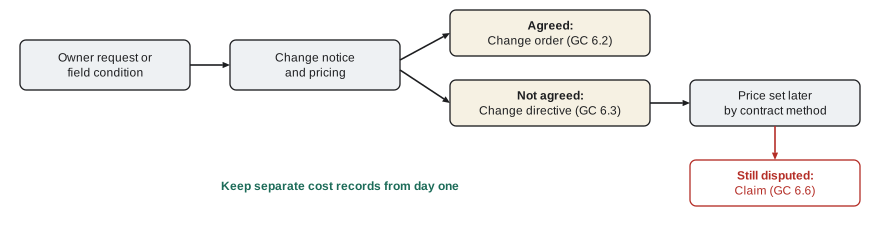
Under CCDC 2-2020 Part 6, the owner, through the consultant, may make changes in the work within the general scope of the contract without invalidating it. A change order (GC 6.2) records an agreed change with its adjustment to the contract price and time. A change directive (GC 6.3) instructs the contractor to proceed with a change before the price and time are agreed, with the adjustment determined later on the basis set out in the contract. GC 6.4 deals with concealed or unknown conditions, and GC 6.6 with claims for a change in contract price.
The general scope limit is important. A change so large or different that it transforms the project, such as adding a second building to a contract for one, is outside the clause. Such a change, sometimes called a cardinal change, may allow the contractor to treat the contract as breached rather than perform the change at the contract's pricing terms.
Is it a change?
Many disputes are not about the price of a change but about whether a change happened at all. The owner says the work was always required by the contract documents; the contractor says it was extra. Answering the question means reading the documents as a whole.
- Was the work shown or specified anywhere in the documents, including in general notes, Division 01 requirements or details on another drawing?
- Was it reasonably inferable from the documents? Many forms require the contractor to provide work that is reasonably inferable as necessary to produce the intended result.
- Does a conflict between documents resolve in favour of the more or less onerous requirement under the order of precedence clause?
- Did the contractor discover, or should it have discovered, the issue before bidding, so that it should have asked a question?
Constructive changes are a second category. A constructive change occurs when the owner, without issuing a formal change order, requires work beyond the contract: by rejecting a compliant submittal, insisting on a stricter interpretation of a specification, ordering acceleration, or giving a direction that has the effect of a change. Courts and boards recognize constructive changes, especially in government contracting, but the contractor must usually show that it gave notice and that it did not volunteer the extra work.
Authority and written change orders
Most contracts require changes to be authorized in writing by a named person before the work is done. These clauses protect owners from paying for work they never authorized, and protect contractors from disputes about whether the owner agreed. They create a trap, however, when the site team acts on verbal instructions to keep the job moving.
Canadian courts generally enforce written change order requirements, but they may find that the owner waived the requirement by its conduct, for example by repeatedly ordering and paying for extras without written orders, or that the owner is estopped from relying on it, or that the work was outside the contract altogether so that the contractor is paid on a quantum meruit basis. These are uncertain arguments; the safe course is to get written authorization, even a brief email confirming the direction, before doing the work.
Worked problem
Documenting a field direction
On a Friday afternoon, the owner's project manager tells the site superintendent to add fire-rated dampers at twelve locations not shown on the drawings, so that the ductwork can be closed in on Monday. The contract requires written change orders signed by the owner's representative. What should the superintendent do?
Show solution
- Ask whether the project manager has authority under the contract, and if not, who does.
- Send an email before the work proceeds: describe the direction, the locations, and that it is considered a change to be priced, and ask for written confirmation or a change directive.
- Track labour, materials and equipment for the dampers separately on daily force account records signed by the owner's representative if possible.
- Submit a priced change proposal promptly and follow the contract's notice requirements for any time impact.
Answer: Confirm authority, confirm the direction in writing before work, keep separate cost records and price the change promptly.
Pricing changes
A change order states an adjustment to the contract price. The usual methods of valuing it, in order of preference in most standard forms, are:
- A lump sum agreed by the parties.
- Unit prices stated in the contract or subsequently agreed.
- Cost plus a fee: actual costs of labour, materials, equipment and subcontracts, plus a percentage or fixed fee for overhead and profit, often called force account or time and materials.
CCDC 2-2020 sets out how the value of a change is determined if the parties do not agree, including the costs that can be included and the contractor's percentage fee, which the supplementary conditions often set. Credits for deleted work are usually valued at the cost saved, sometimes without returning profit.
| Cost element | Typical treatment | Watch for |
|---|---|---|
| Labour | Hours × loaded rates (wage, burden, benefits) | Overtime and productivity loss |
| Materials | Invoice cost plus delivery and tax | Waste allowance and restocking fees |
| Equipment | Rental rates or owned-equipment rate schedules | Standby versus operating time |
| Subcontracts | Subcontractor's price | Markup tiering on lower-tier subs |
| Overhead and profit | Percentage fee set by the contract | Different rates for own work and subcontracted work |
| Time-related costs | Extended general conditions if time is extended | Must be claimed with the change, not later |
Worked problem
Pricing a change by cost plus markup
A change requires 64 hours of carpenter labour at a loaded rate of $92 per hour, materials of $5,800 plus 13 % HST, equipment rental of $1,250, and a subcontractor quote of $14,600. The contract allows 10 % on own work and 5 % on subcontracted work. What is the price before tax?
Show solution
- Labour: 64 × $92 = $5,888.
- Own work subtotal: $5,888 + $5,800 + $1,250 = $12,938.
- Markup on own work: 10 % × $12,938 = $1,293.80.
- Subcontract with markup: $14,600 × 1.05 = $15,330.
- Total: $12,938 + $1,293.80 + $15,330 = $29,561.80.
Answer: $29,561.80 before tax.
Time and the reservation of rights
A change often affects time as well as money: added work can extend the critical path, and disruption can reduce productivity across the job. A change order that adjusts the price but says nothing about time, or that contains a clause stating that the adjustment is full and final compensation for all direct and indirect costs, may prevent the contractor from later claiming delay costs for the same change. Courts generally enforce such accord and satisfaction language.
Contractors protect themselves in two ways. They include the time impact and time-related costs in the change proposal, supported by a schedule fragment showing the effect on the critical path. Or, if the impact cannot yet be measured, they sign the change order with a clear reservation of rights stating that time and impact costs are excluded and will be claimed separately. Some owners refuse to accept reservations, which then becomes a negotiation, but signing a full and final change order without pricing the delay is one of the most common ways contractors give away money.
Worked problem
Adding time-related costs to a change
A structural change adds 6 working days to the critical path. The contractor's time-related site costs (supervision, site office, equipment on standby, temporary services) are $3,400 per working day. The contract allows extended general conditions on approved time extensions without further markup. What time-related amount should be added to the change price?
Show solution
- Time extension requested: 6 working days, supported by a schedule fragment.
- Extended general conditions: 6 × $3,400 = $20,400.
- Add $20,400 to the change price, or reserve the right to claim it separately.
Answer: $20,400 and a 6-day extension.
Differing site conditions
Unknown ground conditions are among the largest risks in construction. Most standard forms give the contractor an adjustment if it encounters subsurface or concealed conditions that differ materially from those indicated in the contract documents, or from those ordinarily found in work of that kind.
CCDC 2-2020 GC 6.4 requires the contractor to notify the consultant promptly, before the conditions are disturbed, if it finds conditions that differ materially from those indicated in the contract documents or from those ordinarily encountered. The consultant investigates, and if the conditions differ and increase or decrease cost or time, a change is made. Owners often amend this clause in supplementary conditions to shift ground risk to the contractor, which is enforceable if the words are clear.
Deleted work and credits
Changes can reduce the work as well as add to it. When the owner deletes work, the contract price is reduced by a credit. Disputes arise over how to value it: the owner wants the full value in the contractor's price, while the contractor points out that it has already bought materials, mobilized crews and spread overhead over the original scope. Most forms value a deletion at the cost saved by the contractor, sometimes with a reduced or no return of markup. A contractor should document committed costs for deleted work promptly, and an owner should not use deletions to transfer work to another contractor without considering whether that breaches the contract.
Common mistakes
MistakeDoing extra work on a verbal instruction from someone without authority.
InsteadConfirm authority and get written confirmation before proceeding.
MistakeSigning a full and final change order without pricing time and disruption.
InsteadInclude the time impact or add a clear reservation of rights.
MistakeDisturbing a differing site condition before giving notice.
InsteadNotify promptly and let the owner's representative inspect first.
MistakeMixing change order costs into the base contract cost records.
InsteadTrack each change on separate cost codes or force account sheets.
MistakeApplying markup on markup through several subcontract tiers without limits.
InsteadFollow the contract's markup rules for each tier.
Summary and key terms
- Construction contracts give owners a right to change the work within the general scope, with fair adjustment of price and time.
- CCDC 2-2020 uses change orders (GC 6.2), change directives (GC 6.3), concealed conditions (GC 6.4) and claims (GC 6.6).
- A change far outside the original scope may be a cardinal change.
- Constructive changes arise from owner directions that require extra work without a formal change order.
- Written change order requirements are usually enforced; get written authorization from someone with authority.
- Changes are priced by lump sum, unit prices or cost plus a fee, with time-related costs included or reserved.
- Differing site conditions clauses require prompt notice before the conditions are disturbed.
- Change order
- A written agreement adjusting the work, price and time.
- Change directive
- An instruction to proceed with a change before price and time are agreed.
- Cardinal change
- A change so far outside the scope that it amounts to a breach.
- Constructive change
- An owner action that requires extra work without a formal change order.
- Force account
- Payment for work on the basis of recorded labour, materials and equipment plus markup.
- Markup
- The percentage added to cost for overhead and profit.
- Reservation of rights
- A statement preserving claims not settled by a document being signed.
- Accord and satisfaction
- An agreement that settles a claim in full.
- Differing site conditions
- Physical conditions materially different from those indicated or ordinarily expected.
- Equitable adjustment
- A fair adjustment of price and time for a change, especially in government contracts.
Practice problems
Work each problem on paper first, then reveal the answer to check.
What is the difference between a change order and a change directive?
Show answer
A change order is agreed; a directive orders the work before price and time are agreed.
What is a constructive change?
Show answer
An owner action requiring extra work without a formal change order.
40 hours at $85 plus $2,000 materials with 15 % markup. Price?
Show answer
($3,400 + $2,000) × 1.15 = $6,210.
A sub quotes $8,000 and the contract allows 5 % markup on subcontracts. Price to the owner?
Show answer
$8,400.
Why is a full and final clause dangerous?
Show answer
It may bar later claims for time and impact costs of the change.
What should a contractor do on finding unexpected rock?
Show answer
Give prompt written notice before disturbing it and let the owner inspect.
4 days of extended general conditions at $2,900 per day?
Show answer
$11,600.
What is a cardinal change?
Show answer
A change so outside the scope that it is a breach rather than a change.
Who can bind the federal government to a change?
Show answer
Only a contracting officer with actual authority.
Name three methods of pricing changes.
Show answer
Lump sum, unit prices and cost plus a fee.
Lesson quiz · 5 questions
Score 60% or more to complete this lesson.
Create a free account to save your progress, take quizzes and earn a certificate.