
CON-220 · Lesson 5 of 12 · 28 min
Payment applications and holdback
Cash is the lifeblood of construction. Contractors and subcontractors finance labour, materials and equipment for weeks or months before they are paid, often on thin margins. The rules on how and when money moves down the contract chain, and how much of it is held back until the work is finished, decide whether a profitable job is also a solvent one. This lesson covers progress payment applications, the schedule of values, payment certification, the money withheld from each payment, substantial completion and final payment. The next lesson covers the statutes that now set deadlines for paying.
Progress payments
Except for small jobs, construction contracts pay in instalments as the work progresses, usually monthly. The contractor submits an application for payment showing the value of work completed to date; the payment certifier, often the architect or engineer, checks it; and the owner pays the certified amount less any money withheld.
Under CCDC 2-2020 Part 5, the contractor submits a monthly application for payment based on the schedule of values, the consultant issues a certificate for payment for the amount it determines is due, and the owner pays the certified amount, less the statutory holdback, within the time the contract allows. In provinces with prompt payment legislation, the timing and the content of a proper invoice are set by statute, and the contract must be read with it.
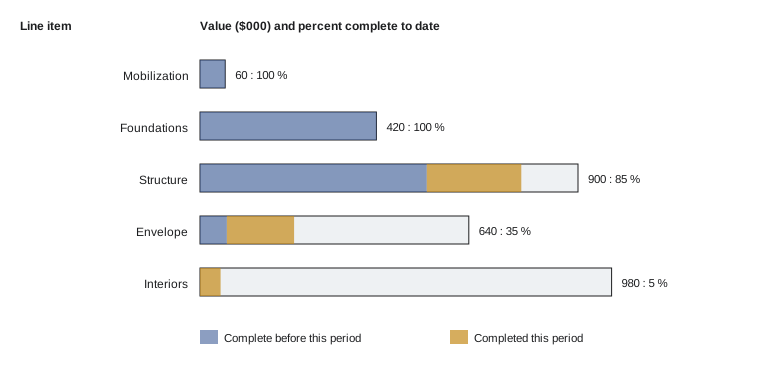
The core of every payment application is the schedule of values: a breakdown of the contract price into line items, each with a value, against which progress is measured. A good schedule of values is agreed early, follows the work breakdown structure, and separates labour, materials and general conditions so that progress can be measured fairly.
What can be claimed
A payment application normally includes:
- Work in place, measured as a percentage of each line item.
- Materials delivered to site and suitably stored, if the contract allows.
- Materials stored off site, sometimes, if the contractor proves title, insurance and security, for example with a bill of sale and photos.
- Approved change orders, and sometimes undisputed amounts for pending changes.
Front-end loading, inflating the value of early line items so that the contractor is overpaid at the start, is a common temptation. It weakens the owner's security, can mislead sureties, and may breach the contract and, in some places, the law. Payment certifiers resist it by comparing the schedule of values with the estimate.
Holdback
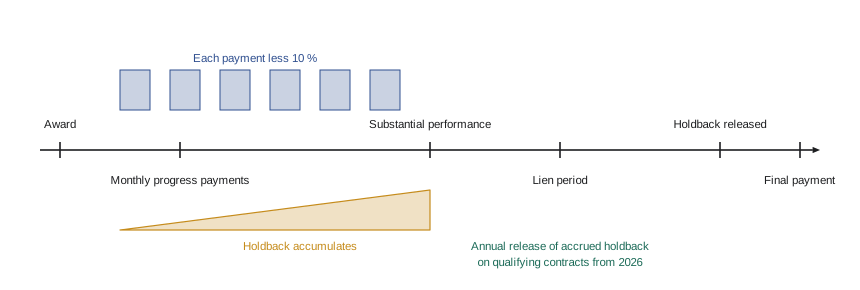
Every common law province requires the owner, and each payer down the chain, to hold back a percentage of the value of work done, usually 10 %, as security for those who might register a lien. The holdback protects the owner: if the owner keeps the statutory holdback and pays it out only after the lien period expires, its liability to lien claimants is generally limited to the holdback amount. Holdback is not a penalty and it is not the owner's money to keep; it must be paid once the conditions for release are met.
| Province | Holdback | Release basics (summary, check the statute) |
|---|---|---|
| Ontario | 10 % basic holdback, plus finishing holdback | Released after the lien period; annual release of accrued holdback from January 1, 2026 |
| British Columbia | 10 % | Retained until the lien period after completion expires; released in a holdback account on larger contracts |
| Alberta | 10 % | Released after the lien period following substantial performance |
| Saskatchewan | 10 % | Released after the lien period, with prompt payment rules |
| Quebec | No statutory holdback | Contractual holdback, often 10 %, protects against legal hypothecs |
Holdback must be retained at each tier. A general contractor holds back 10 % from its subcontractors, who hold back from their own subtrades. Each payer that retains the holdback limits its lien exposure; each payer that pays it out early takes a risk.
Worked problem
Holdback on a progress claim
A contractor's application shows work to date of $1,850,000, previous payments certified of $1,260,000 (net of holdback), and HST at 13 %. The holdback is 10 %. What is the net payment this month before tax, and the total holdback retained?
Show solution
- Holdback or retainage to date: 10 % × $1,850,000 = $185,000.
- Amount earned less holdback: $1,850,000 − $185,000 = $1,665,000.
- Less previous payments: $1,665,000 − $1,260,000 = $405,000.
- Tax is calculated on the amount payable under the rules for the jurisdiction: $405,000 × 1.13 = $457,650 including HST.
Answer: Net payment $405,000 plus HST ($457,650 total); holdback held $185,000.
Substantial performance
Substantial performance is the key milestone for holdback and liens. Under Ontario's Construction Act, a contract is substantially performed when the improvement, or a substantial part of it, is ready for use or is being used for its intended purpose, and the improvement can be completed or corrected at a cost of not more than 3 % of the first $1,000,000 of the contract price, 2 % of the next $1,000,000 and 1 % of the balance. Other provinces use similar formulas. Once the payment certifier certifies substantial performance, the certificate is published, and the lien and holdback release clocks start.
Worked problem
Testing for substantial performance
A contract price is $4,600,000. The building is ready for use, and the cost to complete the remaining work is estimated at $88,000. Is the contract substantially performed under the Ontario formula?
Show solution
- 3 % of the first $1,000,000 = $30,000.
- 2 % of the next $1,000,000 = $20,000.
- 1 % of the balance of $2,600,000 = $26,000.
- Threshold: $30,000 + $20,000 + $26,000 = $76,000.
- $88,000 exceeds $76,000, so the contract is not yet substantially performed under the formula.
Answer: Threshold $76,000; with $88,000 to complete, not yet substantially performed.
Annual and phased holdback release
Waiting years for holdback on a long project strains contractors' cash flow. Ontario's amendments in force on January 1, 2026 require annual release of accrued holdback on contracts that meet the statutory conditions: within 14 days after each anniversary of the contract the owner publishes a notice of the amount it intends to pay, and payment follows after the lien period for that notice, unless a lien blocks it. For contracts made before 2026, the first annual release falls on the second anniversary after January 1, 2026. Accrued holdback must then flow down to subcontractors within 14 days. Contracts can also provide for phased release, for example when a phase or a subcontract is completed, and some provinces allow early release for subcontractors who finish early.
Final payment
Final payment is made after the work is fully complete, deficiencies are corrected, closeout documents such as as-built drawings, manuals, warranties and statutory declarations or lien waivers are delivered, and the release conditions are met. Final payment can have legal consequences: many contracts provide that accepting final payment waives claims not already made, subject to exceptions for latent defects and warranties.
Under CCDC 2-2020, the contractor submits an application for final payment when the work is complete; the consultant certifies; and the owner pays, subject to the holdback rules and any statutory declaration required to show that the contractor has paid its subcontractors and suppliers.
Good payment practice
- Agree a detailed schedule of values early and keep it aligned with the schedule.
- Submit complete, accurate applications on time with the required backup.
- Track holdback or retainage at every tier and diarize release dates.
- Keep stored-material documentation: bills of sale, photos, insurance.
- Read the final payment clause before accepting final payment.
The payment certifier's role
The architect or engineer who certifies payment occupies a delicate position. It is engaged and paid by the owner, but when it certifies payment or decides disputes under the contract it must act fairly and impartially between owner and contractor, using its professional judgment rather than following the owner's instructions. A certifier who refuses to certify amounts plainly due, or who withholds certification on the owner's direction to manage the owner's cash flow, may expose itself and the owner to liability, and the contractor may have remedies for non-certification.
Certification is not a guarantee. A certificate states the certifier's opinion, based on reasonable observation, that work of the stated value has been done; it does not certify that all the work complies with the contract, and payment does not mean acceptance of defective work. Contracts usually say so expressly. Certifiers also rely on the contractor's applications and supporting documents, so false statements in a payment application can lead to claims for misrepresentation and, on public work, to statutory penalties.
Set-off and back-charges
Payers often reduce payments by amounts they say the payee owes them: back-charges for cleanup, damage or rework, or claims for delay. This is set-off. Contracts and statutes limit it in several ways. Many subcontracts allow set-off only for amounts arising under the same subcontract, only after written notice and an opportunity to remedy, or only for liquidated, agreed amounts. Prompt payment statutes generally require any withholding to be identified in a timely written notice. And statutory trusts may limit set-off against trust funds. A payer that sets off unproven claims against undisputed amounts risks interest, statutory remedies and, in some cases, liability for breach of trust.
Worked problem
Testing a back-charge
A general contractor deducts $9,500 from a subcontractor's progress payment for cleanup it performed after giving no notice. The subcontract allows back-charges only after 48 hours' written notice to remedy. What is the effect?
Show solution
- The back-charge does not meet the subcontract's condition of 48 hours' written notice.
- The subcontractor can dispute it and claim the $9,500 as part of its payment.
- Under prompt payment rules, the deduction may also fail if it was not identified in a timely written notice.
- In future, the contractor should give written notice, allow the remedy period and document the work and its cost.
Answer: The $9,500 back-charge is contestable; the procedure was not followed.
Good payment administration therefore rests on three habits: document every potential back-charge as it arises, follow the notice and remedy procedure exactly, and keep disputed amounts separate from undisputed ones so that the undisputed money keeps flowing.
Finally, payment terms interact with financing. Lenders on private projects usually release construction loan advances only after their own cost consultant confirms progress and title searches show no liens, so a late or inaccurate payment application can delay the owner's funding as well as the contractor's. Coordinating the application date with the lender's draw schedule, and providing the supporting documents the lender needs, keeps money moving down the whole chain.
Common mistakes
MistakeFront-end loading the schedule of values.
InsteadPrice line items honestly; front-end loading weakens security and invites disputes.
MistakePaying out holdback before the lien period expires.
InsteadReleasing early can leave the payer exposed to lien claims beyond the holdback.
MistakeIgnoring the formula for substantial performance or completion.
InsteadApply the contract and statutory definition, because many deadlines depend on the date.
MistakeAccepting final payment without listing open claims.
InsteadReserve outstanding claims in writing before accepting final payment.
MistakeClaiming off-site materials without documentation.
InsteadProvide title, insurance and identification documents as the contract requires.
Summary and key terms
- Construction contracts pay monthly against a schedule of values, certified by the payment certifier.
- Applications include work in place, stored materials if allowed, and approved changes.
- Provincial statutes require a 10 % holdback at each tier, which limits owners' lien exposure.
- Substantial performance under Ontario's formula uses 3 %, 2 % and 1 % of the contract price.
- Ontario requires annual release of accrued holdback from January 1, 2026.
- Final payment requires closeout documents and may waive unreserved claims.
- Track release dates and reserve claims in writing.
- Application for payment
- The contractor's monthly claim for work completed.
- Schedule of values
- A breakdown of the contract price into line items for measuring progress.
- Payment certificate
- The certifier's statement of the amount due.
- Holdback and retainage
- A percentage of each payment withheld: in Canada a statutory holdback securing lien claimants; in the US contractual retainage securing completion.
- Front-end loading
- Inflating early line items to obtain early overpayment.
- Stored materials
- Materials delivered but not yet installed, claimable if the contract allows.
- Substantial performance or completion
- The milestone when the work is ready for its intended use.
- Punch list
- A list of incomplete or defective items to be finished after substantial completion.
- Final payment
- The last payment after full completion and closeout.
- Statutory declaration
- A sworn statement, for example that subcontractors and suppliers have been paid.
Practice problems
Work each problem on paper first, then reveal the answer to check.
Work to date is $600,000 and the rate withheld is 10 %. How much is withheld to date?
Show answer
$60,000.
Previous net payments are $400,000 on the job above. What is this month's net payment?
Show answer
$540,000 − $400,000 = $140,000.
What is front-end loading?
Show answer
Inflating early schedule of values items to be overpaid early.
What is the Ontario substantial performance threshold for a $3,000,000 contract?
Show answer
$30,000 + $20,000 + $10,000 = $60,000.
Why does an owner retain holdback?
Show answer
To limit its liability to lien claimants to the holdback amount.
What documents usually accompany final payment?
Show answer
As-builts, manuals, warranties, statutory declarations or lien waivers, surety consent.
What risk comes with accepting final payment?
Show answer
It may waive claims not already made in writing.
When does Ontario's annual holdback release apply to a new contract?
Show answer
From its first anniversary, for contracts under the 2026 rules.
Why document off-site stored materials?
Show answer
To prove title, insurance and identification before payment.
Who usually certifies progress payments?
Show answer
The architect, engineer or other payment certifier.
Lesson quiz · 5 questions
Score 60% or more to complete this lesson.
Create a free account to save your progress, take quizzes and earn a certificate.