
CON-220 · Lesson 1 of 12 · 27 min
Law for construction managers: legal systems and sources of law
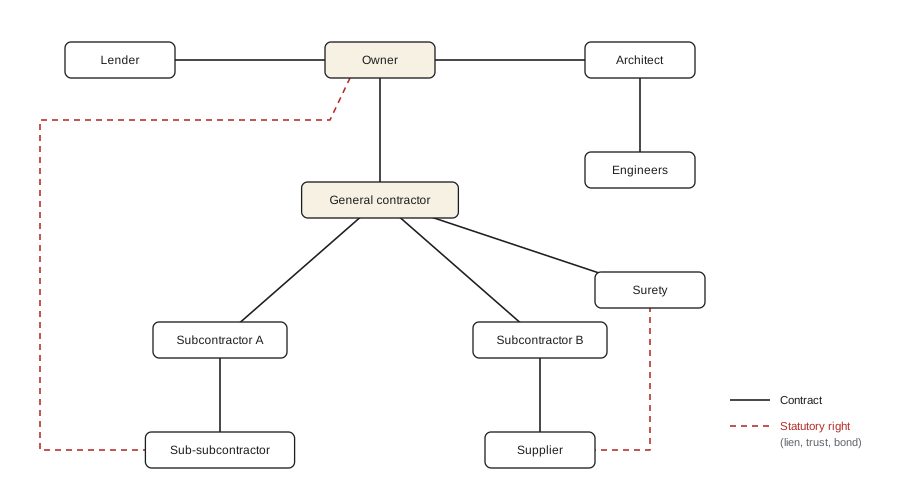
Construction is one of the most legally dense activities in the economy. A single mid-sized building can involve an owner, a lender, a design team, a general contractor, thirty or more subcontractors, dozens of suppliers, a surety, several insurers, a municipality and a utility, each bound to the others by contracts, statutes, permits and the general law of negligence. Construction managers do not need to be lawyers, but they make legal decisions every day: whether to sign a change order, when to send a letter about a delay, how much holdback to keep, whether an email has turned into an agreement. This course gives you enough law to recognize those moments, to manage them sensibly and to know when to call a lawyer.
This lesson sets out the framework. It explains where Canadian law comes from, how the courts and legislatures share the work, why Quebec is different, and how the different bodies of law, from contracts to liens to torts, fit together on a construction project. Later lessons build on each piece in turn.
Important: this course explains general legal principles for construction managers. Laws differ between jurisdictions and change over time, and the outcome of any real dispute depends on its facts and its contract. Consult a lawyer licensed in the relevant jurisdiction before acting on a legal question.
Why law matters to the construction manager
Most construction disputes are not lost in court. They are lost months earlier on site, when someone fails to give written notice in time, signs a lien waiver without being paid, starts extra work on a verbal instruction, or lets a deadline under a statute pass. Courts and adjudicators decide cases on documents and deadlines. The construction manager creates most of those documents and controls most of those deadlines.
A useful way to think about legal risk is to separate three activities.
- Allocating risk at the start, through the contract: who bears the cost of unexpected ground conditions, late drawings, price escalation or bad weather.
- Preserving rights during the work, through notices, records and statutory steps such as preserving a lien or serving a payment claim.
- Resolving disputes at the end, through negotiation, adjudication, mediation, arbitration or litigation.
The construction manager is central to all three. A good manager reads the contract before signing it, keeps a diary of rights and deadlines during the job, and builds a record that makes disputes easy to resolve or easy to win.
Common law and civil law
Canada has two legal traditions. Nine provinces and the three territories follow the common law, inherited from England, in which judges develop legal rules case by case and later courts follow earlier decisions under the principle of stare decisis. Quebec follows the civil law tradition for private law, inherited from France, in which the primary source of law is a comprehensive code, the Civil Code of Québec, and judges interpret its articles rather than building rules from precedent. Federal law, criminal law and much public law apply in Quebec as elsewhere, and Quebec courts do consider earlier decisions, but contracts, property, liability and construction hypothecs in Quebec are governed by the Code.
The difference matters in practice. In a common law system, a construction manager wanting to understand the rule on, say, delay damages looks at statutes first and then at leading cases. In a civil law system, the starting point is the relevant articles of the code, read as a coherent whole, and cases show how courts have applied them.
Sources of law
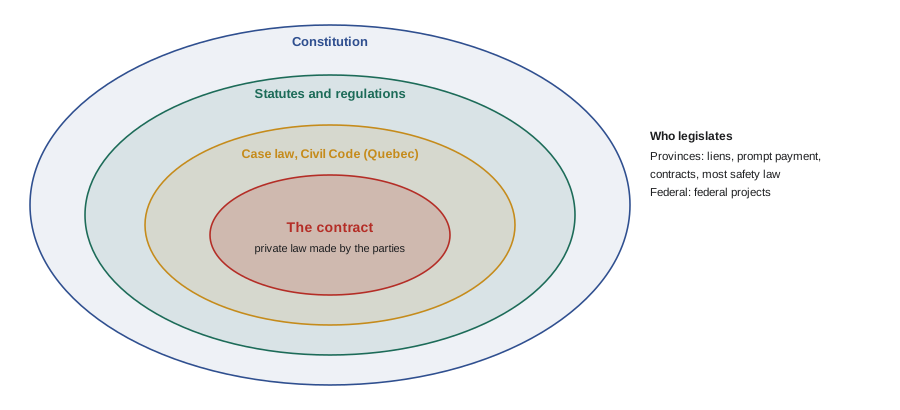
Four sources of law shape every construction project.
- The constitution, which divides law-making power and limits what governments can do.
- Statutes and regulations, made by legislatures and by governments under delegated authority: lien and prompt payment acts, building codes, occupational health and safety rules, limitation statutes, procurement rules.
- Case law, the body of court decisions that interpret statutes and develop the common law of contract and tort.
- The contract, the private law the parties make for themselves, which governs most of their relationship but cannot override mandatory statutes.
In Canada, the Constitution Act, 1867 gives the provinces jurisdiction over property and civil rights, which is why construction liens, prompt payment, contract law and most occupational health and safety rules are provincial. The federal government legislates for its own projects and for federally regulated industries, which is why the federal Prompt Payment for Construction Work Act applies only to federal construction contracts. Municipalities enforce building codes and issue permits under provincial authority.
| Subject | Main source | Who makes it |
|---|---|---|
| Construction liens and holdback | Provincial lien or construction acts | Provincial legislatures |
| Prompt payment, private work | Provincial prompt payment regimes | Provincial legislatures |
| Prompt payment, government work | Federal Act for federal work; provincial rules for provincial work | Parliament and legislatures |
| Contract formation and interpretation | Case law, and the Civil Code in Quebec | Courts |
| Negligence | Case law | Courts |
| Building standards | National and provincial building codes | Governments and code bodies |
| The project relationship | The contract | The parties |
Courts, tribunals and adjudicators
Canadian courts are organized by province. Each province has a superior court of general jurisdiction, such as the Ontario Superior Court of Justice or the Supreme Court of British Columbia, which hears lien actions and large contract claims, and a court of appeal above it. The Supreme Court of Canada hears a small number of appeals of national importance, and its decisions bind every other court. Several of the cases in this course, such as Bhasin v. Hrynew and Tercon Contractors v. British Columbia, are Supreme Court decisions that changed construction practice across the country.
Outside the courts, construction disputes increasingly go to faster forums. Arbitration is private and binding if the contract provides for it. Statutory adjudication, now in force in several jurisdictions, gives an interim decision on payment disputes within weeks. Mediation helps the parties settle with a neutral facilitator. Lesson 12 compares these forums.
The bodies of law on a construction project
Several areas of law overlap on every job.
- Contract law: formation, interpretation, performance, breach and remedies. It governs most relationships on the project.
- Tendering and procurement law: the rules that apply to bids, especially public bids.
- Lien and trust law: statutory security for those who supply labour and materials, and statutory trusts over construction money.
- Prompt payment and adjudication law: deadlines for paying invoices and fast processes for payment disputes.
- Tort law: duties owed regardless of contract, especially negligence by designers, builders and inspectors.
- Regulatory law: building codes, permits, occupational health and safety, environmental rules, employment and labour law.
- Insurance and surety law: the policies and bonds that transfer risk to third parties, covered in depth in CON-350.
These bodies of law interact. A subcontractor who is not paid may have a contract claim against the contractor, a statutory lien against the owner's land, a claim on a payment bond, a prompt payment remedy and, in some places, a trust claim against individuals who diverted the money. A construction manager who knows that these remedies exist, and that each has its own deadline, can protect a company's position far better than one who thinks only of the contract.
Reading the law as a manager
Construction managers meet legal texts in three forms: statutes, cases and contracts. A few habits make each easier to use.
- Read definitions first. Words such as substantial performance, proper invoice or claim usually have defined meanings that differ from everyday use.
- Find the deadlines and the triggers. Most statutory rights depend on doing something within a set number of days after an event.
- Check which version applies. Construction statutes are amended often, and transition rules usually depend on when the contract was made or the procurement began.
- Note who must act. A notice served by the wrong party, or to the wrong address, may not count.
- Keep the source. Record the section number and the date you checked it, so the next person can verify it.
Worked problem
Mapping the remedies of an unpaid subcontractor
A drywall subcontractor on a private office project in Ontario has an unpaid invoice of $84,000. Which remedies should its project manager list for discussion with counsel?
Show solution
- Contract: a claim against the general contractor for the price, plus interest under the contract or the statute.
- Prompt payment: if the contractor has been paid, the Construction Act requires it to pay the subcontractor within 7 days, and adjudication is available for the dispute.
- Lien: a lien may be preserved against the owner's interest in the land, normally within 60 days after the contract is completed, abandoned or terminated, or after publication of the certificate of substantial performance.
- Trust: money received by the contractor for the project is trust money for the subcontractors under the Act.
- Diary: each remedy has a deadline; the first one to expire controls the urgency.
Answer: Four remedies (contract, prompt payment and adjudication, lien and trust), each with its own deadline; the lien deadline is usually the most urgent.
Standard of care for managers
Courts do not expect construction managers to know the law as a lawyer does, but they do expect a reasonable professional to know the main rules of the industry. Failing to preserve a lien, missing a contractual notice period or signing a release without reading it are mistakes a court will rarely excuse. Companies manage this risk through checklists, contract summaries prepared at the start of each project, legal review of unusual clauses, and training such as this course.
Worked problem
Converting days into dates
A statute requires a step to be taken within 45 days after an event that occurred on March 20. The relevant interpretation act says the day of the event is excluded and the last day is included, and if the last day falls on a holiday the time extends to the next business day. What is the last day?
Show solution
- Count from March 21: March has 11 days remaining (21 to 31).
- April has 30 days: 11 + 30 = 41 days by April 30.
- 4 more days are needed: May 4.
- If May 4 is a business day, it is the deadline. Diarize May 4, with an internal target several days earlier.
Answer: May 4, with an internal target about a week earlier.
Common mistakes
MistakeAssuming the contract is the only source of rights and obligations.
InsteadStatutes, such as lien and prompt payment laws, and the law of negligence apply whatever the contract says, and some cannot be contracted out of.
MistakeRelying on a rule learned in another province or state.
InsteadConstruction law is mostly local; check the statute and cases of the place where the project is.
MistakeCounting deadlines loosely in weeks or months.
InsteadCount days exactly under the governing interpretation rules and diarize a target date well before the legal deadline.
MistakeWaiting until a dispute is certain before keeping records.
InsteadBuild the record from day one; most disputes are won or lost on documents created during the work.
MistakeTreating a legal summary as a substitute for advice.
InsteadUse summaries to spot issues, then get advice from a lawyer licensed in the jurisdiction.
Summary and key terms
- Canada uses the common law in nine provinces and the territories, and the civil law of the Civil Code of Québec for private law in Quebec.
- The four sources of construction law are the constitution, statutes and regulations, case law and the contract.
- Liens, prompt payment, contract law and most safety law are provincial; federal law governs federal projects.
- Contract, tendering, lien, prompt payment, tort, regulatory and insurance law all overlap on a project.
- An unpaid party usually has several remedies, each with its own deadline.
- Managers create most of the documents and control most of the deadlines that decide disputes.
- Read definitions, triggers and transition rules, and record which version of the law you checked.
- Common law
- A legal system in which judges develop rules case by case and follow earlier decisions.
- Civil law
- A legal system based on a comprehensive code interpreted by judges.
- Stare decisis
- The principle that courts follow earlier decisions of higher courts.
- Statute
- A law made by a legislature.
- Regulation
- A rule made by a government or agency under authority delegated by a statute.
- Case law
- The body of court decisions that interpret statutes and develop legal rules.
- Jurisdiction
- The authority of a legislature or court over a subject or place, or the place itself.
- Adjudication
- A fast statutory process giving an interim binding decision on a construction payment dispute.
- Remedy
- The legal means of enforcing a right or compensating a wrong.
- Limitation period
- The time within which a legal claim must be started.
Practice problems
Work each problem on paper first, then reveal the answer to check.
Name the four sources of construction law.
Show answer
The constitution, statutes and regulations, case law and the contract.
Which Canadian province follows the civil law for private law?
Show answer
Quebec.
Why is lien law provincial in Canada?
Show answer
The Constitution Act, 1867 gives the provinces jurisdiction over property and civil rights.
Can a contract override a mandatory statute?
Show answer
No; mandatory statutory rights apply whatever the contract says.
List three remedies an unpaid subcontractor may have.
Show answer
A contract claim, a lien, prompt payment and adjudication rights, and a trust claim.
What is the first thing to read in a statute?
Show answer
The definitions.
A deadline is 30 days after June 10, excluding the first day. What is the date?
Show answer
July 10.
What does stare decisis mean?
Show answer
Courts follow the earlier decisions of higher courts.
Where do most construction disputes begin to be won or lost?
Show answer
On site, in the notices, records and deadlines kept during the work.
What should you record when you check a statute?
Show answer
The section number, the version and the date you checked it.
Lesson quiz · 5 questions
Score 60% or more to complete this lesson.
Create a free account to save your progress, take quizzes and earn a certificate.