
CON-220 · Lesson 11 of 12 · 27 min
Negligence, professional liability, warranties and limitation periods
Construction liability does not end when the contract is complete. A roof that leaks after five years, a parking garage slab that spalls after ten, an engineer's error that causes a collapse, a subcontractor's faulty work discovered by a buyer who never had a contract with it: all raise questions of liability outside or after the contract. This lesson covers the law of negligence as it applies to builders and designers, the liability of design professionals, the owner's warranty of the design it furnishes, express and implied warranties, indemnities, and the time limits within which claims must be brought.
Negligence
Negligence is the main tort in construction. A person is liable in negligence if they owed the claimant a duty of care, breached the standard of care, and caused damage that is not too remote. Negligence claims matter in construction because they can be brought by people who have no contract with the defendant: an owner against a subcontractor, a later purchaser against the original builder, a contractor against the owner's engineer, or an injured member of the public against everyone involved.
The modern law of negligence descends from Donoghue v. Stevenson (1932), in which the House of Lords held that a manufacturer owes a duty of care to the ultimate consumer of its product. Canadian courts decide whether a new duty of care exists using the Anns/Cooper test from Cooper v. Hobart (2001): is the harm a reasonably foreseeable consequence of the defendant's conduct, is there sufficient proximity between the parties, and are there policy reasons to negate or limit the duty?
The standard of care is that of a reasonable person in the defendant's position. For contractors, it is the care a reasonably competent contractor would exercise; for professionals, the care of a reasonably competent member of the profession. Compliance with the building code is evidence of reasonable care but not conclusive, and breach of the code is evidence of negligence.
Pure economic loss
The difficult cases in construction involve pure economic loss: financial loss that is not the result of physical injury to a person or damage to other property. The cost of repairing a defective wall, or the profit lost because a building opened late, is pure economic loss. Courts are cautious about allowing such losses in negligence, because contracts are the normal way to allocate them.
Canadian law allows recovery of pure economic loss in recognized categories. In Winnipeg Condominium Corporation No. 36 v. Bird Construction (1995), cladding fell from a building and a condominium corporation, which had no contract with the builder, sued for the cost of repair. The Supreme Court of Canada held that contractors, subcontractors and architects owe a duty to later owners to take reasonable care not to create defects that pose a real and substantial danger to occupants, and can be liable for the cost of repairing such dangerous defects before injury occurs. The Court did not extend this to defects that are merely shoddy. In 1688782 Ontario Inc. v. Maple Leaf Foods (2020), the Court emphasized that pure economic loss is recoverable only in limited categories with close proximity.
| Type of loss | Example | Usual position |
|---|---|---|
| Personal injury | A worker is hurt by a falling object | Recoverable in negligence |
| Damage to other property | A leaking pipe ruins the tenant's stock | Recoverable in negligence |
| Dangerous defect, before injury | Cladding at risk of falling | Recoverable (Winnipeg Condominium) |
| Shoddy but safe defect | Poor finishes, inefficient system | Usually only in contract |
| Delay and lost profit | Late opening | Usually only in contract |
Liability of design professionals
Architects and engineers owe duties in contract to their clients, and in tort to those who foreseeably rely on their work. Their standard of care is that of a reasonably competent professional practising at the time; they do not guarantee perfect designs, but they must design in accordance with accepted practice and the applicable codes, review shop drawings with reasonable care, and administer the contract fairly when acting as payment certifier or interpreter.
In Edgeworth Construction v. N.D. Lea & Associates (1993), the Supreme Court of Canada held that engineers who prepared tender documents could be liable in negligent misrepresentation to the contractor who relied on them in bidding, even though they had no contract with the contractor, following the principle from Hedley Byrne v. Heller (1964). The engineering firm, not only the individual engineers who sealed the drawings, was liable. Contractual limitations between the owner and contractor did not protect the engineers.
The owner, in turn, has a contract claim against its designers. Design professionals usually carry professional liability insurance, and their contracts often limit their liability to their fee or to the insurance limits. Provincial professional regulators can also discipline architects and engineers for professional misconduct.
Who warrants the design?
When the owner provides the design and requires the contractor to follow it, Canadian courts generally hold that the contractor is not responsible for defects that result from building in accordance with the design, provided it built competently, unless the contract shifts design responsibility to it. Contractors do have a duty to warn of obvious design defects they notice or ought to notice. Owners often add supplementary conditions requiring the contractor to review the documents and report errors, which can shift some risk to the contractor.
Worked problem
Design specification or performance specification?
Specification A says: 'Install 200 mm insulated precast panels with the reinforcing, anchors and joint details shown on drawings S-301 to S-310.' Specification B says: 'Provide a curtain wall system designed by the contractor's engineer to resist the wind loads and drift stated in Section 08 44 13.' Panels built to A crack under wind load; the curtain wall built to B leaks. Who bears the design risk in each?
Show solution
- A is a detailed design specification: the owner, through its designer, generally bears the risk of the design if the contractor built as shown.
- B is a performance specification with delegated design: the contractor bears the risk that its engineered system meets the stated performance.
- In both cases the contractor remains responsible for workmanship and for reporting obvious design errors.
Answer: A: owner's design risk; B: contractor's design risk.
Warranties and correction periods
Construction contracts contain express warranties that the work will conform to the contract documents and be free from defects. They usually add a correction period, commonly one year from substantial completion, during which the contractor must return and correct defects that appear.
CCDC 2-2020 GC 12.3 contains the contractor's warranty, with a one-year warranty period from the date of substantial performance, and extended warranties where the specifications require them. Expiry of the warranty period does not end the contractor's liability for defects; it ends the obligation to return and correct under the warranty. The owner can still sue for breach of contract within the limitation period. Sale of goods acts and, for new homes, provincial warranty programs such as Tarion in Ontario add statutory warranties. In Quebec, Civil Code article 2118 makes the contractor, architect and engineer jointly liable for the loss of the work occurring within five years after completion.
Indemnities
An indemnity is a promise to compensate another party for losses, usually third-party claims, arising from specified events. Construction contracts are full of indemnities: the contractor indemnifies the owner against claims arising from its work, subcontractors indemnify the contractor. Broad-form indemnities that require a party to indemnify another even for the other's own negligence are controversial.
CCDC 2-2020 Part 12 contains mutual indemnities, limited in amount, often by reference to insurance limits, and subject to a time limit for claims. Canadian courts interpret indemnities strictly against the party relying on them; an indemnity covers the indemnitee's own negligence only if the words clearly say so.
Limitation periods
Claims must be started within time limits set by statute. Missing the limitation period ends the claim, regardless of its merit.
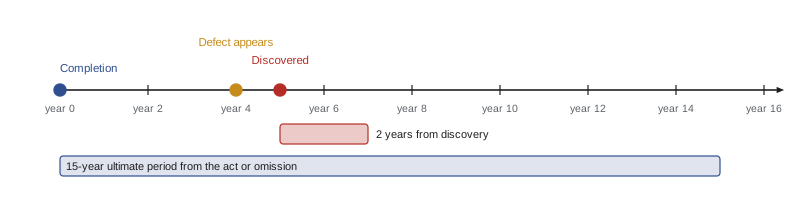
In Ontario, the Limitations Act, 2002 sets a basic limitation period of two years from the day the claim was discovered, meaning the day the claimant knew or ought to have known of the injury, loss or damage, that it was caused by the defendant, and that a proceeding was appropriate. An ultimate limitation period of 15 years from the act or omission applies whatever the discoverability. British Columbia uses two years from discovery with a 15-year ultimate period; Alberta two years from discovery with a 10-year ultimate period. In Quebec, the general prescription period for personal rights is three years. Lien, trust and bond claims have their own much shorter periods.
Worked problem
Calculating limitation deadlines
A condominium reached substantial performance on June 15, 2020. Water staining appeared in 2024, and an engineering report delivered on March 10, 2025 identified defective membrane work by the roofing subcontractor. When does the basic limitation period in Ontario expire, and what is the ultimate deadline?
Show solution
- Discovery: arguably March 10, 2025, when the cause and the defendant were known, although a court might find earlier discovery in 2024 when the staining appeared.
- Basic period: two years from March 10, 2025, so March 10, 2027, at the latest.
- Ultimate period: 15 years from the act or omission (around 2020), so about 2035.
- Prudent target: start the claim well before the earliest arguable deadline, two years from the first staining in 2024.
Answer: By March 10, 2027 at the latest, and earlier to be safe.
Insurance and defect claims
Defect claims are usually paid, if at all, by insurance. Contractors carry commercial general liability insurance, which generally covers property damage and bodily injury caused by an occurrence, but not the cost of repairing the contractor's own defective work. Whether damage to other parts of a project caused by a subcontractor's faulty work is covered depends on the policy wording and on court decisions that differ between jurisdictions. Design professionals carry professional liability insurance written on a claims-made basis, which covers claims made while the policy is in force. Owners often require project-specific policies, such as wrap-up liability or builder's risk insurance, to simplify claims. CON-350 covers insurance and bonding in detail.
For the construction manager, the practical points are to report potential claims to insurers promptly, because late notice can defeat coverage; to keep the records needed to show what caused damage and when; and to read the insurance requirements in the contract before signing, because they decide who carries which risks long after the project is finished.
Practical protection against long-tail claims
Because defect claims can arrive many years after completion, contractors and designers should keep project records, including as-built drawings, inspection and test reports, submittals, photographs and correspondence, for at least as long as the longest limitation or repose period that could apply. Records that seem routine at closeout, such as a field report showing that a membrane was inspected before it was covered, can decide a claim a decade later. Companies should also track which entity performed each project, because claims follow the legal entity, not the brand, and corporate reorganizations can complicate who is responsible.
Common mistakes
MistakeAssuming liability ends when the one-year warranty period expires.
InsteadContract and negligence claims continue within the limitation period.
MistakeBuilding an obviously defective design without comment.
InsteadReport patent design errors in writing; the duty to warn applies.
MistakeWaiting for a full expert report before considering limitation periods.
InsteadLimitation periods may run from earlier discovery; diarize from the first sign of a problem.
MistakeAssuming an indemnity covers the indemnitee's own negligence.
InsteadOnly clear words do, and anti-indemnity statutes may void it.
MistakeTreating performance and design specifications alike.
InsteadIdentify who designed each element; design risk follows design responsibility.
Summary and key terms
- Negligence requires a duty of care, breach of the standard of care, causation and damage that is not too remote.
- Canada uses the Anns/Cooper test for new duties of care.
- Winnipeg Condominium allows recovery of the cost of repairing dangerous defects; shoddy defects stay in contract.
- Designers can be liable in negligent misrepresentation to contractors who rely on their documents (Edgeworth).
- Warranty and correction periods do not limit liability for defects within the limitation period.
- Indemnities are read strictly; broad-form indemnities may be void by statute.
- Ontario: 2 years from discovery and a 15-year ultimate period.
- Negligence
- Failure to take reasonable care, causing foreseeable harm to someone owed a duty.
- Duty of care
- A legal obligation to take reasonable care to avoid harming another.
- Standard of care
- The level of care expected of a reasonable person or professional.
- Pure economic loss
- Financial loss without physical injury or damage to other property.
- Negligent misrepresentation
- A careless statement relied on by someone the maker owed a duty to.
- Design specification
- A specification that tells the contractor exactly how to build.
- Performance specification
- A specification that states the required result and leaves design to the contractor.
- Correction period
- The time after completion during which the contractor must correct defects.
- Indemnity
- A promise to compensate another for specified losses.
- Statute of repose
- A fixed time limit running from completion, regardless of discovery.
Practice problems
Work each problem on paper first, then reveal the answer to check.
Name the four elements of negligence.
Show answer
Duty, breach, causation and damage that is not too remote.
What did Winnipeg Condominium v. Bird decide?
Show answer
Builders can be liable to later owners for repairing dangerous defects.
Is a poor-quality but safe finish usually recoverable in negligence?
Show answer
No; it is usually a contract matter.
What did Edgeworth Construction decide?
Show answer
Engineers can be liable to a contractor for negligent misrepresentation in tender documents.
Does the one-year correction period limit liability?
Show answer
No; claims can be brought within the limitation period.
Who bears design risk under a performance specification?
Show answer
The contractor.
Defect discovered May 1, 2026; 2-year period. Deadline?
Show answer
May 1, 2028.
What does a broad-form indemnity do?
Show answer
Requires indemnity even for the other party's own negligence.
What is a statute of repose?
Show answer
A fixed limit from completion regardless of discovery.
What should a contractor do with an obvious design error?
Show answer
Report it in writing before building it.
Lesson quiz · 5 questions
Score 60% or more to complete this lesson.
Create a free account to save your progress, take quizzes and earn a certificate.