
CON-220 · Lesson 7 of 12 · 28 min
Construction liens, trusts and payment bonds
A subcontractor deep in the contract chain has a problem: it has improved the owner's property, but it has no contract with the owner. If the general contractor fails, a contract claim against it may be worth little. Construction law solves this problem with statutory security: a lien that attaches the value of work to the land itself, trusts that protect construction money, and payment bonds from a surety that guarantee payment. These rights are powerful, but they are created by statute, they depend on strict deadlines, and they are lost permanently if those deadlines are missed. This lesson explains how they work and how construction managers protect and manage them.
Why liens exist
The idea behind a construction lien is simple. Those who supply labour, services or materials to improve land should be able to look to the land for payment, because the owner benefits from the improvement. A lien gives a claimant a charge on the owner's interest in the land, which can be enforced by a court-ordered sale if the claim is not paid or secured. In practice, few liens end in a sale. A registered lien clouds the owner's title, blocks financing draws and sales, and pushes the parties to resolve the payment dispute.
In the common law provinces, liens are created by provincial statutes: Ontario's Construction Act, British Columbia's Builders Lien Act, Alberta's Prompt Payment and Construction Lien Act and their equivalents. In Quebec, the Civil Code of Québec grants a legal hypothec to persons who took part in the construction or renovation of an immovable. The statutes share the same structure: who can claim, what must be done to preserve the lien, when it must be enforced, and how much the owner can be made to pay.
Preserving and perfecting a lien
Under Ontario's Construction Act, a lien arises when a person supplies services or materials to an improvement. To keep it, the claimant must preserve it by registering a claim for lien on title to the land (or, on certain public land, by giving written notice to the owner) within 60 days after the earliest of the triggering events: publication of a certificate of substantial performance, completion of the claimant's contract or subcontract, or abandonment or termination. The claimant must then perfect the lien by starting a court action and registering a certificate of action within 90 days after the last day on which the lien could have been preserved. A lien that is not preserved or perfected in time expires. The 2026 amendments kept this event-based expiry, after an earlier amendment that would have made liens expire annually was reversed.
| Province | Deadline to preserve (summary) | Next step |
|---|---|---|
| Ontario | 60 days after substantial performance is published, or completion, abandonment or termination | Perfect within 90 days after the last day to preserve |
| British Columbia | 45 days after a certificate of completion, or completion, abandonment or termination of the head contract | Start an action within 1 year of filing |
| Alberta | 60 days after the triggering event (90 days for concrete and some oil and gas work) | Start an action within 180 days |
| Quebec | Legal hypothec lasts 30 days after the end of the work without registration; register a notice within that time | Start an action within 6 months after the end of the work |
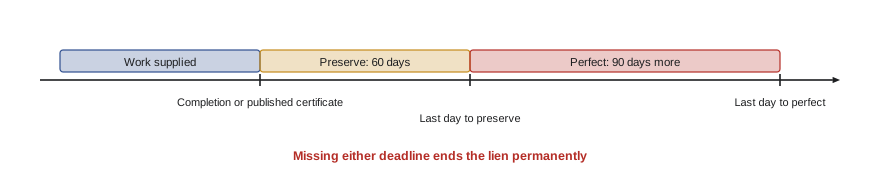
Worked problem
Calculating lien deadlines
An electrical subcontractor's last work on an Ontario office project was on April 18. No certificate of substantial performance has been published, and the subcontract was completed that day. What are the last days to preserve and to perfect its lien?
Show solution
- Preserve: within 60 days after completion of the subcontract. April has 12 days left after April 18; May has 31 (43); June 17 makes 60. Last day: June 17.
- Perfect: within 90 days after June 17. June has 13 days left; July 31 (44); August 31 (75); September 15 makes 90. Last day: September 15.
- Diarize June 10 as the internal target for preservation.
Answer: Preserve by June 17; perfect by September 15.
How much the owner can be made to pay
The lien statutes protect owners who follow the rules. If an owner retains the statutory 10 % holdback and pays it out only when the lien period has expired with no liens preserved, its liability to all lien claimants is generally limited to the holdback amount, plus any amounts it paid after receiving written notice of a lien. An owner who pays out holdback early, or keeps paying after receiving notice of a lien, risks paying twice. Owners and contractors can remove a registered lien from title by paying security into court or posting a lien bond, which then stands in place of the land.
Worked problem
Owner's maximum liability
An owner retained holdback correctly on a $3,200,000 contract and has paid the contractor $2,880,000. A subcontractor preserves a lien for $210,000 and another for $95,000. What is the owner's maximum liability to the lien claimants, if it received no written notice of liens before its payments?
Show solution
- Holdback: 10 % × $3,200,000 = $320,000; the owner has paid $3,200,000 − $320,000 = $2,880,000.
- Total liens: $210,000 + $95,000 = $305,000.
- Maximum owner liability is the holdback, $320,000, which covers both claims.
- The remaining holdback after the liens is $15,000.
Answer: $320,000, the holdback, which covers both liens.
Construction trusts
Most common law provinces also create statutory trusts over construction money. Under Ontario's Construction Act, money received by an owner for the improvement, money owed to and received by a contractor, and money received by a subcontractor are trust funds for the benefit of those below them in the chain, until those people are paid. A contractor that uses project funds to pay overhead on another job while its subcontractors remain unpaid breaches the trust. Directors and officers who assent to or acquiesce in a breach can be personally liable, even if the company is insolvent, and from 2026 trust claims and lien claims can be joined in one action. Trust rights are especially valuable when a contractor fails and a lien has expired.
| Trust | Trustee | Beneficiaries |
|---|---|---|
| Owner's trust | Owner | The contractor, for money received to finance the project |
| Contractor's trust | Contractor | Subcontractors and suppliers |
| Subcontractor's trust | Subcontractor | Its own sub-subcontractors and suppliers |
Payment and performance bonds
A surety bond is a three-party guarantee. The principal, usually the contractor, buys the bond from a surety, an insurance or bonding company, for the benefit of the obligee, usually the owner. Two bonds matter most.
- A performance bond protects the owner if the contractor defaults: the surety may complete the work, arrange for completion or pay the owner up to the bond amount.
- A labour and material payment bond protects subcontractors and suppliers: if the contractor does not pay them, they can claim on the bond.
In Canada, standard bond forms such as CCDC 221 (performance bond) and CCDC 222 (labour and material payment bond) are common, typically at 50 % of the contract price each. Ontario's Construction Act requires both bonds on public contracts of $500,000 or more. A payment bond claimant must give written notice to the surety and principal within the time the bond sets, often 120 days after the claimant last supplied work, and sue within the bond's limitation period, often one year. Payment bonds are a key protection on public projects, where liens may be limited or unavailable.
Worked problem
Checking a payment bond claim
A sheet metal sub-subcontractor last supplied work on August 30 and was not paid $48,000. The labour and material payment bond requires written notice within 120 days after the claimant's last work and suit within one year after the principal stopped work. What should it do?
Show solution
- Written notice: within 120 days of August 30, by December 28; send it to the surety and principal as the bond requires.
- Gather the contract, invoices, delivery records and proof of the amount.
- Diarize the suit deadline from the date the principal stopped work.
- Also consider lien and trust rights if the project is private.
Answer: Give notice by December 28, then sue within the bond's limitation period.
Managing lien and bond risk
- Contractors and subcontractors: diarize lien and bond deadlines for every job from the first day of work; send required notices early; never let an unpaid amount drift past the deadline in hope of a settlement.
- Owners and payers: retain holdback or retainage correctly; collect waivers or statutory declarations with each payment; check title or county records before paying; require bonds on large projects.
- Everyone: keep accurate records of the last day work was supplied, because many deadlines run from it, and minor warranty or repair work may not extend the period.
Removing liens and dealing with exaggerated claims
A registered or recorded lien clouds title and can stall a project's financing, so owners and contractors often need to remove it quickly while the dispute is resolved. The usual method is to post security, either money paid into court or a lien bond from a surety, in the amount the statute requires, often the amount of the claim plus an allowance for costs. The court then orders the lien removed from title, and the claimant's rights attach to the security instead of the land. The underlying dispute continues.
Lien statutes also discourage abuse. A claimant who registers a lien for an amount it knows is exaggerated, or registers a lien without a reasonable basis, can be liable for damages caused by the lien and for costs. Claims should be calculated carefully, should exclude amounts not yet earned or not secured by the statute, such as damages for lost profit on unperformed work in many jurisdictions, and should be supported by the contract, invoices and records. A modest, well-founded lien is far more effective than an inflated one.
When a project is in financial trouble, lien and bond rights become the most valuable assets a subcontractor has. Insolvency proceedings can freeze contract claims against a failed contractor, but properly preserved liens, trust claims and bond claims usually survive and may be paid ahead of ordinary creditors. This is another reason never to let a lien or bond deadline pass while waiting to see how a dispute develops.
Common mistakes
MistakeWaiting to see whether the payer pays before preserving a lien.
InsteadLien deadlines run regardless of negotiations; preserve or record in time and negotiate afterwards.
MistakeAssuming warranty or touch-up work extends the lien period.
InsteadMinor or remedial work often does not; use the date of the last substantive work.
MistakePaying out holdback early to help a contractor's cash flow.
InsteadEarly release can leave the owner exposed beyond the holdback.
MistakeFiling a lien on a public project where liens are not allowed.
InsteadUse the payment bond or statutory notice process for public work.
MistakeOverstating the amount of a lien.
InsteadClaim only what is owed; exaggerated liens can lead to liability for damages and costs.
Summary and key terms
- Liens give unpaid suppliers of labour, services and materials security in the improved land.
- In Ontario, a lien must be preserved within 60 days after the triggering event and perfected within 90 days after that.
- An owner retaining holdback correctly is generally liable only up to the holdback.
- Statutory trusts protect construction money, and directors can be personally liable for breaches.
- Performance bonds protect owners; payment bonds protect subcontractors and suppliers.
- Ontario requires 50 % performance and payment bonds on public contracts of $500,000 or more.
- Diarize every deadline from the first day of work.
- Lien
- A statutory charge on land securing payment for work or materials supplied to improve it.
- Preserve
- To register or give notice of a lien within the statutory period.
- Perfect
- To take the further step, such as starting an action, that keeps a preserved lien alive.
- Legal hypothec
- In Quebec, the security granted to persons who took part in construction.
- Preliminary notice
- An early notice some states require before a lien can be recorded.
- Lien waiver
- A document giving up lien rights, usually in exchange for payment.
- Statutory trust
- A trust created by statute over construction money for those down the chain.
- Surety
- The company that issues a bond guaranteeing the principal's obligations.
- Payment bond
- A bond guaranteeing payment to subcontractors and suppliers.
- Performance bond
- A bond guaranteeing completion of the contract.
Practice problems
Work each problem on paper first, then reveal the answer to check.
How long does an Ontario claimant have to preserve a lien after completing its subcontract?
Show answer
60 days.
How long after the last day to preserve must an Ontario lien be perfected?
Show answer
90 days.
What is the owner's maximum liability on a $1,000,000 contract with proper holdback?
Show answer
$100,000, plus amounts paid after written notice of a lien.
Can liens be filed against federal property?
Show answer
No; claimants use payment bonds.
Who can be personally liable for breach of a construction trust?
Show answer
Directors and officers who assented to or acquiesced in the breach.
Which bond protects subcontractors and suppliers?
Show answer
The labour and material payment bond.
When must Ontario public contracts have bonds?
Show answer
At $500,000 or more.
Last work July 10; deadline 60 days after. What is the date?
Show answer
September 8.
Why should a lien amount not be exaggerated?
Show answer
Exaggerated liens can lead to liability for damages and costs.
Does touch-up work extend the lien period?
Show answer
Often not; minor remedial work may not count.
Lesson quiz · 5 questions
Score 60% or more to complete this lesson.
Create a free account to save your progress, take quizzes and earn a certificate.