
CMPUT-366 · Lesson 1 of 12 · 38 min
What AI is and intelligent agents
Artificial intelligence is the study of how to build systems that choose good actions. That sounds modest, but behind it sit some of the oldest questions in computing. What counts as good? How can a program decide what to do in a world it can only partly see? How much should it compute before acting? This course answers those questions with algorithms: search, constraint satisfaction, logical inference, probabilistic reasoning, decision making and planning. Each lesson builds working Python code, measures how it behaves, and explains the theory that predicts that behaviour.
CMPUT-366 is the classical, algorithmic core of AI. It assumes the data structures and graph algorithms of CMPUT-204 and the probability of STAT-151. Several other courses go deeper into parts of the field. AI-320 develops probabilistic models and inference, AI-330 covers reinforcement learning and Markov decision processes in depth, and AI-470 builds agent systems around today's large models. Machine learning, where a system improves from data rather than from explicitly programmed knowledge, is the subject of CMPUT-367 and CMPUT-466. Here we build the reasoning machinery those courses rely on.
Four ways to define AI
Textbook definitions of AI fall along two axes. One axis asks whether we care about thinking or about acting. The other asks whether we measure success against human performance or against an ideal standard of rationality. The four combinations give four research programs, each with a long history.
In 1950 Alan Turing proposed what he called the imitation game: an interrogator exchanges typed messages with a hidden person and a hidden machine, and the machine passes if the interrogator cannot reliably tell which is which. The test was a clever way to replace the vague question 'can machines think?' with an operational one. It remains culturally important, but researchers rarely aim at it directly, for the same reason aeronautical engineers do not aim to build machines so exactly like pigeons that they can fool other pigeons. What matters for most applications is acting well, not acting human.
This course adopts the fourth view, acting rationally. A rational agent is one that acts to achieve the best expected outcome given what it has perceived. The view has two advantages. It is more general than 'thinking rationally', because correct logical inference is only one way to act well; sometimes a reflex, such as pulling a hand off a hot stove, is better than deliberation. And it is more amenable to science than the human-based views, because rationality is mathematically defined while human behaviour is the product of a particular evolutionary history.
Agents and environments
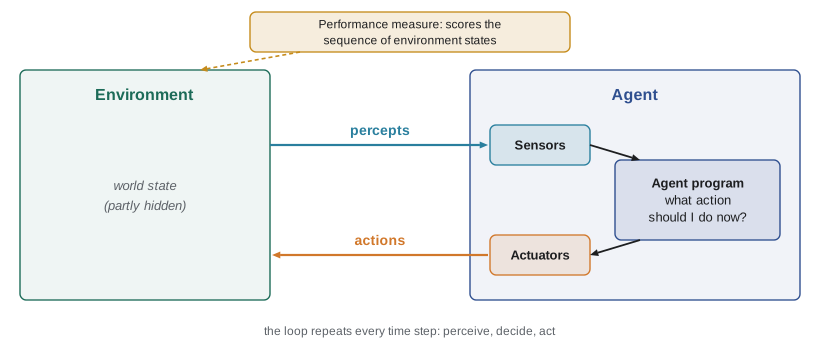
An agent is anything that perceives its environment through sensors and acts on it through actuators. A robot has cameras and motors; a software agent receives network packets or keystrokes and sends files or messages. The agent's percept sequence is the complete history of everything it has perceived. Mathematically, an agent's behaviour is described by an agent function that maps every possible percept sequence to an action. An agent program is a concrete implementation of that function running on some physical architecture.
The distinction between agent function and agent program matters because the obvious implementation is useless. A table-driven agent would store the correct action for every percept sequence and look it up. The program below counts how many entries such a table needs, even for a tiny world. The lesson is that the challenge of AI is to produce rational behaviour from a small program rather than a vast table, just as a few lines implementing Newton's method replace the enormous tables of square roots that engineers once carried.
# Why a lookup-table agent is hopeless: it needs one entry per possible percept sequence.
def table_entries(n_percepts, lifetime):
    return sum(n_percepts ** t for t in range(1, lifetime + 1))

print("corridor agent (8 positions x clean/dirty = 16 percepts):")
for T in (1, 5, 10, 50):
    print(f"  lifetime {T:3} steps: {table_entries(16, T):.3e} entries")
# a camera percept: 640 x 480 pixels, 24 bits each, 30 frames a second
bits_per_frame = 640 * 480 * 24
digits = bits_per_frame * 30 * 3600 * 0.30103      # log10 of 2 ** (bits in an hour of video)
print(f"one hour of video: about 10 to the power {digits:,.0f} possible percept sequences")corridor agent (8 positions x clean/dirty = 16 percepts): lifetime 1 steps: 1.600e+01 entries lifetime 5 steps: 1.118e+06 entries lifetime 10 steps: 1.173e+12 entries lifetime 50 steps: 1.714e+60 entries one hour of video: about 10 to the power 239,698,870,272 possible percept sequences
Rationality and the performance measure
Whether an agent is rational depends on four things: the performance measure that defines success, the agent's prior knowledge of the environment, the actions it can perform, and its percept sequence to date. A rational agent selects, for each percept sequence, an action that is expected to maximize its performance measure, given the evidence of the percepts and its built-in knowledge.
The performance measure should be designed around what we actually want in the environment, not around how we think the agent should behave. Rewarding a cleaning robot for each unit of dirt it picks up sounds sensible, but a rational agent could then maximize its score by dumping dirt and picking it up again. This is a small example of a big problem that returns in lesson 12: an agent optimizes the objective it is given, which may differ from the objective its designers had in mind. Researchers call this misspecification or reward hacking.
Rationality is not omniscience. An agent that crosses a street after looking both ways and is hit by a falling satellite part acted rationally; it could not have known. Rationality maximizes expected performance, not actual performance. It does, however, require information gathering and learning. A rational agent should look before crossing, should explore an unfamiliar environment, and should improve its behaviour when its prior knowledge turns out to be incomplete. An agent that relies only on its designer's prior knowledge, never on its own percepts, lacks autonomy.
Specifying the task environment
Before designing an agent we specify its task environment with four headings, remembered by the acronym PEAS: Performance measure, Environment, Actuators and Sensors. For an automated snowplow on a city route, the performance measure might combine kilometres of lane cleared, time, fuel, salt used, damage and safety incidents; the environment includes roads, parked cars, pedestrians, other vehicles and the weather; the actuators are steering, throttle, brake, blade and spreader; the sensors include cameras, lidar, GPS, wheel encoders and a road-temperature sensor. Writing the PEAS description first forces the designer to say what success means.
Task environments vary along several dimensions, and the right techniques depend heavily on where a task falls. The program below classifies a few tasks; the table after it defines each dimension and names the lesson where we meet algorithms designed for each hard setting.
# Describing task environments along the standard dimensions.
TASKS = {
    "8-puzzle":         dict(observable="fully",     agents="single", deterministic=True,  episodic=False, static=True,  discrete=True),
    "route planning":   dict(observable="fully",     agents="single", deterministic=True,  episodic=False, static=True,  discrete=True),
    "checkers":         dict(observable="fully",     agents="multi",  deterministic=True,  episodic=False, static=True,  discrete=True),
    "poker":            dict(observable="partially", agents="multi",  deterministic=False, episodic=False, static=True,  discrete=True),
    "snowplow driving": dict(observable="partially", agents="multi",  deterministic=False, episodic=False, static=False, discrete=False),
    "spam filtering":   dict(observable="partially", agents="single", deterministic=False, episodic=True,  static=True,  discrete=True),
}
def difficulty(p):
    """Count the 'hard' settings: each one rules out a family of simple techniques."""
    return sum([p["observable"] != "fully", p["agents"] == "multi", not p["deterministic"],
                not p["episodic"], not p["static"], not p["discrete"]])
for name, p in sorted(TASKS.items(), key=lambda kv: difficulty(kv[1])):
    flags = [k for k, ok in [("partial", p["observable"] != "fully"), ("multi-agent", p["agents"] == "multi"),
             ("stochastic", not p["deterministic"]), ("sequential", not p["episodic"]),
             ("dynamic", not p["static"]), ("continuous", not p["discrete"])] if ok]
print(f"{name:17} hard dimensions: {difficulty(p)} {', '.join(flags) or '-'}")8-puzzle hard dimensions: 1 sequential route planning hard dimensions: 1 sequential checkers hard dimensions: 2 multi-agent, sequential spam filtering hard dimensions: 2 partial, stochastic poker hard dimensions: 4 partial, multi-agent, stochastic, sequential snowplow driving hard dimensions: 6 partial, multi-agent, stochastic, sequential, dynamic, continuous
The hardest case, partially observable, multi-agent, stochastic, sequential, dynamic and continuous, describes driving a snowplow, or nearly any task a person does outside a game. The art of applied AI is often to find a simplification that moves a problem toward the easy end of enough dimensions to make it tractable, while keeping enough of the real problem that the solution still works.
Kinds of agent program
Agent programs come in a few basic designs, each adding capability to the last.
The experiment below compares three agents in a corridor of eight cells where dirt keeps appearing. The random agent picks actions blindly. The simple reflex agent cleans when its cell is dirty and otherwise wanders randomly. The model-based agent keeps one bit of internal state, its sweep direction, and so covers the corridor systematically. Each runs for 400 steps in 20 seeded environments, scored by the performance measure in the comment. That single bit of memory nearly doubles the reflex agent's score.
# Three agents clean a corridor of 8 cells in which dirt keeps appearing.
# Performance measure: +10 per unit of dirt removed, -1 per move, over 400 steps.
import random

class Corridor:
    def __init__(self, n=8, p_dirt=0.05, seed=1):
        self.rng = random.Random(seed); self.n, self.p = n, p_dirt
        self.dirty = [self.rng.random() < 0.5 for _ in range(n)]
        self.pos, self.score = 0, 0
    def percept(self):                       # the agent senses only its own cell
        return self.pos, self.dirty[self.pos]
    def act(self, action):
        if action == "suck" and self.dirty[self.pos]:
            self.dirty[self.pos] = False; self.score += 10
        elif action in ("left", "right"):
            self.pos = max(0, min(self.n - 1, self.pos + (1 if action == "right" else -1)))
            self.score -= 1
        for i in range(self.n):              # new dirt appears at random
            if not self.dirty[i] and self.rng.random() < self.p: self.dirty[i] = True

def random_agent(rng):
    return lambda percept: rng.choice(["left", "right", "suck"])

def reflex_agent(rng):
    def act(percept):
        pos, dirty = percept
        return "suck" if dirty else rng.choice(["left", "right"])
    return act

def model_based_agent(n=8):
    state = {"heading": "right"}             # internal state: which way the sweep is going
    def act(percept):
        pos, dirty = percept
        if dirty: return "suck"
        if pos == n - 1: state["heading"] = "left"
        if pos == 0: state["heading"] = "right"
        return state["heading"]
    return act

for name, make in [("random", lambda: random_agent(random.Random(7))),
                   ("simple reflex", lambda: reflex_agent(random.Random(7))),
                   ("model-based sweep", lambda: model_based_agent())]:
    scores = []
    for seed in range(20):
        env, agent = Corridor(seed=seed), make()
        for _ in range(400): env.act(agent(env.percept()))
        scores.append(env.score)
print(f"{name:18} mean score {sum(scores) / len(scores):7.1f} worst {min(scores):5} best {max(scores):5}")random mean score 252.5 worst 172 best 352 simple reflex mean score 543.2 worst 392 best 766 model-based sweep mean score 906.2 worst 722 best 1151
Goal-based and utility-based agents are where most of this course lives. A goal-based agent with a map can find a route by search (lessons 2 and 3); one with a logical model can deduce safe moves (lesson 7); one with action schemas can build a plan (lesson 11). A utility-based agent weighs uncertain outcomes by probability and desirability (lessons 9 and 10). Learning agents are developed in CMPUT-367, CMPUT-466 and AI-330.
A short history of AI
The field has a rhythm of bold predictions, real progress, disappointment and renewal. Knowing the history helps explain why the methods in this course look the way they do, and why some ideas fell out of fashion and then returned.
Canada has played an outsized role in this story, and the University of Alberta in particular. Jonathan Schaeffer's team built Chinook, which won the world checkers championship against human players in the 1990s and in 2007 proved that perfect play from the standard opening leads to a draw, the largest game solved at the time. The same department produced the Cepheus and DeepStack poker programs, and Richard Sutton, who with Andrew Barto shaped the modern field of reinforcement learning, has worked in Edmonton for two decades. In 2025 the ACM announced that Barto and Sutton had received the 2024 Turing Award, computing's highest honour, for that work. Toronto and Montréal were centres of the deep-learning revival through Geoffrey Hinton and Yoshua Bengio, who shared the 2018 Turing Award with Yann LeCun.
A theme runs through the history: early programs reasoned well over small, clean, fully specified problems and failed when problems grew or became uncertain. The classical algorithms in this course are the answers the field found to those failures. Heuristic search tames combinatorial explosion, constraint propagation prunes impossible choices before trying them, and probabilistic reasoning and decision theory handle uncertainty. These methods remain inside modern systems: AlphaZero is Monte Carlo tree search guided by a neural network, route planners run A* variants, chip and airline schedulers run constraint solvers, and hardware verification runs SAT solvers on formulas with millions of variables.
The plan of the course
Lessons 2 to 4 treat problem solving as search: uninformed search, heuristic search and A*, and local search for optimization. Lesson 5 adds an opponent. Lesson 6 exploits the structure of constraint satisfaction problems. Lessons 7 and 8 represent knowledge in logic and reason with it. Lesson 9 replaces certainty with probability, and lesson 10 combines probability with utility to make decisions, including sequential decisions in Markov decision processes. Lesson 11 plans with action schemas, and lesson 12 assembles the pieces into one agent and discusses ethics, governance and the state of the field.
Worked examples
Worked problem
Writing a PEAS description
Give a PEAS description for an agent that schedules exams for a university registrar.
Show solution
- Performance measure: no student has two exams at once, few students have back-to-back exams, rooms are big enough, the exam period is short and accessibility requests are met.
- Environment: the course list, class lists, rooms with capacities, the calendar, and instructors' constraints.
- Actuators: assigning each exam a time slot and a room, and publishing the timetable.
- Sensors: the registrar's database of course registrations, rooms and requests.
Answer: P: conflicts, back-to-back exams, capacity and accessibility met, length of period; E: courses, students, rooms, calendar; A: slot and room assignments; S: registrar database. Lesson 6 solves exactly this kind of problem as a constraint satisfaction problem.
Worked problem
Classifying an environment
Classify a robot that sorts recycling on a moving conveyor belt along the six dimensions.
Show solution
- Observability: cameras see items, but material type can be hidden, so partially observable.
- Agents: single agent (the belt and the items are not trying to win anything).
- Determinism: grasps sometimes slip, so stochastic.
- Episodes: each item can be sorted on its own, so largely episodic.
- Change: the belt keeps moving while the robot decides, so dynamic.
- State space: positions and grasp forces are continuous.
Answer: Partially observable, single-agent, stochastic, episodic, dynamic and continuous. The episodic nature is what makes it tractable: each item is a fresh decision.
Worked problem
Choosing a performance measure
A delivery robot is scored by the number of parcels delivered per hour. What could go wrong, and how would you fix the measure?
Show solution
- Ask how the agent could score well while doing something its designers do not want.
- It could speed through crowds, skip fragile parcels that slow it down, or leave parcels at the wrong door if delivery is recorded by a scan.
- Add terms for what we actually care about: safety incidents, damage, correct recipient, and on-time delivery for every parcel, not a count.
Answer: Measure outcomes in the environment that matter (correct, undamaged, safe, on-time deliveries), and penalize harms, rather than a single easy-to-game count.
Common mistakes
MistakeAI means building machines that think exactly like people.
InsteadThat is one of four views; most AI, and this course, aims at rational action, judged against a performance measure.
MistakeA rational agent always gets the best outcome.
InsteadIt maximizes expected performance given its percepts and knowledge; bad luck does not make a decision irrational.
MistakeThe agent function and the agent program are the same thing.
InsteadThe function is an abstract mapping from percept sequences to actions; the program is a compact implementation running on real hardware.
MistakeAny sensible-sounding performance measure will do.
InsteadAn agent optimizes exactly what it is measured on, so the measure must describe desired outcomes in the environment, not easily gamed proxies.
MistakeClassical AI algorithms are obsolete now that we have deep learning.
InsteadSearch, constraint solving, logic and probabilistic inference run inside game players, planners, schedulers, verifiers and many learned systems today.
Summary and key terms
- AI is the study of agents that perceive and act; this course takes the rational-agent view.
- A rational agent chooses actions that maximize expected performance given its percepts and prior knowledge.
- The performance measure should describe outcomes we want in the environment; poorly chosen measures get gamed.
- PEAS (performance measure, environment, actuators, sensors) specifies a task environment.
- Environments vary in observability, number of agents, determinism, episodes, change over time and continuity.
- Agent designs range from simple reflex through model-based, goal-based and utility-based to learning agents.
- The history of AI alternates enthusiasm and winters; classical algorithms answered the failures of early systems and remain in use.
- Agent
- Anything that perceives its environment through sensors and acts on it through actuators.
- Percept sequence
- The complete history of everything an agent has perceived.
- Agent function
- An abstract mapping from percept sequences to actions.
- Agent program
- A concrete implementation of an agent function on a physical architecture.
- Rational agent
- An agent that acts to maximize its expected performance measure given its evidence and knowledge.
- Performance measure
- The criterion that scores the sequence of environment states an agent produces.
- PEAS
- Performance measure, environment, actuators and sensors: a task environment specification.
- Fully observable
- Describes an environment where the sensors give the complete relevant state at each moment.
- Model-based agent
- An agent that keeps internal state updated by a model of how the world evolves.
- Utility function
- A function that scores states or outcomes by how desirable they are.
Practice problems
Work each problem on paper first, then reveal the answer to check.
State the four definitions of AI on the thinking/acting and human/rational axes.
Show answer
Thinking humanly, acting humanly, thinking rationally and acting rationally.
Why is a table-driven agent impractical?
Show answer
It needs an entry for every possible percept sequence, a number that grows exponentially with the agent's lifetime.
Is an agent that is struck by an unforeseeable event irrational?
Show answer
No; rationality is about expected performance given available information, not actual outcomes.
Give the PEAS description of a spam filter.
Show answer
P: spam caught and legitimate mail kept; E: a user's mailbox and senders; A: mark as spam or not; S: message text, headers and user feedback.
Is chess with a clock static or dynamic?
Show answer
Semidynamic: the board does not change while you think, but your score (time left) does.
What does one bit of memory buy the corridor agent in the experiment?
Show answer
A systematic sweep direction, which nearly doubles its mean score compared with the simple reflex agent.
Why can a goal-based agent be inadequate when several plans reach the goal?
Show answer
Goals only say success or failure; a utility function is needed to prefer faster, safer or cheaper plans.
What was the Dartmouth workshop?
Show answer
The 1956 summer meeting at Dartmouth College where the name artificial intelligence was adopted.
What did Chinook establish in 2007?
Show answer
That checkers played perfectly by both sides is a draw.
Name an agent that is episodic and one that is sequential.
Show answer
Episodic: a defect-spotting camera on a production line; sequential: a chess player or a delivery robot.
Lesson quiz · 5 questions
Score 60% or more to complete this lesson.
Create a free account to save your progress, take quizzes and earn a certificate.