
CMP-301 · Lesson 10 of 12 · 21 min
P, NP and polynomial-time reductions
Every problem so far has had an efficient algorithm. The rest of the course turns to problems that, as far as anyone knows, do not. Recognizing such problems is an essential engineering skill, because the alternative is spending weeks hunting for a fast exact algorithm that almost certainly does not exist. This lesson defines the classes P and NP, introduces polynomial-time reductions, the tool that compares the difficulty of problems, and explains what the famous P versus NP question asks. Lesson 11 then proves that a family of important problems, the NP-complete problems, are all equally hard, and lesson 12 explains what engineers do when they meet one.
The subject arrives at Northway through gateway placement. The new contract covers a corridor where every counter must be within radio range of at least one solar gateway, gateways can only be mounted at certain poles, and each gateway costs about 4,000 dollars installed. Dana asks Jonah for the cheapest set of poles. He writes a brute-force search, it finishes instantly for the 12 candidate poles in the pilot area, and then it runs all weekend without finishing for the 70 poles in the full corridor. That experience, a problem whose obvious algorithm explodes and whose clever algorithm refuses to appear, is what this lesson is about.
Decision problems
The theory is cleanest for decision problems, whose answer is yes or no. Optimization problems are turned into decision problems by adding a threshold. Instead of 'find the fewest gateways that cover every counter', ask 'can every counter be covered with at most k gateways?' The two versions are equally hard up to a polynomial factor: if the decision version can be solved quickly, binary search over k finds the optimum value with about log₂ n calls, and a few more calls recover the actual set. Conversely, solving the optimization version answers every decision question at once.
An instance of a decision problem is encoded as a string, and the problem is the set of strings whose answer is yes. Input size is the length of that string, which for graphs is about the number of vertices plus edges and for numbers is their length in bits, as lesson 1 insisted.
The class P
P is the class of decision problems that can be solved by an algorithm whose worst-case running time is polynomial in the input size. Everything in lessons 2 to 9 is in P: interval scheduling, shortest paths, maximum flow, matching, edit distance, and many more. Linear programming, primality testing (proved in P in 2002 by Agrawal, Kayal and Saxena) and two-satisfiability are less obvious members. P is the theoretical formalization of 'efficiently solvable', with the caveats lesson 1 discussed.
The class NP
NP is the class of decision problems for which a yes answer can be verified in polynomial time, given a suitable certificate. For gateway placement, the certificate is a list of at most k poles; checking that every counter is within range of one of them takes time polynomial in the number of counters and poles. Finding such a list may be very hard, but checking a proposed one is easy. Formally, a problem is in NP if there is a polynomial-time verifier V and a polynomial bound on certificate length such that an instance x is a yes instance exactly when some certificate c makes V(x, c) accept.
The name stands for nondeterministic polynomial time, from an equivalent definition in which a machine may guess the certificate. It does not stand for 'not polynomial'. Every problem in P is in NP, because a polynomial algorithm can verify by ignoring the certificate and solving the instance. The open question is whether the reverse holds.
| Problem | Certificate for yes | Verification |
|---|---|---|
| Vertex cover (cover all edges with ≤ k vertices) | A set of ≤ k vertices | Check every edge has an endpoint in the set |
| Satisfiability (SAT) | A true/false value for each variable | Evaluate every clause |
| Hamiltonian cycle | An ordering of all vertices | Check consecutive vertices are adjacent |
| Travelling salesperson (tour ≤ B) | A tour | Add up its length |
| Subset sum (subset adds to T) | The subset | Add its elements |
| Graph colouring with k colours | A colour for each vertex | Check no edge joins equal colours |
NP is not symmetric. Verifying that no set of k gateways suffices seems to require examining all of them; there is no obvious short certificate for a no answer. Problems whose no answers have short certificates form the class co-NP. Whether NP equals co-NP is another open question, closely tied to P versus NP.
Polynomial-time reductions
A reduction converts instances of one problem into instances of another so that the answer is preserved. Problem A reduces to problem B in polynomial time, written A ≤_p B, if there is a polynomial-time function f that maps every instance x of A to an instance f(x) of B, with x a yes instance of A exactly when f(x) is a yes instance of B. If B can be solved in polynomial time, so can A: transform the instance and solve it as B. Read the other way, if A is hard, B must be at least as hard.
Reductions have already appeared in this course. Lesson 6 reduced bipartite matching to maximum flow, and lesson 7 reduced difference constraints to shortest paths. Those reductions were used to solve problems. In complexity theory the same tool is used in reverse, to prove that problems are hard. The direction is the most common source of confusion: to show B is hard, reduce a known hard problem A to B, not B to A. Reducing B to a hard problem only shows that B is no harder than that problem, which says nothing useful.
Three reductions between classic problems
Independent set asks whether a graph has k vertices with no edge between any two of them. Vertex cover asks whether k vertices touch every edge. They are two views of the same structure: a set S is independent exactly when its complement V − S is a vertex cover, because an edge with both ends outside the cover would have both ends in S. So a graph with n vertices has an independent set of size k exactly when it has a vertex cover of size n − k. The reduction maps (G, k) to (G, n − k) and takes linear time, so the two problems are equally hard.
Clique asks whether a graph has k vertices that are all pairwise adjacent. A set is a clique in G exactly when it is independent in the complement graph, which has an edge wherever G does not. Building the complement takes O(n²) time, so clique and independent set reduce to each other.
Set cover generalizes vertex cover. Given a collection of subsets of a universe and a number k, can k subsets cover the whole universe? Vertex cover reduces to set cover by making the universe the edges and giving each vertex the set of edges it touches. Jonah's gateway problem is a set cover problem: the universe is the counters, and each candidate pole contributes the set of counters within its radio range. The reduction shows that gateway placement is at least as hard as vertex cover, which lesson 11 shows is NP-complete.
# Reductions in code: independent set <-> vertex cover, and vertex cover -> set cover
from itertools import combinations

edges = [(1, 2), (1, 3), (2, 3), (3, 4), (4, 5), (2, 5)]
V = sorted({v for e in edges for v in e})

def is_cover(S):
    return all(u in S or v in S for u, v in edges)

def is_independent(S):
    return all(not (u in S and v in S) for u, v in edges)

def brute(pred, k):
    return any(pred(set(c)) for c in combinations(V, k))

for k in range(1, len(V) + 1):
    print(f"independent set of size {k}: {brute(is_independent, k)!s:5s}  "
          f"vertex cover of size {len(V) - k}: {brute(is_cover, len(V) - k)}")

# vertex cover as set cover: universe = edges, each vertex covers its incident edges
universe = set(edges)
sets = {v: {e for e in edges if v in e} for v in V}
k = 3
found = [c for c in combinations(V, k) if set().union(*(sets[v] for v in c)) == universe]
print("set cover with 3 sets:", found[0] if found else None, "is also a vertex cover:", is_cover(set(found[0])))independent set of size 1: True vertex cover of size 4: True independent set of size 2: True vertex cover of size 3: True independent set of size 3: False vertex cover of size 2: False independent set of size 4: False vertex cover of size 1: False independent set of size 5: False vertex cover of size 0: False set cover with 3 sets: (1, 2, 4) is also a vertex cover: True
NP-hard and NP-complete
A problem B is NP-hard if every problem in NP reduces to it in polynomial time. It is NP-complete if it is NP-hard and also in NP. NP-complete problems are the hardest problems in NP: a polynomial-time algorithm for any one of them would give polynomial-time algorithms for every problem in NP, through the chain of reductions. Thousands of problems from every field of engineering and science are now known to be NP-complete, and none has a known polynomial algorithm.
Proving that a new problem B is NP-complete takes two steps. Show that B is in NP by describing a certificate and a polynomial verifier. Then choose a known NP-complete problem A and give a polynomial-time reduction from A to B, proving both directions: yes instances of A become yes instances of B, and yes instances of B came from yes instances of A. Because reductions compose, this shows every NP problem reduces to B. Lesson 11 starts the chain with the Cook-Levin theorem, which proves directly that satisfiability is NP-complete, and builds the rest from it.
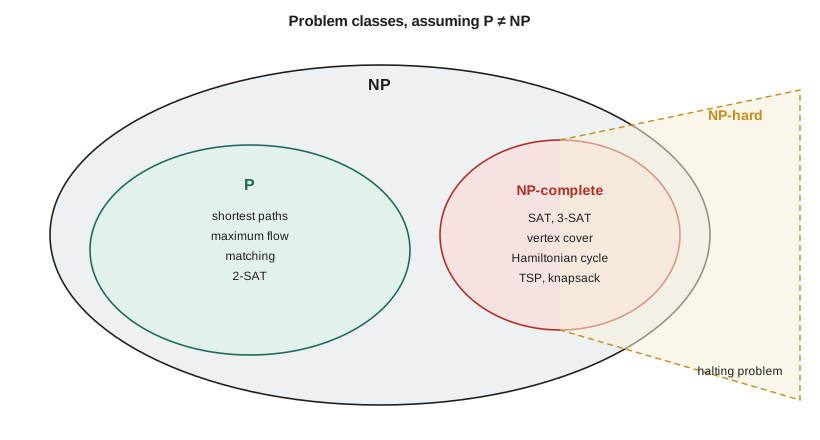
The P versus NP question
The central open question is whether P equals NP: whether every problem whose solutions can be checked quickly can also be solved quickly. Most researchers believe P ≠ NP, partly because decades of effort by very capable people have failed to find a polynomial algorithm for any NP-complete problem, and partly because a world in which finding were as easy as checking would be strange: mathematical proofs, which are easy to check, would be easy to find. The Clay Mathematics Institute has offered a million-dollar prize since 2000 for a proof either way.
The question has practical stakes. Modern cryptography assumes that certain problems in NP, such as inverting a well-designed hash function, are hard; if P = NP with a practical algorithm, much of it would collapse. On the other hand, scheduling, routing, chip layout and protein design would become easy. For an engineer, an NP-completeness proof is a strong signal to stop searching for a fast exact algorithm and to choose one of the strategies in lesson 12.
Beyond NP
Some problems are harder still. PSPACE contains problems solvable with polynomial memory but perhaps exponential time, such as deciding who wins certain generalized board games. EXPTIME problems provably need exponential time. Some problems are undecidable: no algorithm can solve them at all. The halting problem, deciding whether an arbitrary program halts on a given input, is the classic example, and Alan Turing proved its undecidability in 1936 by a diagonal argument. The halting problem is NP-hard, since anything reduces to it, but not in NP, which is why the NP-hard region in the figure extends outside NP. CMPUT-474 Theory of Computation develops these ideas fully.
Worked problem
Proving a problem is in NP
Dana proposes a scheduling variant: given n upload jobs with durations, a set of pairs of jobs that conflict (cannot run at the same time), m parallel links and a deadline D, can all jobs finish by D? Show the problem is in NP.
Show solution
- Certificate: for each job, the link it runs on and its start time.
- Size: n pairs of numbers, each no larger than D or m, so polynomial in the input length.
- Check 1: every job finishes by D (start + duration ≤ D), O(n) time.
- Check 2: no two jobs on the same link overlap, O(n log n) by sorting each link's jobs.
- Check 3: no conflicting pair overlaps in time, O(number of pairs).
- All checks are polynomial, so the problem is in NP.
Answer: This is only half of an NP-completeness proof. The other half would reduce a known NP-complete problem, such as graph colouring, to it.
Common mistakes
MistakeReducing the new problem to a known hard problem to prove it hard.
InsteadTo show B is hard, reduce a known NP-complete problem A to B. Reducing B to A only shows B is no harder than A.
MistakeReading NP as 'not polynomial'.
InsteadNP means nondeterministic polynomial: yes answers are verifiable in polynomial time. P is inside NP.
MistakeProving only one direction of a reduction.
InsteadShow that yes instances map to yes instances and that yes instances of the target came only from yes instances of the source.
MistakeConcluding a problem is NP-complete because the obvious algorithm is exponential.
InsteadMany problems with exponential brute force have clever polynomial algorithms. Only a reduction from a known NP-complete problem proves hardness.
Summary and key terms
- Decision problems have yes or no answers; optimization problems become decision problems with a threshold.
- P contains problems solvable in polynomial time; NP contains problems whose yes answers have polynomial-time verifiable certificates.
- A polynomial-time reduction A ≤_p B maps instances of A to instances of B preserving the answer.
- To prove B hard, reduce a known hard problem to B; independent set, vertex cover, clique and set cover reduce to one another.
- NP-complete problems are in NP and NP-hard; a polynomial algorithm for one would give one for all of NP.
- Whether P = NP is open; most believe P ≠ NP, and undecidable problems such as halting lie beyond NP altogether.
- Decision problem
- A problem whose answer is yes or no.
- P
- The class of decision problems solvable in polynomial time.
- NP
- The class of decision problems whose yes instances have certificates verifiable in polynomial time.
- Certificate
- A short piece of evidence that lets a verifier confirm a yes answer quickly.
- Polynomial-time reduction
- A polynomial-time transformation of instances of one problem into instances of another that preserves answers.
- NP-complete
- A problem in NP to which every problem in NP reduces in polynomial time.
- NP-hard
- A problem to which every problem in NP reduces, whether or not it is itself in NP.
Practice problems
Work each problem on paper first, then reveal the answer to check.
Is shortest path (is there a path of weight ≤ B?) in NP? In P?
Show answer
Both: a path is a certificate checkable in linear time, and Dijkstra or Bellman-Ford solves it in polynomial time.
A graph has 20 vertices and a vertex cover of size 13. What size of independent set does it have?
Show answer
7, the complement of the cover.
Jonah reduces gateway placement to integer linear programming. Does this show gateway placement is hard?
Show answer
No. It shows gateway placement is no harder than integer programming. Hardness needs a reduction from a known hard problem to gateway placement.
Why does a fast algorithm for one NP-complete problem give one for all of NP?
Show answer
Every NP problem reduces to it in polynomial time; composing the reduction with the fast algorithm solves any NP problem in polynomial time.
Lesson quiz · 5 questions
Score 60% or more to complete this lesson.
Create a free account to save your progress, take quizzes and earn a certificate.