
CINE-401 · Lesson 2 of 12 · 28 min
Script breakdown and visual storytelling
Every visual decision on a narrative film should trace back to the script. Before a DP thinks about lenses or lights, they read the script several times, first as an audience member and then as a craftsperson, and build a breakdown: a structured record of what each scene needs to accomplish and how the image might help. This lesson explains how cinematographers read scripts, how they break scenes into beats, how point of view and visual motifs carry meaning across a film, and how a breakdown becomes the foundation for the look book, the shot list and the schedule. The aim is not a rigid formula but a habit of asking, for every scene, what the story needs from the camera.
Reading a script as a cinematographer
A good first reading is fast and uninterrupted, ideally in one sitting, so you experience the story as an audience would. Note your emotional reactions: where you were moved, bored, confused or surprised. Those reactions are data. Later readings are slower and more analytical.
- Second reading: identify the story's structure, the main characters' arcs and the turning points.
- Third reading: go scene by scene, noting location, time of day, characters, key actions, props, effects and any technical challenges such as cars, water, night exteriors, crowds or stunts.
- Ongoing readings: return to the script after every rewrite and after every location scout, because new information changes the visual plan.
Screenplays use conventions that matter to a DP. A scene heading (or slugline) such as INT. KITCHEN – NIGHT tells you interior or exterior, the location and the time of day. Action lines describe what we see. Parentheticals and dialogue carry performance. A page of a standard-format screenplay is often estimated at roughly one minute of screen time, although action scenes usually run longer per page and dialogue-heavy scenes can run shorter.
Story structure and the visual arc
Most narrative films follow some form of dramatic structure: a setup that establishes the world and the characters, a confrontation in which conflict escalates, and a resolution. Whether the writer uses three acts, five acts or a less conventional shape, the DP should map where the story turns, because the image can mark those turns.
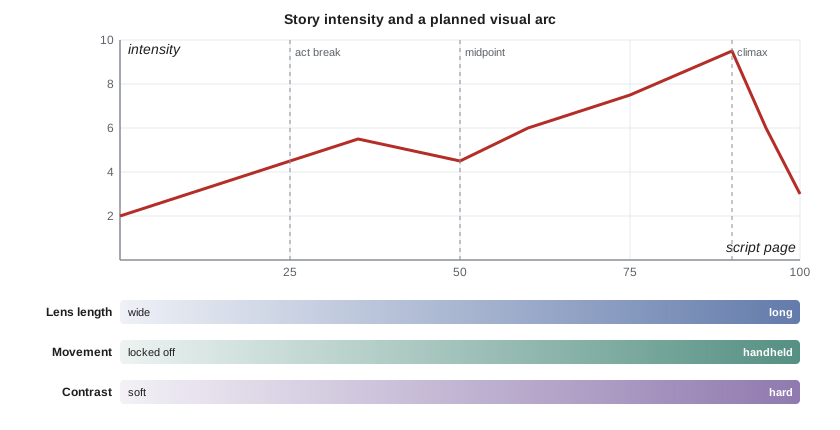
- A visual arc is a planned change in the image across the film that mirrors the characters' journey: lenses that get longer as a character becomes isolated, camera movement that becomes freer as a character gains confidence, or light that gets harsher as a situation deteriorates.
- Visual arcs work best when they are subtle and consistent. Audiences rarely notice them consciously, but they feel the change.
- Breaking the established pattern at a key moment, for example the first handheld shot in a film shot entirely on sticks, gives that moment extra force.
Breaking a scene into beats
A beat is the smallest unit of change in a scene: a moment where a character's objective, tactic or knowledge shifts. Actors and directors use beats to shape performance; DPs use them to decide where the camera should change. A scene with three beats might need three distinct visual ideas, even if the coverage is simple.
- Mark each beat in the script with a line and a short description of what changes, for example "She realizes he lied."
- Ask what the audience needs to see at each beat: the speaker, the listener, a reaction, an object, or the space between characters.
- Decide whether the camera should change at the beat: a push in, a cut to a tighter size, a change of angle, or a deliberate stillness.
- Note who controls the scene at each beat. Power shifts often suggest changes in angle, height or size.
Worked problem
Beats and set-ups for a short scene
A two-page kitchen scene has four beats: (1) small talk while cooking, (2) one character finds a letter, (3) confrontation, (4) one character leaves. The director wants a simple approach. Propose a minimum coverage plan that gives each beat its own visual idea.
Show solution
- Beat 1: a wide two-shot that shows the domestic routine and the space, possibly a slow lateral move with the cooking.
- Beat 2: an insert of the letter and a medium close-up of the finder's reaction; the cut to the insert marks the change.
- Beat 3: matching singles over the shoulder, getting tighter as the conflict escalates; consider lowering camera height on the character who gains power.
- Beat 4: return to a wide shot for the exit, isolating the character who stays in a large empty frame.
Answer: Four beats can be covered with about six set-ups: wide, insert, two reaction or single sizes per character and a final wide. The coverage is simple, but each beat has a distinct image.
Point of view
Every shot implies a point of view: whose experience the audience shares. Point of view is one of the most powerful tools a DP has, and one of the easiest to use carelessly.
- Objective camera: the camera observes from a neutral position, like an invisible witness.
- Subjective camera: the camera adopts a character's literal view, often with a point-of-view shot that matches their eyeline.
- Character-aligned camera: the camera stays close to one character, sees what they see and withholds what they do not know, without becoming literally subjective.
- Omniscient camera: the camera shows the audience information characters do not have, creating suspense.
In the breakdown, note whose scene each scene is. A film told from one character's perspective might keep that character's coverage closer, warmer or more fluid than others', place the camera on their side of the action and use their eyeline for inserts. Shifting point of view deliberately, for example handing the camera to another character halfway through, can mark a major turn in the story.
Visual motifs
A motif is a recurring visual element that gathers meaning through repetition: a colour, a type of frame, a shape, a kind of light, a camera move or an object. Motifs give a film coherence and let images speak without dialogue.
- Frames within frames: doorways, windows and mirrors that trap or separate characters.
- Colour: a single colour associated with a character, an idea or a danger, used sparingly so it stands out.
- Light: shafts of daylight that appear when a character feels hope, or a recurring flicker that signals threat.
- Movement: a camera that circles characters at moments of confusion, or a static frame that holds through moments of truth.
- Composition: centred, symmetrical frames for control and order; off-balance frames with large negative space for isolation.
Motifs must be planned. Note each occurrence in the breakdown and check that the production designer, costume designer and colourist know about it, because a motif that depends on a red coat fails if the costume is changed to blue.
The scene breakdown sheet
Many DPs build a breakdown document, either a spreadsheet or a marked-up script, with one row per scene. The production's first AD will create a separate breakdown for scheduling; the DP's version focuses on image and equipment.
| Column | Example entry | Why it matters |
|---|---|---|
| Scene and pages | Sc. 24, 2 3/8 pages | Time needed and schedule weight |
| Location and time of day | INT. Diner, night | Lighting approach, power, practicals |
| Story purpose | Maya realizes her brother lied | What the image must communicate |
| Beats | Small talk; phone call; silence; exit | Where the camera might change |
| Point of view | Maya | Whose coverage is closer or favoured |
| Visual idea | Static frames; push in on beat 3 | Look and coverage plan |
| Motif | Neon sign red in window | Coordination with art and colour |
| Equipment needs | Dolly, 4 by 4 frames, neon practical | Rental orders and pre-rigs |
| Challenges | Windows facing street, night exterior beyond | Size of lighting package and permits |
| Priority | A (key scene) | Where to spend extra time |
Scene lengths are measured in eighths of a page, so a scene of two and three-eighths pages is written 2 3/8. Schedulers add up eighths to estimate how much can be shot in a day.
Worked problem
Adding up page counts for a day
A shooting day has four scenes of 1 2/8, 3/8, 2 5/8 and 4/8 pages. How many pages is that, and how many minutes of screen time would the rule of thumb suggest?
Show solution
- Convert to eighths: 1 2/8 = 10/8; 3/8; 2 5/8 = 21/8; 4/8.
- Total: 10 + 3 + 21 + 4 = 38 eighths.
- 38 ÷ 8 = 4 6/8 pages, or 4.75 pages.
- At about one minute per page, that is about 4 to 5 minutes of screen time, although action-heavy pages usually run long.
Answer: The day is 4 6/8 pages, roughly 4 to 5 minutes of finished film. For an independent feature this is a full day; for a television drama it may be typical; for an action scene it would be very ambitious.
Prioritizing scenes
Not every scene deserves equal time. Most films contain a handful of scenes that carry the emotional weight of the story and many more that move the plot along. A DP who spends the same effort on a hallway transition as on the climactic confrontation will run out of time where it matters. A simple system is to grade each scene.
- A scenes: emotional and story peaks, signature images, scenes the director cares most about. Protect time, plan in detail and consider extra equipment.
- B scenes: important but conventional. Solid coverage, efficient lighting.
- C scenes: transitions, establishing shots, brief exchanges. Shoot fast with minimal set-ups, or combine into a single developing shot.
Share the grading with the director and first AD. When the schedule gets tight on the day, everyone already knows which scenes can be simplified.
From breakdown to images
The breakdown feeds every later stage of prep.
- The look book (Lesson 3) draws on the visual arc, motifs and the tone of key scenes.
- Camera and lens tests (Lesson 4) target the specific challenges the breakdown reveals: night exteriors, skin tones under sodium-vapour street lights, a scene lit only by candles.
- Shot lists and overheads (Lesson 5) build on the beats and point of view of each scene.
- Lighting plans (Lesson 6) and rigging and power plans (Lesson 7) respond to locations, times of day and equipment needs.
- The schedule (Lesson 8) uses page counts and priorities to allocate time.
Reading for subtext
The most valuable insights in a breakdown often come from subtext: what characters want but do not say. A dinner scene where characters talk politely about the weather but are actually negotiating the end of a marriage needs images that reveal the tension the dialogue hides. Visual tools for subtext include the distance between characters in the frame, foreground objects that separate them, the direction they face, and whether the camera holds on the speaker or the listener. Often the most revealing shot is a reaction, not the line.
Working with the director on the breakdown
Share your breakdown with the director early and invite disagreement. Directors often have different instincts about whose scene it is or what a beat means, and discovering that in prep is far better than discovering it on set. Some directors write their own visual notes; others prefer a conversation scene by scene. Either way, the agreed breakdown becomes a reference that keeps the visual plan anchored to story decisions as rewrites, schedule changes and location losses force adjustments.
When the script changes
Scripts change constantly during prep and production. Revisions are usually issued on coloured pages (the industry calls them by colour, such as blue or pink revisions) so everyone knows which version is current. Each revision can affect the visual plan: a scene moved from day to night, a location changed from an apartment to a car, a new character added to a two-hander. Keep the breakdown version-controlled, note which revision it reflects and update shot lists and equipment orders when scenes change.
Common mistakes
MistakeBreaking down the script only once at the start of prep
InsteadRevisit the breakdown after every rewrite and location change
MistakeGiving every scene the same amount of time and attention
InsteadGrade scenes by importance and protect time for the key scenes
MistakeChoosing camera moves for variety rather than meaning
InsteadChange the camera at beats and power shifts where the story changes
MistakePlanning a colour motif without telling the art and costume departments
InsteadShare motifs with every department whose work they depend on
MistakeCovering only the person speaking
InsteadPlan reactions and listener coverage, because subtext often lives in the listener
Summary and key terms
- DPs read a script several times, first as an audience and then analytically, scene by scene.
- A visual arc changes the image across the film in step with the characters' journey.
- Beats are moments of change in a scene and suggest where the camera should change.
- Point of view decides whose experience the audience shares and shapes coverage choices.
- Motifs gather meaning through repetition and must be coordinated with other departments.
- A DP's breakdown records story purpose, beats, point of view, visual ideas, equipment and priorities for each scene.
- Page counts in eighths and scene priorities guide how time is spent on set.
- Breakdown
- A scene-by-scene record of what each scene needs from the image, equipment and schedule
- Slugline
- A scene heading giving interior or exterior, location and time of day
- Beat
- The smallest unit of change in a scene, where an objective, tactic or knowledge shifts
- Visual arc
- A planned change in the image across a film that mirrors the story
- Point of view
- Whose experience the camera shares in a shot or scene
- Motif
- A recurring visual element that gains meaning through repetition
- Subtext
- What characters want or feel but do not say directly
- Eighths
- The unit used to measure scene length, one eighth of a script page
- Coloured pages
- Script revisions issued on pages of a set colour so the current version is clear
- Insert
- A close shot of an object or detail cut into a scene
Practice problems
Work each problem on paper first, then reveal the answer to check.
What does the slugline EXT. PIER – DAWN tell a DP?
Show answer
The scene is exterior, at a pier, at dawn: a narrow window of changing natural light
Add 3/8, 1 4/8 and 6/8 pages.
Show answer
3 + 12 + 6 = 21 eighths = 2 5/8 pages
Give two examples of a visual arc.
Show answer
For example lenses getting longer as a character becomes isolated, or movement getting freer as they gain confidence
What is the difference between subjective and character-aligned camera?
Show answer
Subjective shows the character's literal view; character-aligned stays close to the character without literally becoming their eyes
Why grade scenes A, B and C?
Show answer
To protect time for the most important scenes and know where to simplify when the day gets tight
Name three kinds of visual motif.
Show answer
Any three of frames within frames, colour, light, movement or composition
Why might the most revealing shot in a scene be a reaction?
Show answer
Because subtext often shows in how the listener responds rather than in what is said
How does a breakdown help the rental order?
Show answer
It lists equipment needs for each scene, such as dollies, frames, practicals or cranes
Why should motifs be shared with the costume designer?
Show answer
A motif that depends on a costume colour fails if the costume changes
A scene is a dialogue-heavy 3 pages. Is one minute per page a reliable estimate?
Show answer
Only roughly; dialogue scenes may run shorter and action longer, so treat it as a planning guide
Lesson quiz · 5 questions
Score 60% or more to complete this lesson.
Create a free account to save your progress, take quizzes and earn a certificate.