
CINE-401 · Lesson 1 of 12 · 28 min
The cinematographer's role in narrative filmmaking
This is the final-year synthesis course in the cinematography program. Earlier courses taught the separate crafts: exposure and the camera system, lighting, movement, grading, documentary, commercial and safety work. Narrative cinematography asks you to combine all of them in the service of one thing: a story told through images. The director of photography, or DP, is the person responsible for that combination. A DP turns a script into a visual plan, builds a crew that can carry out the plan, and then makes hundreds of decisions a day on set while protecting the look, the schedule, the budget and the safety of everyone around the camera. This lesson describes that role: what a DP actually does at each stage of a production, who the DP works with, and the habits that separate a reliable cinematographer from someone who is merely good with a camera.
What a director of photography is responsible for
On a narrative production the DP is the head of the camera, lighting and grip departments. In practice that means four broad responsibilities.
- The look of the film: framing, lens choice, camera movement, lighting, exposure and the colour pipeline that carries the image to the final grade.
- The visual plan for each scene: how the action will be covered, in what order, with what equipment and crew.
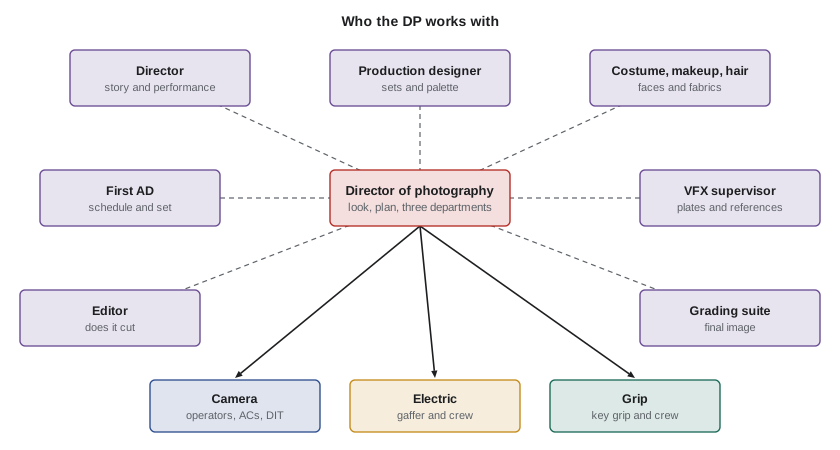
- Leadership of three departments: the camera crew (operators and camera assistants), the lighting crew led by the gaffer, and the grip crew led by the key grip.
- Stewardship of time and money: the camera department spends a large share of each shooting day, and the DP's choices determine whether the day is achievable.
The DP does not decide the story. The director owns the story and the performances; the DP serves that vision. A good working definition is that the director decides what the audience should feel and understand in a moment, and the DP proposes and executes how the image will make them feel and understand it.
The DP across the life of a production
A DP's work starts weeks or months before the first shooting day and continues after wrap.
- Development and hiring: reading the script, meeting the director, discussing references and approach. Many DPs are hired on the strength of how they talk about a script, not only on their reel.
- Prep: breaking down the script, building a look book with the director, scouting locations, running camera and lens tests, designing shot lists and lighting plans with the gaffer and key grip, and working with the first assistant director on the schedule. On a feature, DP prep is often four to eight weeks; on a short film it may be a few days.
- Production: lighting and shooting each set-up, keeping the look consistent, solving problems, watching dailies and adjusting.
- Post-production: supervising or attending the colour grade, approving deliverables and sometimes consulting on visual effects.
The director and the DP
The most important relationship on any production is between the director and the DP. Directors vary enormously. Some arrive with a complete shot list and storyboards; others want to find the scene in rehearsal and rely on the DP to propose coverage. Some care intensely about lenses and lighting; others care mainly about performance and trust the DP with the image. Part of a DP's skill is reading which kind of director they have and adapting.
- Before prep, agree on the big questions: tone, references, aspect ratio, format, the camera movement philosophy and how the film should feel in its quietest and loudest moments.
- In prep, walk every location together, block key scenes with stand-ins or in imagination, and agree which scenes deserve the most time.
- On set, protect the director's time with actors. The DP should never make the director wait for a technical decision that could have been made in prep.
- Disagree in private, support in public. If you think a set-up will not cut, say so quietly and offer an alternative; once the director decides, commit fully.
A common failure is the DP who pursues beautiful images that fight the story. A slow, gorgeous crane move in a scene that should feel claustrophobic is a mistake, however well executed. The test for every visual choice is whether it helps the audience understand and feel the scene the director wants.
The production designer, costume, makeup and hair
The image is not only light and lens. Everything in the frame was designed by someone, and the DP's partners in the art department shape the look as much as any lighting decision.
- Production designer: sets, locations, colour palette, set dressing and practical lamps. The DP and designer agree on wall colours and finishes (a very dark wall absorbs light; a glossy one reflects fixtures), ceiling pieces that can be removed for lighting, windows positioned to motivate light and practical lamps that can hold dimmable bulbs.
- Costume designer: colours and textures that read well on camera, avoiding fine patterns that cause moiré, pure white shirts that clip easily and colours that clash with the palette.
- Makeup and hair: skin texture, shine control and how faces will read under the planned light. Makeup and wardrobe tests (Lesson 4) let these departments see their work through the camera and the intended look.
A shared palette, often agreed in a single document with the director, keeps everyone working toward the same image. Many DPs and designers agree a limited palette for each location or story section so the film's colour carries meaning, for example cool, desaturated tones for a character's isolation and warmer, richer tones when relationships open up.
The first assistant director
The first assistant director, or first AD, runs the set and builds the schedule. The DP and first AD are partners: the first AD needs to know how long each set-up really takes, and the DP needs a schedule that gives the important scenes the time they deserve. Lesson 8 covers this partnership in detail. Here, note the principle: a DP who gives honest time estimates in prep, and then meets them, earns trust that pays off on the day a scene needs an extra hour.
Visual effects, the editor and the colourist
Modern narrative films almost always contain visual effects, even small ones: screen replacements, sign changes, set extensions, removal of modern objects from period scenes. The DP works with the visual effects (VFX) supervisor to plan plates, tracking markers and lighting references so the effects can be integrated (Lesson 11).
The editor is the first audience for the footage. Editors notice whether coverage cuts, whether eyelines match and whether the DP has provided enough options to shape a performance. The colourist (Course CINE-310) finishes the image the DP started. The best relationships start in prep, with the colourist building or refining the show LUT used on set, so dailies and the final grade come from the same plan.
The DP as a department head
A DP leads three departments, and leadership matters as much as craft.
- Camera: the camera operator (on larger shows, often a separate person from the DP), first assistant camera (focus puller), second assistant camera (clapper loader), digital imaging technician (DIT) and sometimes a data wrangler and camera trainee.
- Lighting: the gaffer, best boy electric, lamp operators (electrics), generator operator and, on stages, a rigging gaffer and rigging crew.
- Grip: the key grip, best boy grip, dolly grip, grips and a rigging key grip on larger shows.
The DP hires or approves the heads of department, explains the look, delegates the execution and holds the standard. Lesson 9 covers crew structure, unions and set communication. For now, remember that the gaffer and key grip are creative partners, not just technicians. A DP who asks the gaffer "What would you do here?" often gets a better answer than the one they had in mind.
Different scales of production
The DP role changes with the size of the production.
| Production | Typical crew around the DP | What changes for the DP |
|---|---|---|
| Student or micro-budget short | 2 to 6 people in camera, lighting and grip combined | The DP often operates, sets lights and may pull focus; simple, portable gear and natural light are essential |
| Independent feature | 10 to 25 people in camera, electric and grip | DP usually operates or has one operator; tight schedules force strong prep and efficient coverage |
| Television series | 20 to 50 people; two or more camera units | Episodic DPs often alternate episodes; they must match an established look and work very fast |
| Studio feature | 40 to 100 or more people; second unit, rigging crews, VFX | DP may not operate; leads large crews through gaffers and key grips; long prep, extensive tests |
On a series, the DP of the pilot or first block usually sets the visual rules (lenses, LUT, lighting approach), and later DPs work within them. Matching an established look is a distinct skill and an important one for career longevity.
Worked problem
How much of the day is the camera department?
On a 12-hour shooting day with 3 pages scheduled, the production records that 7.5 hours were spent lighting and setting up the camera and grip equipment, 3.5 hours were spent shooting takes and 1 hour was spent on a company move. What share of the day was spent on set-up, and what does that tell the DP?
Show solution
- Set-up share: 7.5 ÷ 12 = 0.625, or about 63 % of the day.
- Shooting share: 3.5 ÷ 12 ≈ 29 %; move: 1 ÷ 12 ≈ 8 %.
- On most narrative shoots set-up time dominates. If the DP can save 10 minutes on each of 24 set-ups, that is 240 minutes, or 4 hours, over a two-day scene.
Answer: About 63 % of the day went to set-up. The biggest gains in schedule come from planning set-ups in prep: grouping shots that share a lighting direction, pre-rigging and choosing coverage that cuts, not from rushing takes.
Habits of reliable cinematographers
Reputation in narrative work is built on reliability as much as artistry. Productions rehire DPs who deliver the look on schedule, keep crews happy and solve problems without drama.
- Prepare relentlessly: know every scene, every location and every lighting plan before the shoot.
- Communicate clearly and early: if a scene will take longer than scheduled, tell the first AD in prep, not at 4 p.m. on the day.
- Protect continuity: track lens, height, stop, filtration and lighting so scenes shot days apart cut together.
- Stay calm: the set takes its emotional temperature from the DP and the first AD.
- Keep learning: watch films with the sound off, study paintings and photography, test new tools before using them on a job.
- Put safety first: a DP who asks for an unsafe shot to save time endangers the crew and their own career (Course CINE-340).
Ethics and representation in the image
Cinematographers make choices about how people look on screen, and those choices carry ethical weight. Course CINE-310 discussed the history of film stocks and video systems calibrated for lighter skin and the work needed to render every complexion well. In narrative work the DP extends that care to framing and lighting: whose face gets the most flattering light, whose point of view the camera adopts, and whether the camera's gaze treats characters as people or as objects. Discussing these questions with the director in prep is part of professional practice, especially in scenes involving intimacy, violence or vulnerable characters (Lesson 10).
The Canadian context
Canadian narrative production is concentrated in Vancouver, Toronto, Montréal and a growing number of regional centres. Many productions are service work for American studios and streamers, alongside domestic features and series financed through Telefilm Canada, the Canada Media Fund, broadcasters and provincial tax credits. Camera crews are typically represented by IATSE Local 667 in Eastern Canada and Local 669 in Western Canada, with NABET 700-M Unifor and other locals in some regions; the Canadian Society of Cinematographers (CSC) is the professional society for DPs. Lesson 9 covers the union structure.
How this course is organized
The rest of the course follows the order in which a DP works. Lessons 2 to 4 cover the creative prep: breaking down the script, developing the look and testing it. Lessons 5 to 8 cover practical prep: shot design and coverage, lighting plans, planning with the gaffer and key grip, and scheduling with the first AD. Lessons 9 to 11 cover production: leading the departments, shooting different kinds of dramatic scenes, working with VFX and reviewing dailies. Lesson 12 is the capstone, in which you assemble a complete prep package for a three-page scene. Throughout, the course refers back to earlier courses rather than repeating them: lighting craft from CINE-301, camera movement and support from CINE-302, grading from CINE-310, and set safety from CINE-340.
Common mistakes
MistakeThinking the DP decides what the story is about
InsteadThe director owns the story; the DP proposes and executes the visual approach that serves it
MistakeStarting prep when the shoot starts
InsteadMost of a DP's influence is exercised in prep, through breakdowns, tests, shot lists and lighting plans
MistakeTreating the gaffer and key grip as order-takers
InsteadTreat them as creative partners whose ideas often improve the plan and the schedule
MistakePursuing beautiful shots that fight the tone of the scene
InsteadTest every choice against what the audience should feel and understand at that moment
MistakeHiding scheduling problems until the day
InsteadGive the first AD honest time estimates in prep and flag risks early
Summary and key terms
- The DP is responsible for the look, the visual plan, three departments and the efficient use of camera time.
- The director owns the story and performances; the DP serves that vision and proposes how images will express it.
- Production designers, costume, makeup and hair shape the image as much as lighting; a shared palette aligns them.
- The first AD, VFX supervisor, editor and colourist are essential partners from prep onward.
- Set-up time dominates most shooting days, so schedule gains come from prep, not from rushing.
- Reliability, calm communication, continuity and safety build a DP's reputation and career.
- Choices about light, framing and point of view carry ethical weight, especially in sensitive scenes.
- Director of photography (DP)
- The head of the camera, lighting and grip departments, responsible for the look of a film
- Prep
- The period before shooting when the visual plan, tests, scouting and schedule are developed
- Gaffer
- The head of the lighting (electric) department, who executes the DP's lighting plan
- Key grip
- The head of the grip department, responsible for rigging, camera support and light shaping
- First assistant director
- The person who builds the shooting schedule and runs the set
- Production designer
- The head of the art department, responsible for sets, locations and the visual palette
- Show LUT
- A look-up table used on set and in dailies to preview the intended look of the film
- Coverage
- The set of shots, angles and sizes used to film a scene so it can be edited
- Continuity
- Keeping visual details consistent between shots so they cut together smoothly
- Second unit
- A smaller crew that shoots inserts, establishing shots or action separately from the main unit
Practice problems
Work each problem on paper first, then reveal the answer to check.
Name the four broad responsibilities of a DP on a narrative production.
Show answer
The look; the visual plan for each scene; leadership of camera, lighting and grip; and stewardship of camera time and budget
Why might a DP be hired on the strength of a conversation about the script?
Show answer
Because directors want a collaborator who understands the story and proposes an approach that serves it, not only someone with a strong reel
Give two decisions the DP and production designer should agree on in prep.
Show answer
Any two of wall colours and finishes, removable ceiling pieces, window positions that motivate light, practical lamps and the palette
A set-up takes 30 minutes on average and there are 20 set-ups. How many hours is that?
Show answer
20 × 30 = 600 minutes, or 10 hours
What should a DP do if they disagree with the director's choice of shot?
Show answer
Raise it privately with a clear alternative, then commit fully once the director decides
Why should costume designers avoid fine patterns?
Show answer
Fine patterns can cause moiré on digital sensors and distract the viewer
How does the DP's role differ on a television series compared with a feature?
Show answer
On a series the DP often matches an established look, alternates episodes and works faster with less prep
Who executes the DP's lighting plan?
Show answer
The gaffer, with the lighting crew, supported by the key grip and grips for shaping and rigging
Why is the relationship with the colourist worth starting in prep?
Show answer
So the show LUT used on set and in dailies matches the plan for the final grade
Give one ethical question a DP should discuss with the director.
Show answer
For example, whose point of view the camera adopts, how characters are lit and framed, or how intimate or violent scenes are portrayed
Lesson quiz · 5 questions
Score 60% or more to complete this lesson.
Create a free account to save your progress, take quizzes and earn a certificate.