
CINE-401 · Lesson 10 of 12 · 27 min
Shooting dramatic scenes: dialogue, action, intimacy and children
Different kinds of scenes make different demands on the camera. Dialogue scenes test coverage, eyelines and focus. Action scenes test planning, multiple cameras and safety. Intimate scenes test the camera department's professionalism and care for performers. Scenes with children add legal limits and special responsibilities. This lesson brings together the craft of Lessons 5 and 6 with the practical and ethical demands of each scene type. It includes the depth-of-field arithmetic for holding two actors in focus, coverage patterns for dialogue and action, and the protocols for intimacy and child performers in Canada and the US.
Dialogue scenes
Dialogue is the core of most dramas. The goal is to give the audience the words and, more importantly, the reactions, while keeping geography clear and performances consistent across takes.
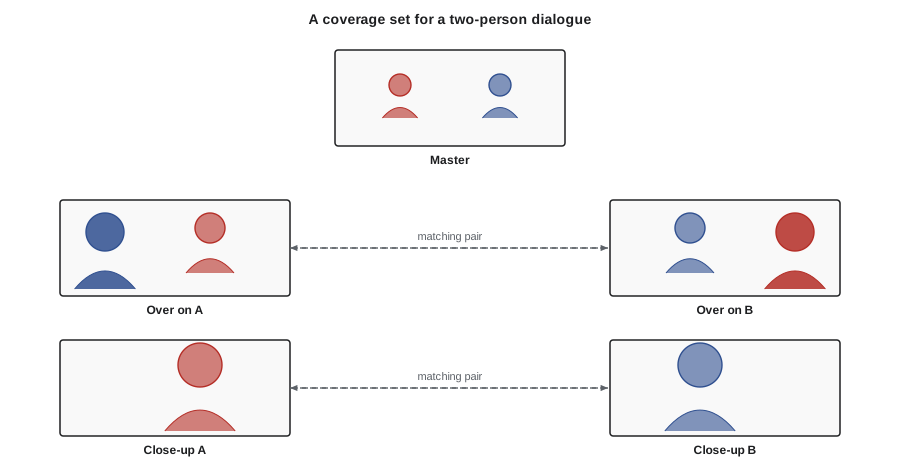
- Coverage: the classic pattern of master, overs, singles and close-ups (Lesson 5), adapted to the scene's beats and point of view.
- Matching sizes: reverse shots should usually match in size and lens so cuts feel balanced, unless the imbalance is deliberate, for example a wider frame on the character losing power.
- Eyelines: keep them close to the lens for intimacy; move them further off-axis for a more observational feel.
- Overlap and continuity: actors' business (drinking, smoking, handling props) must be repeatable across takes and angles.
- Sound: dialogue scenes depend on clean sound; the DP and sound mixer agree where booms can go and how to avoid boom shadows.
Focus in two-shots and overs
Holding two actors in focus at different distances is one of the most common technical problems in dialogue scenes, especially with large sensors and fast lenses. The near and far limits of acceptable focus depend on focal length, aperture, focus distance and the circle of confusion. A useful shortcut uses the hyperfocal distance \( H \):
For two subjects at distances \( D_1 \) (near) and \( D_2 \) (far), the hyperfocal distance needed to hold both, and the focus distance to set, are:
Worked problem
Holding a two-shot
Two actors sit at 3 m and 4 m from the camera. The DP wants a 50 mm lens on Super 35 (circle of confusion about 0.025 mm) and would like to shoot at T2.8. Can both be held in focus, and if not, what stop is needed?
Show solution
- Hyperfocal distance at T2.8: \( H = \frac{50^2}{2.8 \times 0.025} \approx 35{,}700 \) mm.
- Needed: \( H_{needed} = \frac{2 \times 3 \times 4}{4 - 3} = 24 \) m. Since 35.7 m is greater than 24 m, depth of field at T2.8 is too shallow.
- Stop for 24 m: \( N = \frac{f^2}{c H} = \frac{2500}{0.025 \times 24{,}000} \approx 4.2 \). Set focus at \( s = \frac{2 \times 3 \times 4}{7} \approx 3.4 \) m.
Answer: Not at T2.8. About T4 (T4.5 for a safety margin) holds both, with focus set between them, slightly nearer the closer actor. Alternatives: stage the actors closer together in depth, use a wider lens, accept that one actor is slightly soft, or rack focus between them on the beats.
Depth-of-field calculations are a guide. Acceptable sharpness depends on the delivery format, screen size and how the image is viewed. Many first ACs use apps that calculate depth of field for the exact lens and camera, and test with focus charts in prep.
Rack focus and focus as storytelling
Focus is not only technical. Moving focus from one actor to another (a rack or pull) directs attention like a cut, and holding one actor sharp while another is soft can show isolation or emotional distance. Plan pulls with the first AC on the beats where attention shifts, and rehearse them; a well-timed rack is part of the performance.
Action scenes
Action includes fights, chases, stunts and any scene with fast, complex movement. Action is planned more than any other scene type.
- Previs and storyboards: action is often designed shot by shot with the stunt coordinator and director, sometimes using video previs shot at rehearsals.
- Multiple cameras: stunts are expensive and risky to repeat, so productions often use two to six cameras, including locked-off and crash cameras that can be placed close to the action with protection.
- Shutter and frame rate: shorter shutter angles (for example 45 to 90 degrees) give crisp, staccato motion; slight undercranking can speed up action; high frame rates give slow motion (Course CINE-330 covered off-speed arithmetic).
- Lenses and camera position: longer lenses compress distance and help sell fight choreography by hiding the gap between a punch and a face; wide lenses close to the action add energy but expose misses.
- Editing rhythm: action is usually cut fast, so coverage must give the editor many angles, clean entrances and impacts, and reactions.
- Safety: the stunt coordinator leads stunt safety. The DP's camera positions must respect their safe zones, and camera crew near stunts need protection or remote operation (Course CINE-340).
Worked problem
How many cameras for a stunt?
A car stunt can be performed at most twice (the vehicle is destroyed on the second attempt). The director needs at least six angles: a wide, a medium from the driver's side, a tracking shot, a low angle near the impact, an interior point-of-view and a high-speed slow-motion angle. How many cameras are needed, and what roles might they take?
Show solution
- If every angle must be captured on the one good take, six cameras are needed for the attempt.
- Assign: A camera wide on sticks; B camera medium with a long lens; C camera on a tracking vehicle; D crash camera in a protective box near the impact; E small camera mounted inside the car; F high-speed camera for slow motion.
- The second attempt can be used as a safety or to reposition two or three cameras for extra angles.
Answer: Six cameras, each with a defined role, plus the second attempt as a safety. Crash and car-mounted cameras are usually small, inexpensive bodies because they may be damaged.
Intimate scenes
Scenes involving nudity, simulated sex or sexual violence require specific protocols to protect performers. Intimacy coordinators are now standard on professional productions; they work with the director, performers and departments to plan choreography, consent and closed-set procedures.
- Closed set: only essential crew are present, often with monitors restricted or turned off for anyone not needed.
- Planning: the scene is choreographed in advance with the intimacy coordinator, director and performers, and the camera plan (angles, sizes, what will be seen) is agreed before the day.
- Consent: performers' consent is specific and written, and can be withdrawn; any change to what will be shown needs renewed consent.
- Camera crew conduct: minimal crew, professional language, no unnecessary observation, care with modesty garments and barriers in frame, and secure handling of footage.
- Lighting and framing should be agreed in advance so no changes surprise the performers on the day.
In Canada, ACTRA publishes best-practice guidance for scenes involving nudity, intimacy, simulated sex and sexual violence, and its Independent Production Agreement includes provisions requiring advance notice and written consent for nudity and intimate scenes. In Quebec, the UDA has its own agreements and guidance. Productions also have obligations under provincial occupational health and safety and human rights law to prevent harassment.
Children on set
Child performers are protected by law in both countries, with limits on working hours, requirements for education and supervision, and rules on earnings. These rules affect the shooting schedule and the camera plan.
- Shorter working hours, often with limits that depend on age; schedules may need to put a child's coverage first and use doubles or stand-ins for lighting.
- Required breaks, schooling and a parent or guardian present.
- Content limits: scenes involving danger, violence or distressing themes need special planning and often require shooting around the child or using doubles.
- Camera planning: two cameras can capture a child's performance in fewer takes; lighting should be ready before the child arrives on set.
In Canada, rules are provincial. Ontario's Protecting Child Performers Act, 2015 sets hours, breaks, tutoring and trust requirements for performers under 18 in the live and recorded entertainment industries; British Columbia sets conditions for children in recorded entertainment under its employment standards rules; other provinces have their own requirements, and ACTRA and UDA agreements add protections. Check the rules in the province where you shoot.
Emotionally demanding scenes
Grief, violence and trauma scenes ask a great deal of actors. The camera department can help by being ready before the actors are, minimizing resets, keeping the set quiet and focused, and planning coverage so the most demanding moments are captured in as few takes as possible, often with two cameras. Talk with the director about which angle should capture the first take, because first takes of emotional scenes are often the strongest.
Night, rain and weather scenes
Many dramatic scenes take place in rain, snow or wind. Rain must be backlit to show on camera; front-lit rain is nearly invisible. Rain towers and rain bars create controlled rain; their water can damage equipment and create electrical hazards, so plan protection and ground fault protection with the gaffer (Course CINE-340). Snow scenes need exposure care to keep detail in white surfaces, and cold weather drains batteries quickly.
| Scene type | Key camera concerns | Key partners |
|---|---|---|
| Dialogue | Coverage, eyelines, focus split, sound | Director, script supervisor, sound mixer |
| Action | Multiple cameras, shutter, safety zones, coverage for fast cutting | Stunt coordinator, second unit, VFX |
| Intimacy | Closed set, agreed camera plan, consent, minimal crew | Intimacy coordinator, director, performers |
| Children | Limited hours, two cameras, doubles, quick resets | Studio teacher or tutor, parents, first AD |
| Emotional | Readiness, minimal resets, capturing early takes | Director, actors |
| Weather | Backlit rain, equipment protection, electrical safety | Special effects, gaffer, key grip |
Phone and screen scenes
Characters constantly look at phones, laptops and televisions, and these scenes present their own problems. Screens may flicker or band at some frame rates and shutter angles, their brightness rarely matches the scene and their content must be approved for clearance. Many productions now shoot screens with a neutral or green image and replace the content in post, while others use playback operators who drive the screens live so actors can react to the real content. Agree the approach with the VFX supervisor and the props department in prep, and light faces as if the screen is the source, matching its colour and brightness.
Common mistakes
MistakeAssuming depth of field is enough because the monitor looks sharp
InsteadCalculate depth of field and check focus on a large calibrated monitor or with the first AC's tools
MistakeCovering a once-only stunt with one or two cameras
InsteadPlan enough cameras for every essential angle, including crash and mounted cameras
MistakeChanging camera angles in an intimate scene on the day without consent
InsteadAgree the camera plan in advance and get renewed consent for any change
MistakeLighting with a child performer on set waiting
InsteadLight with stand-ins so the child's limited hours are used for performance
MistakeFront-lighting rain
InsteadBacklight rain so it shows on camera
Summary and key terms
- Dialogue coverage needs matching sizes, consistent eyelines, repeatable action and planning with sound.
- The hyperfocal distance \( H \approx f^2/(Nc) \) and the needed \( H = 2D_1D_2/(D_2 - D_1) \) tell you the stop that holds two actors.
- Rack focus directs attention and should be planned on the beats.
- Action needs previs, multiple cameras, deliberate shutter choices and strict respect for stunt safety zones.
- Intimate scenes need intimacy coordinators, closed sets, agreed camera plans and written consent under union guidance.
- Child performer laws limit hours and add supervision and schooling; plan two cameras and stand-ins.
- Emotional and weather scenes benefit from readiness, minimal resets and careful technical planning.
- Hyperfocal distance
- The focus distance beyond which everything to infinity is acceptably sharp
- Circle of confusion
- The largest blur spot still perceived as sharp, used in depth-of-field calculations
- Rack focus
- Shifting focus from one subject to another during a shot
- Crash camera
- An inexpensive camera placed close to a stunt in a protective housing
- Stunt coordinator
- The person responsible for designing and safely executing stunts
- Intimacy coordinator
- A professional who choreographs intimate scenes and protects performers' consent and wellbeing
- Closed set
- A set restricted to essential crew during sensitive scenes
- Consent rider
- A written agreement describing the nudity or intimacy a performer has agreed to
- Studio teacher
- In California, a certified teacher who also acts as a welfare worker for child performers
- Rain tower
- A rig that produces controlled artificial rain on set
Practice problems
Work each problem on paper first, then reveal the answer to check.
What is the hyperfocal distance of a 35 mm lens at T4 with c = 0.025 mm?
Show answer
35² ÷ (4 × 0.025) = 12,250 mm, about 12.3 m
Two actors stand at 2 m and 2.5 m. What hyperfocal distance is needed to hold both?
Show answer
2 × 2 × 2.5 ÷ 0.5 = 20 m
Where should focus be set for subjects at 2 m and 2.5 m?
Show answer
2 × 2 × 2.5 ÷ 4.5 ≈ 2.2 m
Give two alternatives to stopping down when a two-shot won't hold focus.
Show answer
Stage actors closer in depth, use a wider lens, accept one slightly soft, or rack focus
Why do longer lenses help sell fight choreography?
Show answer
They compress depth, hiding the gap between a strike and its target
What happens to consent if the agreed framing of an intimate scene changes?
Show answer
Performers must give renewed, specific consent
Why light with stand-ins when a child performer is in a scene?
Show answer
To save the child's limited hours for performance
Why use two cameras for emotional scenes?
Show answer
To capture strong early takes from two angles at once and reduce repetitions
How should rain be lit to show on camera?
Show answer
From behind (backlit)
Name two people a DP must coordinate with for a stunt.
Show answer
The stunt coordinator and the first AD, often also special effects and VFX
Lesson quiz · 5 questions
Score 60% or more to complete this lesson.
Create a free account to save your progress, take quizzes and earn a certificate.