
CINE-401 · Lesson 12 of 12 · 29 min
Capstone: a prep package for a three-page scene
This capstone brings the whole course together. You will assemble a complete DP prep package for a single three-page scene, of the kind you would hand to a director, first AD, gaffer, key grip and producer before a shooting day. The lesson works through a model package for a fictional scene, step by step, with the decisions and arithmetic shown. Then it sets out the requirements for your own package and the criteria used to assess it. The package has seven parts: breakdown, look notes, shot list, overhead, lighting plan, schedule and budget, plus a short section on tests, safety and VFX.
The model scene
The fictional film is a small-town drama about two siblings, Maya and Daniel, who reunite after their father's death. Scene 41 is three pages long: INT. FAMILY DINER – NIGHT. Maya waits in a booth by the window. Daniel arrives late. Their small talk turns into an argument about who abandoned the family. A neon sign outside flickers. Daniel reveals he has been paying their father's debts for years. Maya, stunned, reaches across the table; Daniel pulls away and leaves. Maya stays alone in the booth as the neon sign finally goes out.
The scene is an A scene: the emotional climax of the second act. The director wants it to feel trapped and quiet at first, then raw, then empty.
Part 1: Breakdown
| Item | Notes |
|---|---|
| Pages and time | 3 pages; night interior; about 3 to 4 minutes of screen time |
| Story purpose | Daniel's revelation reverses Maya's view of him and of herself |
| Beats | 1. Waiting and small talk. 2. The argument escalates. 3. The revelation. 4. Maya reaches out; Daniel leaves. 5. Maya alone; the sign goes out |
| Point of view | Maya's scene: her coverage is closer and more intimate; Daniel is seen more from her side |
| Visual motif | The red neon sign through the window, part of the film's red motif, goes dark at the end |
| Challenges | Window with night street beyond; neon sign practical; reflections in glass; booth limits camera positions |
| Priority | A: protect time; two cameras for the argument |
Part 2: Look notes
The film's rules (from the look book) are: 2.39:1, spherical lenses on a large-format sensor, rehoused vintage primes from 24 mm to 85 mm, mostly static frames with slow pushes at revelations, naturalistic motivated light, warm practicals against cool ambience, red reserved as a motif. For scene 41:
- Beat 1: static frames, slightly wide, Maya small in the booth, the window and empty street behind her.
- Beat 2: tighter singles, matched overs; neon flicker pulses red on the window side of their faces.
- Beat 3: a slow push on Daniel as he reveals the truth, then a slow push on Maya as she absorbs it.
- Beat 4: Maya's hand crossing the table in an insert; Daniel exits through the frame.
- Beat 5: a wide, static frame of Maya alone; the neon goes out and the warm interior practicals remain.
Part 3: Shot list
| No. | Shot | Lens | Camera | Notes | Priority |
|---|---|---|---|---|---|
| 1 | Wide master from inside diner, booth and window | 29 mm | A, sticks | Full scene; neon flicker cue; Daniel's entrance and exit | Must |
| 2 | Slow push on Daniel, over Maya | 50 mm | A, dolly | Beats 2 to 3; push on revelation | Must |
| 3 | Clean single Daniel, tighter | 75 mm | B, sticks | Shot with 2 as cross-coverage partner where possible | Should |
| 4 | Slow push on Maya, over Daniel | 50 mm | A, dolly | Turnaround; beats 2 to 4 | Must |
| 5 | Clean close-up Maya | 75 mm | B, sticks | Beat 3 reaction; beat 5 | Must |
| 6 | Insert: Maya's hand across the table | 85 mm | B | Beat 4 | Should |
| 7 | Exterior through window: Maya alone, sign goes out | 40 mm | A, sticks | Beat 5; reflections managed | Must |
| 8 | Insert: neon sign flicker and out | 85 mm | B | Can go to second unit | Could |
Part 4: Overhead
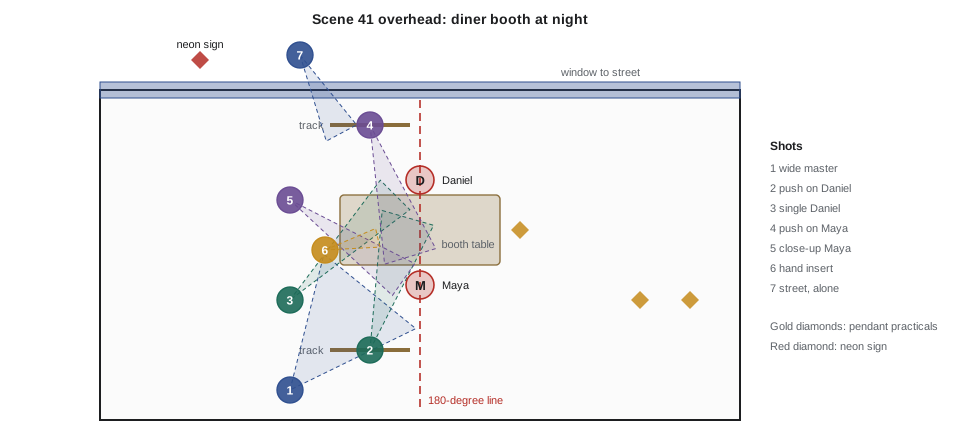
Part 5: Lighting plan
The light comes from three motivated sources: warm pendant lamps over the booths, the red neon sign outside the window, and cool street light beyond. The plan:
- Replace the pendant bulbs with dimmable, colour-adjustable LED bulbs at about 2,700 K; add small soft sources hidden above the booth to put the pendants' light on faces from the far side.
- Build the neon sign as a practical on a dimmer channel, with a matching red LED fixture outside the window to cast the flicker onto the window side of the actors. The console operator programs the flicker and the final cut-out.
- Place a cool 4,300 K unit on a stand in the street to create ambience and separate the window frame; wet down the street to add reflections.
- Black out the diner's fluorescent ceiling fixtures and control reflections in the window with angles and black flags.
- Target levels: key about 120 lux on faces at T2.8 and EI 800 (Lesson 6), with the dark side two to three stops under, and the neon kick about one stop over the key on the window side.
Worked problem
Checking the two-shot and the push
In shot 2, the camera is behind Maya, who is 1.2 m from the lens, and Daniel is 2.1 m from the lens. The 50 mm lens is at T2.8 with c = 0.025 mm. Can both be held, or should the push favour Daniel?
Show solution
- Available hyperfocal distance: \( H = 50^2/(2.8 \times 0.025) \approx 35.7 \) m.
- Needed: \( 2 \times 1.2 \times 2.1/(2.1 - 1.2) = 5.6 \) m. Because 35.7 m is far more than 5.6 m, depth of field is much too shallow to hold both; the stop needed would be about \( 2500/(0.025 \times 5600) \approx 18 \).
Answer: Holding both is impossible at a usable stop. That suits the story: the over-the-shoulder deliberately keeps Maya's shoulder soft and Daniel sharp, and the push makes him the focus of the revelation.
Part 6: Schedule
The scene is scheduled as a full night on a 12-hour day with the diner pre-rigged the day before (Lesson 7). The first AD and DP agree the following plan.
| Time | Activity |
|---|---|
| 17:00 | Crew call; blocking rehearsal with actors |
| 17:30 to 19:00 | Final lighting of master (pre-rig in place); actors in makeup |
| 19:00 to 20:00 | Shot 1 master |
| 20:00 to 21:30 | Shots 2 and 3 (Daniel's side), two cameras |
| 21:30 to 22:30 | Meal |
| 22:30 to 23:15 | Turnaround |
| 23:15 to 01:15 | Shots 4, 5 and 6 (Maya's side) |
| 01:15 to 02:15 | Move camera to street; shot 7 |
| 02:15 to 02:45 | Shot 8 if time; wrap or hand to second unit |
| 02:45 to 05:00 | Wrap and safety margin |
Worked problem
Minutes per set-up and the meal rule
Check that the meal falls within six hours of call, and find the average time per set-up for the eight planned shots, excluding the meal, the turnaround and wrap.
Show solution
- Call at 17:00, meal at 21:30: 4.5 hours, within six hours.
- Shooting blocks: 19:00 to 21:30 (150 min), 23:15 to 02:45 (210 min), total 360 minutes, plus the 90 minutes of final lighting before the master.
- Average per set-up including the opening lighting: (90 + 360) ÷ 8 ≈ 56 minutes; excluding the opening lighting, 360 ÷ 8 = 45 minutes.
Answer: The meal is within six hours, and the plan allows about 45 minutes per set-up after the master is lit, which is reasonable for an A scene with a dolly and a turnaround. The could-shot (8) protects the schedule if the night runs long.
Part 7: Budget
The day's camera, lighting and grip costs for this scene are estimated as day-plays and crew on top of the base package.
| Item | Quantity | Rate | Cost |
|---|---|---|---|
| B camera body and lenses | 1 day | 1,800 | 1,800 |
| Additional B camera crew (operator and two assistants) | 3 × 12 h | 55 per h average | 1,980 |
| Pre-rig crew (gaffer, 3 electrics, 2 grips) | 6 × 10 h | 50 per h average | 3,000 |
| Neon sign build and dimmer programming | 1 | 1,200 | 1,200 |
| Street unit, stand and extra cable | 1 night | 450 | 450 |
| Water truck for wet-down | 1 night | 900 | 900 |
| Expendables (gels, diffusion, black wrap) | allowance | 400 | 400 |
Worked problem
Totalling the budget
Total the day-play budget and find what share is labour.
Show solution
- Total: 1,800 + 1,980 + 3,000 + 1,200 + 450 + 900 + 400 = 9,730.
- Labour: 1,980 + 3,000 = 4,980. Share: 4,980 ÷ 9,730 ≈ 51 %.
Answer: About 9,730, of which about half is labour. Taxes, insurance, fringe benefits and overtime are extra.
The figures are illustrative Canadian dollar amounts. Add GST or HST and the payroll costs (CPP, EI, vacation pay and union fringe) that apply.
Tests, safety and VFX notes
- Tests: in prep, test the neon flicker frequency against the camera's shutter to avoid unwanted banding, and test the red neon on both actors' skin through the show LUT.
- Safety: night work on a public street requires traffic control, a permit and hi-visibility clothing for street crew; the wet-down needs ground fault protection on all electrical equipment near water (Course CINE-340); manage fatigue on a 12-hour night with a safe turnaround before the next call.
- VFX: shoot a clean plate for shot 7 in case the window reflection of the crew must be removed; record lens data for all shots; capture a short HDRI of the street if the sign will be enhanced digitally.
- Continuity: the script supervisor tracks the neon state (on, flickering, out) across shots; the gaffer logs dimmer cues.
Your capstone package
Choose a three-page scene, either from a published screenplay you have permission to use for study or one you write yourself. Prepare a package containing:
- A one-paragraph scene summary and story purpose.
- A breakdown table with beats, point of view, motif, challenges and priority.
- Look notes: the film's visual rules and how this scene applies them.
- A shot list in shooting order with lenses, support, notes and priorities.
- An overhead with camera positions, actor positions and the 180-degree line.
- A lighting plan with motivated sources, a plot or description of fixtures, colour temperatures and target levels with at least one exposure calculation.
- A schedule for the day with set-up times, meal timing and a check of minutes per set-up.
- A day-play budget with totals.
- Notes on tests, safety, VFX and continuity.
- At least four worked calculations, chosen from field of view, depth of field, exposure level, inverse square, time per set-up and budget.
| Criterion | What earns full marks |
|---|---|
| Story connection | Every visual choice is tied to beats, point of view or motif |
| Coverage | Coverage serves performance and editing, respects screen direction and groups set-ups efficiently |
| Lighting | Motivated, consistent across coverage, with correct calculations and realistic fixtures |
| Schedule | Realistic set-up times, legal meal timing, priorities marked and contingency included |
| Budget | Complete, correctly totalled, with labour and taxes noted |
| Safety and VFX | Hazards identified with controls; VFX needs planned |
| Communication | Clear, professional documents a crew could use on the day |
Presenting the package
Present the package as you would to a director and first AD: lead with the story idea for the scene, walk through the shot list and overhead, explain the lighting in one or two sentences before the details, and close with the schedule, budget and risks. Be ready to answer the producer's question, "What can you give up if we lose two hours?" Your priorities column is the answer.
Common mistakes
MistakeBuilding the shot list before deciding the scene's story purpose
InsteadStart from the breakdown so every shot serves a beat or point of view
MistakeIgnoring the meal rule when planning a night
InsteadCheck meal timing against call and plan around it
MistakeLeaving the budget without labour, taxes or fringe
InsteadInclude crew, taxes, payroll costs and contingency
MistakeForgetting continuity for practical effects such as a flickering sign
InsteadLog cues and states with the script supervisor and gaffer
MistakePresenting details before the idea
InsteadLead with the scene's story idea, then explain how the plan delivers it
Summary and key terms
- A DP prep package contains a breakdown, look notes, shot list, overhead, lighting plan, schedule, budget and notes on tests, safety, VFX and continuity.
- Every element should trace back to the scene's beats, point of view and motifs.
- Calculations such as depth of field, exposure and time per set-up turn ideas into workable plans.
- Pre-rigs, two cameras and priorities protect A scenes in tight schedules.
- Budgets must include labour, taxes and payroll costs as well as equipment.
- Safety, VFX and continuity notes prevent problems on the night.
- Presenting the package starts with the story idea and ends with schedule, budget and risks.
- Prep package
- The set of documents a DP prepares to plan and communicate a scene or shoot
- A scene
- A scene graded as most important to the story, with protected time and resources
- Practical effect
- An effect created live on set, such as a flickering sign
- Dimmer cue
- A programmed change in a light's level or behaviour, triggered during a take
- Cross-coverage partner
- A second camera shooting the reverse or a different size at the same time
- Day-play budget
- A budget for equipment and crew added to the base package for specific days
- Contingency
- Time or money held in reserve for problems
- Script supervisor
- The crew member who tracks continuity, coverage and script changes
- Wet-down
- Wetting a street at night to add reflections
- Could-shot
- A shot that is desirable but can be dropped if time runs short
Practice problems
Work each problem on paper first, then reveal the answer to check.
Why is scene 41 shot with two cameras during the argument?
Show answer
To capture matching performances from both directions in fewer takes and protect time
Why does the over-the-shoulder push favour Daniel rather than holding both in focus?
Show answer
Depth of field cannot hold both at a usable stop, and the story focus is on Daniel's revelation
Call is 18:00. When is the latest the meal can start under a six-hour rule?
Show answer
00:00
Total a budget of 2,000, 1,500, 700 and 300.
Show answer
4,500
Name three motivated sources in the model scene.
Show answer
Warm pendants, red neon sign and cool street light
What should the script supervisor track for the neon sign?
Show answer
Its state in each shot: on, flickering or out
Why test the neon flicker against the camera shutter?
Show answer
To avoid unwanted banding or inconsistent flicker on camera
What is the purpose of the could-shot in the plan?
Show answer
It can be dropped or given to second unit if the night runs long
360 minutes of shooting for 8 set-ups: average per set-up?
Show answer
45 minutes
How should a DP answer "What can you give up if we lose two hours?"
Show answer
By pointing to the priorities: drop could-shots, combine should-shots and protect must-shots
Lesson quiz · 5 questions
Score 60% or more to complete this lesson.
Create a free account to save your progress, take quizzes and earn a certificate.