
CINE-330 · Lesson 2 of 12 · 27 min
Boards, treatments, bids and the creative brief
Before a single light is set, a commercial or music video has passed through several documents: a creative brief, a script or song, storyboards, a director's treatment, a bid, a shot list and a schedule. Each document makes promises that the cinematographer will have to keep. This lesson explains how to read a brief and storyboards with a camera department's eye, how to contribute to a treatment, how a bid is built and where camera costs live in it, and how to turn approved boards into a shot list, lighting plan and schedule that a crew can execute in a day.
Reading the creative brief
The creative brief is the agency's statement of what the commercial must achieve. It usually includes the objective (launch a product, change perception, drive sales), the target audience, the single most important message, the tone, mandatory elements such as the logo or legal lines, and the media where the work will run. For a music video, the brief may be a short note from the label with the track, the release date, the budget range and the artist's wishes.
From the cinematographer's point of view, the brief answers several practical questions.
- What must the audience remember? If the message is "the coffee is rich and smooth", the hero shot of the pour and the crema deserves more prep and time than anything else.
- Where will it be seen? A spot for cinema needs a different level of detail from a six-second vertical clip seen on a phone.
- What are the brand rules? Many brands have guidelines on colour, typography, the way the product is shown and even lighting mood.
- What is mandatory? Packshots, legal supers and logo positions affect framing, especially in vertical and square versions.
- How many versions are needed? A brief that lists a sixty-second, a thirty, a fifteen, a six and vertical cut-downs means coverage must be planned for all of them from the start.
Reading storyboards like a cinematographer
Storyboards are drawings, frame grabs or simple renders that show each planned shot. Agencies present boards to clients, so they are often the most detailed record of what the client expects to see. A cinematographer reads boards for information that the drawings may hide.
- Lens and perspective. A wide drawing of a car in a city may imply a long lens compressing the background or a wide lens close to the car; the choice changes the location, rig and safety plan.
- Camera height and movement. Arrows on boards indicate moves; the cinematographer translates them into dolly, crane, gimbal, motion control or drone.
- Lighting conditions. A board that shows a golden sunset in every frame implies a narrow shooting window or a lighting solution that can hold a sunset for hours.
- Product scale and position. Packshot boards show exactly where the product sits; matching them requires the right lens, height and often a locked-off camera.
- Impossible frames. Boards sometimes show physically impossible combinations, such as a macro view and a wide room in one shot. Identifying these early allows the team to plan a composite, a split-dioptre or a different solution.
- Effects requirements. Clean plates, tracking markers, high-speed elements and green screen show up as small notes on boards but drive major choices.
An animatic, a moving storyboard with temporary sound, adds timing. If a board shows a two-second pour, the cinematographer can calculate how much slow motion is needed to stretch a real pour that lasts half a second, a calculation covered in Lesson 4.
The director's treatment and the cinematographer's contribution
When directors pitch for a commercial or music video, they write a treatment: a document, usually illustrated, that explains how they would make the film. A strong treatment has a clear concept, a description of the story or performance, casting ideas, a visual approach and references. The visual approach is where the cinematographer often helps.
- Reference frames from films, photographs and art that show the intended light, colour and composition.
- A lighting philosophy, such as soft and natural daylight, hard sunlight with deep shadows or coloured practical light.
- Lensing choices, such as anamorphic flare, vintage softness or clean modern spherical lenses.
- Camera movement ideas, such as long gliding moves, handheld energy or precise motion control.
- Special techniques, such as high-speed, in-camera effects or LED volume backgrounds.
The cinematographer must make sure that what the treatment promises can be achieved with the budget and schedule. A treatment that shows five locations, a car chase and a robot arm in a one-day, small-budget music video is a recipe for disappointment. Gentle realism at the treatment stage protects everyone later.
Building the bid
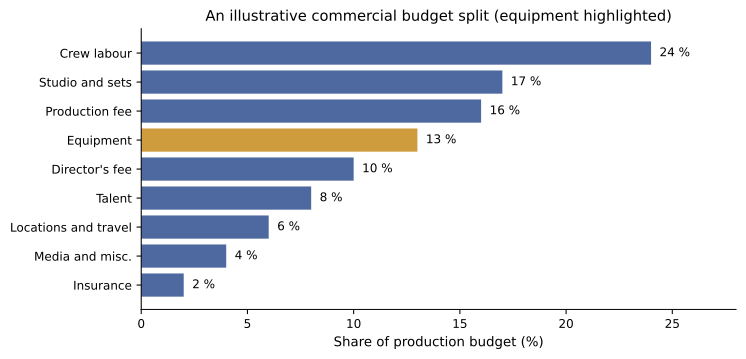
The bid is the production company's detailed estimate of cost. It is built from the boards, the treatment and the schedule. In the United States many companies use the AICP bid form, which groups costs into standard sections such as pre-production and wrap labour, shooting crew labour, location and travel, props and wardrobe, studio rental, set construction, equipment rental, media and storage, miscellaneous costs, the director and creative fees, talent and talent expenses, and post-production if included. Canadian production companies use comparable categories, adapted to Canadian payroll, union and tax rules.
For the camera department, the main lines are crew labour (director of photography, operators, assistants, digital imaging technician, grips, electricians), equipment rental (camera, lenses, support, lighting, grip, specialty items) and media or data. Specialty tools such as a high-speed camera, a motion control rig or a crane with a technician have their own lines because they are expensive.
Crew day rates, kit and overtime
Commercial crew are paid by the day, with a base number of hours included, often ten or twelve depending on the agreement and the market. After the base hours, overtime is paid at a higher rate, commonly time and a half and then double time. Pre-light days, travel days and prep days may have different rates. The exact rules come from the union agreement or the crew member's deal memo, so a bid must use the right ones.
Worked problem
Costing a camera crew for a shoot day
A one-day shoot is scheduled for 12 hours plus a one-hour unpaid meal. The camera crew is a director of photography at 2,500 per 10-hour day, a first assistant at 900 per 10 hours, a second assistant at 700 per 10 hours and a digital imaging technician at 900 per 10 hours. Overtime is time and a half after 10 hours. What is the camera crew labour for the day, before payroll costs?
Show solution
- Each person works 12 paid hours: 10 straight hours plus 2 overtime hours.
- Hourly rate equals day rate divided by 10. Director of photography: 2,500 ÷ 10 = 250 per hour; overtime 1.5 × 250 = 375 per hour; 2 hours = 750. Total 2,500 + 750 = 3,250.
- First assistant: 90 per hour; overtime 135 × 2 = 270; total 1,170.
- Second assistant: 70 per hour; overtime 105 × 2 = 210; total 910.
- Digital imaging technician: same as the first assistant, 1,170.
- Sum: 3,250 + 1,170 + 910 + 1,170 = 6,500.
Answer: About 6,500 for the camera crew for the day, before payroll taxes, union benefits and kit fees. The figures are illustrative; real rates depend on the market and agreement.
Payroll costs add a significant percentage on top of wages: employer contributions, union pension and health payments, and the payroll company's fee. Producers often add a "fringe" percentage in the bid to cover them.
| Line | What it covers | How it is costed |
|---|---|---|
| Director of photography | Prep, tech scout, pre-light, shoot | Day rate plus overtime |
| Camera assistants and DIT | Prep, shoot, wrap | Day rate plus overtime |
| Gaffer, best boy, electricians | Pre-light, shoot, wrap | Day rate plus overtime |
| Key grip and grips | Pre-rig, shoot, wrap | Day rate plus overtime |
| Camera package | Body, lenses, monitors, media | Daily or weekly rental |
| Lighting and grip package | Fixtures, stands, rigging, generator | Daily or package rental |
| Specialty | High-speed camera, motion control, crane, process trailer | Day rate with technician |
| Media and data | Storage drives, backups, transfers | Per terabyte or per day |
Kit fees, packages and negotiation
Rental houses quote equipment at a daily rate and often offer weekly rates equal to three or four days of rental. Production companies negotiate discounts, especially for repeat customers. A cinematographer who owns some equipment, such as lenses or a camera, may rent it to the production as a "kit fee", but should be careful that the rate and insurance are clear.
When the equipment wish list exceeds the budget, the cinematographer and producer look for trades. Can a smaller crane do the move? Can the motion control day be limited to the packshot? Can a pre-light day reduce overtime on the shoot day? These conversations happen during the bid and again after the job is awarded, when the budget is locked.
From boards to a shot list
Once the job is awarded, the director and cinematographer break the boards into a shot list. Each shot has a number, a description, the lens and camera support, the frame rate, any special equipment and notes for effects. The list is ordered for efficient shooting rather than story order.
- Group shots by set-up and lighting state so the crew does not relight repeatedly.
- Shoot talent-heavy shots while the talent is fresh and before overtime starts.
- Schedule product and packshots, which do not need actors, at the end of the day or on a separate table-top day.
- Put any shot that needs a specialty tool together, so the robot or high-speed camera is booked for the shortest time.
- Identify the "must-have" shots that make the commercial work, and the "nice to have" shots that can be dropped if time runs out.
The schedule and the pre-production meeting
The first assistant director builds the schedule from the shot list, estimating time for each set-up. Commercial set-ups can take from fifteen minutes for a simple reframe to several hours for a complex lighting change. At the PPM, the cinematographer may present the look, show test images, explain unusual equipment and confirm that approved boards can be achieved.
Worked problem
Will the schedule fit?
A 12-hour shoot day includes one hour for meals and 30 minutes for the company move between two sets. The first assistant director estimates 14 set-ups, averaging 35 minutes each including lighting tweaks and takes. Does the schedule fit, and how much buffer remains?
Show solution
- Available shooting time = 12 − 1 − 0.5 = 10.5 hours = 630 minutes.
- Required time = 14 × 35 = 490 minutes.
- Buffer = 630 − 490 = 140 minutes.
Answer: The schedule fits with about 140 minutes, or 2 hours 20 minutes, of buffer, a healthy margin for client requests and retakes.
Testing before the shoot
Commercial and music video work rewards testing. A test day or even a few hours with the camera and product can reveal problems that would cost a fortune on the shoot day.
- Product tests: check label reflections, colour accuracy and how the product looks in the planned light.
- Skin and wardrobe tests: check how the chosen fabrics, colours and make-up read on camera.
- Lens tests: compare lenses for flare, sharpness, distortion and character.
- Look tests: build a monitoring look with the colourist so that the client sees something close to the final grade on set, a method from CINE-310.
- Specialty tests: rehearse high-speed timing, motion control moves or vehicle rigs.
Test results go into the PPM presentation, so the client approves a look based on real images rather than guesses.
Common mistakes
MistakeTreating storyboards as exact instructions.
InsteadRead boards for intent and flag impossible frames early with alternatives.
MistakePromising more in the treatment than the budget allows.
InsteadMatch the visual approach to the money and schedule from the start.
MistakeLeaving specialty equipment for every shot.
InsteadGroup shots that need specialty tools to limit expensive rental time.
MistakeForgetting overtime and fringe in camera crew costs.
InsteadInclude overtime at the agreed multiplier and a fringe percentage for payroll costs.
MistakeSkipping tests to save money.
InsteadA short test often saves far more on the shoot day.
Summary and key terms
- The creative brief tells the cinematographer what must be remembered, where the work runs and what is mandatory.
- Storyboards and animatics reveal lens, movement, lighting and effects requirements, including impossible frames.
- The cinematographer helps shape the visual approach of the director's treatment while keeping it realistic.
- Bids group costs into standard categories; camera costs appear in crew labour, equipment, specialty and media lines.
- Crew costs include base day rates, overtime at agreed multipliers and payroll fringe.
- Shot lists are ordered for efficiency, grouping set-ups, talent and specialty tools.
- Testing products, skin, lenses and looks reduces risk and supports approvals at the PPM.
- Creative brief
- The agency's statement of objective, audience, message, tone and mandatories.
- Storyboard
- Drawings or frames showing each planned shot.
- Animatic
- A timed, moving version of the storyboards with temporary sound.
- AICP bid form
- A standard US cost template for commercial production bids.
- Fringe
- The percentage added to wages for payroll taxes, benefits and fees.
- Kit fee
- A rental payment to a crew member for using their own equipment.
- Shot list
- A numbered list of shots with lens, support, frame rate and notes.
- Packshot
- The final product shot, often with logo and tagline.
- Mandatories
- Elements that must appear, such as logos and legal lines.
- Pre-light
- A day for setting lights before the shoot day.
Practice problems
Work each problem on paper first, then reveal the answer to check.
Name two things a cinematographer looks for in a creative brief.
Show answer
The key message and where the work will be seen.
What is an animatic?
Show answer
A timed moving storyboard with temporary sound.
Why group specialty shots together?
Show answer
To limit expensive rental time.
A DP earns 2,000 per 10-hour day; what is 2 hours at time and a half?
Show answer
2 × 300 = 600.
What is fringe?
Show answer
The percentage added for payroll taxes, benefits and fees.
When are packshots often scheduled?
Show answer
At the end of the day or on a separate table-top day.
12-hour day, 1-hour meal, 15 set-ups at 40 minutes. Does it fit?
Show answer
660 minutes available, 600 needed: it fits with 60 minutes spare.
What does a lighting philosophy in a treatment describe?
Show answer
The intended quality and mood of the light.
Why test skin and wardrobe?
Show answer
To see how fabrics, colours and make-up read on camera.
What is a kit fee?
Show answer
Payment for a crew member's own equipment.
Lesson quiz · 5 questions
Score 60% or more to complete this lesson.
Create a free account to save your progress, take quizzes and earn a certificate.