
CINE-301 · Lesson 8 of 12 · 27 min
Screen direction and the 180-degree line
When shots are cut together, the audience must understand where characters are in relation to each other and which way they are moving. In real life we keep track of space by moving our eyes and bodies; in a film, the space is assembled from fragments filmed from different positions. The 180-degree rule, also called the axis of action or the line, is the central convention that keeps this assembled space coherent. This lesson explains the line, how it governs dialogue coverage, screen direction for movement and travel, crossing the line correctly, line problems in groups and moving scenes, the 30-degree rule, and when breaking the line can be effective.
The axis of action
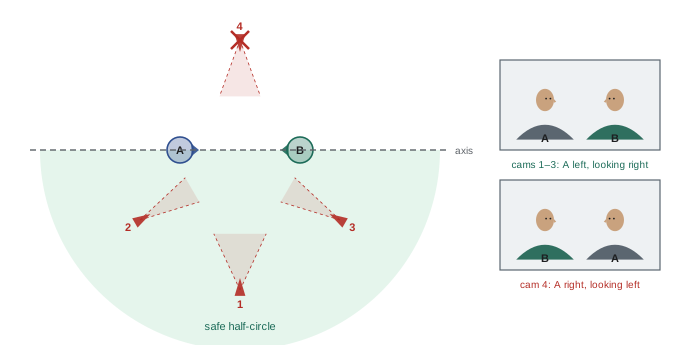
The axis of action is an imaginary line drawn through the main subjects of a scene, typically through the two characters in a conversation, or along the direction of a character's movement. The 180-degree rule states that all camera positions for a scene should stay on one side of this line, within the 180-degree half-circle on that side. If they do, characters maintain consistent screen positions and eyelines across cuts: if character A is on the left looking right and character B on the right looking left in the master, then A's single will show A looking right of frame and B's single will show B looking left, so cutting between them makes them appear to face each other. If the camera crosses the line for one shot, A will suddenly appear looking left, and the audience may feel that A has turned around or is looking at someone else.
The line in dialogue coverage
For a two-person dialogue, the line runs through both characters. All the coverage, the master, overs and singles, is shot from one side. This ensures that over-the-shoulder shots show the foreground character's shoulder on the correct side and that singles have matching eyelines: A looks camera right, B looks camera left. Small departures from the line are invisible as long as the camera stays on the same side; the half-circle offers a wide range of angles, from the profile two-shot to deep overs near the line. When a third character joins, new lines appear between each pair, and coverage must be planned so that each pair's relationship stays consistent (see groups below).
Screen direction in movement
The line also governs movement. If a character walks from left to right across the frame in one shot, continuing the journey in the next shot should keep them moving left to right. If they suddenly move right to left, the audience may think they have turned back. Screen direction is especially important in chases, journeys and battles: if the heroes travel left to right and the pursuers too, the audience understands they are going the same way; if two armies face each other, each consistently on its own side of the frame, the audience understands the battlefield. Many films establish conventional directions for journeys, for example moving left to right for "going out" or progress and right to left for returning, although this convention is not universal. Maps and floor plans help directors and DPs keep screen direction consistent across scenes shot weeks apart.
Worked problem
Planning screen direction for a chase
A chase sequence has a thief running through a market, pursued by a police officer. It will be shot over two days in different streets. How should screen direction be planned so the audience understands the chase?
Show solution
- Decide that both thief and officer move left to right throughout the chase.
- Draw a simple map of the route and mark the camera side for each segment.
- In each location, place the camera so both characters move left to right, even if the real streets run in different directions.
- When the direction must change (for example around a corner), show the turn on screen, or use a neutral shot (running toward or away from camera) between the two directions.
Answer: Keep both characters moving left to right, map the route and camera sides, and show or neutralize any change of direction.
Crossing the line correctly
Sometimes a scene needs the camera on the other side of the line: the most interesting background is there, the blocking changes, or the director wants to show the scene from a new perspective. There are accepted ways to cross the line without confusing the audience:
- Move the camera across the line during a shot, so the audience sees the change happen; a tracking shot or Steadicam move that arcs across the line establishes the new geography.
- Have the characters move, creating a new line; if one character walks around the other, the line moves with them, and coverage can continue on the new side.
- Cut to a shot on the line itself, a neutral shot looking straight down the axis, such as a frontal shot of a character, then continue on the other side.
- Use a cutaway or insert to break continuity briefly, then re-establish with a wide shot from the new side.
- Re-establish the geography with a new wide shot that clearly shows the characters' new positions.
The key is that the audience understands the change rather than perceiving it as an error.
The line with groups and complex blocking
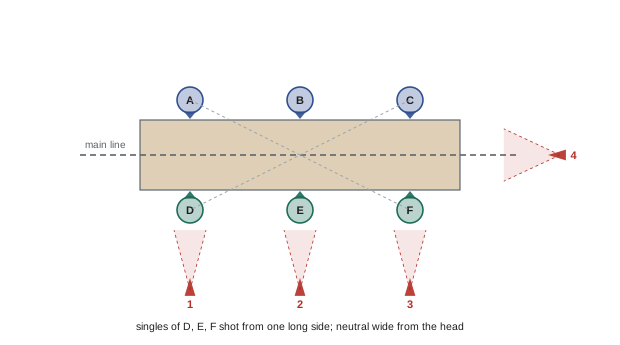
Scenes with three or more characters, such as dinner tables, meetings and parties, contain several lines, one between each pair of characters who interact. Coverage must keep each relationship consistent while allowing a manageable number of setups. Common strategies include treating the group as divided into two sides, like a table with characters on each side, with the main line running along the table; identifying the main lines of interaction and choosing camera positions that respect them; and placing the camera at the head of a table for a neutral view that works with several eyelines. Circular arrangements, such as a group sitting around a campfire, are particularly challenging, because any camera position crosses some lines; careful planning, using diagrams of each character's eyeline, helps. When characters move during the scene, the lines shift, and coverage must follow.
The 30-degree rule
A related guideline, the 30-degree rule, states that when cutting between two shots of the same subject, the camera angle should change by at least about 30 degrees, or the shot size should change significantly. If two shots are too similar in angle and size, the cut looks like a jump, as if frames were missing, producing a jump cut. Changing angle and size together makes the cut feel purposeful. Jump cuts are sometimes used deliberately, in the tradition of Jean-Luc Godard's Breathless (1960) and in many online video styles, to compress time or create energy, but in continuity editing they are avoided by varying angle and size between consecutive shots.
| Guideline | What it says | Purpose |
|---|---|---|
| 180-degree rule | Keep cameras on one side of the axis of action | Consistent screen positions and eyelines |
| Screen direction | Keep movement in a consistent direction across cuts | Clear journeys and geography |
| 30-degree rule | Change angle by about 30° or change size between cuts on the same subject | Avoid unintended jump cuts |
| Re-establishing | Show a new wide shot when geography changes | Reorient the audience |
Breaking the line deliberately
Like all conventions, the line can be broken for effect. Crossing the line abruptly can create disorientation, signal a shift in power or perspective, suggest a character's confusion, or mark a moment of rupture in a relationship. Stanley Kubrick's The Shining (1980) is often discussed for its spatial disorientation, and Yasujirō Ozu frequently placed the camera in positions that ignored the line, creating a distinctive sense of space. Some contemporary films and television series deliberately cross the line during arguments to make the audience feel the instability between characters. Deliberate line breaks work best when the rest of the film respects the line, so that the break is felt as meaningful.
Keeping track on set
On set, the script supervisor, the DP and the 1st AD keep track of the line. The script supervisor notes screen direction and eyelines for each setup, and warns if a planned camera position will cross the line. Floor plans with the line drawn in, and quick sketches of each setup, help. When in doubt, the DP can check by asking, "Which way is she looking?" and comparing with the previous shot on the monitor. Video assist and on-set editing software allow quick checks of how shots will cut together, a common practice on larger productions.
The line in moving scenes
When characters move, the line moves with them. If two characters walk side by side down a corridor, the line runs along their direction of travel, and cameras leading or following them must stay on one side; if one character overtakes the other or crosses behind, the line changes. Walk-and-talks covered by a leading camera are relatively simple, since the camera moves ahead of the characters, but intercutting with side angles requires attention to which character is on which side. Dances, fights and chases involving circling movement require careful choreography of the camera, and often moving cameras that cross the line visibly, allowing the audience to follow the shifting geography.
Worked problem
A line problem in a car
Two characters sit in the front seats of a car: the driver on the left and the passenger on the right (as in Canada and the United States). The director wants singles of each through the side windows and a two-shot through the windshield. How should the camera positions respect the line?
Show solution
- The line runs between the two characters, across the car from left to right.
- A two-shot through the windshield sees both characters from the front, establishing the driver on screen right and the passenger on screen left.
- Singles through the side windows look across the line from opposite sides, which would reverse screen positions.
- Instead, shoot singles from the front, through the windshield at angles favouring each character, or from the back seat over the shoulders, keeping all positions on the front side of the line.
Answer: Keep all positions on one side, usually the front, with angled singles through the windshield or back-seat overs, rather than side-window singles from opposite sides.
Screen direction across scenes
Screen direction also matters between scenes. If a character leaves a house exiting frame right, and the next scene shows her arriving at an office, she should usually enter frame left, continuing the movement, so the audience perceives a continuous journey. If she enters frame right instead, the audience may feel she has returned. Editors and script supervisors track these exits and entrances across the film, and the shot list can note intended directions for travel sequences.
Mirrors, screens and the line
Mirrors and screens complicate the line, because they show reversed or alternative views of characters. A conversation in which one character is seen in a mirror effectively places a second camera position on the other side of the line, and the reflection can be used deliberately to cross it smoothly. Video calls, now common in contemporary stories, create their own geometry: characters on screens look into their own cameras, and filmmakers must decide whether the audience sees them looking at the lens, at the screen, or off to the side, and how eyelines match across the call.
Planning the line in advance is part of the floor plan for every scene, and the habit of drawing it becomes second nature for experienced directors, DPs and script supervisors.
Common mistakes
MistakePlacing one setup on the wrong side of the line.
InsteadDraw the line on floor plans and check each setup.
MistakeReversing screen direction in a chase without explanation.
InsteadMap routes and show or neutralize direction changes.
MistakeCutting between nearly identical angles.
InsteadChange angle by about 30 degrees or change size.
MistakeIgnoring secondary lines in group scenes.
InsteadDiagram each pair's eyeline and plan coverage.
MistakeBreaking the line without purpose.
InsteadBreak it deliberately for a clear effect.
Summary and key terms
- The axis of action runs through the main subjects or along movement.
- Keeping cameras on one side maintains screen positions and eyelines.
- Screen direction keeps journeys and chases understandable.
- Cross the line with a move, character movement, a neutral shot or a re-establishing shot.
- Group scenes contain several lines that need planning.
- The 30-degree rule avoids unintended jump cuts.
- Deliberate line breaks can express disorientation or rupture.
- Axis of action
- Imaginary line through the main subjects.
- 180-degree rule
- Keep the camera on one side of the axis.
- Screen direction
- Direction of movement or look within the frame.
- Crossing the line
- Moving the camera to the other side of the axis.
- Neutral shot
- Shot on the line, such as head-on or straight away.
- Re-establishing shot
- Wide shot that reorients the audience.
- 30-degree rule
- Minimum angle change between cuts on the same subject.
- Jump cut
- Cut between similar shots that appears to skip time.
- Eyeline
- Direction in which a character looks.
- Script supervisor
- Crew member tracking continuity and coverage.
Practice problems
Work each problem on paper first, then reveal the answer to check.
Where does the axis of action run in a two-person scene?
Show answer
Through both characters.
What happens if one shot crosses the line?
Show answer
Screen positions and eyelines reverse.
Why does screen direction matter in a chase?
Show answer
To show both characters going the same way.
Name three ways to cross the line correctly.
Show answer
Camera move, character move, neutral shot, re-establishing wide.
What is a neutral shot?
Show answer
A shot on the line, such as head-on.
Why are campfire scenes difficult?
Show answer
Any camera position crosses some lines.
What does the 30-degree rule avoid?
Show answer
Unintended jump cuts.
Name a film famous for jump cuts.
Show answer
Breathless (1960).
Who tracks the line on set?
Show answer
Script supervisor, DP and 1st AD.
When is breaking the line effective?
Show answer
When deliberate and the rest of the film respects it.
Lesson quiz · 5 questions
Score 60% or more to complete this lesson.
Create a free account to save your progress, take quizzes and earn a certificate.