
CINE-301 · Lesson 7 of 12 · 25 min
Coverage strategies
Coverage is the set of shots filmed so that a scene can be assembled in editing. How much coverage to shoot, and of what kind, is one of the most consequential decisions in filmmaking: it determines how long a scene takes to shoot, how much freedom the editor has, and how the scene will feel on screen. Too little coverage can leave the editor without options to fix pacing, performance or continuity; too much can waste time and lead to generic scenes assembled by default rather than designed. This lesson covers the traditional coverage pattern, the order of shooting, the economics of coverage, targeted and designed coverage, sequence shots and oners, multi-camera coverage, inserts and cutaways, and how to decide the right strategy for each scene.
The traditional coverage pattern
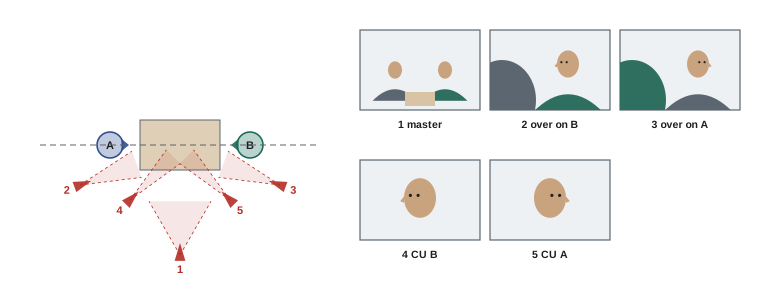
The classical approach to covering a dialogue scene, sometimes called the master-shot method, proceeds from wide to tight:
- Master shot: a wide or medium-wide shot covering the entire scene from beginning to end, showing all the characters and the space. It establishes geography and continuity and gives the editor a safety option for any moment.
- Two-shots and wider overs: shots showing pairs of characters or groups, covering sections of the scene.
- Over-the-shoulder shots: each character from behind the other, played through the scene.
- Singles and close-ups: each character individually, at medium close-up and close-up sizes, often the shots that carry the emotional peaks.
- Inserts and cutaways: details such as hands, objects and reactions of other characters.
Each shot is usually played through the whole scene or a large section of it, so that the editor can cut at any line. This approach is reliable and flexible and remains standard in much television and studio filmmaking.
Shooting order and efficiency
Coverage is usually shot in an order that minimizes lighting and camera changes. Productions typically shoot the master first, then all the coverage facing one direction (for example toward character B), then turn around to shoot the coverage facing the other way, known as the turnaround or reverse. Shooting all the shots in one direction before turning around avoids relighting the set twice. Within each direction, shots typically go from wider to tighter, because tighter shots usually require fewer lighting adjustments. Some directors prefer to shoot close-ups first, while actors are fresh, or schedule the most emotionally demanding shots when performances are likely to peak. The 1st AD and DP plan the order with the director, balancing creative and practical priorities (Lesson 11).
Worked problem
Estimating the time for full coverage
A three-page dialogue scene with two actors will be covered with a master, two overs and two close-ups. Each setup needs about 30 minutes for lighting and camera changes, and each is played through the whole scene in about 4 minutes per take, with 5 takes per setup. How long will the scene take, and how could it be reduced?
Show solution
- Setups: 5; setup time: 5 × 30 = 150 minutes.
- Shooting time: 5 setups × 5 takes × 4 minutes = 100 minutes, plus resets of about 2 minutes between takes, 5 × 5 × 2 = 50 minutes.
- Total: about 150 + 100 + 50 = 300 minutes, about 5 hours.
- Options: shoot the overs and close-ups with two cameras simultaneously, play only key sections in close-up, or stage the scene in depth with fewer setups.
Answer: About 5 hours; cross-shooting with two cameras, partial close-ups or a designed sequence shot could cut this substantially.
The economics of coverage
On a typical shooting day, a production might film three to eight pages of script, depending on budget and complexity. Every additional setup costs time for lighting, camera, sound and actors, so coverage choices directly affect the schedule and budget. Shooting full coverage for every scene is often impossible on independent productions and wasteful on any production. At the same time, insufficient coverage can force expensive reshoots or compromise the edit. The goal is to spend coverage where it matters: generous coverage for complex, emotionally important or uncertain scenes, and minimal coverage for simple, transitional or highly designed moments.
Targeted and designed coverage
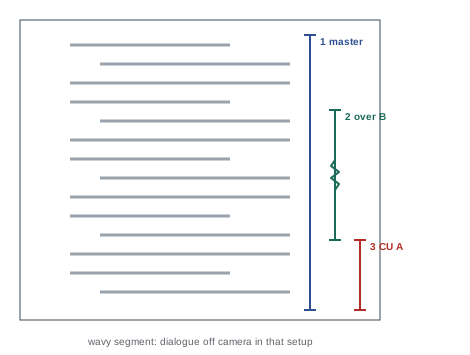
An alternative to covering everything from every angle is targeted or designed coverage, in which the director and DP plan specific shots for specific moments, and play only those sections in each setup. For example, a scene might begin in a wide shot for the first half page, move to an over for the next exchange, and only go to close-ups for the two lines at the climax. This approach requires confidence and clear planning, often using a marked script showing which shot covers which lines, but produces scenes with a deliberate shape and saves time. Many directors combine approaches, designing the key shots and shooting a little extra "insurance" coverage where they are uncertain.
Sequence shots and oners
A sequence shot or oner plays an entire scene, or a significant part of it, in a single continuous shot, often with moving camera and complex blocking. Oners can create immersion and tension, as viewers experience time without interruption; showcase performances; and give scenes a distinctive, memorable shape. Examples range from the opening of Touch of Evil (1958) to the long battle takes of Children of Men (2006) and the apparently continuous structure of 1917 (2019), which joined long takes with hidden cuts. Oners have costs: they require extensive rehearsal, every department must be perfect at once, mistakes late in the take mean starting again, and the editor cannot adjust pacing or performance within the shot. A common compromise is to shoot the oner and some protection coverage, such as a few close-ups, so that the editor can cut away if needed.
Multi-camera coverage
Using two or more cameras simultaneously can capture coverage faster and preserve spontaneity between actors. Common configurations include cross-coverage, with A and B cameras shooting each actor's single at the same time from opposite sides; stacking, with two cameras on similar angles but different sizes, such as a medium and a close-up; and wide-and-tight, with one camera on the master and another picking up a close-up. Multi-camera shooting saves time and allows overlapping dialogue and improvisation to be captured in sync. It also brings compromises: lighting must work for both angles at once, which can flatten the look; cameras must avoid seeing each other, microphones and lights; and lens choices may be constrained. Television sitcoms traditionally use three or four cameras in front of a live audience, while single-camera dramas increasingly use two cameras routinely.
| Strategy | Advantages | Disadvantages |
|---|---|---|
| Full traditional coverage | Maximum editorial flexibility, safety | Time-consuming, can feel generic |
| Targeted coverage | Deliberate shape, efficient | Less flexibility if plans fail |
| Sequence shot / oner | Immersive, memorable, performance-driven | High rehearsal, no editorial adjustment |
| Multi-camera | Fast, captures spontaneity | Lighting and framing compromises |
| Hybrid | Designed shots plus insurance | Requires judgement on where to spend time |
Inserts, cutaways and reactions
Inserts show details essential to the story, such as a ring on a finger, a text message, a key in a lock, or the time on a clock. They are often shot after the main coverage, sometimes by a second unit, and must match the lighting, continuity and action of the main shots. Cutaways show something outside the main action, such as a bystander, a pet or a view out of the window, and give editors a way to compress time, cover continuity errors or vary rhythm. Reaction shots, characters listening and responding, are essential; many editors say that a scene is built as much on reactions as on lines. Capturing good listening performance in singles, by playing off-camera dialogue fully, is important in coverage.
Choosing a strategy for each scene
Questions that help decide coverage for a scene include:
- How important is the scene to the story, and how emotionally complex is it?
- Whose scene is it, and what moments need close attention?
- Is there an idea for how the scene should feel, such as continuous, fragmented or observational, that suggests a particular strategy?
- How confident are the director and editor about the scene's pacing and performance, and how much flexibility will the edit need?
- How much time is scheduled, and what is the cost of each setup?
- Can the scene be staged in depth or with movement to reduce setups?
- What does the rest of the film do, and does this scene need to contrast or match?
Experienced directors often describe coverage in terms of what they would miss: if a close-up of a character at a certain line would be essential in the edit, it must be shot; if a shot would be "nice to have", it may be dropped when time is short.
Communicating coverage
The coverage plan for each scene is shared with the crew through shot lists, storyboards or floor plans (Lesson 10), and on set through the show and tell after blocking. The script supervisor tracks which lines and actions each setup covers, often on a lined script, and notes continuity and takes, so that the editor knows what material exists. The 1st AD uses the coverage plan to manage the schedule, warning when a scene is falling behind and prompting decisions about what to drop.
Coverage for comedy
Comedy has particular coverage needs. Timing between lines and reactions is central, and cutting can destroy or enhance a joke. Many comedy directors favour wider two-shots and group shots that let the audience see the setup and the reaction in one frame, and multi-camera shooting that captures improvisation and overlapping dialogue in sync. Reaction shots are essential, since a character's deadpan response is often the punchline. Coverage for improvised comedy may involve many takes with variations, giving the editor a range of options; this requires disciplined continuity so that alternative lines can still be intercut.
Coverage for action
Action sequences are typically covered with many shots from multiple angles and sizes, often with several cameras, because action happens quickly, stunts are expensive or dangerous to repeat, and editors need options to build rhythm and hide stunt techniques. Coverage plans for action are usually storyboarded or previsualized in detail, with each beat assigned specific shots. Clarity of geography is especially important: audiences need to understand where characters are relative to each other and to threats, so wide establishing shots, consistent screen direction and clear eyelines remain essential even in fast cutting.
Coverage for television
Television series have their own coverage traditions. Episodic drama often uses two cameras routinely, a consistent house style across episodes and directors, and efficient coverage plans that allow eight or more pages a day. Directors of television episodes frequently work within a style established by the series' creators and DPs, adapting it to each script. Streaming series with larger budgets may adopt more cinematic coverage, but schedule pressure remains a defining factor. Understanding the house style and the pace expected is part of a television DP's job.
Coverage and the edit
Ultimately, coverage is judged in the edit. Editors look for options in performance, timing and emphasis, and they often rely on shots that the director considered secondary. A director who watches early assemblies during the shoot can learn which kinds of coverage are working and adjust plans for later scenes, for example adding more reaction shots or simplifying coverage that the edit does not need. This feedback loop between set and cutting room is one of the most effective ways to improve coverage decisions.
A helpful habit is to write, for each scene, a single sentence describing the coverage strategy and why, such as: one moving master and two close-ups for the final exchange, to keep the scene continuous until the confession. Sharing this sentence with the crew focuses everyone on the plan.
Common mistakes
MistakeCovering every scene with the same full pattern.
InsteadMatch coverage to each scene's importance and design.
MistakeTurning around before finishing one direction.
InsteadShoot all coverage facing one way before the reverse.
MistakeOners with no protection.
InsteadShoot some insurance coverage when possible.
MistakeNeglecting reaction shots.
InsteadCapture strong listening performances in singles.
MistakeTwo cameras without adapting lighting and framing.
InsteadPlan multi-camera setups so both angles work.
Summary and key terms
- Traditional coverage moves from master to overs, singles and inserts.
- Shoot all coverage in one direction before turning around.
- Every setup costs time; spend coverage where it matters.
- Targeted coverage designs specific shots for specific moments.
- Oners create immersion but remove editorial flexibility.
- Multi-camera coverage saves time with lighting and framing compromises.
- Inserts, cutaways and reactions give editors essential options.
- Master shot
- Wide shot covering a whole scene.
- Turnaround
- Coverage facing the opposite direction.
- Targeted coverage
- Planned shots for specific parts of a scene.
- Lined script
- Script marked with the coverage of each setup.
- Sequence shot
- A scene played in one continuous shot.
- Protection coverage
- Extra shots shot as insurance.
- Cross-coverage
- Two cameras shooting opposite singles at once.
- Insert
- Close shot of a detail.
- Cutaway
- Shot of something outside the main action.
- Reaction shot
- Shot of a character listening or responding.
Practice problems
Work each problem on paper first, then reveal the answer to check.
List the traditional coverage pattern.
Show answer
Master, two-shots, overs, singles, inserts.
Why shoot one direction before turning around?
Show answer
To avoid relighting twice.
Why shoot wider shots before tighter ones?
Show answer
Tighter shots need fewer lighting changes.
Time for 4 setups at 30 min, 4 takes of 3 min each?
Show answer
About 120 + 48 = 168 min plus resets.
What is targeted coverage?
Show answer
Shooting specific shots for specific moments.
What does a lined script show?
Show answer
Which setup covers which lines.
Name a disadvantage of oners.
Show answer
No editorial adjustment; heavy rehearsal.
What is cross-coverage?
Show answer
A and B cameras shooting opposite singles together.
What are cutaways used for?
Show answer
Compressing time, covering errors, rhythm.
What question decides whether a shot is essential?
Show answer
Would the editor miss it?
Lesson quiz · 5 questions
Score 60% or more to complete this lesson.
Create a free account to save your progress, take quizzes and earn a certificate.