
CINE-301 · Lesson 6 of 12 · 27 min
Blocking actors and camera
Blocking is the choreography of a scene: where actors stand, when and where they move, and how the camera relates to them. It comes from theatre, where directors once marked actors' positions on stage with wooden blocks on a model, but in film it has an extra dimension, because blocking must work for the camera as well as the actors. Good blocking expresses character and relationships, gives actors motivated reasons to move, creates strong compositions and makes coverage efficient. This lesson covers the purposes of blocking, motivation, blocking for the camera, the rehearsal and blocking process on set, marks and stand-ins, blocking patterns such as crossing, entering and exiting, and how blocking determines coverage.
Why blocking matters
Blocking serves several purposes at once:
- Storytelling: movement expresses intention and emotion. A character who steps toward another advances; one who turns away retreats; one who sits down concedes or settles; one who stands up asserts.
- Relationships: distance and position between characters show intimacy, conflict and power. Proximity, height differences and who occupies the centre of the room all carry meaning.
- Rhythm: movement gives scenes energy and punctuation, marking changes of beat.
- Composition: blocking creates the frames, from wide two-shots to close singles, that the camera will capture.
- Practicality: blocking determines what the camera, lights and sound must do, and how long the scene will take to shoot.
Static scenes in which characters sit and talk can be powerful, but a scene in which nothing changes physically risks feeling flat. Even small movements, a lean forward, a glance away, picking up an object, create visual change and give the camera something to respond to.
Motivation
Movement in blocking should be motivated: the character has a reason to move, rooted in their objective in the scene. A character might cross to a window to avoid eye contact, pick up a glass to steady their hands, or move toward a door to signal that they want to leave. Actors often find these motivations themselves in rehearsal, and directors guide them toward movement that also works for the camera. Unmotivated movement, actors moving simply because the director needs them in a different position, looks false. When a camera position or composition requires an actor in a certain place, good directors find a story reason for them to be there, or adapt the camera to the actor.
Blocking for the camera
Blocking for film must consider the camera at every step. Actors who stand side by side facing the camera, as in some theatre, may look artificial on screen; staging in depth, angled bodies and natural spacing usually work better. Some considerations:
- Cheating: positions that look natural on screen may be odd in reality. Actors in a two-shot may stand closer than people normally would, or face slightly more toward the camera, a practice known as cheating. Small cheats in position, eyeline or height help compositions.
- Sightlines: actors must be visible, not hidden behind each other or furniture at key moments.
- Spacing for coverage: the distance between actors affects how easily overs and singles can be shot; very close actors make clean singles difficult, very distant actors make two-shots wide.
- Light: actors should hit their light, moving into positions where the key light falls well on their faces.
- Sound: blocking that turns actors away from microphones or moves them across noisy surfaces affects the sound department.
- Movement and camera: blocking and camera movement are designed together, the camera following, leading or revealing.
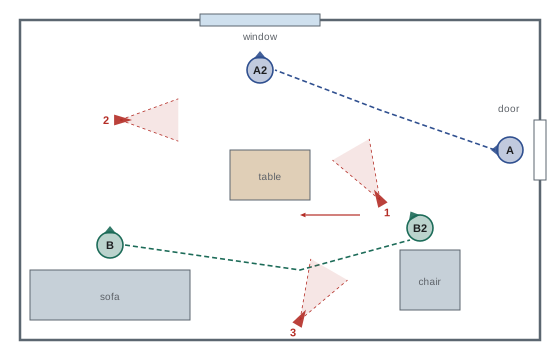
The blocking process on set
On a typical film set, each scene follows a sequence that begins with blocking:
- Blocking rehearsal: the director, actors, DP, first assistant director (1st AD) and key crew watch the actors run the scene in the set. The director shapes movement, the DP and operator observe and suggest camera positions, and the 1st AD notes timing.
- Marking: the second assistant camera places marks on the floor, usually small pieces of coloured tape or T-shaped marks, where actors stop, so that the focus puller and operator know where they will be.
- Show and tell: the director and DP discuss with heads of department how the scene will be covered: the shots, the order and what each requires.
- Lighting and setting up: the actors leave for hair, makeup and wardrobe while stand-ins take their places for lighting and camera rehearsal.
- Camera rehearsal: once lighting is ready, actors return for a rehearsal with the camera, refining moves, focus and frame.
- Shooting: takes proceed, with adjustments between them.
This process, sometimes summarized as "block, light, rehearse, shoot", helps departments work in parallel and efficiently. On fast-moving productions, it may be compressed, but skipping blocking rehearsal usually costs more time later.
Marks and stand-ins
Marks allow actors to arrive at precise positions for focus, framing and light. Actors learn to hit marks without looking down, using peripheral vision or counting steps, and sandbags or small objects may be used where tape would be visible. Marks are coloured differently for each actor and numbered for multiple positions in a scene. Stand-ins, crew members of similar height, build and complexion to the actors, take their places during lighting and camera setup, allowing actors to rest and prepare. A good stand-in watches the blocking rehearsal closely and reproduces the actors' moves and positions, so that the setup is accurate when the actors return.
Worked problem
Solving a blocking problem
In a dining-room scene, two characters sit facing each other across a long table, two metres apart. The director wants intimate over-the-shoulder coverage, but the distance makes the overs wide and distant. How might blocking or camera solve this?
Show solution
- Move the characters to adjacent sides of the table, at the corner, reducing the distance and creating a natural angle.
- Alternatively, cheat the characters closer along the table, which may not be noticed on screen.
- If the distance is important for the story (estrangement), keep it and use longer lenses to compress the space in the overs, or shoot clean singles that emphasize distance.
- Discuss with the actors to find motivation, such as one character moving to sit closer during the scene, which also adds a beat of movement.
Answer: Adjust positions (corner seating or cheating closer), or keep the distance for meaning and use longer lenses or singles; motivate any move.
Common blocking patterns
Some patterns recur across films:
- Entrances and exits: characters entering through the background toward the camera, or exiting past the camera, give scenes clear beginnings and endings and can change shot size without cutting.
- Crosses: a character moving across the frame or the room, often to change their relationship with another character or to reveal part of the set.
- Walk-and-talks: characters moving together while talking, covered with leading or following camera moves, associated with television series such as The West Wing.
- Pivots and turns: characters turning toward or away from each other or the camera, revealing or hiding faces at key moments.
- Sitting and standing: changes in height that shift power and composition.
- Circling: characters moving around each other or an object, as in confrontations.
Each pattern has implications for coverage, eyelines and the 180-degree line (Lesson 8), and planning them in advance helps coverage cut together.
Camera blocking and the oner
Blocking the camera means designing its movement in relation to the actors: when it moves, where it stops, and how its frames evolve. In elaborate single-take scenes, sometimes called oners, the actors and camera are choreographed so that the shot moves through several compositions, effectively providing a master, two-shots and close-ups within one take. Examples include the opening tracking shot of Orson Welles's Touch of Evil (1958), the Copacabana Steadicam shot in Martin Scorsese's Goodfellas (1990) and the extended takes of Children of Men (2006). Oners demand extensive rehearsal and coordination of actors, camera, focus, sound, lighting and extras, and they commit the scene's pacing on set. Lesson 7 discusses when oners are the right choice.
How blocking determines coverage
The blocking chosen for a scene largely determines how it must be covered. A scene in which two characters sit and talk can be covered efficiently with a master and singles; a scene with complex movement may need a moving master, several setups to cover each position, and inserts for key actions; a scene staged in depth may need very little coverage. Experienced directors and DPs often design blocking with coverage in mind, keeping actors in positions that allow overs and singles to match, and limiting unnecessary movement that would complicate continuity. Equally, ambitious blocking can create memorable scenes that standard coverage would flatten, so the balance depends on the scene's importance and the time available.
| Blocking choice | Coverage implications |
|---|---|
| Seated two-person conversation | Master, two overs, two singles; efficient |
| Walk-and-talk | Leading or following moving shot; may need two passes |
| Entrance to a crowded room | Wide master, POV, reactions, inserts |
| Staging in depth | Fewer setups; relies on composition and focus |
| Circling confrontation | Line changes; needs careful planning of screen direction |
Blocking for multiple cameras
When two or more cameras shoot at once, blocking must work for all of them. Actors should be positioned so that each camera sees their faces at important moments, and movement should avoid crossing in front of one camera's view of another actor at key lines. Cameras must also avoid seeing each other, which limits angles; the classic solution places cameras on the same side of the line, at different sizes or angles, or uses cross-coverage with carefully chosen positions. Blocking rehearsals for multi-camera scenes often involve both operators watching and suggesting small adjustments in actor position or timing.
Blocking and performance
Blocking affects performance. Actors need freedom to discover how characters move, and over-precise blocking can make performances stiff. Many directors begin with a loose rehearsal, letting actors find natural movement, and then refine it for the camera, preserving the actors' discoveries where possible. Some actors prefer clear marks and structure; others work best with freedom and adjust to marks later. Communicating early with actors about the shooting style, such as whether scenes will be played in long takes or covered extensively, helps them prepare. Rehearsal time before the shoot, even a few days, can produce blocking that is both expressive and efficient.
Worked problem
Blocking a confrontation
Two characters argue in a small office. The director wants the argument to escalate physically, ending with one character blocking the door. How might blocking and camera be designed?
Show solution
- Begin with the characters on opposite sides of a desk, seated, covered in a master and singles.
- As tension rises, one character stands and moves around the desk, closing the distance; the camera holds a two-shot as the space narrows.
- The second character moves toward the door, and the first steps in front of it; this move creates a new axis, so the camera re-establishes with a wider shot from the new side.
- End on a tight two-shot or overs at the door, with both characters standing close.
Answer: Progress from seated distance to standing proximity, re-establish when the axis changes, and end in tight coverage at the door.
Blocking for sound and safety
Blocking also involves the sound and safety teams. Sound mixers prefer actors to face microphones and avoid noisy surfaces, and they need time to plan boom positions that stay out of frame and out of lights' shadows. Movement near stunts, vehicles, water, fire or heights requires the stunt coordinator and safety officer to review blocking, and rehearsals of risky moves happen at reduced speed before full takes. Including these departments in blocking rehearsals avoids surprises when the camera is ready to roll.
After the shoot, reviewing the floor plans against the edited scene shows how blocking choices translated to the screen, and which movements the editor used or cut. This review builds intuition for future blocking decisions.
Common mistakes
MistakeUnmotivated movement for camera convenience.
InsteadFind story reasons for every move.
MistakeSkipping the blocking rehearsal.
InsteadBlock first so all departments can plan.
MistakeActors too close or far for planned coverage.
InsteadAdjust spacing or adapt lenses to the story.
MistakeIgnoring light and sound in blocking.
InsteadConsider where actors will be lit and heard.
MistakeComplex blocking without a coverage plan.
InsteadDesign blocking and coverage together.
Summary and key terms
- Blocking choreographs actors and camera to tell the story.
- Movement should be motivated by characters' objectives.
- Blocking for camera involves cheating, sightlines, spacing, light and sound.
- Sets follow a block, light, rehearse, shoot process.
- Marks and stand-ins make setups precise and efficient.
- Common patterns include entrances, crosses, walk-and-talks and pivots.
- Blocking largely determines how a scene must be covered.
- Blocking
- Planned movement and positions of actors and camera.
- Motivation
- A character's reason for moving.
- Cheating
- Adjusting positions so they read naturally on camera.
- Mark
- Floor marker where an actor stops.
- Stand-in
- Person who replaces an actor during setup.
- Show and tell
- Explaining coverage plans to departments.
- Cross
- Movement across the frame or room.
- Walk-and-talk
- Dialogue while characters move.
- Oner
- Scene played in a single continuous shot.
- Floor plan
- Top-down diagram of blocking and camera positions.
Practice problems
Work each problem on paper first, then reveal the answer to check.
Name three purposes of blocking.
Show answer
Storytelling, relationships, rhythm, composition, practicality.
Why should movement be motivated?
Show answer
Unmotivated movement looks false.
What does cheating mean in blocking?
Show answer
Adjusting positions to look natural on camera.
List the on-set sequence.
Show answer
Block, light, rehearse, shoot.
Who places marks?
Show answer
The second assistant camera.
What does a stand-in do?
Show answer
Takes the actor's place during lighting and setup.
Name two blocking patterns.
Show answer
Entrances, crosses, walk-and-talks, pivots, sitting/standing.
Name a famous oner.
Show answer
Touch of Evil opening, Goodfellas Copacabana.
How does seated dialogue usually get covered?
Show answer
Master, overs and singles.
How can you fix overs that are too far apart?
Show answer
Corner seating, cheating closer or longer lenses.
Lesson quiz · 5 questions
Score 60% or more to complete this lesson.
Create a free account to save your progress, take quizzes and earn a certificate.