
CINE-230 · Lesson 9 of 12 · 25 min
Steadicam and body-mounted stabilizers
The Steadicam changed cinema by giving the camera the freedom of a handheld shot with the smoothness of a dolly. A skilled operator can walk, run, climb stairs and step into vehicles while the camera floats steadily, following actors through spaces where track could never go. Its characteristic gliding movement appears in countless films, series and live broadcasts. This lesson covers the invention and principles of the Steadicam, its components and balance, dynamic balance, operating technique, typical shots, working with the camera team, other body-mounted systems, and operator health and safety.
Invention and early use
The Steadicam was invented by Garrett Brown, a Philadelphia filmmaker, in the early 1970s and developed with Cinema Products Corporation, which introduced it in the mid-1970s. Its early feature uses included Bound for Glory (1976), shot by Haskell Wexler, in which a Steadicam shot rose on a crane platform and stepped off to walk through a camp; Rocky (1976), with its famous run up the steps of the Philadelphia Museum of Art; and Stanley Kubrick's The Shining (1980), whose low tracking shots following a child on a tricycle through hotel corridors became iconic. Brown received an Academy Award for the invention. Since then, Steadicam and similar body-mounted stabilizers have become standard tools in drama, sport, concerts and television, and the name Steadicam is often used generically, though other manufacturers make comparable systems.
How a Steadicam works
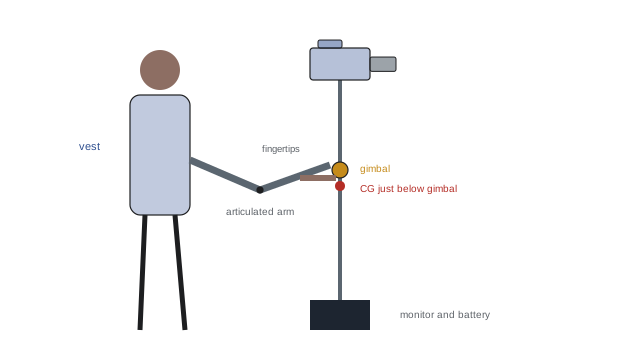
A Steadicam isolates the camera from the operator's body movements through three components:
- The vest, worn by the operator, which transfers the weight of the rig to the hips and shoulders.
- The articulated arm, attached to the vest, a spring-loaded arm with two sections that supports the rig's weight and absorbs vertical and lateral movements of the operator, like a car's suspension.
- The sled, which carries the camera at the top, a central post, and the monitor and batteries at the bottom, connected to the arm by a gimbal near the sled's centre of gravity.
Because the gimbal allows the sled to rotate freely in all directions and the sled is balanced so that its centre of gravity sits slightly below the gimbal, the sled tends to stay upright and resist rotation, while the arm isolates it from the operator's steps. The operator guides the sled with a light touch of the fingers on the post near the gimbal, steering the framing without transmitting the jolts of walking.
Static balance and drop time
Balancing the sled is the foundation of Steadicam operating. Static balance places the centre of gravity directly below the gimbal so that the sled hangs vertically. The vertical distance between the gimbal and the centre of gravity determines how bottom-heavy the sled is, measured by the drop time: the time it takes for the sled, held horizontal and released, to swing down to vertical. A short drop time, under about one second, makes the sled very stable but resistant to tilting and prone to pendulum swing when accelerating; a long drop time, around two to three seconds, makes the sled more neutral and responsive but requires more finesse. Operators set drop time according to the shot: shorter for walking and running, longer for precise framing and tilts. Balance is adjusted by moving the camera fore, aft and sideways on the top stage, changing the post length and moving the gimbal along the post.
This pendulum relationship shows that the period of swing \(T\), related to drop time, increases as the distance \(d\) between the gimbal and the centre of gravity decreases, for a sled of mass \(m\) and moment of inertia \(I\). Extending the post and spreading mass increases the moment of inertia, which makes the sled resist unwanted rotation, an important principle in stabilizer design.
Dynamic balance
A sled can hang vertically at rest yet tilt when panned, because its masses are not distributed symmetrically around the post. Dynamic balance means arranging the camera, monitor and batteries so that the sled stays vertical while spinning around its post, which is essential for whip pans and fast moves. Operators test dynamic balance by spinning the sled and watching whether it wobbles, then adjusting the positions of components until it spins true. Achieving both static and dynamic balance is one of the most technical aspects of preparation, and must be redone whenever the camera package changes, for example with a different lens, matte box or battery.
Operating technique
Steadicam operating requires both physical skill and a feel for framing. Key elements include:
- Walking: a gliding walk with soft knees and smooth steps, and often a step pattern where the operator crosses feet or walks sideways to keep the rig in the desired position relative to the body.
- Don and goofy modes: the sled held on the operator's side away from the arm or on the same side, chosen according to the shot and space.
- Light touch: fingers on the post guide the framing; grabbing the post transmits body movement.
- Low mode: inverting the sled so that the camera hangs below, for very low shots near the ground.
- Anticipation: steering the sled's inertia in advance, since it resists sudden changes.
- Horizon control: keeping the horizon level during turns and accelerations, which pendulum effects disturb.
Operators train intensively, often through manufacturer workshops, and practise constantly, including walking courses, stairs and repeatable figure-eights.
Typical Steadicam shots
Steadicam excels at following or leading actors through complex spaces: walking and talking scenes through offices, hospitals and houses; long takes moving between rooms; stair climbs; shots that step into or out of vehicles; low shots skimming over ground; and moves in crowds where track would be impossible. It also serves sports sidelines, concerts and live events, and handheld-feeling shots with more control. It can be combined with other tools: an operator can step off a crane platform, ride on a vehicle or be carried on a camera car. Steadicam's movement has a recognizable floating quality, which suits some stories and not others; filmmakers choose it for fluid presence rather than raw handheld energy or the precision of a dolly.
Worked problem
Planning a walk-and-talk
Two actors walk and talk for 45 seconds through a hospital corridor, around a corner and into a lift. The director wants the camera to lead them, then turn and follow them into the lift. Which support and what preparation are needed?
Show solution
- Steadicam suits the move: leading through a corridor, turning a corner and entering a lift exceed what track can do quickly.
- Balance the sled for the lens and package, setting a moderate drop time for walking.
- Rehearse the route with the actors and a grip spotting the operator's back, since the operator walks backward while leading.
- Plan focus with the focus puller using wireless lens control and distance marks, and light the corridor for all angles.
- Plan the turn and lift entry so that the operator can pivot smoothly and the lift doors close on cue.
Answer: Use Steadicam with a balanced sled, rehearsed route, a spotter for backward walking, wireless focus and lighting that works for the whole path.
Working with the camera team
The Steadicam operator works closely with a Steadicam assistant or grip who acts as a spotter, guiding the operator when walking backward or over obstacles, and helps them don and doff the rig between takes, since a full rig can weigh 30 kg or more including the camera. The focus puller controls focus wirelessly, often walking behind or watching a monitor. Video is transmitted wirelessly to the director and video village. The director of photography lights the space for a moving camera that may see in all directions, often hiding lights in practicals, ceilings and off-camera spaces. Between takes, the operator rests the sled on a docking stand to relieve the load.
Other body-mounted stabilizers
Several other systems support or stabilize cameras on the body. Vest-and-arm systems from other manufacturers follow the Steadicam principle. Handheld stabilizers without vests, smaller sleds held in the hand, suit light cameras for short shots. Support systems such as the Easyrig use a vest with an overhead arm and a bungee or spring line to hang the camera, taking its weight off the operator's arms and shoulders while preserving handheld movement; they are popular in documentary and drama for long handheld days. Hybrid systems combine an arm and vest with a motorized gimbal (Lesson 10) instead of a passive sled, adding active stabilization and remote framing. Each system offers a different balance between smoothness, control and weight.
Operator health and safety
Steadicam operating is physically demanding. A heavy rig worn for long periods stresses the back, shoulders and knees, and operators must maintain fitness, warm up, and take regular rests between takes. Productions should allow breaks and use docking stands. Walking backward or along uneven paths creates fall risks, so spotters are essential, and the path should be checked for trip hazards, cables and wet surfaces. Operators should not run on stairs or uneven ground without rehearsal, and shots involving vehicles, heights or water require specific safety plans. Heat, cold and long days add strain. Respecting operators' limits prevents injuries that can end careers.
Steadicam and the long take
Many celebrated long takes rely on Steadicam, which can follow actors through rooms, corridors, stairs and doorways in one continuous move. In such shots, the operator becomes part of the choreography: rehearsals with actors, focus pullers and lighting cues establish every step. Handoffs extend Steadicam's reach: an operator can be lifted on a crane platform or step onto a vehicle, then continue on foot, or hand the camera to another system. Because the camera may see in every direction, lighting must be hidden or built into the set, and crew must stay out of view, often moving with the operator in a choreographed group behind the camera.
Steadicam with large cameras and lenses
Modern cinema cameras with large lenses, matte boxes and accessories can be heavy, and Steadicam arms are rated for payload ranges. Operators choose arm springs or settings for the package, keep accessories minimal and position components to balance the sled. Long lenses are less common on Steadicam, because small movements are magnified, but skilled operators can use moderate telephoto lenses for some shots. Wireless video and lens control reduce cables, and lighter camera bodies designed for Steadicam and gimbal use have become popular.
Training and certification
Steadicam operating is a specialist career. Operators usually train through workshops offered by manufacturers and experienced operators, starting with balancing and walking exercises and progressing to complex shots. Many work for years as assistants or in television before operating features. Operators own and maintain their rigs, which represent a significant investment, and are often hired with their equipment. Professional associations share techniques and safety guidance.
Steadicam in live television and sport
Steadicam operators are a familiar sight on sports sidelines, concert stages and awards shows, where they move close to performers and athletes and deliver live pictures to the director. Live work demands stamina and quick reactions, since there are no second takes, and wireless video and lens control must be reliable throughout. Operators work closely with floor managers and safety staff to stay clear of moving players, performers and equipment.
Rigs are also inspected regularly, since the arm springs, gimbal bearings and vest fittings wear with use, and a failure during a move could injure the operator or damage the camera.
Common mistakes
MistakeGripping the post tightly.
InsteadGuide the sled with a light fingertip touch.
MistakeIgnoring dynamic balance.
InsteadSpin-test and adjust so the sled stays vertical.
MistakeWalking backward without a spotter.
InsteadAlways use a spotter for blind moves.
MistakeKeeping the rig on between long setups.
InsteadUse a docking stand and rest.
MistakeUsing Steadicam for every move.
InsteadChoose it for fluid presence when it suits the story.
Summary and key terms
- Garrett Brown invented the Steadicam; early uses included Bound for Glory, Rocky and The Shining.
- Vest, arm and sled isolate the camera from body movement.
- Static balance and drop time set the sled's stability.
- Dynamic balance keeps the sled vertical when spinning.
- Operating uses a gliding walk, light touch and anticipation.
- Steadicam suits walk-and-talks, long takes and complex spaces.
- Spotters, rest and fitness protect operators.
- Steadicam
- Body-mounted camera stabilizer with vest, arm and sled.
- Vest
- Harness transferring rig weight to the body.
- Articulated arm
- Spring-loaded arm isolating the sled.
- Sled
- Post carrying camera, monitor and batteries.
- Gimbal
- Joint letting the sled rotate freely.
- Drop time
- Time for a horizontal sled to swing vertical.
- Dynamic balance
- Balance that keeps the sled vertical when spinning.
- Low mode
- Inverted sled for low shots.
- Spotter
- Person guiding the operator safely.
- Easyrig
- Vest with overhead arm suspending a handheld camera.
Practice problems
Work each problem on paper first, then reveal the answer to check.
Who invented the Steadicam?
Show answer
Garrett Brown.
Name an early Steadicam film.
Show answer
Bound for Glory, Rocky or The Shining.
What does the arm do?
Show answer
Supports the rig and absorbs body movement.
Where is the sled's centre of gravity?
Show answer
Slightly below the gimbal.
What does a short drop time mean?
Show answer
A bottom-heavy, stable sled.
What is dynamic balance?
Show answer
The sled stays vertical while spinning.
What is low mode?
Show answer
Inverted sled for low shots.
Why use a spotter?
Show answer
To guide the operator when walking backward.
What does an Easyrig do?
Show answer
Suspends a handheld camera from an overhead arm.
Name two operator health measures.
Show answer
Docking stands, rest breaks, fitness, warm-ups.
Lesson quiz · 5 questions
Score 60% or more to complete this lesson.
Create a free account to save your progress, take quizzes and earn a certificate.