
CINE-230 · Lesson 4 of 12 · 27 min
Dollies and the craft of the dolly grip
The camera dolly is the workhorse of moving-camera cinematography. A well-operated dolly can push in, pull out, track, arc and boom with a smoothness and precision that no other tool matches, and it can hold a heavy camera package with an operator and assistant aboard all day. The dolly grip, who pushes and steers the dolly and operates its arm, is a key member of the camera team, and great dolly grips are prized for their timing, sensitivity and consistency. This lesson covers types of dolly, their parts and steering modes, hydraulic arms and booming, payloads and riders, risers and accessories, the dolly grip's craft, hitting marks and timing moves, and working safely with dollies.
Types of dolly
Dollies range from simple platforms to sophisticated hydraulic machines:
- Doorway dollies: simple wooden or aluminium platforms on four wheels, narrow enough to pass through doors, often used with a tripod on top and pushed by hand. Inexpensive and versatile for small productions.
- Western dollies: larger platforms with pneumatic tyres for rough surfaces.
- Spider dollies and skateboard dollies: wheel assemblies attached to tripod legs or small platforms, for use on track.
- Studio dollies: purpose-built camera dollies, such as the Fisher 10 and 11, the Chapman PeeWee and Hybrid series, and the Panther dollies, with steerable wheels, a hydraulic or electric arm, seats and accessory mounts. These are the standard on feature and television sets.
- Electric and remote dollies: motorized dollies, sometimes programmable or remotely driven, for repeatable moves, motion control and situations where pushing is impractical.
| Dolly type | Typical features | Typical use |
|---|---|---|
| Doorway dolly | Flat platform, hard or soft wheels | Small productions, tripod on dolly |
| Western dolly | Large platform, pneumatic tyres | Rough ground, equipment transport |
| Skateboard / spider dolly | Wheels on track, tripod or platform | Light track moves |
| Studio dolly with arm | Steering modes, hydraulic arm, seats | Features, television drama, commercials |
| Motorized dolly | Electric drive, programmable | Repeatable moves, motion control |
Parts of a studio dolly
A studio dolly has a heavy chassis that provides stability and smooth rolling; four wheel assemblies, often with dual wheels that can run on a floor or on track; a steering handle at the rear; an arm or column that raises and lowers the camera; a mounting point at the top of the arm, usually a Mitchell mount, for the head; seats or platforms for the operator and assistant; and accessory points for monitors, battery boxes and risers. Wheels can be switched between soft wheels for floors and track wheels, and many dollies run directly on track using the same wheels. The weight of the dolly, often 200 kg or more, is part of what makes its movement smooth: mass resists small bumps and jerks.
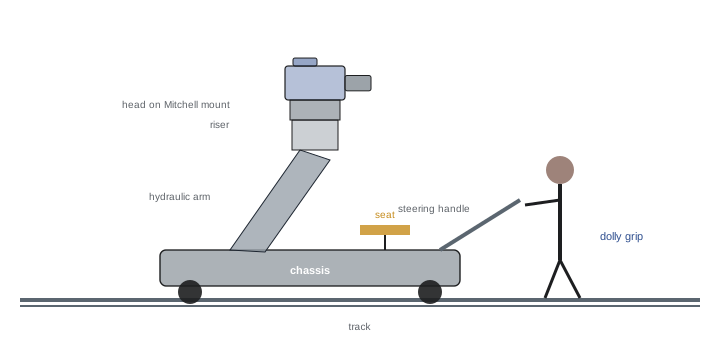
Steering modes
Studio dollies offer several steering modes, selected by a lever or switch:
- Rear steer (conventional): only the rear wheels turn, like a car in reverse, used for gentle curves and general manoeuvring.
- Round steer: front and rear wheels turn in opposite directions, letting the dolly turn in a tight circle or follow curved paths smoothly.
- Crab steer: all wheels turn in the same direction, letting the dolly move diagonally or sideways while keeping its orientation, useful for moving across a room while keeping the camera facing the same way.
Dolly grips switch between modes during a move as needed. On track, steering is set to straight or the wheels follow the track, and the grip concentrates on speed and position.
Arms and booming
The arm, or column, raises and lowers the camera, either as a vertical column on smaller dollies or as a swinging hydraulic arm on dollies such as the Fisher and Chapman. Hydraulic arms are charged with pressure from a pump or nitrogen system so that they can lift the payload smoothly; the grip controls speed with a valve or by hand pressure on the arm. Booming during a move, for example rising as an actor stands, adds a vertical dimension to dolly shots and requires the grip to coordinate push and boom together. The arm's range is typically from near floor level to about 1.5 m or more at the mount, extended further with risers, which are spacers between the arm and the head, and low-mode or drop-down plates for low angles. The payload rating of the arm limits the total weight of camera, head and accessories; riders on the dolly are separate.
Worked problem
Checking an arm payload
A dolly arm is rated to lift 100 kg at the top of the arm. The production plans a camera package of 22 kg, a geared head of 14 kg, a 25 cm riser of 5 kg and a monitor with bracket of 4 kg. Can the arm boom smoothly with this load, and what else should be checked?
Show solution
- Total arm payload: 22 + 14 + 5 + 4 = 45 kg.
- This is well within the 100 kg rating, leaving margin for accessories.
- Riders seated on the dolly are not part of the arm load, but the dolly's total weight limit and stability should still be considered.
- Charge the arm for the actual payload, test the boom speed, and check that the riser and head are secured and the operator's position is safe at the top and bottom of the move.
Answer: Yes: 45 kg is within the 100 kg rating; charge and test the arm, and check the riser, head and operator position.
Riders and loading
Operators and camera assistants often ride on the dolly, seated or standing on platforms, so that they move with the camera. Riders change the dolly's total mass and its feel; the dolly grip must account for their weight when accelerating and stopping. Seats and platforms must be locked, riders must hold on and keep limbs within the dolly's footprint, and nobody should climb on or off while the dolly is moving. When riders are aboard, the grip communicates every move and stop clearly. Heavy accessories, such as large monitors, batteries and lens cases, should be secured or kept off the dolly so they do not shift or fall.
The dolly grip's craft
The dolly grip's job is to move the camera so that the move feels inevitable. Key skills include:
- Smooth starts and stops: easing the dolly into motion and gently decelerating to the final position, rather than jerking. Many grips describe feathering the start and landing the stop.
- Constant speed: maintaining an even speed through the move, or varying it deliberately to match the action.
- Timing to actors: starting with the actor's movement, matching their pace, and arriving at the end mark as they arrive at theirs, so that framing stays consistent.
- Hitting marks: stopping precisely at the planned positions, take after take, which also lets the focus puller rely on marks.
- Booming in coordination: raising or lowering the arm in time with the action and the push.
- Listening and communication: responding to the operator's and director's cues and to actors' variations in performance.
Dolly grips often watch the actors rather than the monitor, sensing timing from performance. Many describe the job as a dance: the dolly must respond to the scene's rhythm, not a stopwatch.
Hitting marks and timing
Marks for the dolly are usually placed on the floor or track with tape, often colour-coded for different positions, and sometimes with a reference mark on the dolly chassis that lines up with the floor mark. A grip may also use a tape measure or markings on the track to land the dolly within a centimetre or two. Timing comes from rehearsal: the grip practises with stand-ins, then adjusts to the actors' real pace. Moves can be timed against dialogue or beats, such as "arrive on the close-up as she says the name". When actors vary, the grip must decide whether to follow them or hold to the plan; good communication with the operator helps.
For example, a 3.6 m push timed to a 6-second line requires an average speed of 0.6 m/s, but with gentle acceleration and deceleration the peak speed in the middle will be somewhat higher. Grips feel this rather than calculate it, but understanding it helps plan track length and rehearsal.
Worked problem
Planning a push with acceleration
A push must cover 4 m in 8 seconds. The grip wants to accelerate smoothly for the first 2 seconds, travel at constant speed, and decelerate over the last 2 seconds. What peak speed is needed?
Show solution
- With linear acceleration and deceleration of 2 s each, the distance covered in those phases equals the peak speed \(v\) times 1 s each (half of 2 s × v).
- Constant-speed phase: 4 s at speed \(v\).
- Total distance: \(v \times 1 + v \times 4 + v \times 1 = 6v = 4\) m, so \(v \approx 0.67\) m/s.
- This is about 33 % faster than the 0.5 m/s average, which the grip must accommodate.
Answer: A peak of about 0.67 m/s, compared with an average of 0.5 m/s.
Dollies on floors
When floors are smooth, such as stage floors, polished concrete or laid dance floor (Lesson 5), a dolly can move freely on its wheels without track, allowing complex curved moves and repositioning. Floors must be swept clean of debris, since small stones or screws can cause bumps; cable crossings must be avoided or bridged with cable ramps; and joints between floor sections must be taped flush. Many locations have floors too uneven for free dollying, which is why track and dance floor are laid.
Dolly safety
Dollies are heavy, and their arms can move suddenly if hydraulic pressure is mismanaged. Safety practices include setting wheel brakes when stationary; never leaving the arm charged with a light load, which can spring up when weight is removed; removing the camera before reducing arm pressure; keeping hands and feet clear of wheels and arm mechanisms; ensuring riders are seated and hold on; securing the dolly on slopes with brakes and wedges; using ramps rated for the dolly's weight when moving it over steps, curbs or into vehicles; and communicating before every move. When pushing on track near the end, end stops prevent the dolly from running off. Transporting dollies requires lifting help or lift gates because of their weight. Grip departments follow manufacturer instructions and industry safety guidelines (Lesson 12).
Dolly moves beyond push and pull
Experienced dolly grips combine moves in ways that make the dolly feel alive. Common combinations include a push in with a slight arc, so that the camera drifts around the subject as it approaches; a pull back with a boom up, revealing a room as a character is left alone; a lateral track that changes speed to stay level with a walking actor; and a counter move, in which the dolly moves opposite to the actor's direction so that the background slides past quickly and the shot gains energy. Small adjustments, such as a few centimetres of boom to keep an eye line or a slight push as an actor leans forward, are often as important as the large moves.
Dollies in tight spaces
Many locations, such as apartments, offices and vehicles, leave little room for a full studio dolly. Grips solve this with narrower dollies, removing seats and accessories, using offset arms or side mounts that place the camera beyond the dolly's footprint, mounting a remote head so that the operator does not need to ride, and laying short sections of track or dance floor in hallways. Doors may be removed from their hinges, furniture moved and walls of studio sets pulled out, called wild walls, to make room for the dolly and crew.
Common mistakes
MistakeJerky starts and stops.
InsteadFeather the start and land the stop smoothly.
MistakeTiming the move to a stopwatch instead of the actors.
InsteadWatch the performance and match its rhythm.
MistakeRemoving the camera before discharging the arm.
InsteadLower and depressurize the arm with the load on, per procedure.
MistakeIgnoring riders' weight.
InsteadAccount for riders in acceleration and stopping.
MistakeDollying over debris and cable.
InsteadSweep floors and use cable crossings or track.
Summary and key terms
- Dollies range from doorway and western platforms to studio dollies with arms.
- Studio dollies offer rear, round and crab steering.
- Hydraulic arms boom the camera smoothly within a payload rating.
- Riders, risers and accessories affect load and feel.
- Dolly grips start and stop smoothly, time moves to actors and hit marks.
- Peak speed exceeds average speed when moves accelerate and decelerate.
- Brakes, arm procedures, ramps and communication keep dolly work safe.
- Dolly grip
- Grip who pushes, steers and booms the dolly.
- Doorway dolly
- Narrow platform dolly.
- Studio dolly
- Purpose-built dolly with steering and arm.
- Rear steer
- Steering with rear wheels only.
- Round steer
- Front and rear wheels turn opposite ways.
- Crab steer
- All wheels turn together for sideways travel.
- Arm
- Hydraulic lifting column or boom on a dolly.
- Riser
- Spacer raising the head above the arm.
- Mark
- Floor or track position for a stop.
- Feathering
- Easing smoothly into or out of motion.
Practice problems
Work each problem on paper first, then reveal the answer to check.
Name two studio dolly makers.
Show answer
Fisher, Chapman, Panther.
What does crab steer allow?
Show answer
Moving sideways or diagonally without turning.
What is round steer used for?
Show answer
Tight turns and curves.
What does a riser do?
Show answer
Raises the head above the arm.
Arm payload for 20 kg camera, 12 kg head, 6 kg accessories?
Show answer
38 kg.
Why must the grip account for riders?
Show answer
They change mass and stopping.
Average speed for 3 m in 5 s?
Show answer
0.6 m/s.
Peak speed for 6 m in 10 s with 2 s ramps each end?
Show answer
About 0.75 m/s.
Why sweep floors before dollying?
Show answer
Debris causes bumps.
Name two dolly safety practices.
Show answer
Brakes, arm procedures, riders seated, ramps, communication.
Lesson quiz · 5 questions
Score 60% or more to complete this lesson.
Create a free account to save your progress, take quizzes and earn a certificate.