
CINE-230 · Lesson 3 of 12 · 25 min
Geared heads, remote heads and stabilized heads
Fluid heads are not the only way to pan and tilt a cinema camera. Geared heads, operated with hand wheels, offer precise, repeatable movement that many feature operators prefer for its fluidity and control. Remote heads separate the operator from the camera, allowing it to sit at the end of a crane, on a vehicle or in a dangerous position while the operator works from wheels, joysticks or pan bars at a distance. Stabilized remote heads combine remote control with gyroscopic or motorized stabilization, isolating the camera from vibration on vehicles, boats, helicopters and cranes. This lesson covers geared heads and wheel operating, Dutch heads and roll axes, remote heads and their control interfaces, stabilized heads, latency and setup, nodal and panoramic heads, and choosing the right head for a shot.
Geared heads
A geared head pans and tilts through gear trains driven by two hand wheels: one wheel for pan, usually on the operator's right side, and one for tilt, usually at the back, turned with the left hand. Turning a wheel steadily produces perfectly smooth, constant-speed movement, and the operator can combine pan and tilt in fluid, precise curves once the technique is learned. Geared heads, such as the Arri Geared Head, the Mitchell and the Panavision Panahead, have a long tradition in feature filmmaking, where operators value their precision for slow, deliberate moves, their ability to frame architectural lines exactly, and their steadiness with heavy cameras and long lenses. Most offer two or three gear ratios per axis, selected for faster or slower moves, and a tilt plate or wedge to extend the tilt range for steep angles.
Learning wheels takes time: operators often describe practising for months, drawing circles, figure-eights and handwriting with the lens until movements become instinctive. The advantage is a characteristic quality of movement: controlled, graceful and repeatable take after take. Wheels are also the standard control for remote heads on cranes, so wheel skills transfer directly to remote operating.
Dutch heads and the roll axis
A Dutch head, also called a Dutch angle head or roll head, adds a third axis, letting the camera roll around the lens axis. Static Dutch angles express unease, imbalance or stylization; rolling during a shot creates disorientation or energy. Dutch heads mount between the main head and the camera, and some geared and remote heads include a roll axis directly. A tilt plate, or wedge, mounted between the head and the camera, tilts the camera forward or back beyond the head's normal range, for steep down angles from cranes or overhead positions.
Remote heads
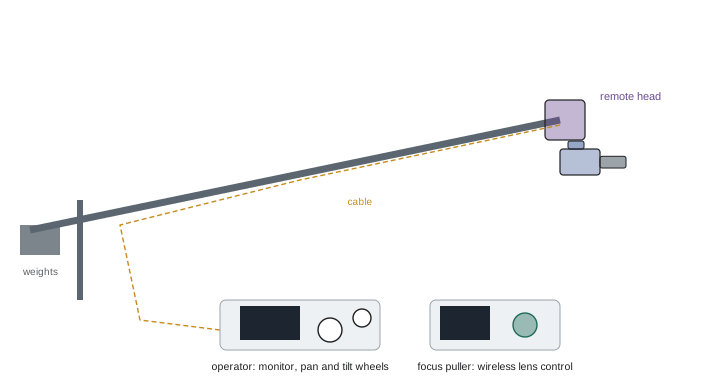
A remote head is a motorized pan, tilt and often roll head that the operator controls from a distance. Remote heads are mounted on cranes, telescopic cranes, cable cams, vehicles, poles, walls, ceilings and anywhere a person cannot or should not stand. The operator sits at a control station with a monitor and controls such as:
- Hand wheels, which emulate a geared head and are preferred by many feature operators.
- Pan bars, which emulate a fluid head, with sensors converting bar movement into motor commands.
- Joysticks, common in broadcast, sport and live events, and for rapid repositioning.
- Handheld or wearable controllers, in which the operator moves a small device and the head mirrors it.
Remote heads also offer lens control for focus, iris and zoom, adjustable speed and acceleration curves, soft stops at the ends of a move, and sometimes programmable or repeatable moves. Well-known systems have included the Hot Gears, Libra, Scorpio, Flight Head, Oculus and many others; specifications change quickly, so crews choose heads from rental houses according to payload, axes, speed and compatibility with their crane or vehicle.
Stabilized heads
A stabilized head isolates the camera from vibration and unwanted movement of its mount. Two technologies are common. Gyro-stabilized heads use gyroscopes and motors to hold the camera pointing steadily while the vehicle, aircraft or boat beneath it bounces and turns; they are used on helicopters, camera cars, boats and long cranes, often in gimbal-like spherical housings that also protect the camera from wind. Motorized gimbal stabilization, using inertial sensors and fast brushless motors, has brought stabilization to lighter, cheaper heads and handheld gimbals (Lesson 10). Many modern remote heads add stabilization on all axes, so that the operator can frame smoothly while the head cancels vibration from a moving crane arm or vehicle. Stabilization has limits: it cannot remove lateral or vertical translation, the bouncing of the whole mount, only rotation; and fast, large disturbances may exceed its range.
| Head type | Control | Strengths | Typical use |
|---|---|---|---|
| Fluid head | Direct, pan bar | Fast, intuitive, light | Documentary, TV, most tripod work |
| Geared head | Direct, hand wheels | Precise, repeatable, graceful | Features, slow precise moves |
| Remote head | Wheels, bars or joystick at a distance | Camera anywhere, lens control | Cranes, rigs, dangerous positions |
| Stabilized remote head | Remote with gyro or motor stabilization | Steady on moving mounts | Vehicles, boats, aircraft, long cranes |
| Nodal / panoramic head | Manual indexing | No parallax when rotating | Plates, panoramas, VFX |
Latency, calibration and setup
Remote operation introduces a delay between the operator's input and the camera's response, and between the camera's image and the operator's monitor. Video transmission, processing and motor response add latency that can make fast following difficult; even 100 milliseconds of delay can cause the operator to overshoot. Crews minimize latency with wired connections where possible, low-latency video links and monitors, and by setting head response curves and acceleration to suit the shot. Remote heads must be balanced with the camera package, like any head, so that motors do not strain and stabilization works properly; this is often done with the head's own balance procedure. Lens motors must be calibrated to each lens. Cables running along cranes and vehicles must be secured with enough slack for the head's full range of motion. Before the first take, the crew checks that the head cannot collide with the crane arm, the camera or anything nearby at the extremes of its travel, and sets soft stops accordingly.
Worked problem
Estimating overshoot from latency
An operator follows a car crossing frame at an angular rate of 20° per second using a remote head. The total latency from the image to the operator and back to the head is about 150 milliseconds. How far behind does the frame lag, and what can reduce the effect?
Show solution
- Lag angle ≈ angular rate × latency = 20°/s × 0.15 s = 3°.
- With a 40° horizontal view, 3° is about 7.5 % of the frame width.
- When the car stops, the operator may overshoot by a similar amount before correcting.
- Reduce latency with wired video, lower-latency transmitters and monitors; widen the framing slightly; rehearse the move; or use the head's programmable moves for repeatable timing.
Answer: About 3° of lag, roughly 7.5 % of the frame; reduce latency, rehearse and allow framing margin.
Nodal and panoramic heads
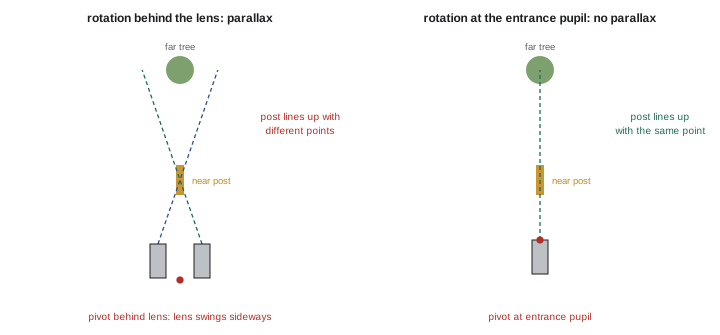
When a camera pans, the image shifts because the lens rotates around a point behind its optical centre, causing parallax between near and far objects. A nodal head positions the camera so that it rotates around the lens's entrance pupil, often called the nodal point, eliminating parallax. Nodal heads are used for visual effects plates that will be stitched or tracked, for panoramic backgrounds, for virtual production plates and for shots where foreground and background must stay aligned during a pan, such as foreground miniatures or matte paintings. Setting the nodal point involves sliding the camera forward or back on the head until near and far objects stay aligned when the camera pans; the position differs for each lens and zoom setting.
Choosing a head
The choice of head depends on the shot and the operator. Fluid heads suit fast, reactive work and operators trained on them; geared heads suit precise, graceful moves and operators trained on wheels; remote heads are necessary when the camera is beyond the operator's reach or on a moving platform; stabilized heads are essential on vehicles, boats and aircraft; nodal heads serve visual effects and panoramas. Practical factors include the payload, including lens and accessories, the axes needed (pan, tilt, roll), the speed and range of movement, power and cabling, the weight that the crane or vehicle can carry, and the time available to rig and balance. Many productions carry both a fluid head and a geared head, switching according to the operator's preference and the shot.
The camera operator's craft
Whatever the head, the camera operator's job is to frame the shot as the director and cinematographer have designed it, adjusting in real time to actors who never hit their marks exactly. Operators watch the edges of the frame for boom microphones, crew and unwanted elements, keep horizons level, maintain consistent headroom and lead room, and make judgements about when to adjust framing and when to hold. On feature films, the camera operator is a distinct role from the director of photography, who designs the images and lighting; on smaller productions, the cinematographer often operates. In both cases, operating is a performance in partnership with the actors, the dolly grip and the focus puller: the best operators anticipate movement and make their adjustments feel invisible.
Learning to operate wheels
Operators who learn wheels usually begin with simple exercises on a geared head pointed at a wall chart: holding a horizontal line steady while panning, tracing a vertical line while tilting, then drawing diagonals, circles and figure-eights by combining both wheels. The goal is to make speed and direction changes without conscious thought, so that attention can stay on the actors and the frame. Gear ratios are chosen so that comfortable wheel speeds produce the needed camera speeds: a high gear for fast pans following action, a low gear for slow, precise moves on long lenses. Many operators practise with the same remote head controls they use on cranes, so that their muscle memory transfers between geared heads on the dolly and remote heads at the end of an arm.
Remote heads on dollies and fixed positions
Remote heads are not only for cranes. On a dolly, a remote head lets the operator sit beside the dolly or at a monitor station while the camera travels through tight spaces, such as passing close to a wall or through a narrow doorway where there is no room for a person. In fixed positions, remote heads mounted on walls, ceilings, poles or set pieces allow the camera to sit where a person would be in the shot or in danger, such as inside a fireplace, under a car or above a stunt. Some productions mount several remote heads on a set to cover a scene from many angles at once, particularly for live events, studio shows and stunts that can only be performed once.
Lens control and metadata
Remote heads usually carry lens motors for focus, iris and zoom, controlled by the focus puller from a wireless hand unit, since nobody can reach the lens. Modern systems also record lens and head data, such as pan and tilt angles, focus distance and focal length, frame by frame. This metadata can be passed to visual effects teams so that computer-generated elements can be matched to the camera's movement, and in virtual production it can drive the perspective of LED backgrounds in real time. Recording accurate metadata requires calibrating the encoders and lenses before shooting.
Practising with remote heads
Remote heads reward practice away from set. Many rental houses and operators keep training rigs where operators can practise wheels and pan bars with realistic latency and monitors. Simple exercises, such as following a walking person along a line, holding a horizon while the arm moves, or reproducing a move from a reference clip, build confidence before a production depends on it.
Common mistakes
MistakeExpecting to operate wheels well without practice.
InsteadPractise shapes and moves until wheels are instinctive.
MistakeIgnoring latency on remote heads.
InsteadMinimize it and allow framing margin.
MistakeLeaving remote heads unbalanced.
InsteadBalance the camera on the head before calibrating.
MistakeAssuming stabilization removes all bumps.
InsteadRemember it removes rotation, not translation.
MistakePanning plates for VFX without a nodal setup.
InsteadRotate around the entrance pupil.
Summary and key terms
- Geared heads use hand wheels for precise, repeatable movement.
- Dutch heads add a roll axis; tilt plates extend tilt range.
- Remote heads let operators control the camera from a distance with wheels, bars or joysticks.
- Stabilized heads isolate rotation from vehicle and crane vibration.
- Latency, balance, lens calibration and cable management matter for remote work.
- Nodal heads rotate around the entrance pupil to remove parallax.
- Choose heads by shot, operator, payload, axes and mount.
- Geared head
- Head moved by gear trains and hand wheels.
- Wheels
- Hand wheels controlling pan and tilt.
- Dutch head
- Head adding a roll axis.
- Tilt plate
- Wedge extending the tilt range.
- Remote head
- Motorized head controlled from a distance.
- Stabilized head
- Head that cancels unwanted rotation.
- Latency
- Delay between input and response.
- Soft stop
- Programmed limit that eases movement to a halt.
- Nodal head
- Head rotating around the lens entrance pupil.
- Camera operator
- Crew member who frames and moves the camera.
Practice problems
Work each problem on paper first, then reveal the answer to check.
Which wheel usually controls pan?
Show answer
The right-hand wheel at the side.
Why do operators value geared heads?
Show answer
Precision, smoothness and repeatability.
What does a tilt plate do?
Show answer
Extends the tilt range.
Name three remote head controls.
Show answer
Wheels, pan bars, joysticks, handheld controllers.
What can stabilization not remove?
Show answer
Translation of the mount.
Lag at 10°/s with 200 ms latency?
Show answer
About 2°.
Why set soft stops?
Show answer
To avoid collisions and ease into limits.
What does a nodal head eliminate?
Show answer
Parallax during rotation.
Name two uses of nodal heads.
Show answer
VFX plates, panoramas, virtual production backgrounds.
Name two duties of the camera operator.
Show answer
Framing, watching edges, horizons, headroom, coordinating with grips.
Lesson quiz · 5 questions
Score 60% or more to complete this lesson.
Create a free account to save your progress, take quizzes and earn a certificate.