
CINE-230 · Lesson 7 of 12 · 25 min
Jibs and cranes
Cranes lift the camera into the air and sweep it through space, creating some of cinema's most memorable images: the opening of a musical number rising above a crowd, a slow descent from rooftops to a street, a swing over a battlefield or a gentle lift away from characters at the end of a film. Jibs, smaller cranes that carry only the camera, bring crane movement to modest budgets and tight spaces. This lesson covers how jibs and cranes work, the physics of balance and counterweight, jib types and sizes, ride-on cranes, bases and mounting, operating jib and crane moves, crane crews and communication, and safety, including working near power lines, wind and ground conditions.
A short history
Camera cranes appeared in the silent era, when filmmakers built large wooden and steel structures to lift cameras over elaborate sets, such as D. W. Griffith's Intolerance (1916), whose Babylon sequence used an elevator tower on rails. By the 1930s, studios had purpose-built cranes, such as the Universal crane built for Broadway (1929), which could lift camera crews high above sets. Through the classical Hollywood era, large ride-on cranes carried operator, assistant and camera on a platform at the end of a counterweighted arm, used for sweeping musical numbers and epic scenes. Lightweight jibs and remote heads in the 1980s and later separated the operator from the camera, making crane movement faster, cheaper and safer, while telescopic cranes (Lesson 8) added the ability to extend and retract the arm during a shot.
How jibs and cranes work
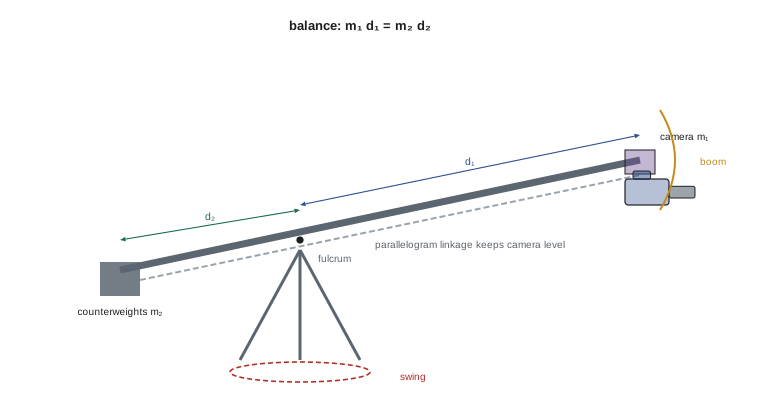
A jib or crane is a lever: a long arm pivots on a fulcrum mounted on a base, with the camera at one end and counterweights at the other. When the weights balance the camera, the operator can raise, lower and swing the arm with little effort. The arm may be a single beam, a truss of tubes, or segments that bolt together to set the length. A levelling mechanism, often a parallelogram linkage or cables running along the arm, keeps the camera platform level as the arm rises and falls, so that the head does not tilt with the arm. The camera is mounted on a manual head for small jibs or a remote head for most professional jibs and cranes, operated from the ground (Lesson 3).
Balance and counterweights
Balancing a jib means making the turning moment of the camera side equal to that of the counterweight side about the fulcrum:
Here \(m\) is mass and \(d\) the distance from the fulcrum to each mass's centre of gravity. The arm's own mass also contributes on each side and is included in the manufacturer's counterweight tables. Because the camera usually sits far from the fulcrum and the counterweights close, the counterweight mass is often several times the camera mass. A well-balanced arm floats, staying where it is left; an arm that is camera-heavy sinks, and one that is weight-heavy rises. Grips balance the arm with the full camera package attached, adding or removing weights in small increments, and rebalance whenever lenses or accessories change. When loading and unloading, the order matters: on many jibs, the camera is added and removed while the arm is locked or held, and weights are added gradually as the camera is mounted, so that the arm never becomes dangerously unbalanced. Follow the manufacturer's loading procedure exactly.
Worked problem
Counterweight for a jib
A jib has 3.6 m of arm in front of the fulcrum and 1.2 m behind it. The camera, remote head and cables at the front end total 22 kg, centred 3.5 m from the fulcrum. The counterweight bar centres its weights 1.1 m behind the fulcrum. Ignoring the arm's own weight, how much counterweight is needed? How would it change if the arm's front section weighs 10 kg with its centre at 1.8 m and the rear section 4 kg at 0.6 m?
Show solution
- Camera moment: 22 kg × 3.5 m = 77 kg·m.
- Counterweight needed: 77 / 1.1 ≈ 70 kg.
- Including the arm: front moment = 77 + 10 × 1.8 = 95 kg·m; rear arm moment = 4 × 0.6 = 2.4 kg·m.
- Counterweight needed: (95 − 2.4) / 1.1 ≈ 84 kg.
Answer: About 70 kg ignoring the arm, or about 84 kg including it, which is why manufacturer tables must be used.
Jib types and sizes
Jibs range from lightweight arms of a few metres for small cameras, mounted on heavy tripods, to large modular jibs reaching 10 m or more, mounted on dollies or purpose-built bases. Small jibs often use a manual head or a lightweight remote head, operated by one person who swings the arm and controls the head with a joystick. Larger jibs need a grip on the arm and a separate remote head operator, plus a focus puller with wireless lens control. Modular jibs can be configured to the length needed, with the payload decreasing as length increases. Ride-on cranes carry the operator and assistant on a seat or platform at the camera end, giving a traditional, hands-on operating experience at the cost of much larger counterweights, more crew and stricter safety requirements; they are less common today than remote-head cranes.
| Type | Typical reach | Crew | Typical use |
|---|---|---|---|
| Small jib on tripod | 1.5–4 m | 1–2 | Small productions, events, B-roll |
| Modular jib on dolly or base | 4–10 m | 2–4 | Drama, commercials, music videos |
| Ride-on crane | Varies | Several grips, operator and assistant aboard | Traditional large crane moves |
| Telescopic crane | About 4.5–15 m or more | Technician, grips, remote operator | Moves with extension (Lesson 8) |
| Vehicle-mounted crane | Varies | Specialist crew | Moving shots from vehicles (Lesson 11) |
Bases and mounting
A jib or crane is only as stable as its base. Small jibs mount on heavy-duty tripods or stands, often with sandbags on the legs. Larger jibs and cranes sit on dolly bases, purpose-built pedestal bases with outriggers, or vehicle platforms. The base must resist tipping when the arm is extended to the side, which creates a large overturning moment. Outriggers, wide-set legs and ballast increase stability. The base must sit on firm, level ground, with load-spreading pads on soft surfaces. Cranes on dollies can travel along track during a shot, combining a crane move with a tracking move. The total weight of crane, counterweights and base can be several hundred kilograms or more, so floor loading must be checked on upper floors, stages and decks.
Operating jib and crane moves
Jib and crane moves combine several axes: boom (raising and lowering the arm), swing (rotating the arm around the base), and, on track or wheels, travel of the base, while the head pans, tilts and sometimes rolls. Typical moves include the rise or reveal, lifting from close on a subject to a high, wide view; the descent, beginning high and landing on a character; the swing, arcing over or around a scene; and the combination of a crane move with dolly travel to follow action. Because the camera moves on an arc, its distance from the subject and the horizon change during the move, and the operator must adjust framing continuously. The grip on the arm and the remote head operator must coordinate closely: the grip controls the camera's position in space, the operator the framing. Smooth starts and stops are as important as with a dolly, and the arm's inertia makes them harder: a long arm with heavy counterweights takes effort to start and stop.
Here \(h\) is the lens height, \(h_0\) the height of the fulcrum, \(L\) the arm length from fulcrum to lens and \(\alpha\) the arm angle above horizontal. For a 5 m arm on a 1.5 m fulcrum, raising the arm from −10° to +40° takes the lens from about 0.6 m to about 4.7 m.
Crane crews and communication
On larger cranes, a team works together: the key grip or crane grip supervises setup and safety; one or more grips operate the arm and base; a crane technician, for specialist systems, sets up and maintains the crane; the camera operator works the remote head; and the focus puller operates wireless lens control. Clear communication is vital: grips and operators use agreed commands such as "booming up", "swinging left", "settle" and "hold", and nobody adds or removes weight, climbs on or steps near the arm without the crane grip's instruction. A safety zone is maintained around the swing radius of the arm and counterweights, where crew and actors must not stand during moves.
Safety
Cranes are among the most hazardous pieces of camera equipment. Key safety practices include following manufacturer instructions for assembly, loading and unloading, payload and counterweight; inspecting components before each use; checking the base, ground and floor capacity; establishing a swing zone around the arm and counterweights; limiting operation in wind, according to manufacturer wind limits, since long arms act as sails; keeping a safe distance from overhead power lines, as contact or arcing can be fatal, with minimum approach distances set by regulations and utilities; avoiding operation in lightning; and briefing cast and crew before crane moves. Ride-on cranes require seatbelts or harnesses for riders and specific procedures for getting on and off. Industry safety bulletins and occupational health and safety regulations govern crane use on set; Lesson 12 covers these frameworks.
Jib operating as one person
On small productions, a single operator often runs a jib with a remote head controlled by a joystick or a handheld controller mounted on the arm's rear. The operator swings and booms the arm with one hand and frames with the other, a demanding multitasking skill. Lightweight jibs designed for one person often include a pan and tilt head with motorized control and a monitor at the rear of the arm. Practice is essential: moving the arm smoothly while framing a moving subject requires coordination similar to that of a dolly grip and operator combined. Focus is usually handled by a wireless follow-focus operated by an assistant, or set to a fixed distance with wide lenses.
Jib moves on location
Jibs bring production value to music videos, events, commercials and dramas on location: rising over a crowd at a concert, lifting above a wedding party, sweeping over a market. On location, the main constraints are space for the arm's swing, the ground beneath the base, overhead obstructions such as ceilings, trees and wires, and the safety of the public. Jibs used near crowds need barriers and spotters, and the swing zone must remain clear throughout. Wind is a frequent problem outdoors, making arms difficult to control and potentially unsafe; crews monitor wind and lower or stop the arm when limits are approached.
Planning crane shots
Crane shots are planned by measuring the space and calculating the reach and height needed: the arm length determines how far the camera can reach from the base and how high it can rise, so a shot that must rise from 1 m to 6 m above a stage requires an arm of sufficient length at a suitable angle, plus clearance for the counterweights at the rear. Plans show the base position, the arc of the arm, the counterweight swing and the camera path. Previsualization in 3D software can test whether a particular crane can achieve a shot before it is booked.
Jibs in multi-camera and live work
In concerts, sports and television studios, jibs are standard for sweeping shots over audiences and stages. Live jib operators combine smooth arm movement with fast reframing as performers move, and must coordinate with directors calling shots in real time. Safety zones around the arm are especially important when audiences are close, and jibs are usually positioned on platforms or behind barriers.
Common mistakes
MistakeIgnoring the arm's own weight in balance.
InsteadUse manufacturer counterweight tables.
MistakeRemoving the camera before securing the arm.
InsteadFollow the loading and unloading sequence exactly.
MistakeMounting jibs on light tripods without ballast.
InsteadUse rated bases, outriggers and sandbags.
MistakeStanding within the swing zone.
InsteadKeep a clear zone around arm and counterweights.
MistakeOperating near power lines or in high wind.
InsteadRespect approach distances and wind limits.
Summary and key terms
- Cranes evolved from silent-era towers to ride-on cranes and remote-head jibs.
- Jibs are counterweighted levers with levelling linkages.
- Balance requires equal moments: m_front d_front = m_back d_back.
- Jibs range from small tripod arms to modular and ride-on cranes.
- Bases must resist overturning with outriggers and ballast on firm ground.
- Moves combine boom, swing, travel and head operation; h = h₀ + L sin α.
- Crews communicate clearly and follow strict safety procedures.
- Jib
- Small crane carrying only the camera.
- Fulcrum
- Pivot point of the arm.
- Counterweight
- Mass balancing the camera end.
- Moment
- Turning effect of a mass at a distance.
- Parallelogram linkage
- Mechanism keeping the camera level.
- Ride-on crane
- Crane carrying operator and assistant.
- Outrigger
- Extended leg increasing base stability.
- Swing
- Rotation of the arm around the base.
- Swing zone
- Area kept clear around a moving crane.
- Crane grip
- Grip responsible for crane operation and safety.
Practice problems
Work each problem on paper first, then reveal the answer to check.
What film used an elevator tower for its Babylon sequence?
Show answer
Intolerance (1916).
What keeps the camera level on a jib?
Show answer
A parallelogram linkage or cables.
Counterweight for 15 kg at 3 m with weights at 1 m (ignoring arm)?
Show answer
45 kg.
What happens if an arm is camera-heavy?
Show answer
It sinks.
Why rebalance after a lens change?
Show answer
The front moment changes.
What resists overturning of a crane base?
Show answer
Outriggers, wide legs and ballast.
Lens height: 4 m arm at 30°, fulcrum 1.5 m?
Show answer
3.5 m.
Name three crane moves.
Show answer
Rise, descent, swing, combined with travel.
Who operates the remote head on a crane?
Show answer
The camera operator.
Name two crane safety hazards.
Show answer
Power lines, wind, unbalanced loading, swing zone, ground.
Lesson quiz · 5 questions
Score 60% or more to complete this lesson.
Create a free account to save your progress, take quizzes and earn a certificate.