
CHE-470 · Lesson 7 of 12 · 21 min
Catalytic reforming and isomerization
Straight-run naphtha from the crude unit makes poor gasoline. Its paraffins and naphthenes have research octane numbers in the 50s and 60s, far below the 91 to 95 that modern engines need. Two units at the St. Clair refinery fix that. The catalytic reformer turns heavy naphtha into reformate, a high-octane aromatic blend stock, and in doing so makes most of the refinery's hydrogen. The isomerization unit turns light naphtha, the pentanes and hexanes, into branched isomers with much higher octane. Ingrid, who handled hydrogen supply contracts at Kingfisher, has asked Theo to explain why a refinery that makes so much hydrogen in its reformer still buys or makes more. This lesson answers part of her question, and lesson 11 finishes it.
Octane number
Octane number measures a fuel's resistance to knock, the uncontrolled autoignition of the end gas in a spark-ignition engine. It is measured in a standard single-cylinder engine by comparing the fuel with blends of isooctane, rated 100, and n-heptane, rated 0. The research octane number (RON) is measured at mild conditions and the motor octane number (MON) at more severe ones; the difference between them, the sensitivity, is larger for olefins and aromatics than for paraffins. Pumps in North America post the antiknock index, the average of RON and MON, often written \((R+M)/2\). Regular gasoline is sold at 87 and premium at 91 to 93 on that scale.
Molecular structure controls octane. Normal paraffins have low octane, falling steeply with chain length: n-pentane is about 62 RON, n-hexane about 25 and n-heptane, by definition, 0. Branched paraffins are much better: isopentane is about 92 and 2,2-dimethylbutane about 92. Naphthenes are intermediate, and aromatics are high, around 100 to 120. Reforming and isomerization both work by rearranging molecules toward the high-octane structures.
Reforming chemistry
The reformer passes heavy naphtha, usually the 85 to 175 °C cut, with hydrogen over a platinum catalyst on chlorided alumina at about 480 to 530 °C and 3.5 to 35 bar. Several reactions occur. Naphthenes dehydrogenate to aromatics, which is fast, strongly endothermic and the main source of octane and hydrogen. Paraffins dehydrocyclize to aromatics, which is slower and also endothermic. Paraffins isomerize to branched forms. Some paraffins hydrocrack to lighter gases, which costs yield. And coke deposits slowly on the catalyst.
The first reaction turns cyclohexane into benzene and the second turns n-heptane into toluene. Both release hydrogen, so the reformer is a net hydrogen producer. The catalyst is bifunctional, like a hydrocracking catalyst: platinum, often with rhenium or tin added, provides the hydrogenation and dehydrogenation function, and the acidity of the chlorided alumina provides isomerization and cyclization. The operators inject a small amount of chloride to hold the acidity in balance.
Feed quality: N + 2A
Naphtha rich in naphthenes and aromatics reforms easily, giving high reformate yield and lots of hydrogen at mild conditions. A paraffinic naphtha needs higher severity, gives lower yield and makes more gas. A quick index is \(N + 2A\), the volume percent of naphthenes plus twice the aromatics. Values above about 60 mark a rich feed, values below 40 a lean one. The naphtha at the St. Clair refinery, a blend of the crude unit and hydrocracker naphthas, scores about 60.
Reforming catalysts are poisoned by sulfur, nitrogen, water, metals such as arsenic and lead, and olefins. The heavy naphtha therefore passes through a naphtha hydrotreater first, which brings sulfur and nitrogen below 0.5 ppm. This is one of the reasons hydrotreating is everywhere in the refinery: it protects the more sensitive catalysts downstream.
# Catalytic reforming: hydrogen yield from naphthene dehydrogenation and octane blending of reformate
# Feed composition (vol %): paraffins, naphthenes, aromatics; N + 2A is a common reformability index
P, N, A = 52.0, 36.0, 12.0
print(f"N + 2A = {N + 2*A:.0f}  (higher means richer, easier reforming feed)")
# Cyclohexane -> benzene + 3 H2 : each mole of naphthene converted releases 3 mol hydrogen
naphtha_bpd = 22000
sg, mw = 0.75, 110.0
kmol_d = naphtha_bpd * 0.159 * sg * 1000 / mw
frac_naph = 0.36 * 0.90       # naphthenes converted (mole fraction approximated by volume)
h2_kmol = kmol_d * frac_naph * 3 + kmol_d * 0.52 * 0.15 * 4  # plus paraffin dehydrocyclization (15 %, 4 H2 each)
print(f"feed {kmol_d:.0f} kmol/d; hydrogen made about {h2_kmol:.0f} kmol/d = {h2_kmol*22.4*35.3/1e6:.1f} million scf/d")
# Reformate yield falls as severity (target RON) rises
for ron in (92, 96, 100, 102):
    c5plus = 0.90 - 0.012 * (ron - 92) - 0.0015 * (ron - 92) ** 2
    print(f"RON {ron}: C5+ reformate yield {c5plus*100:.1f} vol %")
# Isomerization raises light naphtha octane; benzene precursors removed upstream to meet benzene limits
ln_ron, isom_ron = 68.0, 87.0
print(f"light naphtha RON {ln_ron:.0f} -> isomerate RON {isom_ron:.0f} (once-through)")N + 2A = 60 (higher means richer, easier reforming feed) feed 23850 kmol/d; hydrogen made about 30623 kmol/d = 24.2 million scf/d RON 92: C5+ reformate yield 90.0 vol % RON 96: C5+ reformate yield 82.8 vol % RON 100: C5+ reformate yield 70.8 vol % RON 102: C5+ reformate yield 63.0 vol % light naphtha RON 68 -> isomerate RON 87 (once-through)
The code estimates that a 22,000 b/d reformer at the St. Clair refinery makes about 24 million scf of hydrogen per day. It also shows the yield penalty of severity. At a target of RON 92 the reformate yield is about 90 % by volume of feed, but at RON 100 it falls to about 71 %, because more paraffins crack to gas to raise the octane of what remains. The planners decide each month how hard to run the reformer: more severity means more octane and more hydrogen but less gasoline volume.
Reactor configurations
Because the main reactions are endothermic, the temperature falls sharply as the feed passes through the catalyst. Reformers therefore use three or four reactors in series with a fired heater before each one. In a semi-regenerative unit, the reactors are fixed beds operated for six months to two years, with the temperature raised gradually to offset coke deposition, then shut down so the catalyst can be regenerated by burning off the coke. In a cyclic unit, an extra swing reactor allows one reactor at a time to be regenerated. In a continuous catalyst regeneration (CCR) unit, the reactors are stacked or side by side and the catalyst flows slowly through them as moving beds. A stream of catalyst is withdrawn from the last reactor, its coke is burned off, chloride and platinum dispersion are restored, and it returns to the first reactor, typically every few days.
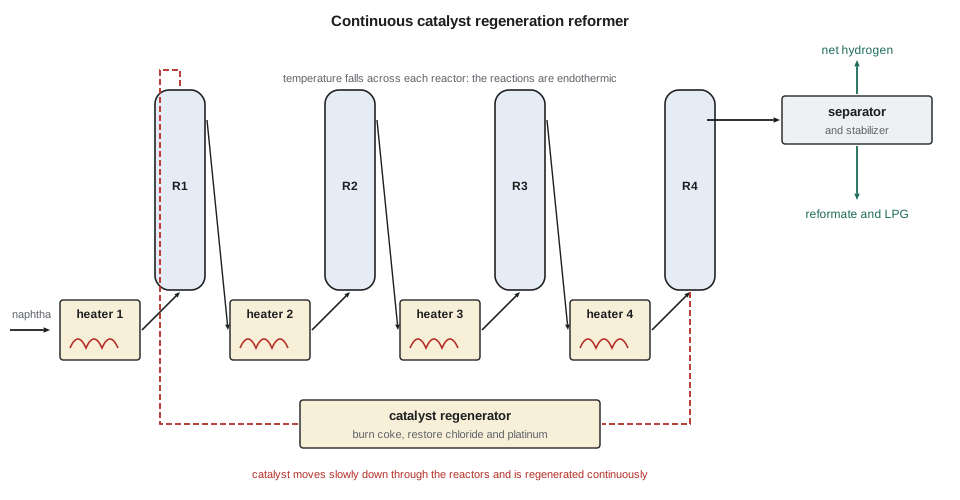
CCR units run at low pressure, around 3.5 bar, which favours the dehydrogenation reactions, raises reformate and hydrogen yield, and would coke the catalyst quickly were it not regenerated continuously. Most new reformers since the 1990s have been CCR units. the St. Clair refinery has a CCR unit that runs between four-year turnarounds.
Catalyst care and the chloride balance
Reforming catalyst is expensive because of its platinum content, and the refinery manages it as a long-lived asset. Each regeneration burns off coke, but repeated regenerations slowly sinter the platinum crystallites and reduce the surface area of the alumina. To keep the platinum dispersed, the regenerator adds chloride and oxygen in an oxychlorination step that redistributes the metal across the support. The chloride also sets the acidity. Too little chloride and isomerization and cyclization slow down, lowering octane; too much and the catalyst becomes too acidic and hydrocracks more paraffins to gas. The operators monitor the chloride on catalyst samples and the water content of the recycle gas, because water strips chloride from the catalyst.
Some of that chloride leaves the reformer with its products. It appears as hydrogen chloride in the net hydrogen and in the stabilizer overhead, where it can form ammonium chloride salts with traces of ammonia and deposit in cooler exchangers, or cause corrosion when liquid water condenses. Reformers therefore have chloride guard beds of treated alumina on the net gas and the LPG. Spent guard bed material and spent catalyst are sent to specialist reclaimers, which recover the platinum for reuse in fresh catalyst, so very little of the metal is lost over the catalyst's life.
The planner's view of the reformer
For Sanjay, the reformer is a lever with three outputs that move together: octane barrels, hydrogen and LPG. Each month the planning model decides how severely to run it, based on the octane the gasoline pool needs, the price of buying octane in the form of alkylate or ethanol, and the hydrogen the hydrotreaters require. In winter, when gasoline can carry more butane and the octane demand is lower, the reformer often runs at lower severity, which saves catalyst life and gives more reformate volume but less hydrogen. In summer, higher severity is common. When the hydrogen balance is tight, the model may keep the reformer severity higher than gasoline alone would justify, effectively making octane as a by-product of making hydrogen. Theo finds this reversal surprising, but it is a good example of why refineries are optimized as a whole rather than unit by unit, a point lesson 12 returns to.
Benzene
Reformate contains benzene, formed both from cyclohexane and methylcyclopentane in the feed and by dealkylation of heavier aromatics. Benzene is a known human carcinogen, and gasoline benzene is limited: in Canada, the federal Benzene in Gasoline Regulations. Refineries control it in three ways. They can cut the reformer feed to exclude the benzene precursors, sending the light C6 fraction to isomerization instead. They can split a benzene-rich heart cut out of the reformate and saturate it to cyclohexane or sell it to a petrochemical plant. Or they can extract benzene and the other aromatics with a solvent, which is the route to petrochemical benzene, toluene and xylenes covered in lesson 10.
Isomerization
Light straight-run naphtha, mostly pentanes and hexanes, would crack to gas in a reformer, so it goes to an isomerization unit instead. Over a platinum catalyst on chlorided alumina, sulfated zirconia or zeolite, at 120 to 280 °C depending on the catalyst, normal paraffins rearrange toward their branched isomers. The reaction is limited by equilibrium, and lower temperatures favour the branched forms, which is why the most active chlorided alumina catalysts, working at 120 to 180 °C, give the highest octane. They are also the most sensitive to water and sulfur.
A once-through unit raises the RON of light naphtha from about 68 to about 87, as the code shows. Recycling the unconverted normal paraffins, separated by distillation in a deisohexanizer or by molecular sieve adsorption, raises it to 90 or more. Isomerate has no aromatics, no olefins, no benzene and no sulfur, so it is a clean blendstock, though its vapour pressure is high and limits how much can go into summer gasoline.
| Unit | Feed | Catalyst | Product RON | Hydrogen |
|---|---|---|---|---|
| Semi-regenerative reformer | Heavy naphtha | Platinum-rhenium on chlorided alumina | 90 to 98 | Net producer |
| CCR reformer | Heavy naphtha | Platinum-tin on chlorided alumina | 98 to 104 | Larger net producer |
| Isomerization, once-through | Light naphtha | Platinum on chlorided alumina or zeolite | 82 to 87 | Small consumer |
| Isomerization with recycle | Light naphtha | Same | 88 to 92 | Small consumer |
Hydrogen from the reformer
Returning to Ingrid's question: the reformer's hydrogen comes from the aromatics it makes, so its output depends on how much naphtha the refinery runs and how severely. When gasoline demand falls or the refinery cuts reformer severity to make less octane, hydrogen output falls too, just as the hydrotreaters need more of it for ultra-low sulfur fuels. The reformer hydrogen is also only about 75 to 90 % pure, with methane and ethane, so purification by pressure swing adsorption may be needed for the hydrocracker. Most refineries therefore supplement reformer hydrogen with a steam methane reformer, the subject of lesson 11. Theo writes back that the reformer is a by-product supplier whose output rises and falls with gasoline, not with the refinery's need for hydrogen.
Worked problem
Hydrogen from naphthene dehydrogenation
A reformer converts 1,000 kmol/h of methylcyclohexane to toluene. How much hydrogen does that reaction release, in kilograms per hour?
Show solution
- \(\mathrm{C_{7}H_{14}} \to \mathrm{C_{7}H_{8}} + 3\,\mathrm{H_{2}}\), so 3,000 kmol/h of hydrogen.
- \(3\,000 \times 2.016 = 6\,050\) kg/h.
Answer: About 6 t/h of hydrogen.
Common mistakes
MistakeRunning maximum reformer severity for octane alone.
InsteadReformate yield falls steeply above about RON 98; balance octane against volume.
MistakeSending light naphtha to the reformer.
InsteadPentanes and hexanes crack to gas; isomerize them instead.
MistakeSkipping the naphtha hydrotreater.
InsteadSulfur and nitrogen poison the platinum catalyst.
MistakeTreating reformer hydrogen as a fixed supply.
InsteadIt varies with naphtha rate and severity, and its purity is limited.
Summary and key terms
- Octane measures knock resistance; branched paraffins and aromatics have high octane.
- The reformer dehydrogenates naphthenes and cyclizes paraffins into aromatics over platinum, making hydrogen.
- Feed richness, measured by N + 2A, and severity set reformate yield.
- CCR reformers regenerate catalyst continuously and run at low pressure.
- Isomerization converts light normal paraffins to branched isomers for clean octane.
- Research octane number
- Knock resistance measured at mild engine conditions.
- Antiknock index
- The average of RON and MON, posted on North American pumps.
- Reformate
- The high-octane, aromatic product of catalytic reforming.
- Dehydrocyclization
- Conversion of a paraffin into an aromatic ring with release of hydrogen.
- CCR
- Continuous catalyst regeneration, in which catalyst moves through the reactors and is regenerated continuously.
- Isomerate
- The branched-paraffin product of light naphtha isomerization.
Practice problems
Work each problem on paper first, then reveal the answer to check.
Why does the temperature fall across a reformer reactor?
Show answer
The main reactions are endothermic.
What does N + 2A measure?
Show answer
The richness of a reformer feed in naphthenes and aromatics.
Why do CCR units run at low pressure?
Show answer
Low pressure favours dehydrogenation and raises yield; continuous regeneration handles the faster coking.
Give one way a refinery limits gasoline benzene.
Show answer
Exclude benzene precursors from the reformer feed, saturate a benzene cut, or extract benzene.
Why do isomerization catalysts work at low temperature?
Show answer
Equilibrium favours branched isomers at lower temperature.
Why does a refinery with a reformer still need a hydrogen plant?
Show answer
Reformer hydrogen varies with gasoline operations and is not enough for hydrotreating and hydrocracking.
Lesson quiz · 5 questions
Score 60% or more to complete this lesson.
Create a free account to save your progress, take quizzes and earn a certificate.