
CHE-470 · Lesson 2 of 12 · 21 min
Crude oil characterization
Roz's first assignment for Theo is the crude assay file. the St. Clair refinery buys crude every month, choosing among a dozen grades offered by pipeline shippers and marketers, and the planners need to know what each grade will yield in each unit before they buy it. The answer starts with the assay: a laboratory characterization of a crude that tells the refinery how much of each boiling fraction it contains and what those fractions are like. Theo is asked to check the assays of three grades the planners are weighing for next quarter: a light sweet pipeline crude, a synthetic crude from the oil sands upgraders near Fort McMurray and Edmonton, and diluted bitumen.
What crude oil is made of
Crude oils are mixtures of four main hydrocarbon families. Paraffins are straight or branched chains such as hexane and isooctane. Naphthenes are saturated rings such as cyclohexane and methylcyclopentane. Aromatics have benzene rings, from benzene itself to large condensed polyaromatic molecules. Asphaltenes and resins are very large, polar, partly aromatic molecules that carry much of the crude's sulfur, nitrogen, nickel and vanadium. A paraffinic crude makes good diesel and wax but poor gasoline; a naphthenic crude reforms well; an aromatic crude has dense, poor-cetane distillates. Heavy crudes and bitumen are rich in asphaltenes and resins.
Crude also carries contaminants. Sulfur appears as hydrogen sulfide, mercaptans, sulfides and, above all, thiophenes, which are the hardest to remove. Nitrogen poisons cracking and reforming catalysts. Nickel and vanadium deposit on catalysts and kill them. Salt and water cause corrosion and fouling and are removed in the desalter. Naphthenic acids cause corrosion in hot sections of the crude and vacuum units. Every one of these is measured in the assay.
API gravity
The most quoted crude property is API gravity, a scale invented by the American Petroleum Institute to express density. It runs opposite to density: light crudes have high API gravity and heavy crudes low.
Here \(SG\) is the specific gravity at 15.6 °C (60 °F), the density relative to water at the same temperature. Water has an API gravity of 10. Light crudes are above about 31 °API, medium crudes 22 to 31, heavy crudes below 22, and extra-heavy oils and bitumen below 10, which means bitumen is denser than water. Raw bitumen cannot flow in a pipeline at ordinary temperatures, so it is diluted with condensate or light synthetic crude to make diluted bitumen, or dilbit, at about 20 to 22 °API.
A common trap is blending API gravities. API gravity is not linear in density, so the API gravity of a blend is not the volume average of the components' API gravities. Specific gravity does blend linearly by volume, to a good approximation, so the correct method is to convert each crude to specific gravity, average by volume, and convert back.
Sulfur and sweetness
Crudes with less than about 0.5 wt % sulfur are called sweet, and those with more are sour. Western Canadian heavy blends and diluted bitumen carry 3 to 4 wt % sulfur, while synthetic crude from upgraders carries very little because the upgraders have already hydrotreated it. Sulfur blends by mass, not by volume, so a heavy sour crude raises the sulfur of a blend more than its volume share suggests.
# Crude characterization: API gravity, Watson K and blending of two crudes
import math
def api(sg): return 141.5 / sg - 131.5
def sg_from_api(a): return 141.5 / (a + 131.5)
crudes = {  # name: (specific gravity at 15.6 C, sulfur wt %, mean average boiling point K)
    "light sweet (pipeline)": (0.825, 0.35, 570.0),
    "synthetic crude": (0.860, 0.15, 590.0),
    "diluted bitumen": (0.925, 3.70, 680.0),
}
for n, (sg, s, tb) in crudes.items():
    k = (tb * 1.8) ** (1 / 3) / sg   # Watson K uses the boiling point in degrees Rankine
    print(f"{n:24s} API {api(sg):5.1f}  sulfur {s:4.2f} wt %  Watson K {k:5.2f}")
# Blend 70 % synthetic crude with 30 % diluted bitumen by volume
fv = {"synthetic crude": 0.70, "diluted bitumen": 0.30}
sg_b = sum(fv[n] * crudes[n][0] for n in fv)               # specific gravity blends by volume
s_b = sum(fv[n] * crudes[n][0] * crudes[n][1] for n in fv) / sg_b   # sulfur blends by mass
print(f"blend: SG {sg_b:.4f}, API {api(sg_b):.1f} (not the volume average of API {0.7*api(0.860)+0.3*api(0.925):.1f}), sulfur {s_b:.2f} wt %")
# True boiling point curve: cumulative volume % distilled vs temperature, linear interpolation for cut yields
tbp = [(0, 30), (10, 105), (20, 160), (30, 215), (40, 270), (50, 330), (60, 395), (70, 460), (80, 535), (90, 620)]
def vol_at(T):
    for (v1, t1), (v2, t2) in zip(tbp, tbp[1:]):
        if t1 <= T <= t2: return v1 + (v2 - v1) * (T - t1) / (t2 - t1)
    return 100.0
cuts = [("light naphtha", 30, 85), ("heavy naphtha", 85, 175), ("kerosene", 175, 235), ("diesel", 235, 345), ("vacuum gas oil", 345, 560), ("vacuum residue", 560, 900)]
for n, a, b in cuts:
print(f"{n:16s} {a:4d}-{b:<4d} C {vol_at(b) - vol_at(a):5.1f} vol %")light sweet (pipeline) API 40.0 sulfur 0.35 wt % Watson K 12.23 synthetic crude API 33.0 sulfur 0.15 wt % Watson K 11.86 diluted bitumen API 21.5 sulfur 3.70 wt % Watson K 11.56 blend: SG 0.8795, API 29.4 (not the volume average of API 29.6), sulfur 1.27 wt % light naphtha 30-85 C 7.3 vol % heavy naphtha 85-175 C 15.4 vol % kerosene 175-235 C 10.9 vol % diesel 235-345 C 18.7 vol % vacuum gas oil 345-560 C 30.6 vol % vacuum residue 560-900 C 17.1 vol %
The code shows that a blend of 70 % synthetic crude and 30 % dilbit has a gravity of about 29.4 °API and about 1.3 wt % sulfur. The volume average of the API gravities would have given 29.6, a small error here but a larger one for wider blends. Planners at the St. Clair refinery blend crudes in tanks before the crude unit to keep the feed within the limits the units can handle: sulfur for the hydrotreaters and sulfur plant, metals and Conradson carbon for the coker and the cracker, and total acid number for corrosion.
The Watson characterization factor
The Watson factor, often written \(K_W\) or the UOP K, is a single number that indicates whether a crude or fraction is paraffinic or aromatic. It combines the mean average boiling point in degrees Rankine with specific gravity.
Values near 12.5 to 13 indicate a highly paraffinic material, around 11.5 to 12 a mixed or naphthenic one, and around 10 to 11 a highly aromatic one. The light sweet crude in the code scores about 12.2 and the dilbit about 11.6. The Watson factor feeds into many property correlations used in refinery design, including viscosity, molecular weight and heat of combustion.
The true boiling point curve
The heart of an assay is the true boiling point (TBP) curve. In the laboratory, a sample of crude is distilled in a column with many theoretical stages and a high reflux ratio, so that each fraction boils close to its true boiling point. The cumulative volume or mass distilled is plotted against temperature. At temperatures above about 340 °C the distillation continues under vacuum to avoid cracking the oil, and the temperatures are corrected to their atmospheric equivalents. Standard methods are ASTM D2892 for the atmospheric part and ASTM D5236 for the vacuum part.
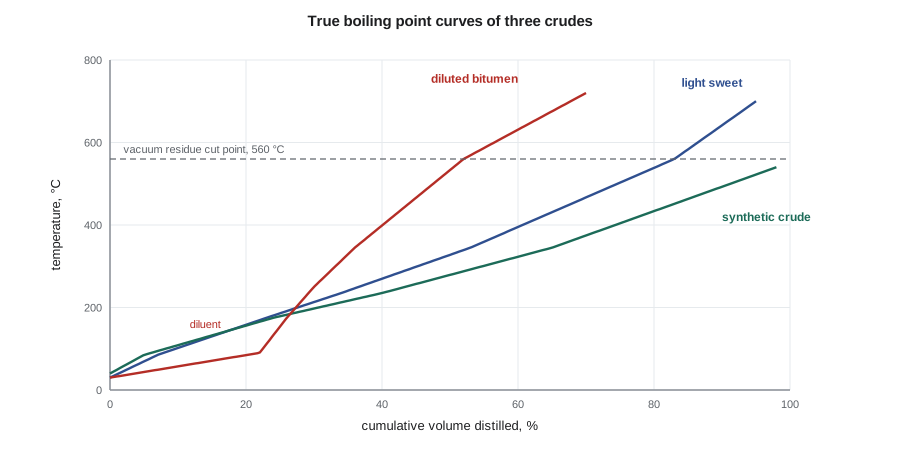
From the TBP curve, the refinery reads the yield of each cut: light naphtha, heavy naphtha, kerosene, diesel, vacuum gas oil and vacuum residue. The code interpolates a TBP curve for a typical light crude and finds about 22 % naphtha, 11 % kerosene, 19 % diesel, 31 % vacuum gas oil and 17 % vacuum residue by volume. Dilbit would show a very different pattern: a light diluent fraction at the front, little middle distillate, and half or more of the barrel boiling above 550 °C.
What else the assay reports
A full assay reports, for the whole crude and for each cut, properties that each unit needs. For naphtha, it gives the paraffin, naphthene and aromatic content that sets reforming yield. For kerosene and diesel, it gives freezing and cloud points, cetane index, aromatics and sulfur. For vacuum gas oil, it gives nitrogen, metals and the Conradson carbon residue, which predicts coke make in the cracker. For vacuum residue, it gives Conradson carbon, asphaltenes, metals and viscosity, which together set the coker yield and whether the residue can make asphalt. Assays also report total acid number, salt, water, light ends and wax.
| Property | Light sweet | Synthetic crude | Diluted bitumen |
|---|---|---|---|
| API gravity | about 40 | about 33 | about 21 |
| Sulfur, wt % | about 0.35 | about 0.15 | about 3.7 |
| Watson K | about 12.2 | about 11.9 | about 11.6 |
| Vacuum residue, vol % | about 15 | near zero | 45 to 50 |
| Metals (Ni + V), ppm | under 10 | under 1 | about 250 |
Crude quality and price
Crude prices follow quality. Light, sweet crude commands a premium because it yields more gasoline and diesel with less processing. Heavy, sour crude sells at a discount. Benchmark prices such as West Texas Intermediate and Western Canadian Select are quoted daily, and the difference between them is watched closely by refiners with coking capacity. Synthetic crude, which is light and nearly sulfur-free but lacks a residue fraction and has poor-quality distillates, often trades near light crude prices. The planners at the St. Clair refinery put each grade's assay and price into the refinery planning model, the subject of lesson 12, to find which mix of crudes earns the most.
Roz's caution is that an assay is a snapshot. Crude grades change as fields age, as diluent sources change and as pipelines commingle crudes from different producers. The refinery samples every crude receipt and runs quick checks on gravity, sulfur, water and salt, and commissions a full assay of each major grade at least once a year.
Light ends, wax and other handling properties
Some assay properties matter before the crude reaches any process unit. Light ends, the dissolved methane to butane, set the vapour pressure of the crude and therefore how it must be stored; a crude with a high Reid vapour pressure loses light hydrocarbons from floating-roof tanks and needs careful handling at the receiving terminal. Pour point and wax content decide whether the crude can be pumped in winter without heating, which matters in Ontario, where tank farms and pipelines see long periods below freezing. Viscosity at two or three temperatures lets the engineers size pumps and tank heaters. Hydrogen sulfide dissolved in the crude is measured separately because it is a hazard to people at tank gauging hatches and sample points long before it is a processing issue.
Metals deserve a word of their own. Nickel and vanadium sit almost entirely in the heaviest part of the barrel, bound in porphyrin structures and asphaltenes. They pass through the crude unit into the vacuum residue and, in smaller amounts, into the heaviest vacuum gas oil. In the catalytic cracker, nickel promotes unwanted dehydrogenation that makes hydrogen and coke, and vanadium destroys the zeolite structure of the catalyst. That is why the vacuum cut point and the metals content of the crude slate are linked: the planners must know how much of the metals the gas oil will carry before they agree to a new heavy grade.
Compatibility and the crude slate
Two crudes that are each easy to process can cause trouble together. Asphaltenes stay dispersed in crude oil because the surrounding resins and aromatics keep them in solution. Mix an asphaltenic heavy crude with a very paraffinic light crude, and the paraffins can push the asphaltenes out of solution, where they deposit in tanks, exchangers and furnace tubes. Laboratories test compatibility by titrating a crude with a paraffinic solvent and watching for the onset of precipitation; the results are expressed as solubility and insolubility numbers that can be blended to predict whether a mixture will be stable. At the St. Clair refinery, which runs a mix of light pipeline crude, synthetic crude and diluted bitumen, Theo learns that the order in which crudes are added to a tank can matter as much as the final proportions: adding the heavy crude to a tank already full of paraffinic crude passes through unstable intermediate compositions.
Roz shows Theo the planners' rule of thumb: every new grade gets a compatibility check against the two or three grades it will most often be blended with, and the blend sheet records the limits. The synthetic crude, which is nearly free of asphaltenes and fairly aromatic, is a useful partner for dilbit; the very light, waxy shale crudes that sometimes arrive at a discount are not.
Worked problem
API gravity of a two-crude blend
A blend is 60 % by volume of a 38 °API crude and 40 % of a 20 °API crude. Find its API gravity correctly.
Show solution
- \(SG_{1} = 141.5/(38 + 131.5) = 0.8348\); \(SG_{2} = 141.5/(20 + 131.5) = 0.9340\).
- Blend: \(0.6 \times 0.8348 + 0.4 \times 0.9340 = 0.8745\).
- \(141.5/0.8745 - 131.5 = 30.3\) °API, compared with 30.8 from averaging API gravities.
Answer: About 30.3 °API.
Common mistakes
MistakeAveraging API gravities by volume.
InsteadConvert to specific gravity, average by volume, and convert back.
MistakeAveraging sulfur by volume.
InsteadSulfur is a mass fraction; weight each crude by its mass.
MistakeTreating dilbit as a single heavy crude.
InsteadIt is bitumen plus a light diluent; its TBP curve has two very different parts.
MistakeRelying on an old assay.
InsteadCrude quality drifts; sample receipts and refresh full assays regularly.
Summary and key terms
- Crudes are mixtures of paraffins, naphthenes, aromatics, resins and asphaltenes, with sulfur, nitrogen, metals and salt.
- API gravity is 141.5/SG minus 131.5; blend crudes through specific gravity, not API gravity.
- Sweet crudes have under about 0.5 wt % sulfur; bitumen blends carry 3 to 4 %.
- The Watson factor indicates whether a material is paraffinic or aromatic.
- The true boiling point curve gives the yield of every cut; the assay adds the properties each unit needs.
- API gravity
- An inverse density scale for petroleum; water is 10 °API.
- Sweet and sour
- Crudes with low and high sulfur content.
- Watson factor
- A characterization factor from boiling point and specific gravity that indicates paraffinicity.
- True boiling point curve
- Cumulative amount distilled against temperature in a high-efficiency laboratory distillation.
- Crude assay
- A full laboratory characterization of a crude oil and its fractions.
- Diluted bitumen (dilbit)
- Bitumen mixed with a light diluent so it can flow in pipelines.
Practice problems
Work each problem on paper first, then reveal the answer to check.
What is the API gravity of a crude with SG 0.876?
Show answer
\(141.5/0.876 - 131.5 = 30.0\) °API.
Why does bitumen sink in water?
Show answer
Its API gravity is below 10, so it is denser than water.
Which family of hydrocarbons carries most of the sulfur, nickel and vanadium?
Show answer
Resins and asphaltenes, in the heaviest fraction.
What does a Watson factor of 12.5 suggest?
Show answer
A paraffinic material.
Why is the TBP distillation continued under vacuum?
Show answer
To avoid thermally cracking the heavy oil at high temperature.
Which assay property predicts coke make?
Show answer
Conradson carbon residue.
Lesson quiz · 5 questions
Score 60% or more to complete this lesson.
Create a free account to save your progress, take quizzes and earn a certificate.