
CHE-470 · Lesson 6 of 12 · 21 min
Hydrocracking and residue conversion
The bottom of the barrel is where a refinery makes or loses its margin. Vacuum residue, the heaviest material from the crude unit, is worth less than crude oil if it is sold as heavy fuel oil, and since the international limit on marine fuel sulfur fell to 0.5 % in 2020, high-sulfur fuel oil has become harder still to sell. Refineries that can convert residue into light products earn more from the same crude, which is why the St. Clair refinery runs a delayed coker and is studying the addition of a hydrocracker. Theo's task this week is to work with Sanjay Kapoor, the refinery planner, on how much residue the coker can take if the planners buy more diluted bitumen.
Two ways to upgrade a heavy molecule
Heavy molecules have too little hydrogen relative to carbon. A vacuum residue has a hydrogen-to-carbon atomic ratio of about 1.4 to 1.5; gasoline and diesel are near 1.9 to 2. There are only two ways to raise the ratio. Carbon rejection removes carbon, as coke, leaving lighter, more hydrogen-rich liquids. Hydrogen addition adds hydrogen over a catalyst. Coking is the main carbon rejection route, and hydrocracking and residue hydroconversion are hydrogen addition routes. The FCC of lesson 5 also rejects carbon, but it burns its coke inside the unit.
The choice between them is economic and strategic. Carbon rejection is cheaper to build and run and tolerates almost any feed, but it loses part of the barrel as coke, which is a low-value product, and its liquids need heavy hydrotreating. Hydrogen addition keeps more of the barrel as liquid and gives better-quality products, but it costs more to build and consumes large amounts of hydrogen, which in turn brings carbon dioxide from hydrogen production.
Delayed coking
Delayed coking is the most common residue conversion process in North America. Vacuum residue is heated in a furnace to about 490 to 500 °C, with steam injected to keep velocities high and delay coking in the tubes; hence the name. The hot residue flows into a large vertical drum, where, over many hours, it cracks thermally. Vapour leaves the top for a fractionator; the residue left in the drum polymerizes and condenses into solid coke. When one drum is full, the feed switches to a second drum, and the full drum is steamed, cooled with water and opened. The coke is cut out with high-pressure water jets, falls into a pit or rail cars below, and the drum is closed, heated and readied for the next cycle.
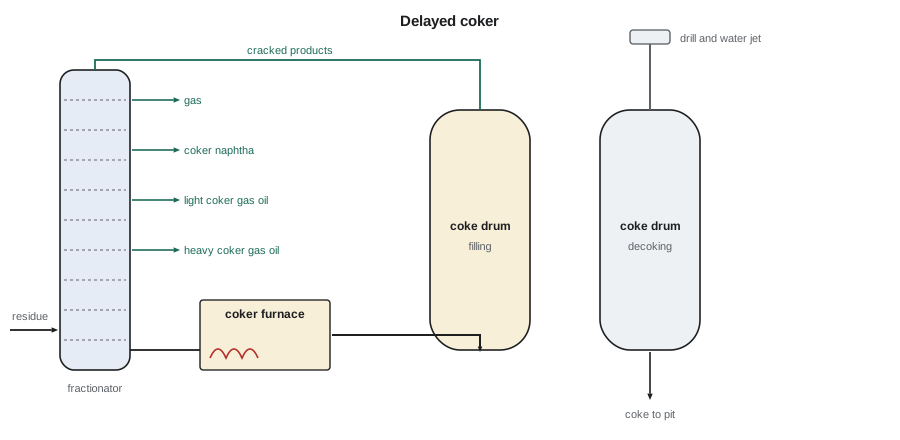
Coke yield is closely related to the Conradson carbon residue of the feed. A common rule of thumb puts coke yield at about 1.6 times the Conradson carbon. A vacuum residue with 22 wt % Conradson carbon, typical of residue from Canadian heavy crude, makes around 35 % coke. The rest is gas, naphtha and gas oil, all cracked, olefinic and high in sulfur and nitrogen, which must be hydrotreated.
# Residue conversion: delayed coker yields from Conradson carbon, and hydrocracker hydrogen and volume gain
ccr = 22.0     # Conradson carbon residue of the vacuum residue, wt %
feed_bpd = 26000
sg = 1.03
feed_t = feed_bpd * 0.159 * sg            # t/d
coke = 1.6 * ccr / 100                     # a common rule of thumb: coke yield about 1.6 times CCR
gas = 0.07 + 0.144 * ccr / 100
liquids = 1 - coke - gas
print(f"coker feed {feed_t:.0f} t/d: coke {coke*100:.1f} wt % ({feed_t*coke:.0f} t/d), gas {gas*100:.1f} %, liquids {liquids*100:.1f} %")
drums = 2; cycle_h = 18.0
coke_per_drum = feed_t * coke * cycle_h / 24
print(f"{drums} drums on an {cycle_h:.0f} h fill cycle: about {coke_per_drum:.0f} t of coke per drum")
# Hydrocracker: liquid volume gain because products are lighter (lower density) than the feed
vgo_bpd, vgo_sg = 12000, 0.92
prod = {"naphtha": (0.22, 0.74), "jet": (0.30, 0.80), "diesel": (0.40, 0.84), "LPG and gas": (0.08, 0.55)}
h2_wt = 0.025      # hydrogen consumed, fraction of feed mass
m_feed = vgo_bpd * vgo_sg
m_out = m_feed * (1 + h2_wt)
vol_out = sum(m_out * f / d for f, d in prod.values())
print(f"hydrocracker: {vgo_bpd} b/d VGO -> {vol_out:.0f} b/d products (volume gain {100*(vol_out/vgo_bpd-1):.0f} %)")
scf = h2_wt * 0.159 * vgo_sg * 1000 / 2.016 * 836   # kg H2 per bbl / 2.016 kg/kmol x 836 scf per kmol
print(f"hydrogen consumption about {h2_wt*100:.1f} wt % of feed, roughly {scf:.0f} scf per barrel")coker feed 4258 t/d: coke 35.2 wt % (1499 t/d), gas 10.2 %, liquids 54.6 % 2 drums on an 18 h fill cycle: about 1124 t of coke per drum hydrocracker: 12000 b/d VGO -> 14642 b/d products (volume gain 22 %) hydrogen consumption about 2.5 wt % of feed, roughly 1516 scf per barrel
For the St. Clair refinery, the code finds that a coker processing about 4,260 t/d of residue makes about 1,500 t/d of coke, with each of the two drums filling to about 1,100 t of coke in an 18-hour cycle. The coke is sold as fuel-grade coke, mainly to cement kilns and power stations, or, from low-sulfur, low-metals feeds, as anode-grade coke for aluminum smelting. Some refineries with very specific feeds make needle coke for graphite electrodes.
Coker drum operation is cyclic and involves heavy manual work at height, high-pressure water and hot material. Drum switching, steaming, quenching, unheading and cutting are all done to strict procedures. Opening a drum that is still hot or full of unquenched material can release hot coke, steam and hydrocarbon. Modern drums have remotely operated unheading devices, and the cutting is controlled from a shelter rather than at the drum top, which has greatly reduced injuries.
Other thermal processes
Visbreaking is a mild thermal cracking of residue, used mainly to reduce the viscosity of fuel oil so that less light diluent is needed to meet specification. Fluid coking, used at some oil sands upgraders, cracks residue in a fluidized bed of hot coke particles and burns part of the coke to supply heat. Flexicoking adds a gasifier that turns most of the coke into a low-heating-value fuel gas. Solvent deasphalting is a physical separation rather than a reaction: propane, butane or pentane dissolves the lighter, paraffinic part of the residue as deasphalted oil, which can go to a cracker, leaving a hard asphaltene pitch.
Hydrocracking
A hydrocracker converts vacuum gas oil, coker gas oil or cycle oil into naphtha, jet fuel and diesel by cracking it in the presence of hydrogen at high pressure, typically 100 to 180 bar and 370 to 430 °C. Its catalysts are bifunctional. A metal function, nickel-molybdenum or nickel-tungsten sulfide, or for clean feeds a noble metal, hydrogenates aromatics and olefins; an acid function, an amorphous silica-alumina or a zeolite, cracks the saturated molecules. Because the products are hydrogenated as they form, they are almost free of sulfur and nitrogen, and the diesel has a high cetane number and the jet fuel a good smoke point.
Most hydrocrackers have a first stage of pretreating catalyst, which removes nitrogen that would poison the acid sites, followed by cracking catalyst. In a single-stage once-through unit, the unconverted oil leaves as a valuable, clean feed for the FCC, for lube base oil plants or for steam crackers. In a recycle unit, the unconverted oil returns to the reactor for nearly complete conversion. Two-stage units send the unconverted oil to a second reactor where, with the ammonia and hydrogen sulfide removed, a more active catalyst can be used.
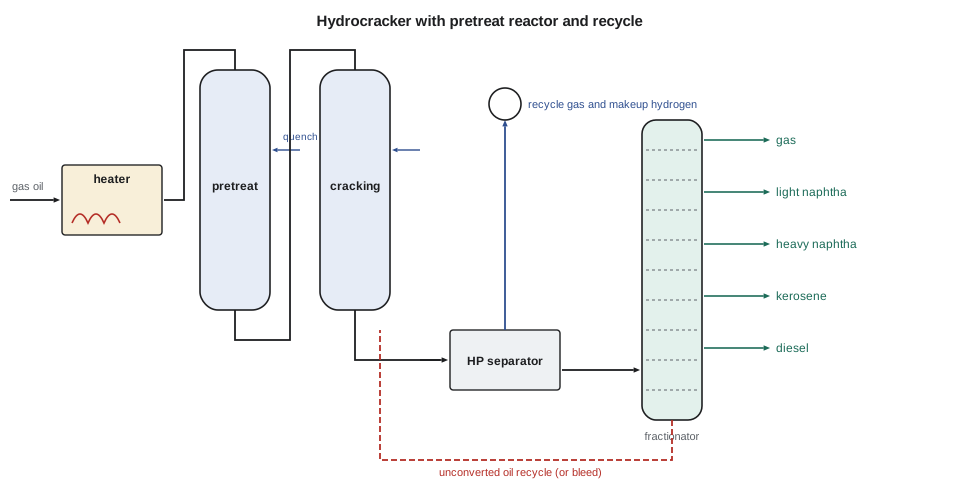
Hydrocrackers have a large volume gain. The feed is dense and the products are light, so the volume of product can be 15 to 25 % greater than the volume of feed. The code shows that the 12,000 b/d hydrocracker the St. Clair refinery is considering would produce about 14,600 b/d of products, a gain of about 22 %. That extra volume is paid for with hydrogen: about 2.5 wt % of the feed, roughly 1,500 scf per barrel or about 270 Nm³ per m³, which would make the hydrocracker the refinery's largest hydrogen consumer, a point lesson 11 takes up.
The reactions are strongly exothermic, around 200 to 300 kJ per kilogram of feed when cracking is severe, and the rate of cracking rises steeply with temperature. That combination can produce a temperature runaway, in which a hot spot in a catalyst bed accelerates cracking, which releases more heat. Hydrocrackers have many thermocouples in each bed, quench between beds, and an emergency depressuring system that dumps the reactor pressure to the flare in minutes, stopping the reaction by removing hydrogen. Runaway prevention is one of the central themes of the hydrocracker's process hazard analysis, in the language of CHE-380.
Hydrocracker flexibility
A hydrocracker can be tuned toward naphtha, jet fuel or diesel by changing its catalyst, its temperature and the cut points of its fractionator. A catalyst with a strong zeolite acid function cracks deeply and favours naphtha, which can feed the reformer; an amorphous silica-alumina catalyst cracks more gently and favours middle distillates. North American refiners have mostly chosen distillate-selective catalysts in recent years, because diesel and jet margins have usually exceeded gasoline margins. Roz points out that, once a unit is running, the decision is revisited at every catalyst change, roughly every three to four years, and that the planning model is run with both catalyst options before the order is placed.
The products are among the cleanest in the refinery. Hydrocracker diesel has well under 10 ppm sulfur and a cetane number in the high 50s or 60s, so it can lift the quality of the whole diesel pool and let the refinery blend in more light cycle oil from the cracker. Hydrocracker kerosene meets jet fuel smoke point and aromatics limits with little further treatment. The unconverted oil from a once-through unit is very low in sulfur, nitrogen and aromatics, which makes it a premium feed for steam crackers and for Group II and Group III lubricant base oils.
Residue hydroconversion
Residue itself can be hydrocracked, but its metals and asphaltenes would quickly plug and poison a fixed catalyst bed. Fixed-bed residue hydrotreaters use guard beds and graded catalysts with large pores to trap metals and are limited to moderate conversion. Ebullated-bed units, such as those at some Alberta upgraders, keep the catalyst in a fluidized state by circulating the liquid upward through the reactor, so fresh catalyst can be added and spent catalyst withdrawn while the unit runs. They reach 60 to 80 % residue conversion. Slurry hydrocracking, using a finely dispersed catalyst that passes through with the oil, aims for more than 90 % conversion and has been commercialized at a small number of refineries. The limit in all of these is the stability of the unconverted residue: push conversion too far and the asphaltenes precipitate as sediment that fouls downstream equipment.
| Process | Route | Typical conversion of residue | Main drawbacks |
|---|---|---|---|
| Delayed coking | Carbon rejection | All residue; 30 to 35 % to coke | Coke by-product; cracked liquids need treating |
| Visbreaking | Carbon rejection (mild) | 10 to 20 % | Low conversion; product stability |
| Solvent deasphalting | Physical separation | Depends on solvent; pitch remains | Pitch disposal |
| Ebullated-bed hydroconversion | Hydrogen addition | 60 to 80 % | High hydrogen use and cost; sediment |
| Slurry hydrocracking | Hydrogen addition | Over 90 % | High capital cost; few units in service |
Choosing the residue route at the refinery
Sanjay's question is how much extra diluted bitumen the refinery can buy before the coker becomes the limit. Dilbit carries 45 to 50 % vacuum residue, nearly three times as much as light crude. Each extra 10,000 b/d of dilbit in place of light crude adds roughly 3,000 to 3,500 b/d of residue to the coker, and with it more coke, more sour gas for the amine units and sulfur plant, and more cracked gas oil for the hydrotreaters. Theo builds a spreadsheet that follows the residue through the coker, using the same yield correlation as the code, and finds that the drums, not the furnace, set the limit: the cycle time would have to fall below 16 hours, which the cutting crew cannot achieve reliably. That answer, a capacity limit set by a manual operation, feeds into the planning model in lesson 12.
Worked problem
Coke from a residue
A coker processes 3,000 t/d of vacuum residue with a Conradson carbon of 20 wt %. Estimate the coke make using a coke yield of 1.6 times the Conradson carbon.
Show solution
- Coke yield: \(1.6 \times 20 = 32\) wt %.
- Coke: \(0.32 \times 3\,000 = 960\) t/d.
Answer: About 960 t/d of coke.
Common mistakes
MistakeTreating coke as a minor by-product.
InsteadIt can be a third of the residue; its sale price and handling matter to the economics.
MistakeForgetting the hydrogen bill of hydrocracking.
InsteadVolume gain is paid for with 1,000 to 2,000 scf of hydrogen per barrel.
MistakeAssuming coker liquids are finished products.
InsteadThey are olefinic and high in sulfur and nitrogen; they must be hydrotreated.
MistakePushing residue conversion without regard to stability.
InsteadAsphaltenes precipitate as sediment and foul downstream equipment.
Summary and key terms
- Heavy oil is upgraded by carbon rejection or hydrogen addition.
- Delayed coking cracks residue thermally in drums, making about 1.6 times the Conradson carbon as coke.
- Hydrocracking uses bifunctional catalysts at high pressure to make clean naphtha, jet and diesel.
- Hydrocrackers have a large volume gain and are the largest hydrogen consumers.
- Ebullated-bed and slurry processes hydroconvert residue itself, limited by sediment formation.
- Carbon rejection
- Upgrading by removing carbon as coke.
- Hydrogen addition
- Upgrading by adding hydrogen over a catalyst.
- Delayed coking
- Thermal cracking of residue in drums that fill with coke over a cycle.
- Conradson carbon residue
- The carbon left after a sample is pyrolyzed in a standard test.
- Bifunctional catalyst
- A catalyst with both metal (hydrogenation) and acid (cracking) functions.
- Volume gain
- The increase in liquid volume from feed to products.
Practice problems
Work each problem on paper first, then reveal the answer to check.
What is the hydrogen-to-carbon ratio of vacuum residue, roughly?
Show answer
About 1.4 to 1.5, compared with about 1.9 to 2 for gasoline and diesel.
Why is steam injected in a coker furnace?
Show answer
To raise velocity and delay coking in the tubes.
What is anode-grade coke used for?
Show answer
Anodes for aluminum smelting.
Why does a hydrocracker need a pretreat stage?
Show answer
Nitrogen compounds poison the acid cracking sites.
Why are hydrocrackers fitted with emergency depressuring?
Show answer
To stop a temperature runaway by removing hydrogen pressure quickly.
What limits conversion in residue hydroconversion?
Show answer
Stability of the unconverted residue; sediment formation.
Lesson quiz · 5 questions
Score 60% or more to complete this lesson.
Create a free account to save your progress, take quizzes and earn a certificate.